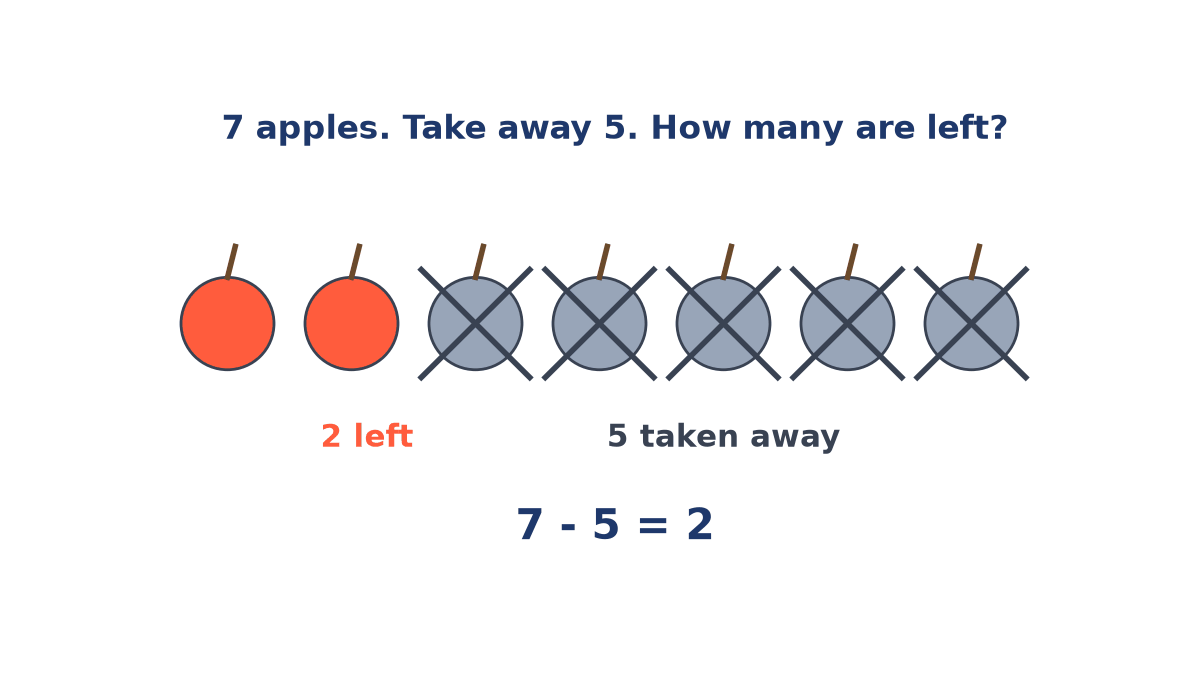
You have seven apples in a basket. You give five of them to your friends. How many are still in the basket? Questions like this come up every day: sweets shared out, birds flying off a wire, pencils lent to a classmate. Finding how many are left is called taking away. Here you will learn every take-away sum up to nine, along with two simple rules that make many of them easy.
Taking away is the opposite of adding. On the number ladder from the last lesson, adding climbs up and taking away climbs down. To work out , stand on 9 and take three steps down: 8, 7, 6. So .
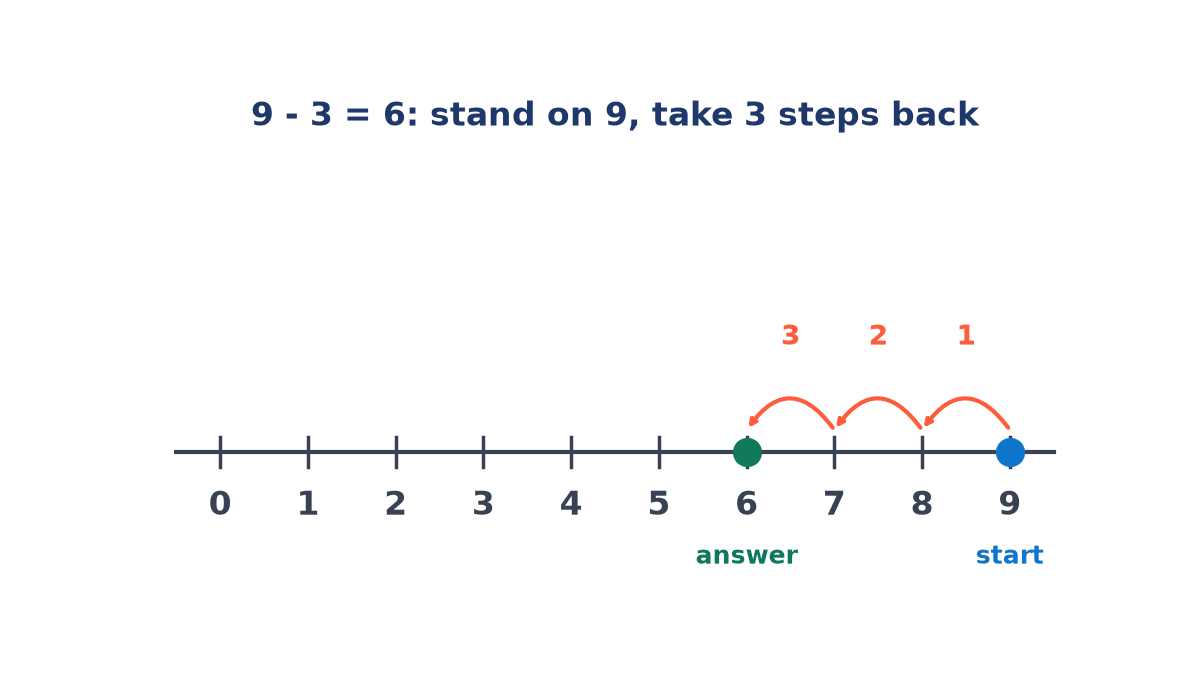
The proper name for taking away is subtraction, and the sign is a small dash: . It is read as "minus" or "take away".
Three ways to take away
There is more than one way to find the answer. Use whichever one helps you most. All of them give the same answer.
Using real things
Put out the first number of things. Take away the second number of things. Count what is left.
Example 1:
Put 7 apples on the table. Take 5 of them away, one at a time: one, two, three, four, five. Now count the apples still on the table: one, two. So .
Counting back on a number line
Put your finger on the first number. Take one step back for each thing you take away. The number you stop on is the answer.
Example 2:
Start on 8. Step back three times and say the numbers as you go: 7, 6, 5. You stop on 5. So .
Say only the numbers you land on. Do not say 8 as a step. You are already standing on 8 before you move.
Using adding
Every take-away sum has an adding sum hiding inside it. To work out , ask: 4 and what make 9? You know that . So .
Example 3:
Ask: 2 and what make 6? Count on from 2: 3, 4, 5, 6. That is four more. So . Check it: . It is right.
This is a good way to check any take-away answer. Add the answer to the number you took away. You should get back the number you started with.
Taking away zero
Nothing is taken, so nothing changes.
Think of a plate with 5 laddoos. Nobody takes any. There are still 5 laddoos on the plate.
Remember. When you take zero away from a number, the answer is that same number.
Taking away one
One step down the ladder, so the answer is the number you say just before it when counting.
Count backwards: nine, eight. The number before 9 is 8, so .
Taking away two
Two steps down the ladder. You can also think of it as taking away one, and then one more.
Taking away three
Taking away four
Taking away five
Hold up one hand with all five fingers showing. Fold all five down and none are left: . Now hold up 8 fingers and fold down one whole hand. Three fingers stay up: .
Taking away six
Taking away seven
Taking away eight
When you take away a big number, counting back is slow. Count up instead. For , start at 8 and count up to 9. That is one step, so the answer is 1.
Taking away nine
Two rules hiding in the tables
Look down the first sum of every table above. Each one is a number take away itself, and every answer is zero.
Remember. A number take away itself is always zero. A number take away zero is always the number itself.
Look along a table instead and you will see the answers going up by one each time, because the number you start from goes up by one while the number you take away stays the same.
Look at the table for taking away three. The answers go 0, 1, 2, 3, 4, 5, 6. Each time you start with one more, you have one more left.
A word problem
Example 4. Meena has 9 balloons. 4 balloons fly away. How many balloons does Meena have now?
Step 1: She starts with 9. Step 2: 4 go away, so we take away 4. Step 3: Count back from 9 four times: 8, 7, 6, 5.
. Meena has 5 balloons now.
Check: . That is how many she started with, so the answer is right.
Example 5. There are 6 birds on a wire. All 6 fly away. How many birds are left on the wire?
We start with 6 and take away 6. A number take away itself is zero. So . No birds are left on the wire. Check: , which is the number we started with.
When you read a word problem, look for words such as left, gave away, flew off, ate or fewer. They tell you to take away.
Your turn
| 1) | 7) | 13) |
| 2) | 8) | 14) |
| 3) | 9) | 15) |
| 4) | 10) | 16) |
| 5) | 11) | 17) |
| 6) | 12) | 18) |
Common mistakes
- Counting the starting number as a step. For , the steps are 7, 6, 5, not 8, 7, 6.
- Swapping the numbers round. In you start with 7. You cannot start with 5 and take away 7 here.
- Thinking a number take away zero is zero. Taking away nothing leaves the number as it was: .
- Adding when the question says take away. Look at the sign first. A dash means take away.
- Forgetting to check. Add your answer to the number you took away. You should get the starting number back.
Key terms
- Subtraction
- Taking one amount away from another to find how many are left.
- Minus sign
- The small dash , read as "minus" or "take away".
- Difference
- The answer to a take-away sum. In the difference is 6.
- Counting back
- Stepping down a number line or ladder, one step for each thing taken away.
- Zero
- The number for nothing at all. Taking a number from itself leaves zero.