Adding is something you do every day. You add when you count the sweets in two packets, when you work out how many children are in two classes, and when a shopkeeper totals your bill of ₹123 and ₹8. Small sums you can do on your fingers. Big sums need a plan, and that is what you will get here.
Everything so far has been building up to this moment. You will not meet any new idea here. Instead, we collect the four ways of adding you have already met and see that they keep working however big the numbers get.
Think of a number as a heap of beads. Adding two numbers means pushing the two heaps together and counting how many beads there are now. You can move beads from one heap to the other, or sort them into hundreds, tens and units first. The total never changes, because no bead is added and no bead is lost. That is the secret behind all four ways.
The four ways
| Way | What you do | Example |
|---|---|---|
| Down the page | Write the numbers one under the other, units under units and tens under tens, and add each column. | |
| Split the second number | Break off just enough to reach a round number, then add the rest. | |
| Split them both | Hundreds with hundreds, tens with tens, units with units. | |
| Move an amount across | Take from one number and give to the other, until one of them is round. |
They all give the same answer, because none of them changes how much there is altogether. Choose whichever one makes the sum easiest in your head.
Which way to choose
- If one number is close to a round number, like or , move an amount across. Make it round first.
- If both numbers have several digits, split them both. Add hundreds, then tens, then units.
- If the second number is a single digit, split the second number so that the first one reaches the next ten.
- If the numbers are long, write them down the page and add column by column, starting with the units.
Worked examples
123 + 2
The units are small, so nothing spills over and only the last digit changes.
123 + 8
Split the second number
Or move an amount across
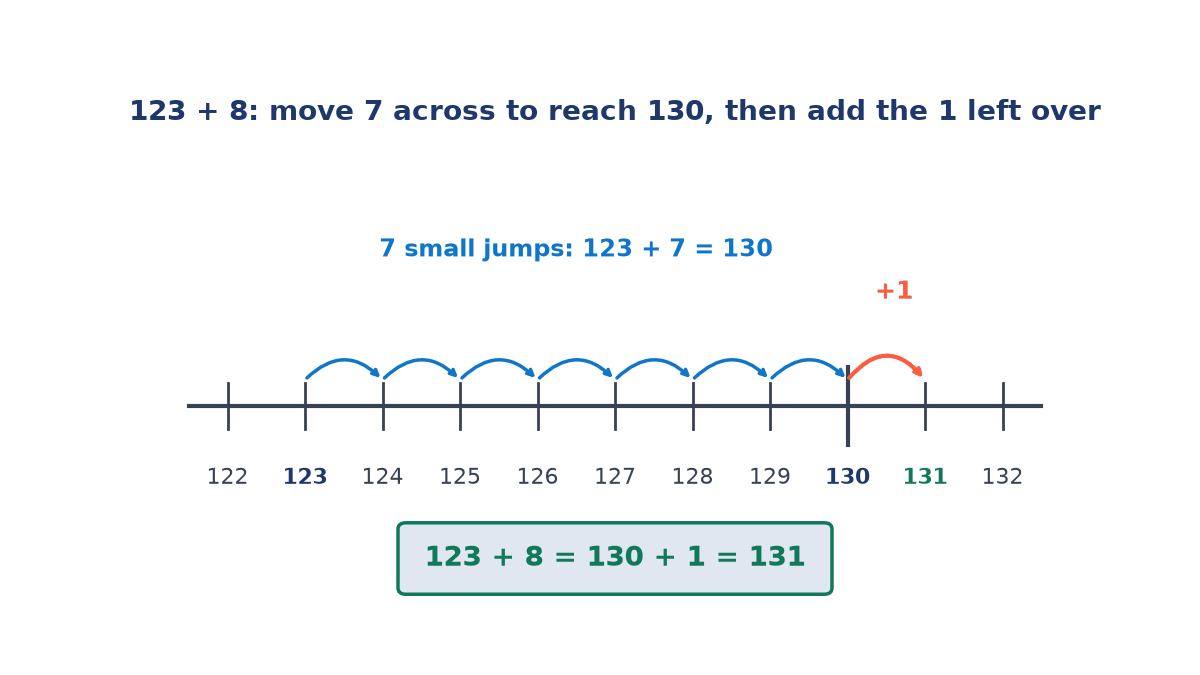
Seven of the eight was given to the 123 to make it 130, and one was left over.
The number line below shows those two steps. The first seven small jumps take you from 123 to the round number 130. One more jump lands on 131.
256 + 67
Split them both
Or move an amount across
38 + 45
Two two-digit numbers. Split them both: the tens go together and the units go together.
The units made , which is one more ten and units. That extra ten joins the to make .
49 + 36
is just one short of . So move across from the .
357 + 468
Split them both
Or move an amount across
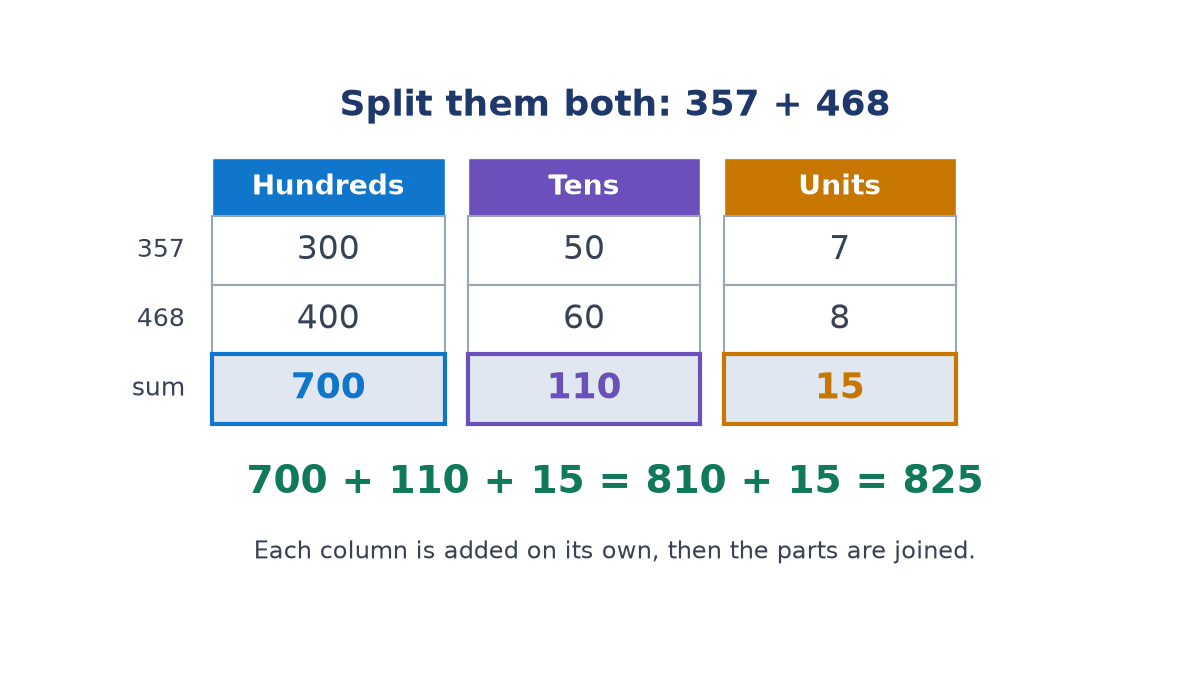
Three was taken from the 468 and given to the 357 to make it the round number 360. The chart below shows the other way, with each place added on its own.
928 + 794
Split them both
Or move an amount across
Six was taken from the 928 and given to the 794, which turned it into a round 800. Adding 800 to anything is easy.
1999 + 2345
is one short of , so move across.
4675 + 2398
is two short of . Take from the and give it to the .
Adding a round number like is quick: add the thousands, then the hundreds.
Bigger still
The same splitting works however many digits there are. Write them down the page, column by column.
Start with the units column. If a column adds up to ten or more, write the units digit and carry the ten into the next column on the left. For : units ; tens , so write and carry ; hundreds , write and carry ; thousands . The answer is .
| Question | Answer |
|---|---|
Doubling a number
The double of a number is what you get by adding the number to itself once.
| Number | Its double |
|---|---|
Doubling is useful for sums like . You know the double , and is one more than , so is one more than , which is .
Remember. Moving an amount from one number to the other, or splitting numbers into parts, never changes the total.
Your turn
Single digits
| 1) | 10) | 19) | 28) |
| 2) | 11) | 20) | 29) |
| 3) | 12) | 21) | 30) |
| 4) | 13) | 22) | 31) |
| 5) | 14) | 23) | 32) |
| 6) | 15) | 24) | 33) |
| 7) | 16) | 25) | 34) |
| 8) | 17) | 26) | 35) |
| 9) | 18) | 27) | 36) |
A digit added to a two-digit number
| 1) | 7) | 13) |
| 2) | 8) | 14) |
| 3) | 9) | 15) |
| 4) | 10) | 16) |
| 5) | 11) | 17) |
| 6) | 12) | 18) |
Two-digit numbers together
| 1) | 7) | 13) |
| 2) | 8) | 14) |
| 3) | 9) | 15) |
| 4) | 10) | 16) |
| 5) | 11) | 17) |
| 6) | 12) | 18) |
Common mistakes
- Writing numbers down the page without lining up the units. Units must sit under units, tens under tens.
- Forgetting to carry. When a column makes or more, the extra ten belongs in the next column.
- When moving an amount across, adding to both numbers. If you give to one number, you must take from the other.
- Mixing up and . Adding zero leaves a number as it is.
- Stopping after adding the parts. In the parts must still be joined to give .
Key terms
- Sum
- The answer you get when you add numbers.
- Units, tens, hundreds
- The places a digit can sit in. In there are hundreds, tens and units.
- Round number
- A number ending in zero, such as or , which is easy to add to.
- Carry
- To move a ten from one column into the next column on the left.
- Double
- A number added to itself once.
- Split
- To break a number into parts, such as .
Answers
Single digits
1) , 2) , 3) , 4) , 5) , 6) , 7) , 8) , 9) , 10) , 11) , 12) , 13) , 14) , 15) , 16) , 17) , 18) , 19) , 20) , 21) , 22) , 23) , 24) , 25) , 26) , 27) , 28) , 29) , 30) , 31) , 32) , 33) , 34) , 35) , 36)
A digit added to a two-digit number
1) , 2) , 3) , 4) , 5) , 6) , 7) , 8) , 9) , 10) , 11) , 12) , 13) , 14) , 15) , 16) , 17) , 18)
Two-digit numbers together
1) , 2) , 3) , 4) , 5) , 6) , 7) , 8) , 9) , 10) , 11) , 12) , 13) , 14) , 15) , 16) , 17) , 18)