Where you meet division
You share things all the time. A packet of biscuits is shared among friends. Rotis are shared around the family at dinner. A teacher puts thirty children into teams of the same size. Each time, the question is the same: if we share fairly, how many does each one get?
That question is division. Here you will see what the sign means, learn the four names used in every division, and find out how to check your answer so you always know it is right.
Sharing fairly
Division is sharing out equally. If six books are shared between two children, how many does each child get? Three each. We write that as , read aloud as "six divided by two".
It is the opposite of multiplying, in the same way that taking away is the opposite of adding. Because , you know at once that .
Sharing one at a time
If you do not know the answer yet, you can share one at a time, the way you deal cards. Take 12 mangoes and 3 baskets. Put one mango in each basket. That uses 3 mangoes. Do it again, and again, and again. After four rounds all 12 mangoes are gone and each basket holds 4. So .
Counting the rounds is the same as asking how many threes make twelve. That is why the times tables help so much.
Sharing and grouping
Division answers two kinds of question, and both are written the same way.
- Sharing. 12 mangoes go into 3 baskets. How many in each basket? The answer is 4.
- Grouping. 12 mangoes are packed 3 to a bag. How many bags are needed? The answer is 4 bags.
In the first question you know how many shares there are. In the second you know how big each group is. Both are , because both ask how many threes fit into twelve. Choose whichever picture makes the question easier to think about.
The four names
| Name | What it is | In |
|---|---|---|
| Dividend | the number being shared out | |
| Divisor | how many it is shared between | |
| Quotient | how many each one gets | |
| Remainder | what is left over, too little to share again |
Eleven sweets between two children: each child takes five, and one sweet is left on the table. It cannot be shared without cutting it, so it stays behind as the remainder.
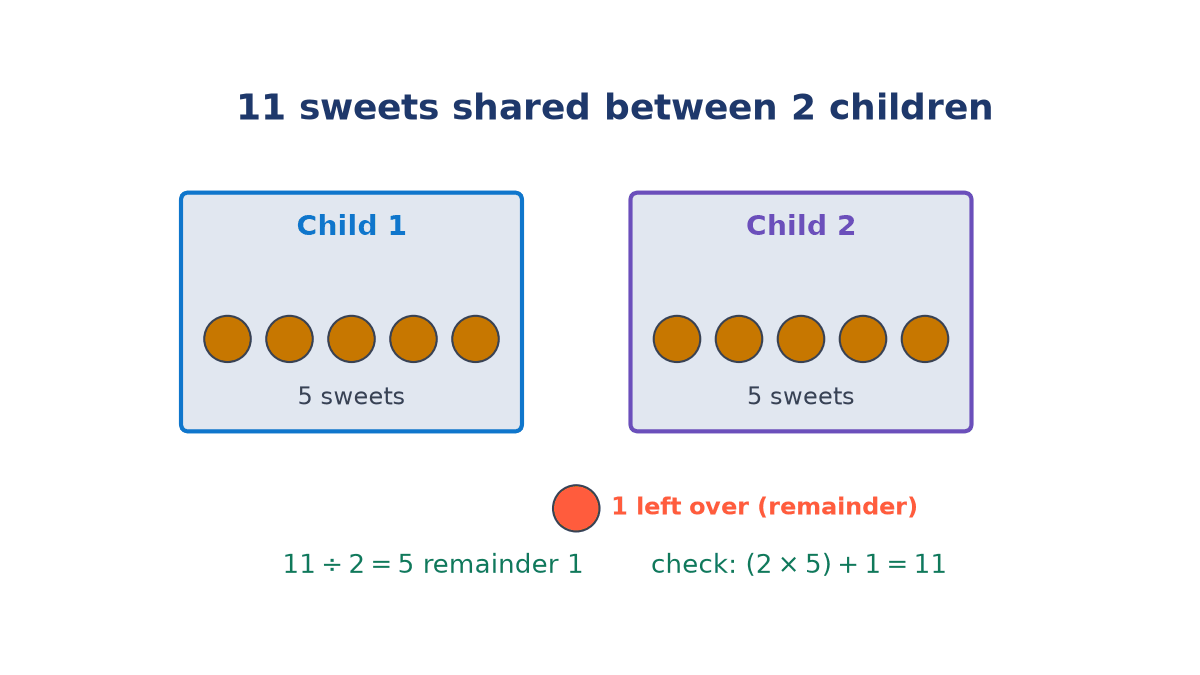
A remainder is always smaller than the divisor. If one sweet were left for each child, you could share again. So when you divide by 2 the remainder can only be 0 or 1. When you divide by 5 it can only be 0, 1, 2, 3 or 4.
Checking a division
Every division can be checked by multiplying back:
Check that 11 divided by 2 gives 5 remainder 1
It comes back to the number you started with, so the answer is right.
Remember. Always check a division by multiplying the divisor by the quotient and adding the remainder. You should get the dividend back.
Two more worked checks
23 pencils shared among 5 children. Five fours are twenty, and five fives are twenty-five, which is too many. So each child gets 4 pencils, and pencils are left.
So gives quotient , remainder , and the check brings back 23.
40 eggs packed into boxes of 6. Six sixes are thirty-six. Six sevens are forty-two, which is too many. So 6 boxes are filled, and eggs are left over.
So gives quotient , remainder . Notice that the remainder, 4, is smaller than the divisor, 6.
When there is nothing left over
If the remainder is zero, the sharing came out exactly even. Those are the divisions hiding inside the times tables you already know.
| Times fact | The division it gives |
|---|---|
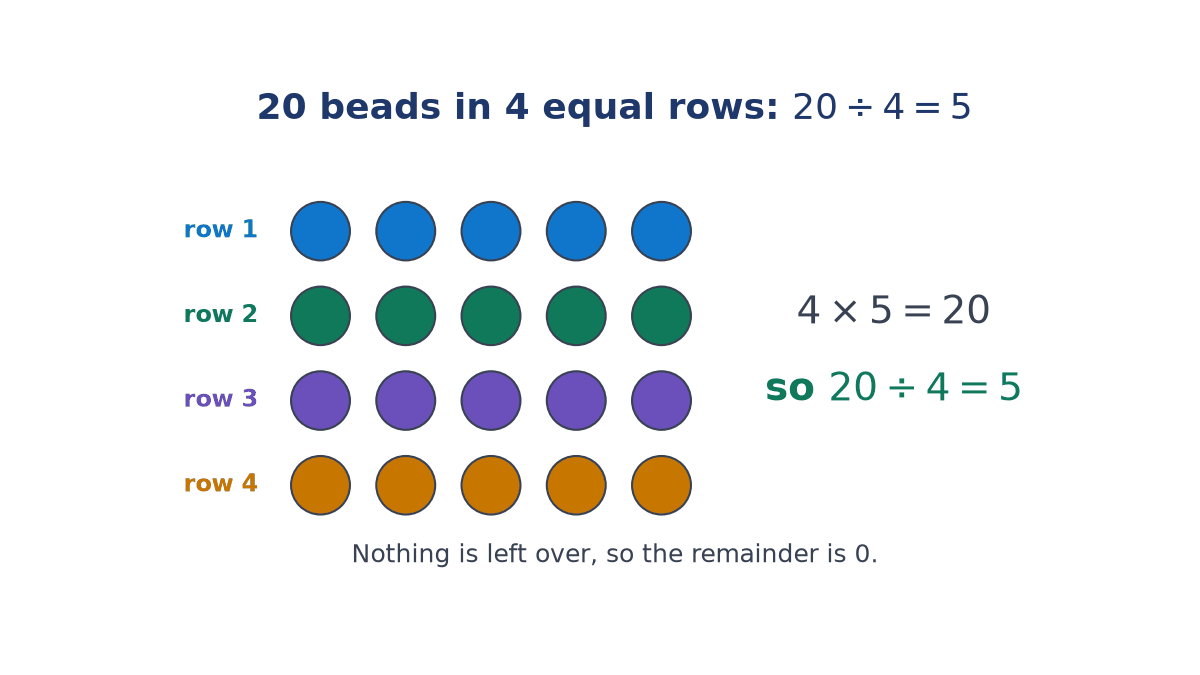
For example, 36 children in 4 equal teams: you know , so each team has 9 children and nobody is left out. And 15 bananas shared among 3 monkeys: , so each monkey gets 5 and the remainder is 0.
Half of a number
The half of a number is what you get by dividing it by two. It is the opposite of doubling, which you met when adding.
| Number | Half of it |
|---|---|
Check any of them by doubling the answer. Half of 1010 is 505, and .
For a bigger number, halve each part. Half of 246 is half of 200, half of 40 and half of 6 put together: 100, 20 and 3, which make 123.
Your turn
Share these out exactly
| 1) | 4) | 7) |
| 2) | 5) | 8) |
| 3) | 6) | 9) |
Find the quotient and the remainder, then check by multiplying back
Find half of
Common mistakes
- Leaving a remainder that is as big as the divisor or bigger. If you divide by 4 and have 5 left, you can share once more.
- Mixing up the dividend and the divisor. In , 20 is being shared and 4 is the number of shares.
- Forgetting to add the remainder when checking. For , is not 11; you must add the 1.
- Thinking division can be turned round like adding. is 3, but is not.
- Writing a remainder when the sharing is exact. If nothing is left, the remainder is 0.
Key terms
- Division
- Sharing a number into equal parts, written with the sign .
- Dividend
- The number being shared out.
- Divisor
- The number of equal shares, or the size of each group.
- Quotient
- How many each share gets.
- Remainder
- What is left over, too little to make another full share.
- Half
- What you get when you divide a number by two.
Answers
Share these out exactly
Find the quotient and the remainder
- gives quotient , remainder . Check:
- gives quotient , remainder . Check:
- gives quotient , remainder . Check:
- gives quotient , remainder . Check:
- gives quotient , remainder . Check:
- gives quotient , remainder . Check:
Find half of
- Half of is
- Half of is
- Half of is
- Half of is
- Half of is
- Half of is