Where you will use this
You have 9 marbles. Your friend gives you 5 more. How many marbles do you have now?
You could count on from 9, one finger at a time: 10, 11, 12, 13, 14. That works. But it is slow, and it is easy to lose count.
There is a quicker way. You make a ten first. Tens are easy to add to. Once you know the trick, sums like and take only a moment. You will use it every day: counting money, adding scores in a game, or finding how many pencils are in two boxes.
So far every answer has stopped at ten. Now the answers go past it, and counting on your fingers starts to run out. So here is the trick that the whole academy course is built on.
The idea
Ten is an easy number to add to. is without any thinking at all. The four simply sits in the units place. So the plan is always the same: get to ten first, then add on what is left over.
To get to ten you use the pairs from the first lesson, the tens complements:
| Number | Needs | To make |
|---|---|---|
Try it on 9 + 5
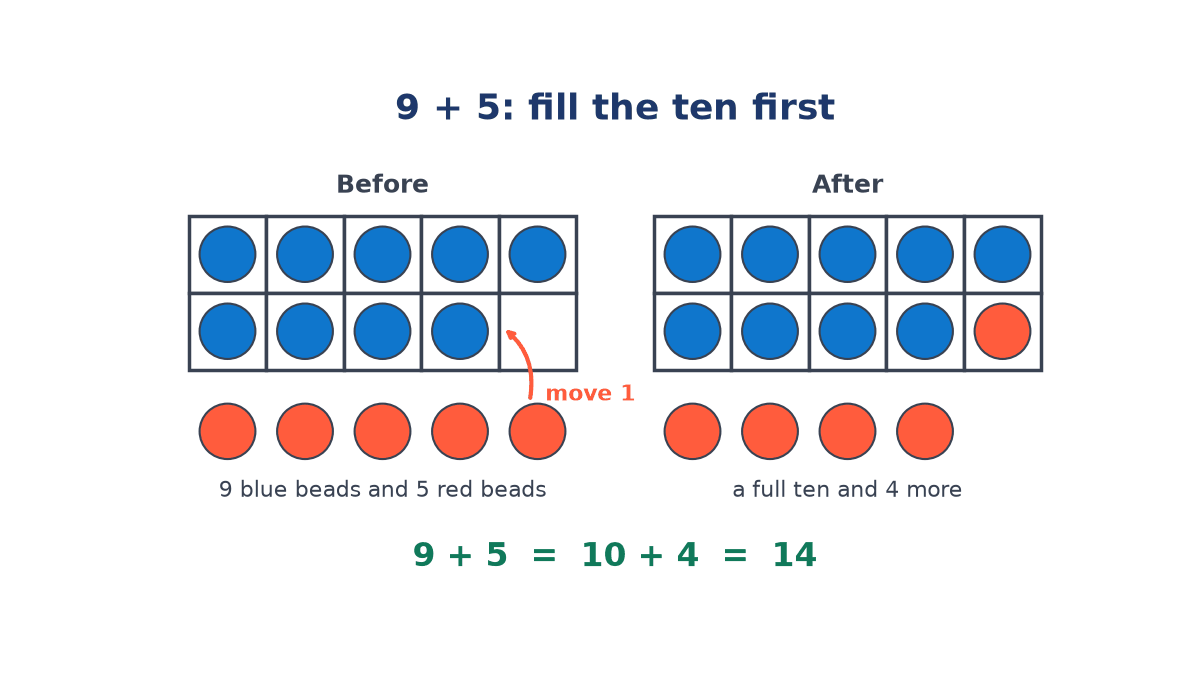
Nine needed one, so one was borrowed from the five. That left four, and ten and four make fourteen. Nothing was lost and nothing was added. The five was only split into .
The three steps
- Look at the bigger number. Ask: what does it need to make ten?
- Take that much from the other number. See what is left.
- Put the ten and what is left together. Ten and 4 is 14.
Try it with beads or buttons on the table. Put 9 in a row and 5 in another row. Slide one button across. Now you have a row of ten and four more. Count them to check.
Adding 9
Nine needs one. Take one from the other number and the rest goes after the ten.
9 + 6
There is a shortcut worth noticing here. Every answer is one less than the number you added with a ten in front of it: gives , and 6 is one less than 7. That happens because nine borrowed one.
Adding 8
Eight needs two.
8 + 5
One more: 8 + 6
Eight needs two. Take two from the six. Four are left.
Think of eight apples in a basket that holds ten. Two more apples fill the basket. Four apples wait outside. A full basket and four is fourteen.
Adding 7
Seven needs three.
7 + 6
One more: 7 + 5
Seven needs three. Take three from the five. Two are left. So .
Adding 6
Six needs four.
6 + 7
One more: 6 + 9
Here the other number is bigger. You can still make ten with six: six needs four, and nine gives four, leaving five. So . Or you can turn it round: nine needs one, six gives one, leaving five. The answer is the same.
Adding 5
Five needs five.
5 + 8
Adding 4, 3 and 2
The same trick still works, but by now the other number is the bigger one, and it is easier to turn the sum round and start from that instead. is the same as , which you already know is .
Remember. You may always start from the bigger number. Turning a sum round never changes its answer.
The doubles past ten
These four finish the set of doubles you began in the first lesson.
A double is a number added to itself. Here is one more double, worked with the tens partner.
Nine needs one. The second nine gives one and keeps eight. Ten and eight make eighteen.
Worked answers to check yourself against
These are the sums the sheet works through. Cover the answers, do them yourself, then look.
| 1) | 6) | 11) |
| 2) | 7) | 12) |
| 3) | 8) | 13) |
| 4) | 9) | 14) |
| 5) | 10) | 15) |
Your turn
| 1) | 11) | 21) |
| 2) | 12) | 22) |
| 3) | 13) | 23) |
| 4) | 14) | 24) |
| 5) | 15) | 25) |
| 6) | 16) | 26) |
| 7) | 17) | 27) |
| 8) | 18) | 28) |
| 9) | 19) | 29) |
| 10) | 20) | 30) |
Common mistakes
- Forgetting to take the partner away from the other number. For , the five gives one and keeps four. It does not keep five.
- Mixing up the partners. Seven needs three, not four. Say the pairs aloud: nine and one, eight and two, seven and three, six and four, five and five.
- Writing the ten wrong. Ten and four is fourteen, written , not .
- Counting on from the smaller number. Start from the bigger one. It is quicker and there is less to count.
- Thinking that turning a sum round changes it. and both make .
Key terms
- Add
- To put two amounts together and find how many there are in all.
- Sum
- The answer you get when you add.
- Tens partner (tens complement)
- The number that makes ten with another number. The tens partner of 7 is 3.
- Double
- A number added to itself, such as .
- Units place
- The right-hand digit of a number. In 14, the units digit is 4.
- Ten frame
- A box of ten squares in two rows of five, used to see when a ten is full.
Answers
Here are the answers to the thirty sums in Your turn. Check each one you got wrong with beads or with the tens partner.
| Sums 1 to 10 | Sums 11 to 20 | Sums 21 to 30 |
|---|---|---|
| 1) | 11) | 21) |
| 2) | 12) | 22) |
| 3) | 13) | 23) |
| 4) | 14) | 24) |
| 5) | 15) | 25) |
| 6) | 16) | 26) |
| 7) | 17) | 27) |
| 8) | 18) | 28) |
| 9) | 19) | 29) |
| 10) | 20) | 30) |
Some of these stay below ten, like and . You do not need the tens partner for those. Just count on. Sums 1, 3, 6, 7, 9, 16, 18, 20, 21, 25 and 28 are like that.
Sums 12, 24 and 30 land exactly on ten. The two numbers are tens partners. Sum 1 adds nought, so the answer is the number you started with.