You already know how to add. This les­son shows you that the times tables are noth­ing more than adding the same num­ber again and again. You will use them every day: to count legs on chairs, sweets in pack­ets, or rupees for three pen­cils at ₹5 each. Once the tables are built from adding, you can always work a fact out, even on a day when your mem­ory lets you down.

Take the tables one at a time. Read each one slowly, say it aloud, and check every answer by adding. Speed comes later, with prac­tice; being sure comes first.

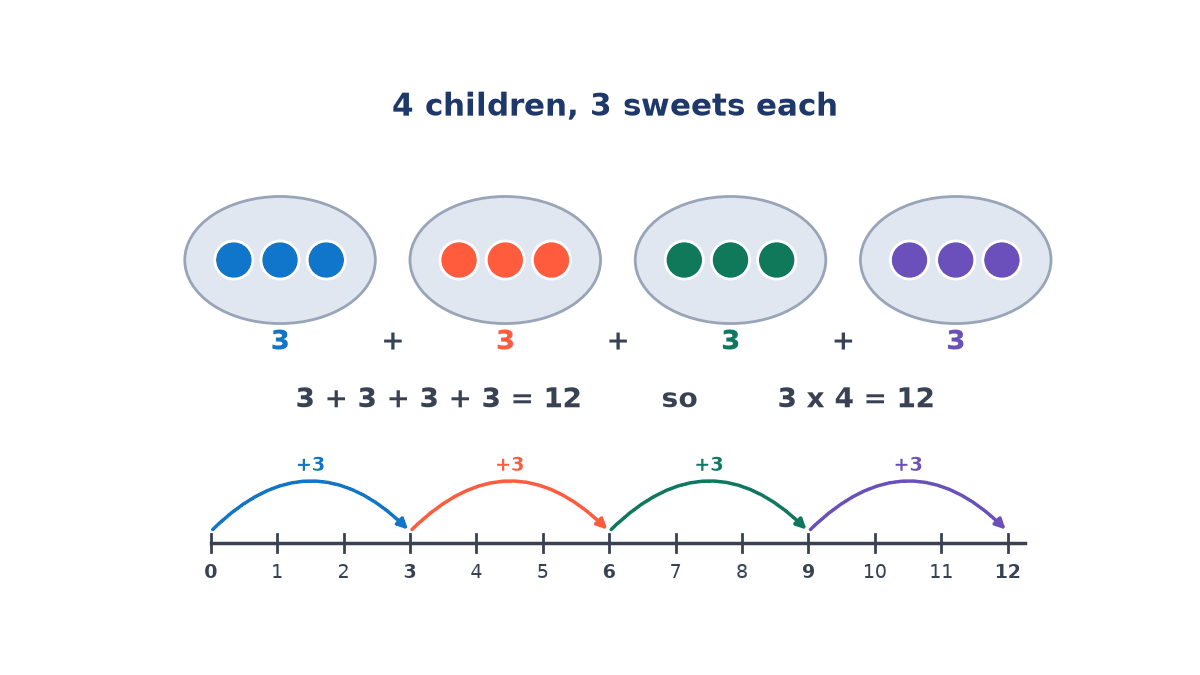
Mul­ti­ply­ing is a short way of writ­ing a long addi­tion. If four chil­dren each have three sweets, you could add 3+3+3+33 + 3 + 3 + 3 and get 1212 — or you could say 3×4=123 \times 4 = 12, which means exactly the same thing.

The sign ×\times is read as "times" or "mul­ti­plied by". 3×43 \times 4 means three, four times over.

See­ing a times fact

Put four plates on the table. Put three sweets on each plate. How many sweets are there?

You can count them one by one. Or you can add the plates: 3+3+3+3=123 + 3 + 3 + 3 = 12. Four lots of three is twelve. That is what 3×4=123 \times 4 = 12 says.

Four plates with three sweets on each, the sum 3 + 3 + 3 + 3 = 12 written as 3 x 4 = 12, and a number line from 0 to 12 with four jumps of 3.
Four equal groups of three make twelve. The jumps along the num­ber line are the same adding, one plate at a time.

The num­ber line shows the count­ing on. Start at 00. Jump 33 for each plate. You land on 33, then 66, then 99, then 1212. Those land­ing places are the answers in the three times table.

How to read the tables below

Each table has three columns. The first is the times fact to learn. The sec­ond counts on from the answer before it — that is how you work the fact out when you can­not remem­ber it. The third shows the addi­tion the fact stands for.

Remem­ber. If a times fact escapes you, do not guess. Go to the one before it and add the num­ber on once more.

The two times table

Times factCount­ing onWhat it means
2×1=22 \times 1 = 22=22 = 22=22 = 2
2×2=42 \times 2 = 42+2=42 + 2 = 42+2=42 + 2 = 4
2×3=62 \times 3 = 64+2=64 + 2 = 62+2+2=62 + 2 + 2 = 6
2×4=82 \times 4 = 86+2=86 + 2 = 82+2+2+2=82 + 2 + 2 + 2 = 8
2×5=102 \times 5 = 108+2=108 + 2 = 102+2+  5 times=102 + 2 + \cdots \; 5 \text{ times} = 10
2×6=122 \times 6 = 1210+2=1210 + 2 = 122+2+  6 times=122 + 2 + \cdots \; 6 \text{ times} = 12
2×7=142 \times 7 = 1412+2=1412 + 2 = 142+2+  7 times=142 + 2 + \cdots \; 7 \text{ times} = 14
2×8=162 \times 8 = 1614+2=1614 + 2 = 162+2+  8 times=162 + 2 + \cdots \; 8 \text{ times} = 16
2×9=182 \times 9 = 1816+2=1816 + 2 = 182+2+  9 times=182 + 2 + \cdots \; 9 \text{ times} = 18
2×10=202 \times 10 = 2018+2=2018 + 2 = 202+2+  10 times=202 + 2 + \cdots \; 10 \text{ times} = 20

The three times table

Times factCount­ing onWhat it means
3×1=33 \times 1 = 33=33 = 33=33 = 3
3×2=63 \times 2 = 63+3=63 + 3 = 63+3=63 + 3 = 6
3×3=93 \times 3 = 96+3=96 + 3 = 93+3+3=93 + 3 + 3 = 9
3×4=123 \times 4 = 129+3=129 + 3 = 123+3+3+3=123 + 3 + 3 + 3 = 12
3×5=153 \times 5 = 1512+3=1512 + 3 = 153+3+  5 times=153 + 3 + \cdots \; 5 \text{ times} = 15
3×6=183 \times 6 = 1815+3=1815 + 3 = 183+3+  6 times=183 + 3 + \cdots \; 6 \text{ times} = 18
3×7=213 \times 7 = 2118+3=2118 + 3 = 213+3+  7 times=213 + 3 + \cdots \; 7 \text{ times} = 21
3×8=243 \times 8 = 2421+3=2421 + 3 = 243+3+  8 times=243 + 3 + \cdots \; 8 \text{ times} = 24
3×9=273 \times 9 = 2724+3=2724 + 3 = 273+3+  9 times=273 + 3 + \cdots \; 9 \text{ times} = 27
3×10=303 \times 10 = 3027+3=3027 + 3 = 303+3+  10 times=303 + 3 + \cdots \; 10 \text{ times} = 30

The four times table

Times factCount­ing onWhat it means
4×1=44 \times 1 = 44=44 = 44=44 = 4
4×2=84 \times 2 = 84+4=84 + 4 = 84+4=84 + 4 = 8
4×3=124 \times 3 = 128+4=128 + 4 = 124+4+4=124 + 4 + 4 = 12
4×4=164 \times 4 = 1612+4=1612 + 4 = 164+4+4+4=164 + 4 + 4 + 4 = 16
4×5=204 \times 5 = 2016+4=2016 + 4 = 204+4+  5 times=204 + 4 + \cdots \; 5 \text{ times} = 20
4×6=244 \times 6 = 2420+4=2420 + 4 = 244+4+  6 times=244 + 4 + \cdots \; 6 \text{ times} = 24
4×7=284 \times 7 = 2824+4=2824 + 4 = 284+4+  7 times=284 + 4 + \cdots \; 7 \text{ times} = 28
4×8=324 \times 8 = 3228+4=3228 + 4 = 324+4+  8 times=324 + 4 + \cdots \; 8 \text{ times} = 32
4×9=364 \times 9 = 3632+4=3632 + 4 = 364+4+  9 times=364 + 4 + \cdots \; 9 \text{ times} = 36
4×10=404 \times 10 = 4036+4=4036 + 4 = 404+4+  10 times=404 + 4 + \cdots \; 10 \text{ times} = 40

The five times table

Times factCount­ing onWhat it means
5×1=55 \times 1 = 55=55 = 55=55 = 5
5×2=105 \times 2 = 105+5=105 + 5 = 105+5=105 + 5 = 10
5×3=155 \times 3 = 1510+5=1510 + 5 = 155+5+5=155 + 5 + 5 = 15
5×4=205 \times 4 = 2015+5=2015 + 5 = 205+5+5+5=205 + 5 + 5 + 5 = 20
5×5=255 \times 5 = 2520+5=2520 + 5 = 255+5+  5 times=255 + 5 + \cdots \; 5 \text{ times} = 25
5×6=305 \times 6 = 3025+5=3025 + 5 = 305+5+  6 times=305 + 5 + \cdots \; 6 \text{ times} = 30
5×7=355 \times 7 = 3530+5=3530 + 5 = 355+5+  7 times=355 + 5 + \cdots \; 7 \text{ times} = 35
5×8=405 \times 8 = 4035+5=4035 + 5 = 405+5+  8 times=405 + 5 + \cdots \; 8 \text{ times} = 40
5×9=455 \times 9 = 4540+5=4540 + 5 = 455+5+  9 times=455 + 5 + \cdots \; 9 \text{ times} = 45
5×10=505 \times 10 = 5045+5=5045 + 5 = 505+5+  10 times=505 + 5 + \cdots \; 10 \text{ times} = 50

The six times table

Times factCount­ing onWhat it means
6×1=66 \times 1 = 66=66 = 66=66 = 6
6×2=126 \times 2 = 126+6=126 + 6 = 126+6=126 + 6 = 12
6×3=186 \times 3 = 1812+6=1812 + 6 = 186+6+6=186 + 6 + 6 = 18
6×4=246 \times 4 = 2418+6=2418 + 6 = 246+6+6+6=246 + 6 + 6 + 6 = 24
6×5=306 \times 5 = 3024+6=3024 + 6 = 306+6+  5 times=306 + 6 + \cdots \; 5 \text{ times} = 30
6×6=366 \times 6 = 3630+6=3630 + 6 = 366+6+  6 times=366 + 6 + \cdots \; 6 \text{ times} = 36
6×7=426 \times 7 = 4236+6=4236 + 6 = 426+6+  7 times=426 + 6 + \cdots \; 7 \text{ times} = 42
6×8=486 \times 8 = 4842+6=4842 + 6 = 486+6+  8 times=486 + 6 + \cdots \; 8 \text{ times} = 48
6×9=546 \times 9 = 5448+6=5448 + 6 = 546+6+  9 times=546 + 6 + \cdots \; 9 \text{ times} = 54
6×10=606 \times 10 = 6054+6=6054 + 6 = 606+6+  10 times=606 + 6 + \cdots \; 10 \text{ times} = 60

The seven times table

Times factCount­ing onWhat it means
7×1=77 \times 1 = 77=77 = 77=77 = 7
7×2=147 \times 2 = 147+7=147 + 7 = 147+7=147 + 7 = 14
7×3=217 \times 3 = 2114+7=2114 + 7 = 217+7+7=217 + 7 + 7 = 21
7×4=287 \times 4 = 2821+7=2821 + 7 = 287+7+7+7=287 + 7 + 7 + 7 = 28
7×5=357 \times 5 = 3528+7=3528 + 7 = 357+7+  5 times=357 + 7 + \cdots \; 5 \text{ times} = 35
7×6=427 \times 6 = 4235+7=4235 + 7 = 427+7+  6 times=427 + 7 + \cdots \; 6 \text{ times} = 42
7×7=497 \times 7 = 4942+7=4942 + 7 = 497+7+  7 times=497 + 7 + \cdots \; 7 \text{ times} = 49
7×8=567 \times 8 = 5649+7=5649 + 7 = 567+7+  8 times=567 + 7 + \cdots \; 8 \text{ times} = 56
7×9=637 \times 9 = 6356+7=6356 + 7 = 637+7+  9 times=637 + 7 + \cdots \; 9 \text{ times} = 63
7×10=707 \times 10 = 7063+7=7063 + 7 = 707+7+  10 times=707 + 7 + \cdots \; 10 \text{ times} = 70

The eight times table

Times factCount­ing onWhat it means
8×1=88 \times 1 = 88=88 = 88=88 = 8
8×2=168 \times 2 = 168+8=168 + 8 = 168+8=168 + 8 = 16
8×3=248 \times 3 = 2416+8=2416 + 8 = 248+8+8=248 + 8 + 8 = 24
8×4=328 \times 4 = 3224+8=3224 + 8 = 328+8+8+8=328 + 8 + 8 + 8 = 32
8×5=408 \times 5 = 4032+8=4032 + 8 = 408+8+  5 times=408 + 8 + \cdots \; 5 \text{ times} = 40
8×6=488 \times 6 = 4840+8=4840 + 8 = 488+8+  6 times=488 + 8 + \cdots \; 6 \text{ times} = 48
8×7=568 \times 7 = 5648+8=5648 + 8 = 568+8+  7 times=568 + 8 + \cdots \; 7 \text{ times} = 56
8×8=648 \times 8 = 6456+8=6456 + 8 = 648+8+  8 times=648 + 8 + \cdots \; 8 \text{ times} = 64
8×9=728 \times 9 = 7264+8=7264 + 8 = 728+8+  9 times=728 + 8 + \cdots \; 9 \text{ times} = 72
8×10=808 \times 10 = 8072+8=8072 + 8 = 808+8+  10 times=808 + 8 + \cdots \; 10 \text{ times} = 80

The nine times table

Times factCount­ing onWhat it means
9×1=99 \times 1 = 99=99 = 99=99 = 9
9×2=189 \times 2 = 189+9=189 + 9 = 189+9=189 + 9 = 18
9×3=279 \times 3 = 2718+9=2718 + 9 = 279+9+9=279 + 9 + 9 = 27
9×4=369 \times 4 = 3627+9=3627 + 9 = 369+9+9+9=369 + 9 + 9 + 9 = 36
9×5=459 \times 5 = 4536+9=4536 + 9 = 459+9+  5 times=459 + 9 + \cdots \; 5 \text{ times} = 45
9×6=549 \times 6 = 5445+9=5445 + 9 = 549+9+  6 times=549 + 9 + \cdots \; 6 \text{ times} = 54
9×7=639 \times 7 = 6354+9=6354 + 9 = 639+9+  7 times=639 + 9 + \cdots \; 7 \text{ times} = 63
9×8=729 \times 8 = 7263+9=7263 + 9 = 729+9+  8 times=729 + 9 + \cdots \; 8 \text{ times} = 72
9×9=819 \times 9 = 8172+9=8172 + 9 = 819+9+  9 times=819 + 9 + \cdots \; 9 \text{ times} = 81
9×10=909 \times 10 = 9081+9=9081 + 9 = 909+9+  10 times=909 + 9 + \cdots \; 10 \text{ times} = 90

Worked exam­ples

Exam­ple 1: a small one

Two hands. Five fin­gers on each hand. How many fin­gers?

5×2=5+5=10\begin{aligned}5 \times 2 &= 5 + 5 \\ &= 10\end{aligned}

Exam­ple 2: count­ing on from a fact you know

You have for­got­ten 6×76 \times 7. But you know 6×6=366 \times 6 = 36. Add one more six.

6×7=(6×6)+6=36+6=42\begin{aligned}6 \times 7 &= (6 \times 6) + 6 \\ &= 36 + 6 \\ &= 42\end{aligned}

Exam­ple 3: a harder one

A box holds 77 pen­cils. How many pen­cils are in 88 boxes? That is 7×87 \times 8. If you know 7×7=497 \times 7 = 49, add one more seven.

7×8=(7×7)+7=49+7=56\begin{aligned}7 \times 8 &= (7 \times 7) + 7 \\ &= 49 + 7 \\ &= 56\end{aligned}

You could also turn it round and use the eight times table: 8×7=568 \times 7 = 56. Both give the same answer, as the next sec­tion shows.

Exam­ple 4: money

One pen­cil costs ₹55. Four pen­cils cost 5+5+5+55 + 5 + 5 + 5 rupees, which is 5×4=205 \times 4 = 20. So four pen­cils cost ₹2020.

Two things worth notic­ing

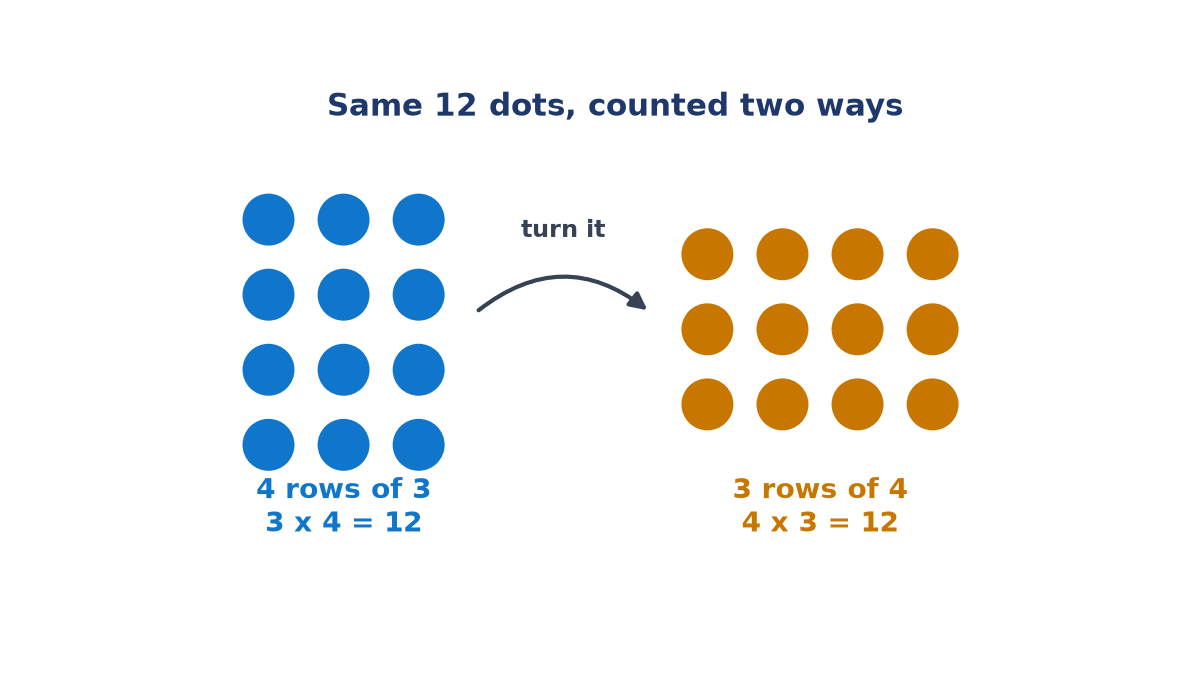
The first is that turn­ing a mul­ti­pli­ca­tion round does not change it. 3×4=123 \times 4 = 12 and 4×3=124 \times 3 = 12. Four rows of three sweets and three rows of four sweets are the same pile counted two ways, so learn­ing one fact gives you two.

Twelve blue dots in 4 rows of 3 beside twelve orange dots in 3 rows of 4, with an arrow showing that turning the array keeps the count at 12.
The same twelve dots can be seen as 4 rows of 3 or as 3 rows of 4. Turn­ing a mul­ti­pli­ca­tion round never changes the answer.

This halves the work. Once you know the two, three, four and five times tables, most of the six, seven, eight and nine tables are already known from the other side. For exam­ple, 8×38 \times 3 is the same as 3×8=243 \times 8 = 24.

The sec­ond is that the nine times table always adds up. Look at 9×4=369 \times 4 = 36: 3+6=93 + 6 = 9. Try it on 4545, 5454, 6363 — the dig­its of every answer add up to nine. It is a quick way to check your­self.

Here is how it works on 9×7=639 \times 7 = 63: 6+3=96 + 3 = 9. If you ever write 9×7=649 \times 7 = 64 by mis­take, the dig­its add to 1010, and you know at once to look again. The check works for 9×19 \times 1 up to 9×10⁹ \times 10, since 9+0=99 + 0 = 9 too.

Your turn

Say each table aloud from top to bot­tom, then from bot­tom to top. Then answer these with­out look­ing back.

1) 2×72 \times 77) 8×68 \times 613) 8×88 \times 8
2) 3×63 \times 68) 9×59 \times 514) 9×99 \times 9
3) 4×84 \times 89) 3×93 \times 915) 5×65 \times 6
4) 5×95 \times 910) 4×44 \times 416) 2×92 \times 9
5) 6×46 \times 411) 6×76 \times 717) 7×77 \times 7
6) 7×37 \times 312) 7×87 \times 818) 6×96 \times 9

Com­mon mis­takes

  • Adding the two num­bers instead of mul­ti­ply­ing. 3×43 \times 4 is 1212, not 77.
  • Adding the num­ber one time too many or too few. 3×43 \times 4 has four threes in the sum, not three.
  • Count­ing on by the wrong num­ber. In the seven times table every step adds 77, how­ever big the answer gets.
  • Guess­ing a fact you have for­got­ten. Go back to the fact before it and add the num­ber once more.
  • Think­ing 4×34 \times 3 is a new fact to learn. It is the same as 3×43 \times 4.

Key terms

Times (×\times)
The sign for mul­ti­ply­ing, read as "times" or "mul­ti­plied by".
Times table
A list of one num­ber mul­ti­plied by 11, 22, 33 and on.
Repeated addi­tion
Adding the same num­ber again and again; mul­ti­ply­ing is a short way to write it.
Count­ing on
Adding the num­ber once more to the answer before to get the next answer.
Equal groups
Groups that all hold the same num­ber of things, like plates with three sweets each.
Dig­its
The sin­gle num­ber signs 00 to 99 that make up a num­ber, like the 33 and 66 in 3636.

Answers

Say­ing the tables aloud has no sin­gle writ­ten answer. A good model is: "two ones are two, two twos are four, two threes are six", and so on down to "two tens are twenty", then back up from "two tens are twenty" to "two ones are two". Do the same for each table up to nine.

  1. 2×7=142 \times 7 = 14
  2. 3×6=183 \times 6 = 18
  3. 4×8=324 \times 8 = 32
  4. 5×9=455 \times 9 = 45
  5. 6×4=246 \times 4 = 24
  6. 7×3=217 \times 3 = 21
  7. 8×6=488 \times 6 = 48
  8. 9×5=459 \times 5 = 45
  9. 3×9=273 \times 9 = 27
  10. 4×4=164 \times 4 = 16
  11. 6×7=426 \times 7 = 42
  12. 7×8=567 \times 8 = 56
  13. 8×8=648 \times 8 = 64
  14. 9×9=819 \times 9 = 81
  15. 5×6=305 \times 6 = 30
  16. 2×9=182 \times 9 = 18
  17. 7×7=497 \times 7 = 49
  18. 6×9=546 \times 9 = 54