You add every day, even before you know the word. Two sweets in one hand and three in the other: how many sweets altogether? Four children at the table and one more comes to sit: how many children now? Each time you are putting two groups together and counting the whole lot.
What you learn here is the first step in all the adding you will ever do. The numbers are small, so you can use your fingers, beads, buttons or a number line to check every answer. Take it slowly. Say each sum out loud. You will need these facts again and again, in every lesson that comes after this one.
Adding means putting things together and counting how many there are altogether. For now every answer stays at ten or below, so your fingers can always tell you if you are right.
The number ladder
Before adding anything, say the numbers in order. Going up is called ascending order:
Going down is called descending order:
Think of it as a ladder of numbers. Adding is climbing up it, and taking away is climbing down. To work out , stand on 4 and take three steps up: 5, 6, 7. So .
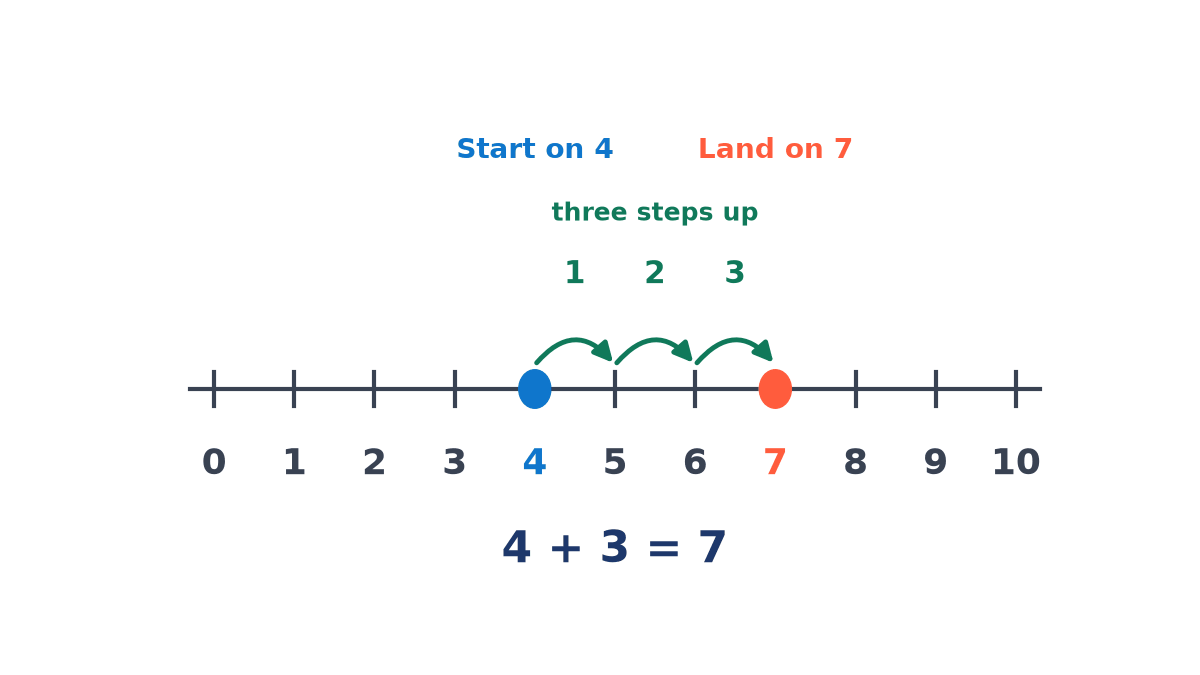
The picture shows the three steps. Count the hops, not the marks: you start on 4, so the first hop takes you to 5. Here are two more to try on the line.
Example: 2 + 5
Stand on 2. Take five steps up: 3, 4, 5, 6, 7. You land on 7.
Example: 5 + 2, the quicker way
Now stand on the bigger number, 5, and take only two steps: 6, 7. You land on 7 again, and it took fewer steps.
Adding zero
Zero means nothing at all. If you have four sweets and somebody gives you nothing, you still have four sweets.
Remember. When you add zero to a number, the answer is that same number.
On the ladder, adding zero means taking no steps at all. You stay exactly where you are.
Adding one
Adding one is taking a single step up the ladder, so the answer is simply the next number you say when you count.
Remember. Adding one gives the number that comes next in counting.
Example: apples in a basket
A basket has 6 apples. Amma puts in 1 more apple. Count on from 6 by one: 7. There are 7 apples in the basket.
Adding two
Adding two is two steps up. Stand on 6, step to 7, then step to 8. So .
Adding two also skips a number. From 3, adding two jumps over 4 and lands on 5. From 6 it jumps over 7 and lands on 8. That is a quick way to check yourself.
Adding three
Three steps up the ladder this time.
Example: beads on a string
Riya has 5 red beads on her string. She adds 3 blue beads. Point at the red ones and say "five", then touch each blue bead and count on: 6, 7, 8.
Doubles
A double is a number added to itself. Doubles are worth learning by heart, because once you know them a great many other sums become easy.
You can see doubles on your own body. Two hands, each with 5 fingers, make . A spider has 4 legs on each side, so legs altogether.
Doubles also help with the sums next door to them. If you know , then is just one more, so it is .
A sum that is one more than a double is called a near double. Here is the thinking written out for :
The pairs that make ten
These pairs are called the tens complements, and if you learn only one thing from these pages, let it be these. Each number below has one partner that finishes the journey to ten.
| Number | Its partner | Why |
|---|---|---|
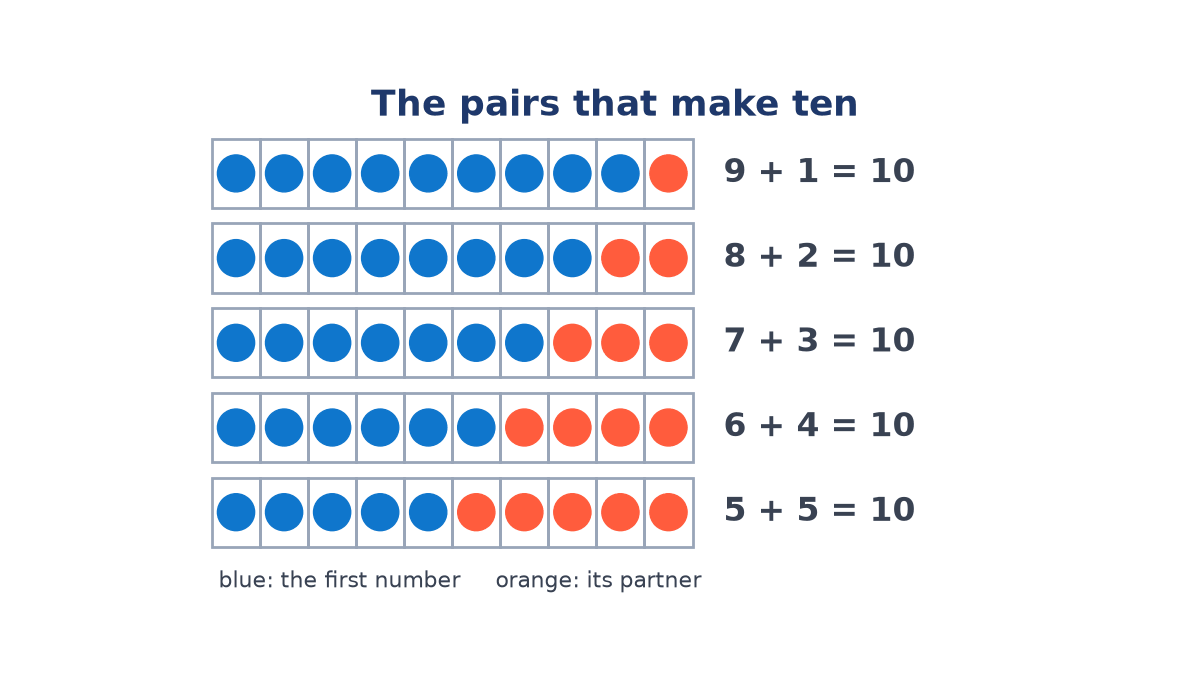
Look at each row of the picture. The blue counters and the orange counters always fill all ten places. If you know how many are blue, the empty places tell you how many more you need to reach ten. Hold up ten fingers, fold down 7, and the 3 still standing are the partner of 7.
Notice the third column. It does not matter which way round you add: and both give ten. That is true of every addition, and it means you may always start with the bigger number and count on from there.
Remember. Learn the five pairs: 9 and 1, 8 and 2, 7 and 3, 6 and 4, 5 and 5. Every later lesson leans on them.
Your turn
Fill in the missing number
Use doubling to help you
Common mistakes
- Counting the starting number as a step. For some children say "4, 5, 6" and answer 6. Start on 4 and say only the new numbers: 5, 6, 7.
- Thinking adding zero makes zero. is 7, not 0. Nothing was added, so nothing changed.
- Counting on from the smaller number. It is not wrong, but it is slow and easy to lose count. For , start on 6 and count two more.
- Mixing up the partners of ten. 6 goes with 4, not with 3. Check with ten fingers or a ten-frame.
- Forgetting the missing number can be at the front. In you need the number that 2 is added to, which is 2.
Key terms
- Add
- Put two groups together and find how many there are altogether. The sign is .
- Ascending order
- Numbers written going up: 0, 1, 2, 3 and so on.
- Descending order
- Numbers written going down: 10, 9, 8, 7 and so on.
- Count on
- Start on one number and say the next numbers, one for each thing you add.
- Double
- A number added to itself, such as .
- Near double
- A sum one more than a double, such as .
- Tens complements
- The pairs of numbers that add up to ten: 9 and 1, 8 and 2, 7 and 3, 6 and 4, 5 and 5.
Answers
Fill in the missing number
- , so the missing number is 4.
- , so the missing number is 0.
- , so the missing number is 3.
- , so the missing number is 1.
- , so the missing number is 3.
- , so the missing number is 2.
- , so the missing number is 1.
- , so the missing number is 3.
- , so the missing number is 8.
- , so the missing number is 1.
Use doubling to help you
- , one more than .
- , one more than .
- , one more than .