Riya has marbles. Her brother gives her more. How many does she have now? Sums like this come up all the time: counting marbles, adding runs in a game, working out how many pages you have read. In each one a big number meets a small one, and there are quick, sure ways to add them. Let us see how.
A two-digit number is made of tens and units. In the 2 means two tens, which is twenty, and the 5 means five units. So .
Hold on to that split, because it is really all you need. Once a number is broken into its tens and its units, adding a single digit to it becomes a single-digit sum. And you have learned all of those already.
Think of tens as sticks of ten beads, and units as single beads. The number is two sticks and five loose beads. When Riya gets more marbles, only the loose beads change. The sticks stay just as they were.
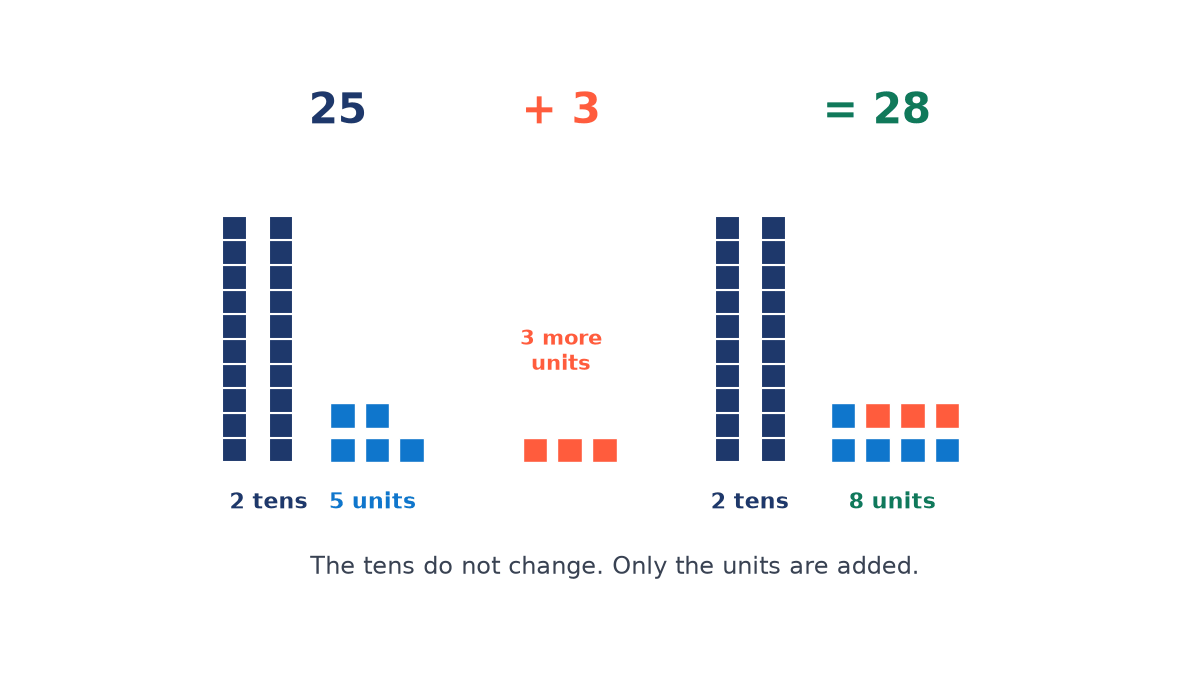
So Riya has marbles. Keep this picture in your head as you read the rest of the lesson.
A whole ten plus a digit
The easiest case of all. The tens stay where they are and the digit simply drops into the units place.
Remember. A whole ten plus a single digit just writes the digit in the units place.
When the units add up to less than ten
Split the two-digit number, add the units, and put it back together.
12 + 3
25 + 3
Nothing spills over into the tens, so the tens digit does not change at all.
One more to try. Work it out before you read the steps.
34 + 5
Four units and five units make nine units. Nine is still less than ten, so the three tens stay three tens.
When the units add up to exactly ten
Now the units make a whole new ten, and the answer is a round number.
63 + 7
52 + 8
This is the tens complement again, doing its work inside a bigger number. Whenever the units are partners, such as 3 and 7 or 2 and 8, the answer lands on a round ten.
Here is one more with partners. Seven and three are partners, because they make ten.
47 + 3
Four tens and one new ten make five tens. That is .
When the units add up to more than ten
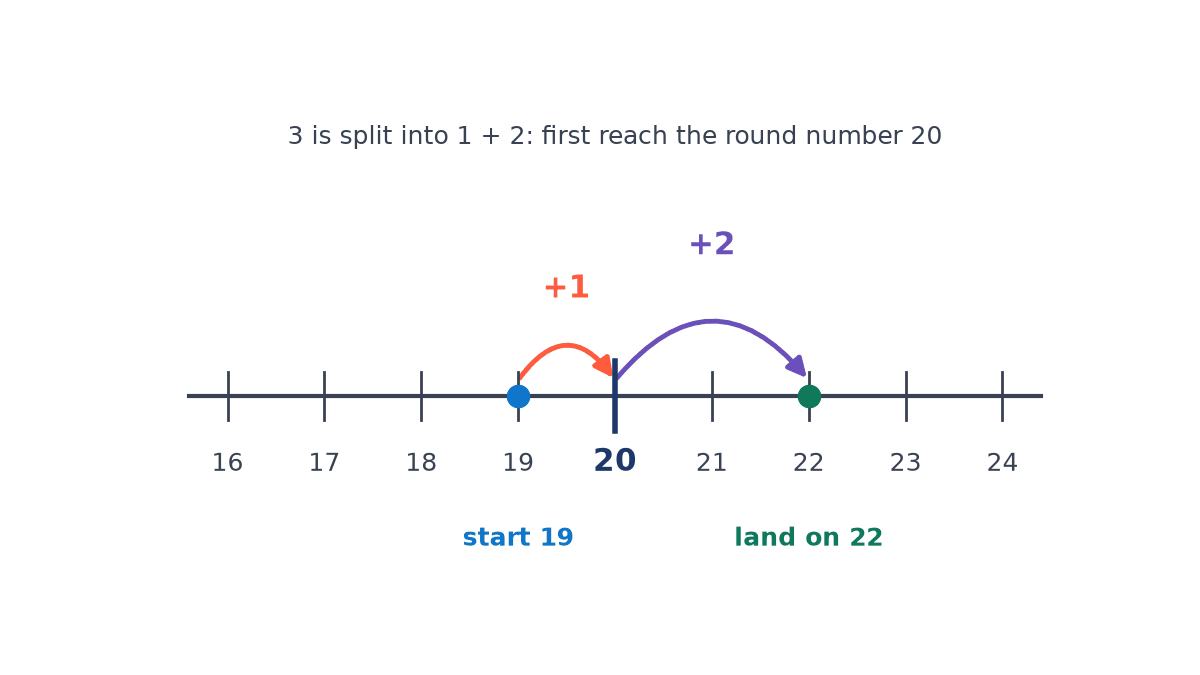
Here it is easier to go the other way about: push the two-digit number up to the next round ten first, then add whatever is left.
19 + 3
95 + 7
Remember. Reach the next round ten first. Ten, twenty, one hundred: round numbers are easy to add to, so it is always worth getting to one.
A number line shows this idea very clearly. Start at . Take one small hop to reach . You have used of the . Two are left, so hop two more to .
Two more to try
First ask: how many does the number need to reach the next round ten? Take that many out of the digit. Add what is left.
58 + 6
needs to reach . Six take away two leaves four. So the answer is .
27 + 8
needs to reach . Eight take away three leaves five. So the answer is .
Counting on in steps
Adding the same number again and again builds a ladder. These ladders are the times tables in disguise, and you will meet them properly two lessons from now. For the moment, just read each column downwards and say it aloud.
Counting on in twos, threes, fours and fives
Counting on in sixes, sevens, eights and nines
Adding three or more numbers
When there are several numbers to add, you may take them in any order you like. So look for a pair that makes ten and do that pair first.
6 + 8 + 4
The six and the four were partners, so they were taken together and the eight added afterwards. Hunting for partners like that turns a long line of numbers into a short one.
3 + 9 + 7
Three and seven are partners. Put them together first, and the nine is easy to add.
Which way should I add?
Before you start a sum, look at the units.
- If the units add to less than ten, just add them. The tens stay the same.
- If the units add to exactly ten, you land on a round number.
- If the units add to more than ten, reach the next round ten first, then add what is left.
- If there are three or more numbers, look for partners that make ten.
Your turn
Add the digit
| 1) | 7) |
| 2) | 8) |
| 3) | 9) |
| 4) | 10) |
| 5) | 11) |
| 6) | 12) |
Look for the pairs that make ten
Common mistakes
- Adding the digit to the tens. is , not . The digit goes with the units.
- Forgetting the new ten. In the units make , so the tens go up by one: the answer is , not .
- Using up too much of the digit. In , only is needed to reach , so is left, not .
- Missing a number when adding a long line. Tick off each number as you use it.
Key terms
- Tens
- Groups of ten. In the means two tens, which is twenty.
- Units
- Single ones. In the means five units.
- Two-digit number
- A number from to , made of tens and units.
- Round ten
- A number that ends in , such as , or .
- Partners
- Two numbers that make ten together, such as and .
- Counting on
- Adding the same number again and again, starting from where you are.