Subtraction is everywhere: working out change at the shop, how many pages are left in a book, or how many runs a team still needs. Many children learn one way to subtract, with borrowing, and use it for every sum. There is a quicker way, and you can often do it in your head. It works for small numbers and for very large ones.
The one big idea
We are going to take the trick from the earlier subtraction lesson and use it on numbers of any size. Let me say the idea once more, because everything below is really that one sentence used again and again.
Remember. A subtraction asks how far apart two numbers are. Move both of them up by the same amount, or both down by the same amount, and the gap does not change.
So you move them until one of them becomes a round number, and then the sum is easy.
Think of two children standing on a staircase, one on step and one on step . They are steps apart. If both climb steps, they stand on steps and , still steps apart. That is why and have the same answer, and the second one is much easier.
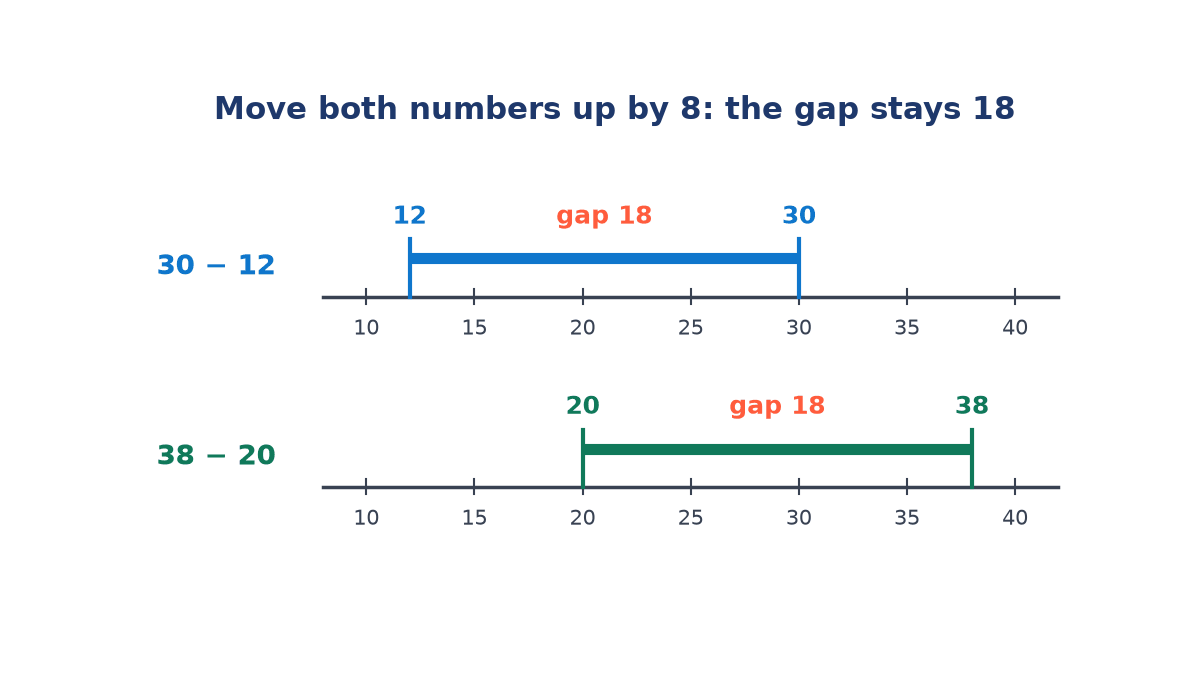
Remember. Add the same to both, or take the same from both. Never add to one and take from the other.
Which way should I move?
Look at the number being taken away. If it is just below a round number, like , or , move up to make it round. If it is just above a round number, like or , move down.
Warming up
Single digits
| 1) | 7) | 13) |
| 2) | 8) | 14) |
| 3) | 9) | 15) |
| 4) | 10) | 16) |
| 5) | 11) | 17) |
| 6) | 12) | 18) |
From a two-digit number
| 1) | 7) | 13) |
| 2) | 8) | 14) |
| 3) | 9) | 15) |
| 4) | 10) | 16) |
| 5) | 11) | 17) |
| 6) | 12) | 18) |
Taking away whole tens
Only the tens digit changes, so these can be done at a glance.
Two-digit take away two-digit
Take the tens off both numbers first. That is the move-both-down step, done ten at a time, and it shrinks the sum to something small.
35 - 12
Ten came off each. Then two off each again would give , which is the same answer.
25 - 13
56 - 34
Sometimes moving up is easier, because it makes the number being taken away into a round ten:
30 - 12, moving down
30 - 12, moving up
| Question | Moving down | Moving up | Answer |
|---|---|---|---|
Taking away from a hundred
A hundred is the friendliest number to take from, because you can use the pairs that make ten.
100 - 12
100 - 36
Thirty came off both numbers, leaving .
Three digits and more
123 - 8, moving down
123 - 8, moving up
125 - 82
Or in one move: .
342 - 57
Or in one move: .
600 - 123
535 - 258
Or in one move: .
927 - 649
Or in one move: .
More worked examples
71 - 28
Two was added to both, so became the round number .
63 - 27
400 - 168
Taking one off both turns into . Now no digit needs borrowing: , , .
5003 - 1998
Adding two to both makes into , and the rest is easy.
Taking away from round numbers
A thousand, ten thousand, a lakh: the working is the same each time, and the answer is always a string of nines with the last digits made up to ten.
And the very same working holds however long the numbers are: , and .
The last trick with round numbers is the same take-one-off idea: . With a row of nines on top, each digit is taken from and nothing is ever borrowed.
Your turn
Go back to the two warming-up tables at the top of the lesson and write down each answer. Then try the mixed questions below, choosing whether to move up or down each time.
Check your answers
Work these out, then look at the answers beside them.
| Question | Answer | Question | Answer |
|---|---|---|---|
Checking an answer
Every subtraction can be checked with an addition. If , then must give back . Add the ones: , write and carry . Add the tens: , write and carry . Add the hundreds: . The total is , so the answer was right.
A second quick check is size. The answer to must be a little less than , because is a little more than and is a little more than . An answer like or would be easy to spot as wrong. The real answer, , fits.
Use both checks on the questions below. They take only a few seconds, and they catch most slips before a teacher does.
Common mistakes
- Moving the two numbers in opposite directions. is not .
- Moving only one of the numbers, which changes the gap.
- Forgetting that and appear twice in the tables; they have the same answer each time.
- Miscounting the zeros in a round number such as . Say it aloud as one lakh.
- Not checking. Add your answer to the number you took away; you should get back the first number.
Key terms
- Subtraction
- Finding how far apart two numbers are, or how many are left.
- Difference
- The answer to a subtraction.
- Round number
- A number ending in zeros, such as , or .
- Moving up or down
- Adding the same amount to both numbers, or taking the same amount from both.
- Borrowing
- The step in column subtraction where a ten is moved to the next column; the tricks here avoid it.
Answers
Single digits
From a two-digit number
Check your answers
The answers to the mixed questions are printed beside each question in the table above: , , , , , , , , , , in the first column, and , , , , , , , , , , in the second.