Taking away is something you do all the time. You have 13 marbles and give 7 to a friend. A bus has 23 people and 5 get off. A shop has 35 mangoes and sells 7. Each time you ask the same question: how many are left? Let us learn some quick and safe ways to find out.
Taking a digit from a two-digit number is easy when the units are big enough. is just , which is . The real question is what to do when they are not big enough, as in , where seven is more than the three you have.
Ten take away a digit
Start here, because it is the tens complements once more, read backwards.
If , then . Every addition fact you know is a subtraction fact as well.
Try it with ten beads on a string. Push beads to one side. Count the beads left on the other side. There are . So , and . The two numbers that make ten are called partners. Learn the partners of ten well. You will use them in every sum below.
A whole ten take away a digit
The answer drops into the ten below, and the units are the partner of what you took.
Look at . Sixty becomes fifty, and the units are 3, which is the partner of 7. That is the pattern in every row.
Why does this work? Think of as six bags of ten sweets. To take away , you open one bag. Five bags stay shut, which is . From the open bag of ten you take , and are left. So you have .
When the units are big enough
Nothing has to be borrowed. Take the digit off the units and leave the tens alone.
For example, . The units digit is , and is more than . So take from the to get . The four tens do not change. The answer is .
When the units are not big enough
Here is the idea everything below depends on. A subtraction asks how far apart two numbers are. If you move both numbers up by the same amount, or down by the same amount, the gap between them stays exactly the same. So the answer does not change.
Imagine two children standing on the number ladder. If they both climb three rungs, they are still the same distance apart.
The picture shows this for . The gap between and is steps. Slide both numbers down by and you get and . The gap is still . Slide both up by and you get and . The gap is still .
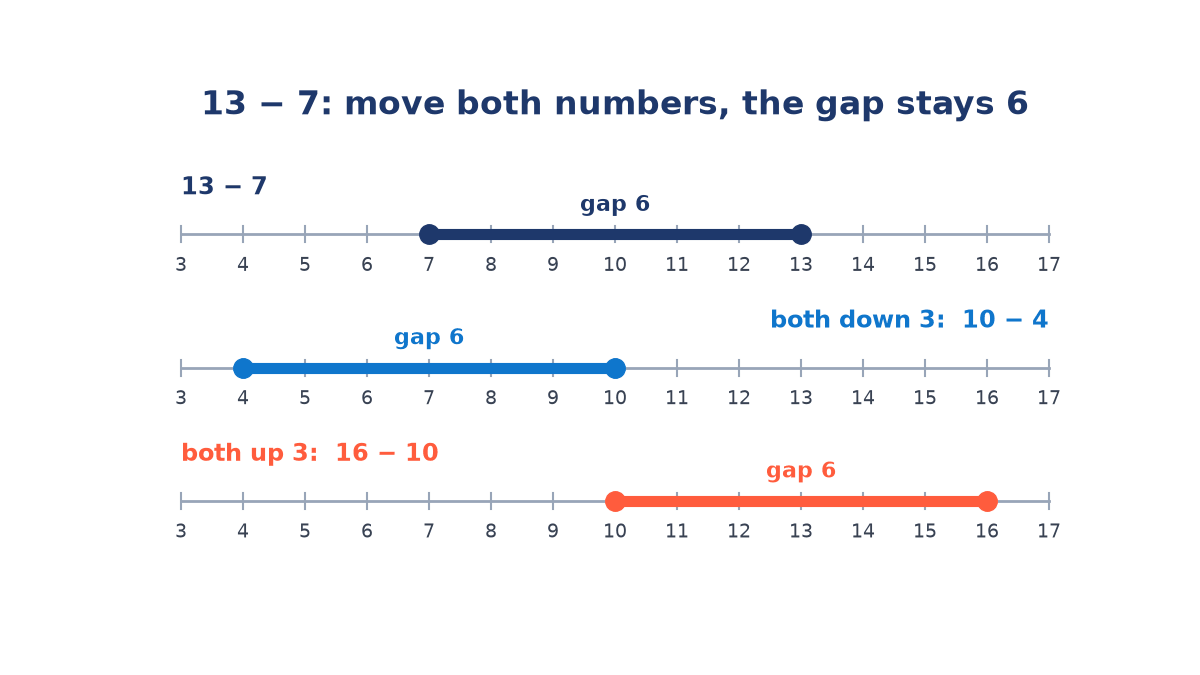
First way: move both down, so the top becomes a ten
13 - 7
Three came off both numbers. The top became a round ten, and is a fact from the very first table above.
Second way: move both up, so the number being taken becomes a ten
13 - 7
Three went on to both numbers this time. Taking away a whole ten is easy: .
Third way: know it
After enough practice comes straight to mind with no working at all. That is where you want to get to. Until then, the two ways above are the scaffolding that holds you up.
Two more, step by step
32 - 9, moving both down
The units digit of is . Take off both numbers. Then the top is a round .
And is a whole ten take away a digit. The answer drops into the twenties, and is the partner of . So it is .
71 - 6, moving both up
The partner of is . Add to both numbers. Then you take away a round .
Taking away ten is easy. The tens digit goes down by one and the units stay the same.
Which way to choose
Both ways always give the same answer, so pick the one that feels easier. If the units digit of the top number is small, like the in , moving down is quick. If the number you take away is close to ten, like or , moving up is quick, because you only add a little. With practice you will choose without thinking, and one day you will just know the answer.
Check by adding back
You can always check a subtraction with an addition. If , then must give . It does. If the addition does not give the number you started with, look at your working again.
More worked examples
Each one is done both ways, so you can see that they always agree.
| Question | Move both down | Move both up | Answer |
|---|---|---|---|
Remember. Move both numbers the same way and the answer stays the same. Move them until one of them is a round ten.
Your turn
| 1) | 11) | 21) |
| 2) | 12) | 22) |
| 3) | 13) | 23) |
| 4) | 14) | 24) |
| 5) | 15) | 25) |
| 6) | 16) | 26) |
| 7) | 17) | 27) |
| 8) | 18) | 28) |
| 9) | 19) | 29) |
| 10) | 20) | 30) |
Common mistakes
- Taking the smaller units digit from the bigger one. In , some children do and write . The right answer is .
- Moving only one number. If you add to the top, you must add to the number you take away too.
- Moving the numbers in opposite directions. Both go up, or both go down.
- Forgetting that the tens drop by one when the units are not big enough, as in , not .
- Mixing up the partners of ten. Say them aloud until they come quickly.
Key terms
- Subtract
- To take one number away from another.
- Difference
- The answer to a subtraction: how far apart two numbers are.
- Units digit
- The last digit of a number. In it is .
- Tens digit
- The digit that counts tens. In it is .
- Partners of ten
- Two numbers that add to make , such as and .
- Round ten
- A number that ends in zero, such as , or .
Answers
1) , 2) , 3) , 4) , 5) , 6) , 7) , 8) , 9) , 10) , 11) , 12) , 13) , 14) , 15) , 16) , 17) , 18) , 19) , 20) , 21) , 22) , 23) , 24) , 25) , 26) , 27) , 28) , 29) , 30)
Check any one by adding back. For question 1, . For question 30, .