Once you can add single digits, you can add much bigger numbers, because a two-digit number is only some tens and some units sitting side by side. You meet these sums all the time: 25 children in one class and 32 in the next, ₹45 spent on a notebook and ₹38 on pencils, a batter scoring 18 runs in one match and 27 in the next.
A number like 56 is 5 tens and 6 units, so . Keep that picture in mind through the whole lesson: tens rods and loose unit cubes, like the ones in the picture further down.
Both numbers have tens and units now. The plan does not change: split them both, add the tens to the tens and the units to the units, then put the answer back together.
Tens with tens
Adding whole tens is single-digit addition with a zero on the end. If , then .
Say it with the tens as things: 3 tens and 2 tens make 5 tens, and 5 tens is 50. The word "tens" works just like the word "apples".
The pairs that make a hundred
These are the tens complements again, grown ten times bigger. They are worth knowing as well as you know the small ones.
Look at the first row: , so 9 tens and 1 ten make 10 tens, which is 100. Every pair in the table works the same way.
Doubling the tens
And a few that go past a hundred
A whole ten plus a two-digit number
Only the tens change, so add those and carry the units across untouched.
30 + 43
50 + 78
64 + 30
97 + 80
When the units do not spill over
Add the tens, add the units, put them together.
52 + 33
Or add the tens on first and the units afterwards, which some children find easier because there is only one thing to hold in mind at a time:
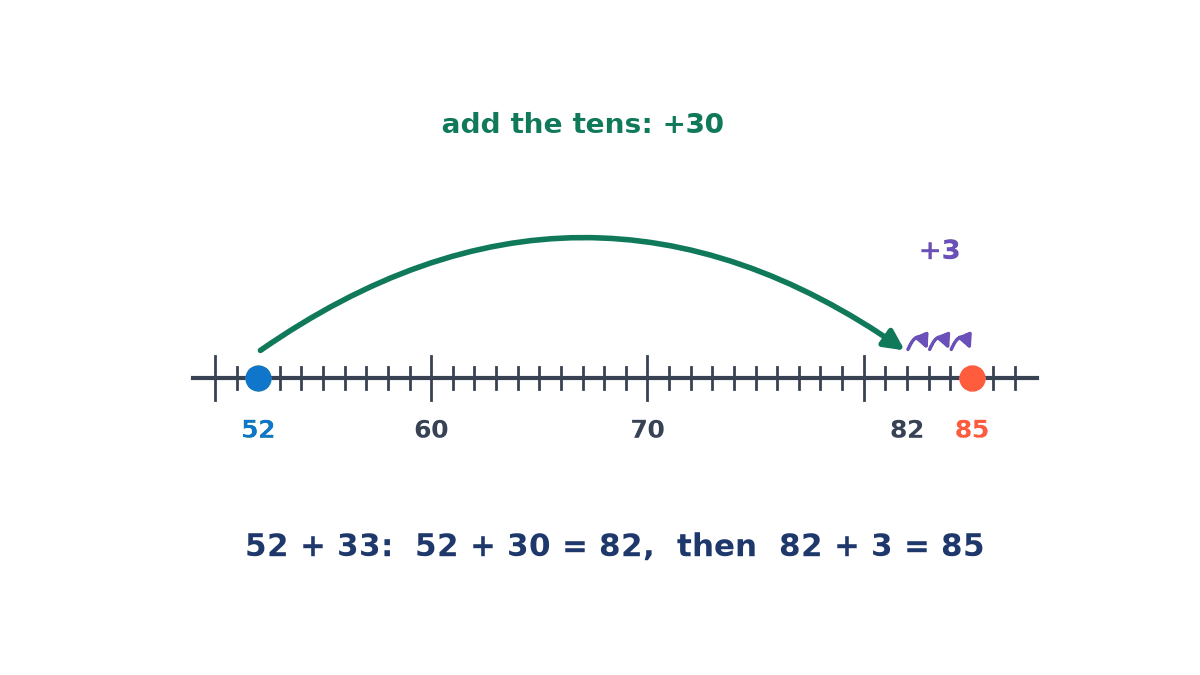
52 + 33, the other way
53 + 75
53 + 75, the other way
When the units spill over
If the units add up to ten or more they make a whole new ten of their own. Don't panic, nothing has gone wrong. Just add that ten on too.
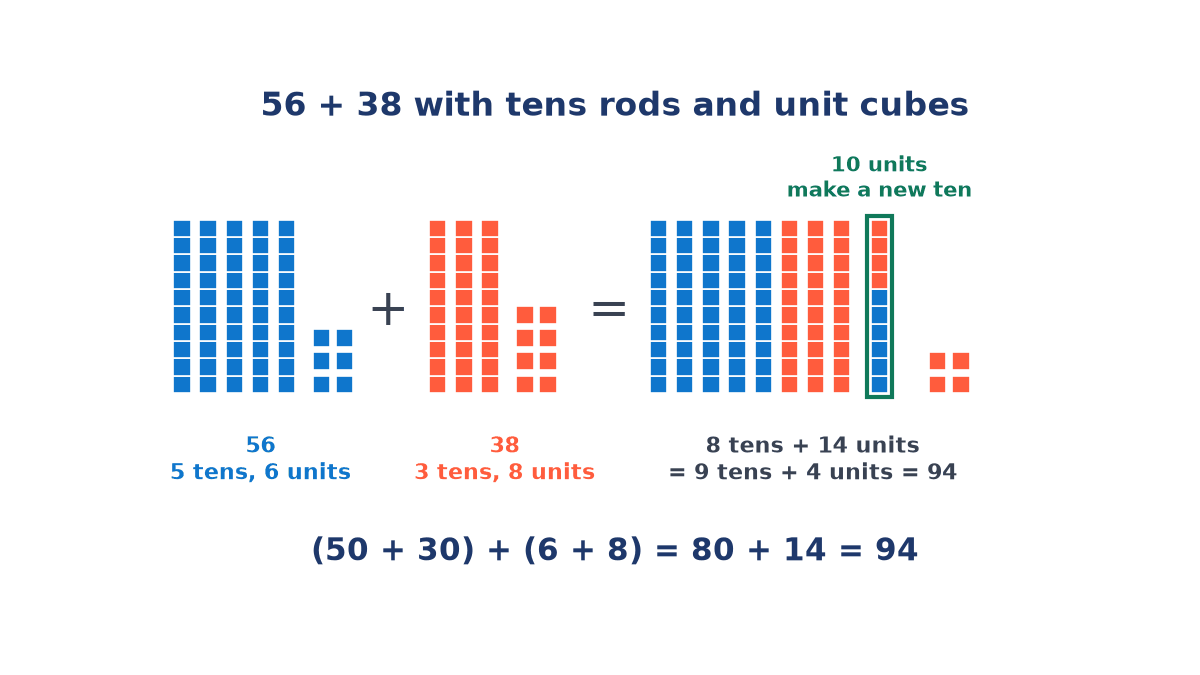
In the blocks picture there are 6 blue cubes and 8 orange cubes, 14 cubes in all. Ten of them are put together to make one more rod. That leaves 9 rods and 4 loose cubes, which is 94.
56 + 38
56 + 38, the other way
76 + 48
76 + 48, the other way
There is a third way for this one. Move some of the second number across to make the first a round ten:
76 + 48, the shortest way
Two were taken from the 76 and given to the 48. The total is unchanged, because nothing left the sum. It only moved from one number to the other.
Remember. In an addition you may move an amount from one number to the other. Move enough to make one of them round.
More worked examples
A small one: 24 + 15
The units, 4 and 5, make 9, which is less than ten, so nothing spills over.
The units make exactly ten: 46 + 54
Here , a whole new ten with no units left over.
Going past a hundred: 68 + 57
The same sum, the shortest way
Take 2 from the 57 and give it to the 68. That makes 70, a round number.
A story sum
Class 2A collected 38 newspapers for recycling and Class 2B collected 45. How many did they collect together?
Together they collected 83 newspapers. A quick check: 38 is nearly 40, and . The answer should be 2 less than that, and .
Doubling, again and again
Double a number, then double the answer, then double that. It grows quickly, and every step is a sum you can already do.
Notice how the columns are chains. In the first column, 11 doubles to 22, which doubles to 44, which doubles to 88. Each answer becomes the next question.
Counting on in twelves and beyond
The same ladders as before, built from two-digit steps. Read each column downwards.
Twelves, thirteens, fourteens and fifteens
Sixteens, seventeens, eighteens and nineteens
Each ladder goes up by the same step every time. Check one line of the fourteens: is . The units spilled over, so the tens went up by two.
Your turn
Use whichever way you like: tens and units apart, tens first, or moving an amount to make a round number.
| 1) | 7) | 13) |
| 2) | 8) | 14) |
| 3) | 9) | 15) |
| 4) | 10) | 16) |
| 5) | 11) | 17) |
| 6) | 12) | 18) |
Common mistakes
- Adding a ten as if it were a unit. In the 3 is 3 tens, so the answer is 94, not 67.
- Losing the new ten. In the units make 14. Writing only the 4 and forgetting the extra ten gives 84 instead of 94.
- Writing 14 inside the answer. is 94, not 8014. Add the 14 to the 80.
- Moving an amount one way only. When you take 2 from one number you must give the same 2 to the other number, or the total changes.
- Thinking a hundred ends the sum. Tens can go past 100: , just as 7 and 5 make 12.
Key terms
- Tens
- The left digit of a two-digit number. In 56 it is 5, worth fifty.
- Units
- The right digit, also called ones. In 56 it is 6.
- Place value
- What a digit is worth because of where it sits in the number.
- Spill over
- When the units add up to ten or more, ten of them become one new ten.
- Round number
- A number ending in 0, such as 50 or 120, which is easy to add on.
- Double
- A number added to itself, such as .