You already know the tables up to nine. Now picture a shop with boxes of eggs, packets of biscuits and trays of laddoos. To count five boxes or seven packets quickly, you need the tables from ten to twenty. The good news is that you can build each of them from things you already know: adding, tens, and the small tables.
The numbers are bigger, but nothing new has to be learned. A two-digit number splits into tens and units, as in , and the multiplication splits the same way.
13, five times over
Five tens are fifty, and five threes are fifteen, which you know from the three times table. So the only difficult part of the thirteen times table is a table you learned two lessons ago.
Remember. Split the two-digit number. Ten of anything is easy, and the units are a small table you already know.
See it as rows of counters
Put out five rows of counters with counters in each row. That is . Now colour the first ten counters of every row blue and the last three orange.
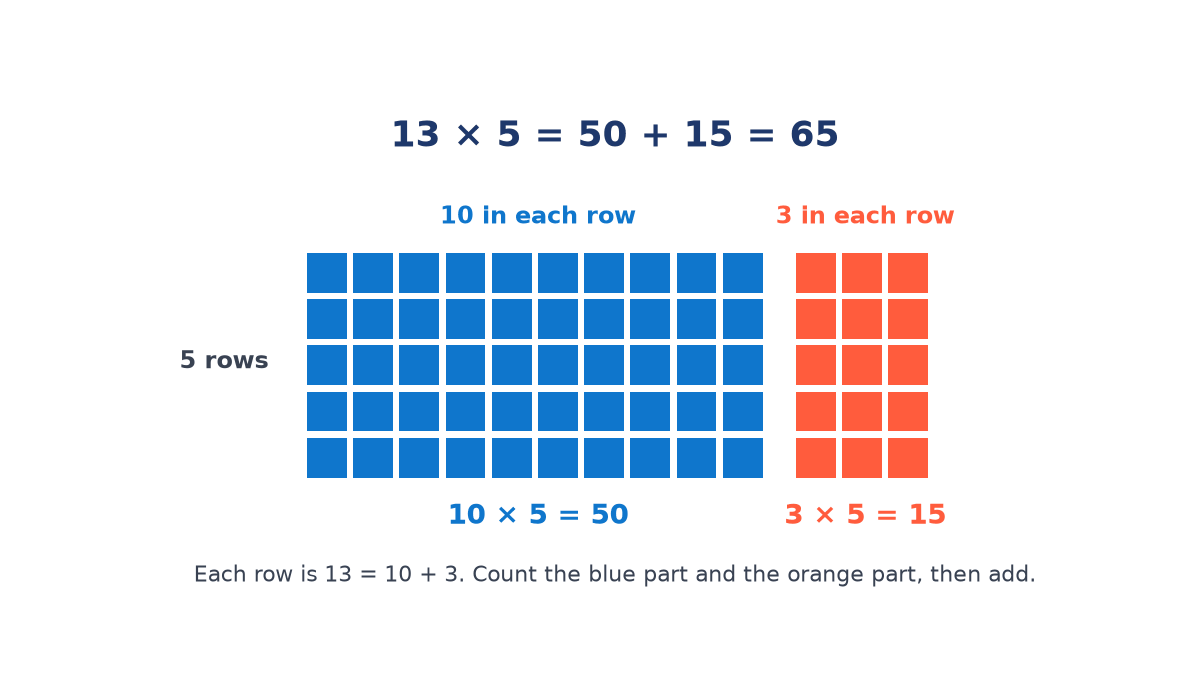
Count the blue counters: five rows of ten is fifty. Count the orange counters: five rows of three is fifteen. Put them together and you have sixty-five. You did not have to count all sixty-five one by one.
Every one of these tables works in the same way. The number splits into ten and a small part. The ten part is easy. The small part is a table you learned before. Then you add the two parts.
The ten times table
Start with the easiest of all. Ten of anything is the number with a zero after it.
| Times fact | Adding it up |
|---|---|
The eleven times table
Eleven is ten and one, so each answer is a lot of tens with the same number of ones alongside.
| Times fact | Adding it up | Tens and units |
|---|---|---|
Look down the answers of the eleven times table up to . The tens digit and the units digit are always the same: , , and so on. That pattern is a quick check. It stops at , where the ten tens make a hundred.
From the twelve times table onwards, the units part can grow past ten. Look at . The units part is , which is more than ten. So you add , and the answer is . The tables below show every such step in the third column.
The twelve times table
| Times fact | Adding it up | Tens and units |
|---|---|---|
The thirteen times table
| Times fact | Adding it up | Tens and units |
|---|---|---|
The fourteen times table
| Times fact | Adding it up | Tens and units |
|---|---|---|
The fifteen times table
| Times fact | Adding it up | Tens and units |
|---|---|---|
The sixteen times table
| Times fact | Adding it up | Tens and units |
|---|---|---|
The seventeen times table
| Times fact | Adding it up | Tens and units |
|---|---|---|
Here is the seventeen times table drawn as a rectangle. The long side is , split into and . The short side is .
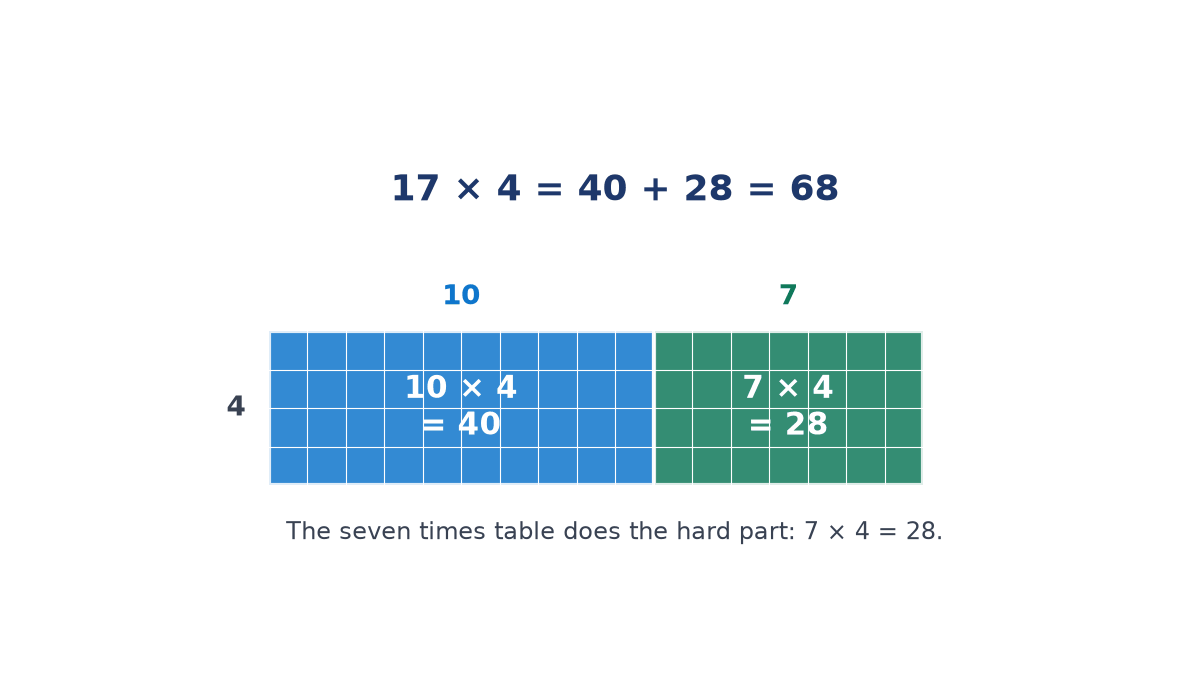
17 times 8
Eight tens are eighty. Eight sevens are fifty-six. Eighty and fifty-six make one hundred and thirty-six.
The eighteen times table
| Times fact | Adding it up | Tens and units |
|---|---|---|
The nineteen times table
| Times fact | Adding it up | Tens and units |
|---|---|---|
The twenty times table
Twenty is two tens, so this is the two times table with a zero on the end.
| Times fact | Adding it up |
|---|---|
Two more ways to check
Split and add
14 times 6
Go up to twenty, then come back
Nineteen is one less than twenty. So nineteen lots of anything is twenty lots, take away one lot.
19 times 7
This matches in the nineteen times table. Two different roads, one answer: that is a good sign your answer is right.
Double a table you know
Sixteen is double eight. So sixteen lots of four is double eight lots of four.
Patterns to notice
- Every answer in the ten and twenty tables ends in .
- Every answer in the fifteen table ends in or .
- Answers in the twelve, fourteen, sixteen and eighteen tables are always even.
- Each answer in a table is the one above it plus the table number. In the thirteen table, .
How to practise
Take one table a day. First say it aloud while reading the table above. Then cover the answers and say it again, splitting each fact into its ten part and its small part. Last of all, ask a friend or someone at home to call out facts in a mixed-up order. When you can answer each one without counting, that table is yours, and you can move on to the next one tomorrow.
Your turn
Work each one out by splitting it, then check it against the table above.
| 1) | 5) | 9) |
| 2) | 6) | 10) |
| 3) | 7) | 11) |
| 4) | 8) | 12) |
Common mistakes
- Forgetting to add the ten part. is not ; the fifty from the tens must be added.
- Adding the units part wrongly when it goes past ten. In the parts are and , so the answer is , not .
- Mixing up the tables. Say the table name out loud before you start: "fourteen, six times".
- In the go-up-to-twenty shortcut, taking away the wrong amount. is , not .
Key terms
- Times table
- A list of a number multiplied by and on up to .
- Multiply
- Add the same number again and again. means five thirteens added together.
- Tens and units
- The two parts of a two-digit number. is one ten and three units.
- Split
- Break a number into easy parts, such as .
- Array
- Objects set out in equal rows, used to picture a multiplication.
- Double
- Multiply by two.