Think of prime numbers as the building blocks of all whole numbers, the way letters are the building blocks of words. Every composite number is built by multiplying primes together. Breaking a number back into its primes is called prime factorisation. You will use it to find the H.C.F and L.C.M, to simplify fractions, and later to work with square roots and algebra.
You know how to list the factors of a number. You know which numbers are prime. Now we join the two ideas. Every composite number can be taken apart into primes, and here is the lovely part: there is only one way to do it.
Look at . Its factors are and . Only two of them are prime: and . So if you keep splitting until nothing will split any more, s and s are what you are left holding. All the other factors are composite, except . And is neither prime nor composite.
What prime factorisation means
Two words are needed first. Every number divides by . Every number divides by itself as well. A number is composite when some other number divides it too. Take . It divides by , and is neither nor . So is composite.
The other word is product. A product is what you get when you multiply numbers together. So is a product. It is the product of three s and one .
Take any composite number . You can write it as a product of prime factors. There is one and only one way to do it. That product is called the prime factorisation of . To factorise a number means to take it apart like this.
That rule promises two things. The first is that you can always finish. This part is easy to see.
Start with a composite number. Some smaller factor divides it. Take that factor out. What comes away is prime or composite. If it is prime, that piece is done. If it is composite, it splits again.
Every split leaves smaller numbers than before. Every piece is a whole number, and no piece is smaller than . So the pieces cannot keep getting smaller for ever. Below there is nowhere left to go. The splitting has to stop, and it can only stop when every piece is prime.
The second promise is that you always finish with the same primes. That one is shown further down, once has been taken apart.
Taking 24 apart
Divide by the smallest prime that goes into the number. Then divide the answer the same way. Keep going until you reach .
Prime factorisation of 24
is even, so divides it. The it leaves is even too. So is the after that. That brings you to . And is prime. Nothing but itself will divide it.
The last division gives . That is where you stop. You divided by and along the way. Those are the prime factors.
The at the bottom is never written among the factors. Multiplying by changes nothing. And is neither prime nor composite.
Only one answer
The rule promises there is only one answer. can show you what that means. You can break it open at . Or you can break it open at . Keep going either way. See where you end up.
24 broken open two ways
One route began at . The other began at . Both finished with three s and one . The ladder above gave that same answer. Say two people factorise the same number. If they end with different primes, one of them has slipped.
Drawing it as a factor tree
A factor tree is a picture of the same splitting. Write the number at the top. Draw two branches down to any two factors whose product is that number. Any branch that ends in a prime stops there; ring it. Any branch that ends in a composite number splits again.
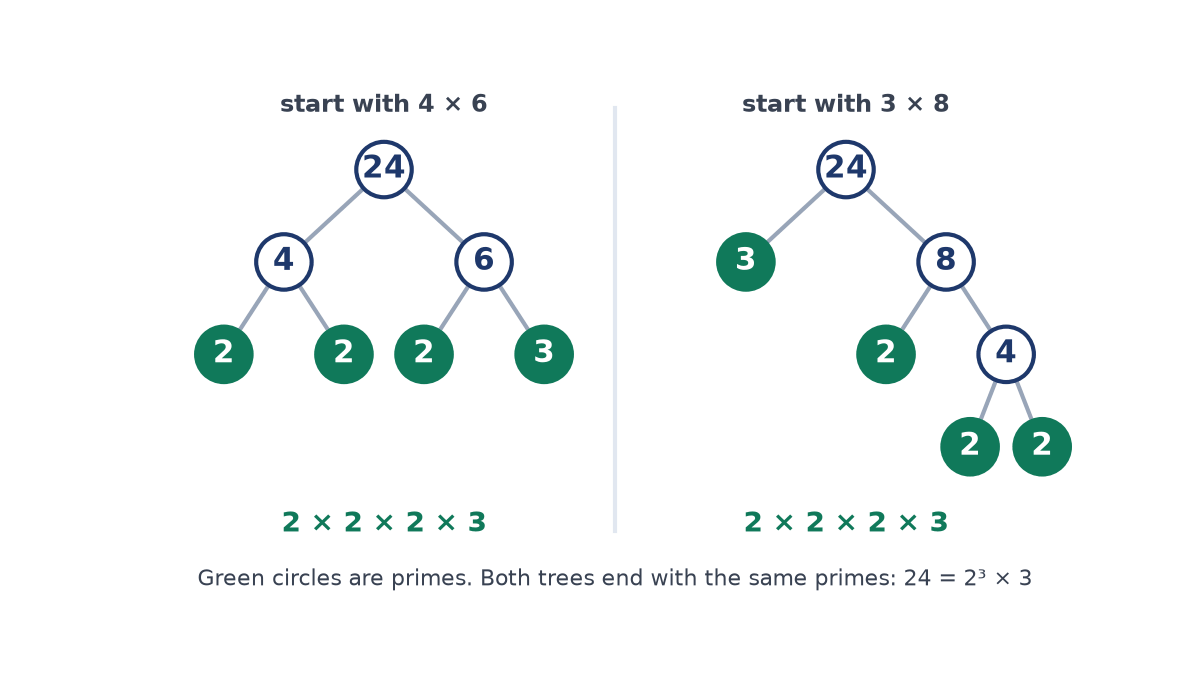
The two trees have different shapes, but the green circles at the ends hold exactly the same primes. That is the promise of one and only one way, seen in a picture.
Remember. A composite number can be written as a product of prime factors. There is one and only one way to do it.
Standard form
Three s multiplied together give . You write that as . The base says what is being multiplied. The small raised number is the index. It counts how many times the base was used.
A power written in this short way, like , is called the exponential form. You met powers and the exponential form in Letters that stand for numbers. That short way of writing is all you need here.
Start with a number you have taken apart. You found . Count the three s with an index. That gives . There is a prime, and above it a count. Then another prime, and its count. That is all standard form is.
Now write the rule out for any number at all. The counting numbers are the natural numbers. Take a natural number bigger than .
The rule has to fit every number, so it uses letters in place of the primes. The small numbers below the letters count nothing. They are only labels. means the first prime. means the second. And stands for how many different primes the number has.
The small numbers above the letters are the indices. Those ones do count. Dots in the middle mean the list carries on in the same way.
One word in the rule needs care. It is distinct. It means each prime is written down once only. Say a prime turns up three times. You do not write it three times. You write it once, with an index of . A prime that does not divide the number is left out.
Now here is the rule itself. The standard form of is . The letters are distinct primes. The letters are natural numbers. Each one is at least .
Standard form of 54
ends in , so it is even. That means divides it. It leaves , which is odd. So is finished with.
The digits of add to . And goes into that total. So goes into as well. That is the next prime to divide by. It goes in three times.
Standard form of 54
An index of tells you nothing new. So it is not usually written. The standard form is left as .
When a prime is missing: 100
Not every prime turns up in every number. is even, and so is the it leaves. So two s come out. That leaves .
It is odd, so is done. Its digits add to . And does not go into that total. So no will come out of . But ends in . So divides it.
Standard form of 100
There is no in . There is no either. Those primes are just missing. A missing prime is not written down. Standard form records the primes a number is made of. It records nothing else.
Remember. In standard form each prime is written once. An index says how many times it was used.
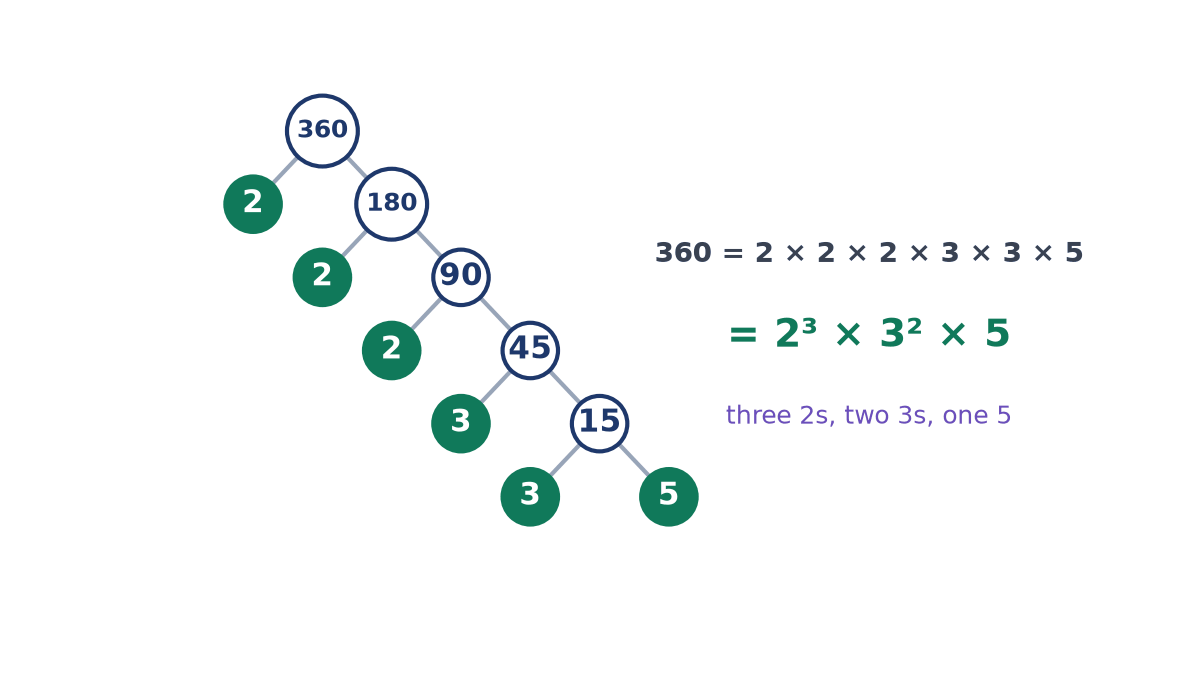
A bigger number: 360
Larger numbers take more steps, but the method is exactly the same. Keep dividing by while you can, then by , then by , and so on.
Standard form of 360
One with a larger prime: 84
After you are left with . Neither , nor divides it, and is prime, so it divides itself and you reach .
When to stop trying primes
Suppose what is left is a number like . Try in turn. None divides it. The next prime is , and is already bigger than . If had a factor bigger than , the other factor in the pair would be smaller than , and you have tried all of those. So is prime. Once a prime multiplied by itself passes the number, you can stop.
Why one and only one way matters
A number's prime factorisation is a name that belongs to it alone. is and can be nothing else. And is and can be nothing else.
Look at and . They are built from the very same two primes. What tells them apart is the indices. Change how many times each prime is used. You get a different number.
Now set the two lists side by side. You have and . At a glance you can see what they share. Both have a and a . You can see what they do not share too.
That works because each number has one list and no other. Later on, this is how numbers get compared. H.C.F is short for highest common factor. L.C.M is short for least common multiple. Both come in later lessons. The academy calls this way of finding them the 2nd method (Prime factorization method).
Remember. Each number has one list of primes and no other. So the list can stand in for the number itself.
The three numbers we keep coming back to
| Number | As a product of primes | Standard form |
|---|---|---|
The middle column writes every prime out in full. Each prime is there as many times as the number needs. The right-hand column says the same thing more shortly. An index counts the repeats.
Quick tests that save time
- divides a number that ends in or .
- divides a number whose digits add to a multiple of . For , .
- divides a number that ends in or .
- For , and larger primes, just try the division.
Your turn
Write each number as a product of primes
| 1) | 5) | 9) | 13) |
| 2) | 6) | 10) | 14) |
| 3) | 7) | 11) | 15) |
| 4) | 8) | 12) | 16) |
Write each of these in standard form
| 1) | 3) | 5) | 7) | 9) |
| 2) | 4) | 6) | 8) | 10) |
Check every answer by multiplying your primes back together. You should get the number you started with. If you do not, divide again one prime at a time. The mistake will show itself.
Common mistakes
- Stopping at a composite factor. is not finished, because is not prime.
- Writing as a prime factor. is neither prime nor composite.
- Getting the index wrong. is , not .
- Writing the same prime twice in standard form, as in . Combine it: .
- Not checking. Multiply the primes back together and make sure you get the number you started with.
Key terms
- Prime number
- A number greater than whose only factors are and itself, such as .
- Composite number
- A number greater than that has some factor other than and itself.
- Product
- The answer when numbers are multiplied together.
- Prime factorisation
- Writing a number as a product of primes, in one and only one way.
- Factor tree
- A branching picture that splits a number into factors until every branch ends in a prime.
- Index
- The small raised number that counts how many times the base is multiplied, as the in .
- Standard form
- A prime factorisation written with each distinct prime once and an index, as in .