Every time you share sweets equally, pack eggs into trays or count in twos and fives, you are using multiples and factors. They are two of the most useful words in the whole of arithmetic. Later you will need them to add fractions, to simplify fractions, and to find the HCF and LCM of numbers. So we will build both ideas slowly from the times tables you know, and you will not have to take anything on trust.
You know that . Now read that one fact in two ways. Read it one way, and it says is a multiple of . Read it the other way, and it says is a factor of . The two words describe the same link between two numbers. You are just looking at it from the other end.
Everything below rests on the times tables you have already learned. If a times fact escapes you, do not guess. Go back to the one before it. Then add the number on once more.
Multiples
Multiply a number by . Then by . Then by . Keep going, on and on. The answers you get are the multiples of that number.
Here is the same thing in the academy's own words. It uses one word you may not know yet. That word is product. A product is what a multiplication gives you. So is the product of and .
The products obtained when a number is multiplied by are called the multiples of that number.
That is the rule you have just read, in the academy's words. You multiply the number by , then by , then by . The answers you get are its multiples.
So you never have to hunt for multiples. You build them. Multiply the number by , then by , then by . Go on for as long as you please.
You are multiplying by each counting number in turn. That is the name for and the rest of the numbers you count with. Here are the first five multiples of . Next to them are the first five of .
Those answers are usually written short. They go in a list. An equals sign stands in for the word are. This short way of writing is used all through the course.
The short way looks like this: multiples of
It means the multiples of are and on without end.
The same short way gives multiples of
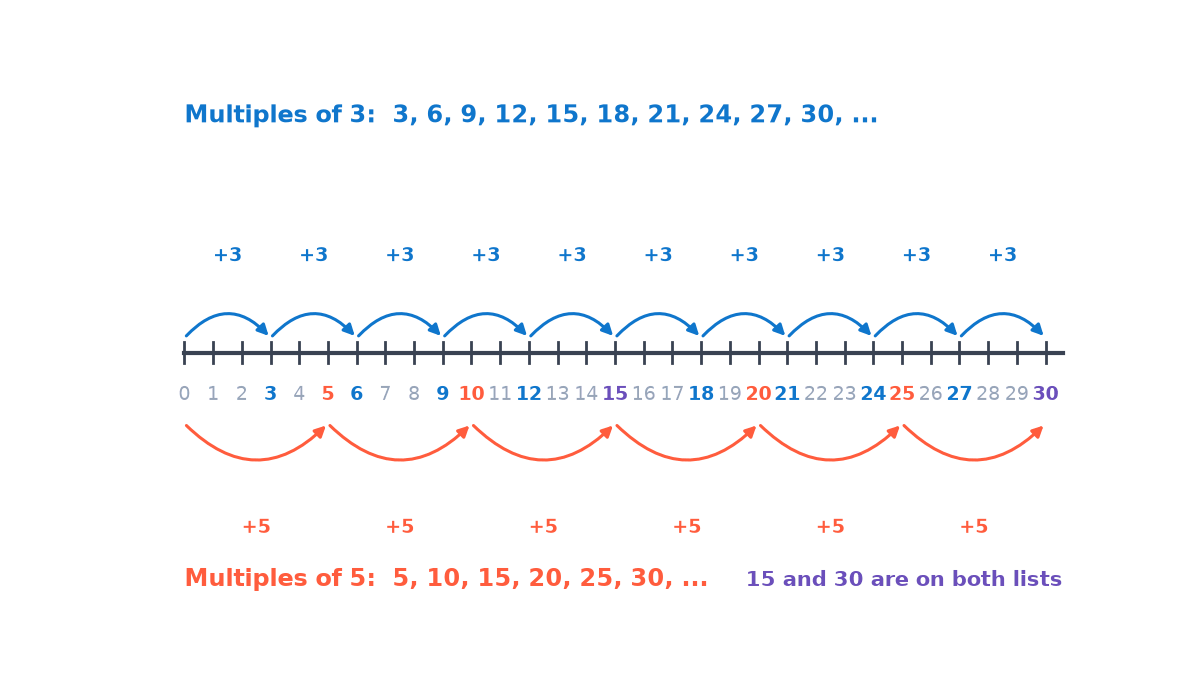
Look down either column of the grid. Each multiple is one whole step bigger than the one above it. On the left it goes up by three each time. On the right it goes up by five. That is not chance.
Multiplying is repeated adding. So you get from the fourth multiple to the fifth by adding the number on once more.
This is why a list of multiples has no end. There is no last counting number to multiply by. So there can be no last multiple. You can always add the number on one more time. The dots at the end of every such list say just that.
Remember. A multiple of a number is what you get when you multiply it by a counting number. A counting number is one of and onwards. Every number is a multiple of itself. Why? Multiplying by changes nothing.
Worked example: building multiples of 7
Suppose you want the first six multiples of . Start with one lot of seven. Then keep adding seven more.
So multiples of Each line used only the line before it. You never needed a fact you did not already have.
Worked example: is a number a multiple?
Is a multiple of ? Ask whether some counting number times gives . Count up in sixes: . You reach on the seventh step, so . Yes, is a multiple of .
Is a multiple of ? Count on: . The count jumps from straight past to . It never lands on , so is not a multiple of .
Multiples written out
Read a row across as answers. Then you are reading a times table. Read the same row as a list. Then you are reading multiples. They are the same numbers wearing a different name.
| Number | Its multiples |
|---|---|
The dots at the end of each row are doing real work. Either row could have been carried on for ever. A row stops only where there was room to stop.
Longer lists of the same kind are written out in Least Common Multiple. There you will find them for , for and for . They are needed there to find the smallest multiple that two or three numbers share.
Factors
A factor of a number is a number that divides into it exactly. Nothing at all is left over.
What is left over after you divide has a name. It is called the remainder. If the divide comes out exactly, there is no remainder at all.
Now here is the academy's own wording. In it, "the given number" means the number you started with.
The numbers which divide the given number without remainder are the factors of the given number.
A factor is also called a divisor. The two words mean exactly the same thing. You will meet both.
There is one more word to have ready. Sometimes one number divides another exactly. Then we say the second is divisible by the first. So is divisible by . And is not divisible by .
"Without remainder" is the whole test. Divide, and look at what is left. If nothing at all is left over, the number you divided by is a factor. If something is left over, it is not. Being close does not count.
Take . There is a slow but certain way to find its factors. Try dividing it by every number from up to . Then keep the ones that come out exactly.
| Try dividing | What is left over | A factor? |
|---|---|---|
| nothing | yes | |
| nothing | yes | |
| nothing | yes | |
| over | no | |
| over | no | |
| nothing | yes |
Only and left anything over. The other four divided exactly. So factors of .
The same test on takes twelve lines. It asks exactly the same question twelve times.
| Try dividing | What is left over | A factor? |
|---|---|---|
| nothing | yes | |
| nothing | yes | |
| nothing | yes | |
| nothing | yes | |
| over | no | |
| nothing | yes | |
| over | no | |
| over | no | |
| over | no | |
| over | no | |
| over | no | |
| nothing | yes |
Six of the twelve divisions came out exactly. Those six divisors are the factors. So factors of .
Remember. A factor divides its number exactly. If anything at all is left over, it is not a factor.
Writing all the factors, in pairs
Later in the course you will meet a method with a long name: 1st method (By writing all factors). The name says what you do first. You write down all the factors.
That is the part to take care over. You must write down every factor. It is easy to miss one.
Look again at the divisions above that came out exactly. Take . It says that divides with nothing over. So is a factor.
But it says a second thing at the same time. It says is two lots of . So divides as well. One division has named two factors.
That is what the pairing method uses. Test the numbers in order: , then , then , and on. Every time one of them divides exactly, write down its partner beside it. The partner is what the multiplication gives. , so and both go on the list.
Factors of , in pairs
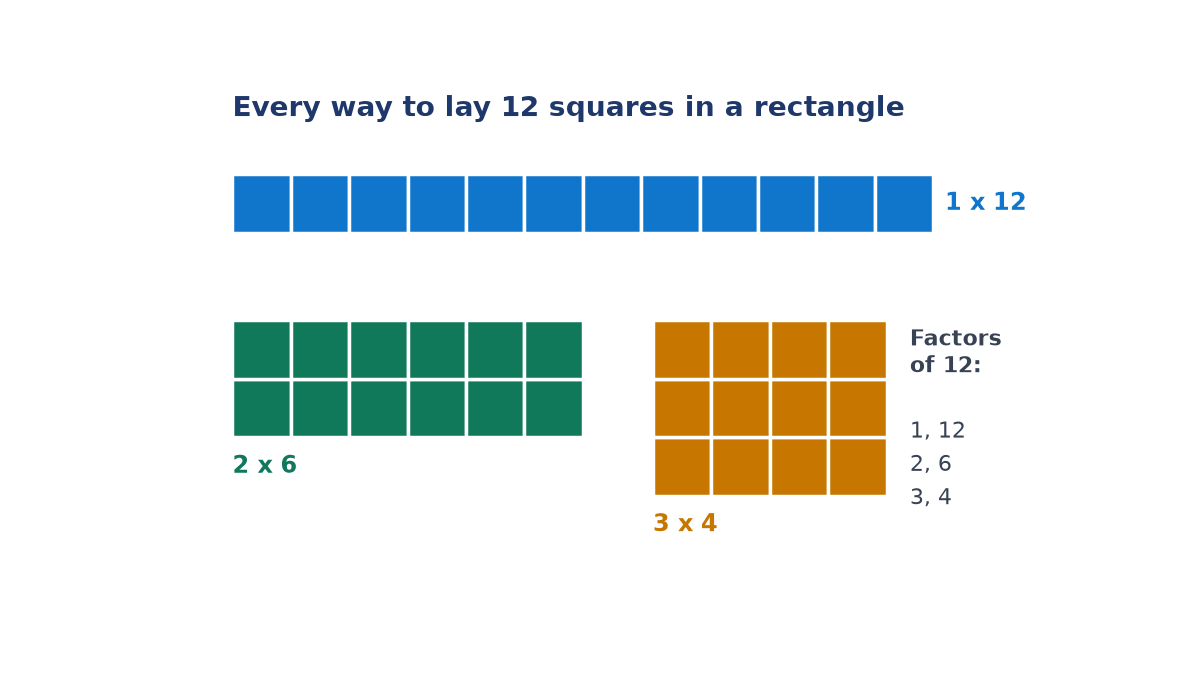
The next number to try is . But is already written down as the partner of . The two sides have met in the middle. That is the signal to stop.
Anything bigger than went on the list long ago. It went on the moment its partner was found. Read the left column down, then the right column back up. You get factors of . Those are the same six the twelve-line table found, in three lines.
Remember. To write down every factor, test , , and on in turn. Put each divisor on the list beside its partner. So puts both and there. Stop when the number you are about to try is already there as a partner. The two sides have met. There is nothing left to find.
Three longer lists
Both ways of working will do any number you like. You can divide by every number in turn. Or you can pair. Here are three lists worth having. Each one is set out as the divisions that prove it.
Read each table straight down. The question is on the left. What it comes to is on the right. Every division in them comes out exactly, with nothing left over. That is what puts each divisor on the list.
Factors of
Eight numbers divide exactly. is not one of them. Five goes into four times and leaves over. So is not divisible by . Nor is , which leaves over. Nor are , or .
| Question | Answer |
|---|---|
So factors of .
Factors of
has nine factors. Again is not among them. is not divisible by . Five sevens are , and one is left over. Notice that is written once, although . Here is its own partner. You still put it down one time only. A factor never goes on the list twice.
| Question | Answer |
|---|---|
So factors of .
Factors of
has twelve factors. That is more than either number above. is not among them. Neither are , , and . Each of those leaves something over.
A list this long is worth building in pairs. Do not trust it to memory. Test , , and on. Write each divisor beside its partner.
Factors of , in pairs
None of , , , and divides exactly. So none of them brought a partner. The next number to try after is . But is already on the list, as the partner of . The two sides have met. So the list is complete.
The pairing settles as well. is an easy number to write down by mistake. It is nobody's partner here. Twenty-six goes three times into and leaves over. But is the partner of , because exactly.
| Question | Answer |
|---|---|
So factors of .
Notice the two columns. The questions run forwards down the first. The answers run backwards up the second. That is the pairing, printed as divisions. and are one fact. So each line puts one factor near the top of the list. Its partner goes near the bottom.
Factor lists at a glance
Here are seven numbers with their factors. Read a row across. First comes the number. Then comes every number that divides it exactly, smallest first. Then comes how many there are. The lists for and are short enough to check in your head. The rest were worked out above.
| Number | Its factors | How many |
|---|---|---|
| three | ||
| four | ||
| four | ||
| six | ||
| eight | ||
| nine | ||
| twelve |
Every list begins at . Every list ends at the number itself. Nothing outside those two ends appears anywhere. A bigger number does not always have more factors. Look at and . is the bigger number, but each of them has four factors.
Worked example: every factor of 48
Test , , and on. Write each divisor beside its partner.
leaves over, so it brings no partner. leaves over, so it brings none either. The next number to try is , and is already on the list as the partner of . The two sides have met. Read down the left column and back up the right: factors of . That is ten factors.
Worked example: a number with only two factors
Try the same method on . , so and go on the list. Now test and . Each one leaves something over: for the twos and for the threes. The next number to try is , but is already past . Any partner of or of a bigger number would have to be smaller than , and those have all been tested. So no new pair can appear. Factors of . A number like this, with exactly two factors, is called a prime number. You will meet primes properly in a later lesson.
Two factors every number has
Every counting number divides by exactly. You get one lot of the number, and nothing over. Every counting number divides by itself exactly too. You get one of itself, and nothing over.
So and the number itself are factors of every number. They are the smallest and the largest it has. That is why every factor list above begins at and ends at the number.
So no factor can be bigger than the number it belongs to. Take . It is not divisible by . Seven will not go into six even once. So cannot be a factor of .
Multiples run the opposite way. No multiple of is smaller than . The smallest one is itself.
Remember. is a factor of every number. Every number is a factor of itself. A factor list always starts at and ends at the number.
The same fact, read two ways
. Because that is true, all of these say one and the same thing. is a factor of . is a factor of . is a multiple of . is a multiple of . Dividing by either of them leaves nothing over. Whenever you can say one, you can say the others.
| This sentence | Says the same as |
|---|---|
| is a factor of | is a multiple of |
| is a factor of | is a multiple of |
| is a factor of | is a multiple of |
| is a factor of | is a multiple of |
| is a factor of | is a multiple of |
| is a factor of | is a multiple of |
There is one big difference between the two words. It is worth keeping in mind. A number has only so many factors. You can write every one of them down. Its multiples never run out. You can never write them all down. has six factors, and no last multiple at all.
Remember. A number has only so many factors. You can write every one of them down. None is bigger than the number itself. Its multiples never run out. None of them is smaller than the number itself.
Your turn
Write the first five multiples of each
| 1) | 5) | 9) |
| 2) | 6) | 10) |
| 3) | 7) | 11) |
| 4) | 8) | 12) |
Find every factor of each
| 1) | 5) | 9) |
| 2) | 6) | 10) |
| 3) | 7) | 11) |
| 4) | 8) | 12) |
True or false, and say how you know
- is a factor of .
- is a multiple of .
- is a factor of .
- is a factor of .
- is a multiple of .
- is a factor of .
- is a factor of .
- is a multiple of .
- is a factor of .
- has more factors than .
Common mistakes
- Mixing up the two words. A factor goes into a number; a multiple comes out of multiplying it. is a factor of , and is a multiple of , never the other way round.
- Forgetting or the number itself when listing factors. Every factor list starts at and ends at the number.
- Missing a factor from the middle of a list. Work in pairs, and stop only when the two sides meet.
- Writing a square factor twice. In , the factor is its own partner and goes on the list once.
- Starting a list of multiples at . The first multiple is the number times , which is the number itself.
- Thinking a bigger number must have more factors. and each have four.
Key terms
- Product
- The answer you get when you multiply numbers together.
- Counting number
- One of and onwards.
- Multiple
- A product of a number and a counting number, such as .
- Factor (divisor)
- A number that divides a given number with no remainder.
- Remainder
- What is left over after a division.
- Divisible
- A number is divisible by another when the division leaves no remainder.
- Factor pair
- Two factors that multiply to give the number, such as and for .
- Prime number
- A number with exactly two factors, and itself.
Answers
Write the first five multiples of each
Find every factor of each
True or false, and say how you know
- True. with nothing left over.
- True. ; this says the same as question 1.
- False. leaves over.
- True. is a factor of every number.
- True. ; every number is a multiple of itself.
- True. with nothing left over.
- False. leaves over.
- True. .
- False. is bigger than , and no factor is bigger than its number. (It is the other way: is a factor of .)
- True. has twelve factors and has nine.