Suppose you have sweets to share equally among some children, or chairs to set out in equal rows. Before doing any long division, it helps to know whether the sharing will come out exact. Divisibility rules answer that question in a few seconds, just by looking at the digits.
You will use these rules again and again: when you find factors, when you simplify fractions, when you find the H.C.F. and L.C.M. of numbers, and when you check your own multiplication. They are worth knowing well, and worth understanding, because a rule you understand is a rule you will not mix up.
One number divides another when it goes in exactly. Nothing is left over.
Take and . divides , because with no remainder. Now take . does not divide . Here is , with left over.
When one number divides another exactly, we say the second is divisible by the first.
You know this idea by another name. The numbers that divide a number exactly are its factors. Multiples and factors sets them out in full.
You could test any number by dividing it. Then you look at what is left over. But for , , and you do not have to. Each one has a rule of its own. The rule reads the answer off the digits. It takes a moment.
Below are the four rules, written the way the academy states them, and with each one you will also see why it is true.
The rules are for natural numbers. Those are the counting numbers and on and on. You use them to count things.
Where the rules come from
Every number is built out of place value. That means each digit has a place of its own. The place tells you what the digit is worth.
Look at . The sits in the hundreds place. It means four hundreds. The sits in the tens place. It means five tens. The means two units. So .
Now look at what a ten is made of. A ten is . So any whole number of tens is divisible by . It is divisible by too.
Now look at a hundred. A hundred is . So any whole number of hundreds is divisible by .
All that dividing is done before you even look at the number. Only the part left behind can decide the answer. That part is the last digit. Or it is the last two digits. The rule for works in another way. Its own part of the lesson shows how.
Divisibility Rule for 2
A natural number is divisible by if the digit at the unit place of the number is either or or or or .
That is the rule. Here is how you use it. Look at the digit at the unit place. Is it or or or or ? Then the number is divisible by .
The unit place is the last digit. It is the one on the right. Split the number there. Then you can see why one digit is enough.
is and . The is forty-five tens. Every ten is . So can be halved exactly. The count of tens makes no difference. That leaves only the at the end. And halves cleanly into .
You can also see this with objects. Put buttons into pairs. The bags of ten pair off perfectly, five pairs to a bag. Only the loose buttons are left to check, and they make one more pair.
Is 452 divisible by 2?
splits the same way. It splits into and . The is ninety-five tens. It gives no trouble at all. But is with still over. So the whole number leaves a remainder of . That is why is not divisible by .
Is 953 divisible by 2?
This is the same thing as even and odd. An even number leaves when you divide by . An odd number leaves . Natural numbers, whole numbers, even and odd sets that out.
So this rule takes the even numbers. It turns down the odd ones. is even. is odd. The unit digit told you so. You did no dividing at all.
Remember. For , only the unit digit matters. Everything above it is a whole number of tens. And every ten is already even.
Divisibility Rule for 3
A natural number is divisible by if the sum of all its digits is divisible by .
Here is how you use it. Add up all the digits. Is that sum divisible by ? Then the number is divisible by too.
This rule looks odder than the others. Here is why. Ten does not divide by exactly. It leaves over.
But look at ten again. Ten is one more than . A hundred is one more than . A thousand is one more than . And , and all divide by exactly.
So a hundred splits into two parts. One part is , which divides by . The other part is the left over.
A ten splits in the same way. One part is , which divides by . The other part is again. A unit is just .
Now make two heaps. Put every piece that divides by into the first heap. Put every leftover into the second heap.
The second heap holds one for each hundred. It holds one for each ten. It holds one for each unit. So the second heap is the sum of the digits. The number divides by when that heap does. It does not when the heap does not.
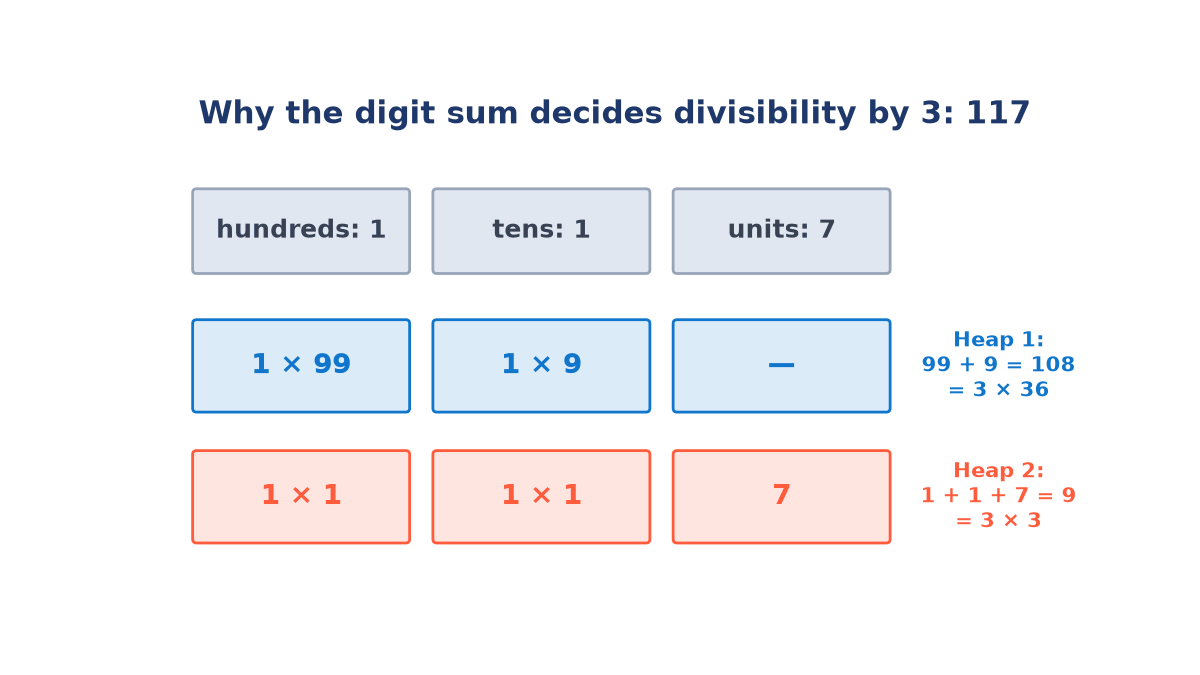
Is 117 divisible by 3?
The is the first heap. It holds the from the hundred. It holds the from the ten. And is .
The is the second heap. That is the digit sum . And it is . Both heaps divide by . So is divisible by .
fails this test. It fails by just as much as its digit sum does. The digits add to . That is with over. The number itself is with the same over.
The digit sum of 7874
And 7874 itself
A bigger one: is 4782 divisible by 3?
Add the digits. If the sum is still large, you may add its digits again.
The digit sum is , so is divisible by . Dividing confirms it: .
There is a shortcut while you add. Any digit that is , , or already divides by , so you may leave it out of the sum. In every digit, , , and , can be dropped, so nothing is left over at all. So is divisible by , and indeed .
Remember. For , add the digits. A number and its digit sum leave the same remainder. That is the remainder you get when you divide by . So if one of them is divisible by , the other must be too.
Divisibility Rule for 4
A natural number is divisible by if the last two digits of the number, all together, are divisible by .
Here is how you use it. Take the last two digits, all together. Are they divisible by ? Then the number is divisible by .
A hundred is . So a whole number of hundreds always divides by . Cut the number after the hundreds. Everything you cut off has passed the test already. Only the last two digits are left to check.
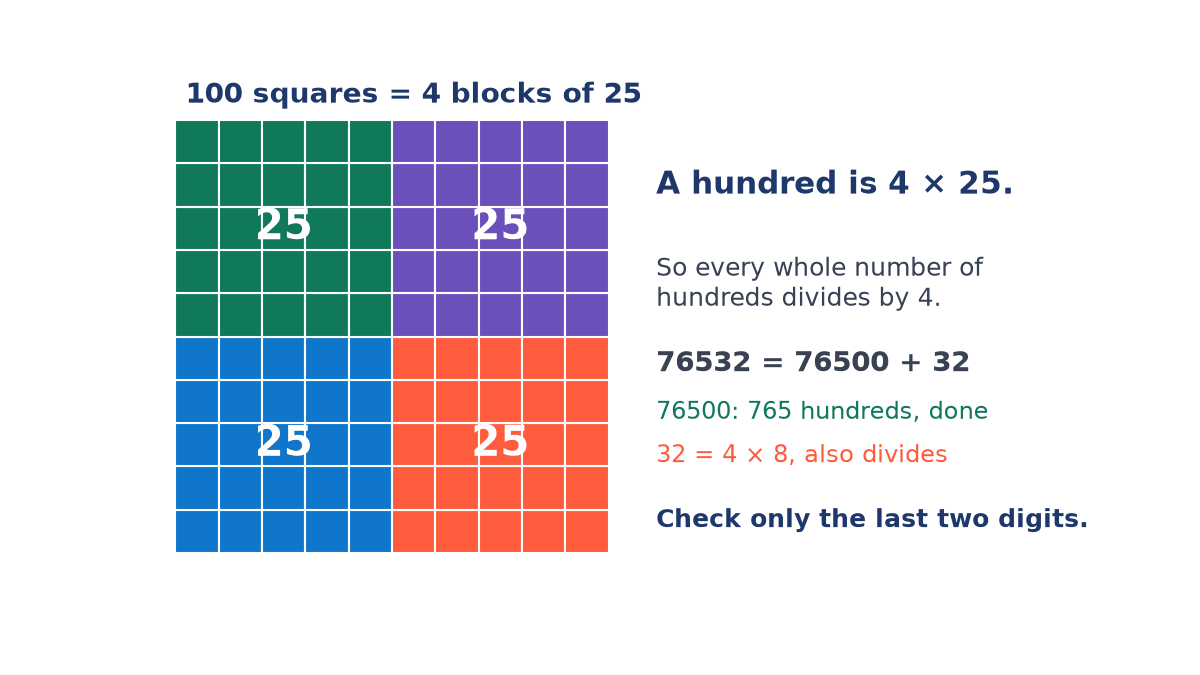
Is 76532 divisible by 4?
Start with the . Count it in hundreds. There are seven hundred and sixty-five of them. Every hundred is . So this part divides by .
Now take the last two digits. They are . That is . Both parts divide by . So the whole number does too: .
Is 126 divisible by 4?
The hundred is no trouble. But is with over. So is with the same over.
Now look at again. It ends in . So it passes the test for . But passing for does not settle the question for .
Two more to try: 3500 and 7318
ends in . The number made by the last two digits is , and divides by (it is ). So is divisible by : .
ends in , and . So leaves the same remainder, : .
If the last two digits are hard to judge, halve them twice. halves to , and halves to . Both halvings worked, so divides by . But halves to , and is odd, so does not.
Remember. For , cover everything but the last two digits. What you covered is a whole number of hundreds. And every hundred is .
Divisibility Rule for 5
A natural number is divisible by if the digit at the unit place of the number is either or .
Here is how you use it. Look at the digit at the unit place again. Is it or ? Then the number is divisible by .
The reason is the one that gave you the rule for . Read it the other way round. A ten is . So any whole number of tens divides by exactly.
Only the unit digit is left to check. There are ten digits it could be. Out of those ten, only and divide by with no remainder.
Is 5785 divisible by 5?
Is 6021 divisible by 5?
Count in tens. There are six hundred and two of them. So divides by exactly. But the on the end does not. That one unit is the whole remainder.
Think of coins. Only ₹5 coins and ₹10 notes are allowed. Any amount you can pay exactly with them ends in or . An amount like ₹6021 cannot be paid exactly: one rupee is always left over.
Remember. Two and five are partners, because . That is why both rules look only at the unit digit.
The four rules side by side
Here are the four rules together. The reason for each one sits beside it. You have met all these reasons already. The table is only a place to look them up.
| Divisible by | What to look at | Why that is enough |
|---|---|---|
| the unit digit — or | a ten is . So every ten is already even. Only the unit digit is left to check. | |
| the sum of all the digits | a ten is . The divides by . Only the is left over. One from each place adds up to the digit sum. | |
| the number made by the last two digits | a hundred is . So every hundred divides by already. Only the last two digits are left to check. | |
| the unit digit — or | a ten is . So every ten divides by already. Only the unit digit is left to check. |
Passing one rule does not settle the next one. Take . It ends in , so it is divisible by . But its digits add to , so it is not divisible by .
Now take . Its digits add to , so it is divisible by . But it ends in , so it is not divisible by .
One link does run between two of them. Say a number divides by . Then you can split it into fours. Each four is two twos. So you can split the number into twos as well. That means it divides by . Anything the rule for takes, the rule for takes too.
Look at . It is divisible by , as its last digit shows. The link does not run backwards. is divisible by . It still fails the test for .
Check the rules by dividing
A rule is worth nothing if the division does not agree with it. Here are the four numbers that passed. Each one is divided out in full.
| Question | Answer | Question | Answer |
|---|---|---|---|
Every one is exact. Nothing is left over anywhere. Now do the same with the four that failed. Try by , by , by and by . You will find something left over each time.
Your turn
Which of these are divisible by 2?
| 1) | 3) | 5) |
| 2) | 4) | 6) |
Which of these are divisible by 3? Write down the digit sum you used.
| 1) | 3) | 5) |
| 2) | 4) | 6) |
Which of these are divisible by 4? Write down the last two digits you used.
| 1) | 3) | 5) |
| 2) | 4) | 6) |
Which of these are divisible by 5?
| 1) | 3) | 5) |
| 2) | 4) | 6) |
Test each of these against all four rules. Write down which of 2, 3, 4 and 5 divide it
Common mistakes
- Using the last digit for 3. ends in but is not divisible by ; its digit sum is . The rule for always uses all the digits.
- Using only the last digit for 4. ends in , which is even, but does not divide by . You need the last two digits together.
- Adding the last two digits for 4. For you test the number , not .
- Thinking the link runs backwards. Every number divisible by is divisible by , but not every even number is divisible by .
- Forgetting 0 as a unit digit. and end in , so they are divisible by both and .
Key terms
- Divides
- Goes into a number exactly, with nothing left over.
- Divisible
- Able to be divided exactly by a given number: is divisible by .
- Remainder
- What is left over after dividing as far as possible.
- Factor
- A number that divides another exactly. is a factor of .
- Unit digit
- The last digit of a number, in the units (ones) place.
- Digit sum
- The total of all the digits of a number. The digit sum of is .
- Natural numbers
- The counting numbers and so on.
Answers
Which of these are divisible by 2?
- : yes, it ends in .
- : no, it ends in .
- : yes, it ends in .
- : yes, it ends in .
- : no, it ends in .
- : yes, it ends in .
Which of these are divisible by 3?
- : digit sum , yes.
- : digit sum , no.
- : digit sum , yes.
- : digit sum , yes.
- : digit sum , no.
- : digit sum , yes.
Which of these are divisible by 4?
- : last two digits , yes.
- : last two digits , no.
- : last two digits , yes.
- : last two digits , no.
- : last two digits , yes.
- : last two digits , yes.
Which of these are divisible by 5?
- : yes.
- : no.
- : yes.
- : yes.
- : no.
- : yes.
Test each of these against all four rules
- : divisible by , , and (ends in , digit sum , last two digits ).
- : divisible by and only (odd, digit sum , ends in ).
- : divisible by and only (digit sum , last two digits ).
- : divisible by and only (digit sum , last two digits not divisible by ).
- : divisible by , and (digit sum , last two digits ), not by .
- : divisible by and only (odd, digit sum , last two digits ).