Suppose you have pencils and erasers and want to make identical gift packs with nothing left over. The largest number of packs you can make is the Highest Common Factor of and . The same idea helps you simplify fractions, cut ribbons into equal lengths and tile a floor with the largest square tiles. You will learn three ways to find it, and why each one works.
Factors and common factors
A factor of a number goes into it exactly. It leaves nothing over. You have made lists of them already. The factors of are and . The factors of are and .
Put two lists side by side. Some numbers turn up in both. Those are the common factors. Our interest is in the biggest one. There are three ways to find it, and two of them let you skip the lists altogether.
What the H.C.F is
Definition. Take two or more numbers. Find the factors they share. The biggest one is called the Highest Common Factor (H.C.F). It is also called the Greatest Common Divisor (G.C.D).
The two names mean the same thing. A factor is also called a divisor. So the names are two labels for one idea. You will meet both. Use the one you are asked for.
Two things are true before you work anything out. Every number has as a factor. So is a common factor of any set. That means there is always an answer.
No factor of a number is bigger than the number. So the H.C.F is never bigger than the smallest number you were given. The answer sits between and that smallest number.
Example 1: the H.C.F of 6 and 8
1st method (By writing all factors)
Write out every factor of each number.
| Number | All its factors |
|---|---|
Now read the two lists together. is in both. is in both. is in the first list only. and are in the second list only. So the common factors are and . The bigger one is . The H.C.F of and is .
A Venn diagram shows the same reading at a glance. Each circle holds the factors of one number, and the overlap holds the factors they share.
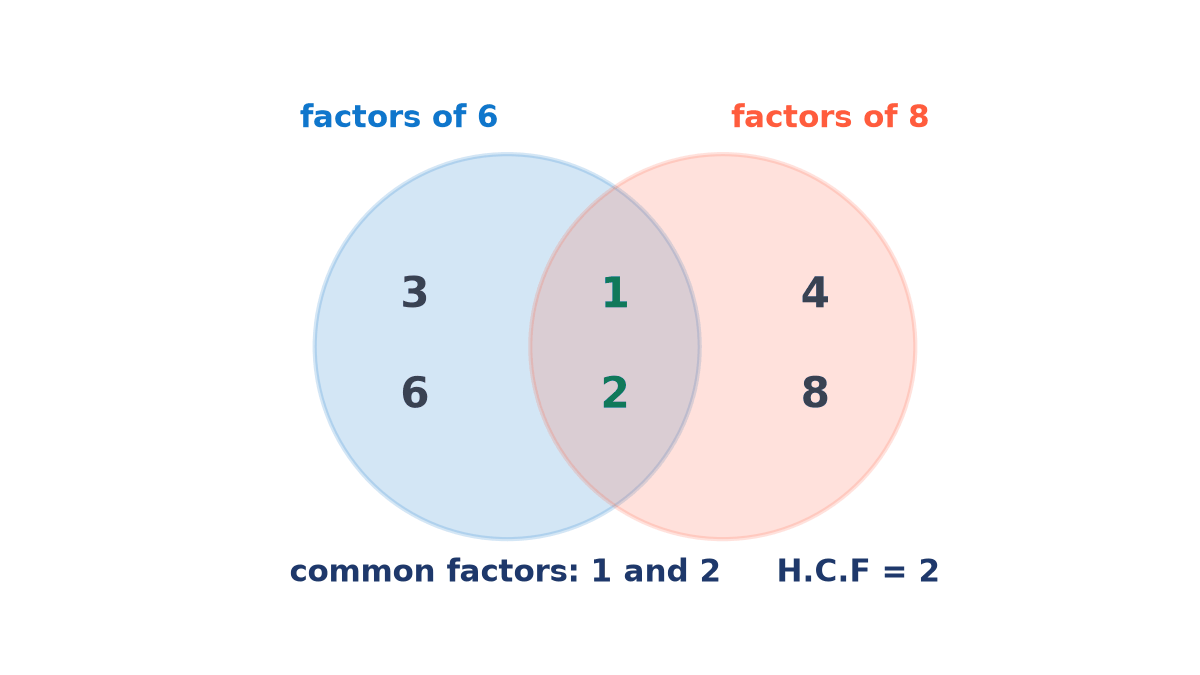
This method just does what H.C.F means. You write out the factors. You pick the ones both numbers share. You take the biggest of those. Nothing is hidden in it. That is why it is worth learning first. Its weak point is the work. A number like has twelve factors. Writing all twelve without missing one takes care. The next two ways need less writing.
2nd method (Prime factorization method)
To prime factorise a number is to write it as primes multiplied together. The working below does that for and for . The steps are these. First prime factorise the given numbers. Then take out the common factors and multiply them. That gives you the H.C.F of the given numbers.
H.C.F of 6 and 8
Count what each number can spare. holds one and one . holds three s and no . The cannot be used. has none to give. The can be used once. has only one to give. What is left is a single .
Here is why that counting works. A composite number is one you can build by multiplying smaller numbers. and are both composite. Every composite number breaks into primes in one way only. So anything that divides is built from 's own primes. That means a , or a , or both. Anything that divides is built from 's primes. Those are all s.
So a number that divides both is built from s alone. But has only one to give. So it can use only one . Here is the rule that comes out of that. Look at each prime the numbers share. Count how many of it each number holds. Then take it as many times as the smallest count. Do that, and you have built the biggest common factor there is.
3rd method (Division method)
Two words come first. The rule below turns on them. You do this method line by line. On each line you divide by some number. That number is the divisor of the line. What is left over is the remainder. In the divisor is and the remainder is .
In the rule below, a divisor does not have to go in exactly. is not a factor of . It is still the divisor of that line. A divisor of this kind is just the number you divided by. That is the sense the rule uses when it talks about a divisor.
The steps are these. Divide the greater number by the smaller one. Then divide the divisor by the remainder. Go on dividing the divisor of the line above by the remainder. Stop when the remainder is zero. The divisor on that last line is the H.C.F of the given numbers. That is what the rule calls the last divisor.
| Divide | Remainder |
|---|---|
Read it downwards. Eight divided by six leaves . So six is divided by next. That leaves nothing. You stop there. The last divisor was . The H.C.F of and is . The other two methods gave the same answer.
There is also a picture behind the division method. Take a rectangle units wide and units tall. Cut off the largest square you can, a by one. What is left is a strip units wide, and by squares fill it exactly. Squares of side therefore tile the whole rectangle, and no larger square can.
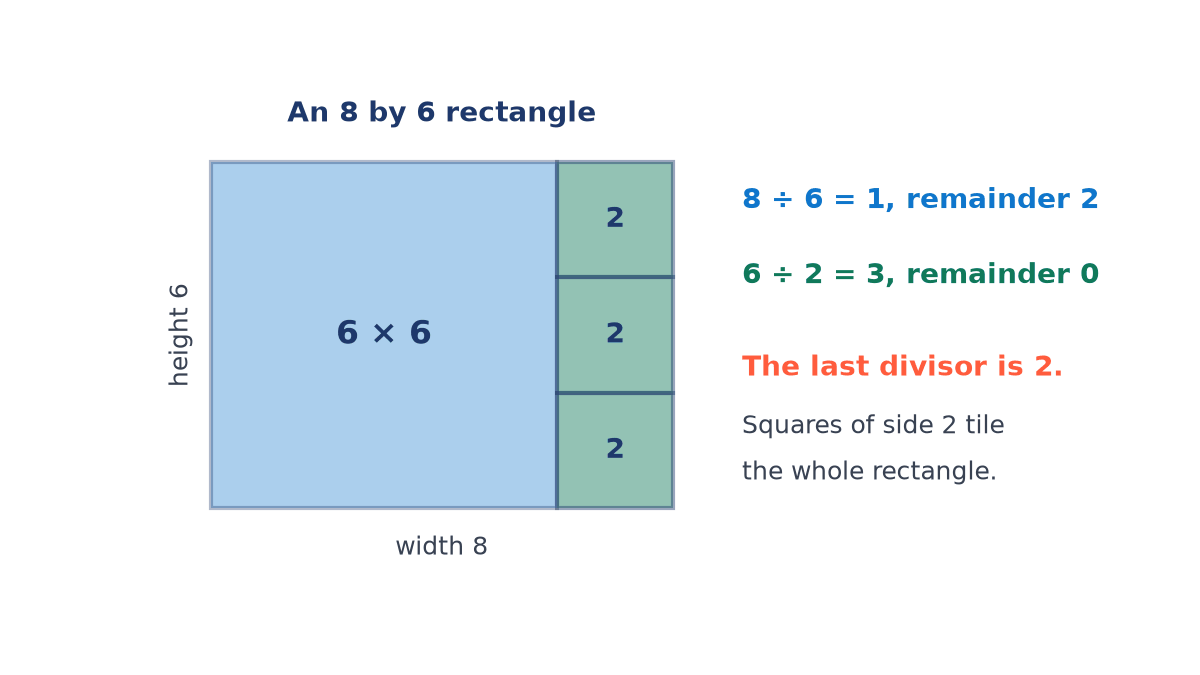
Here is why the shrinking is safe. The first line says . Take away from both sides. That gives . Now pick any number that divides and also divides . It goes into the whole . It goes into the inside it. So it must go into the that is left over.
Now go the other way. Take a number that divides and . It divides as well. So the pair and has the same common factors as the pair and .
Every line swaps the numbers for smaller ones. The answer stays the same. In the end the remainder reaches . The last divisor then goes into the number above it exactly. That divisor is the H.C.F.
Remember. The division method never asks you to list a factor. It only asks you to divide. The numbers get smaller at every step. Reach for it when the numbers are large.
Example 2: the H.C.F of 24, 36 and 84
1st method (By writing all factors)
Three lists this time. Each one is built with the pairing method from Multiples and factors. They are printed in full here. You read the H.C.F straight off them.
| Number | All its factors |
|---|---|
Two of those lists are not the same as the sheet's. That is worth saying plainly. The sheet leaves out of the factors of . But belongs there, as exactly.
The sheet also prints among the factors of . The number that belongs there is . goes three times into and leaves over. And exactly.
Look for the numbers in all three lists. and are in all three. is in the first list but not the second. is in the second but not the first. is in the third alone. So the common factors are . The H.C.F is .
Check it by dividing. Every division must come out exactly.
Nothing bigger will do. The only factor of above is itself. And does not divide . It goes once into and leaves over.
2nd method (Prime factorization method)
H.C.F of 24, 36 and 84
Count the primes again. Start with the s. has three, has two and has two. The smallest count is two. So two s may be taken.
Now the s. has one, has two and has one. The smallest count is one. So one may be taken. The is in alone. The spare in has no partner. Neither one can be used. Multiply what is left: .
3rd method (Division method)
The division method works on two numbers at a time. So start with two of them. Take and . Bring the third one in after that.
| Divide | Remainder |
|---|---|
The last divisor is . Now consider and .
| Divide | Remainder |
|---|---|
The remainder is at the first step. So the last divisor is . The H.C.F of , and is .
Why may you work two at a time? The chain of remainders above shows it. Every number that divides and divides as well. And the numbers that divide are and . There are no others.
So you do not have to ask what all three numbers share. You may ask what and share instead. The answer comes out the same.
Remember. All three methods must give the same answer. If two of them disagree, one of your lists is short. Go back and find what you missed.
Example 3: the H.C.F of 48 and 180
This extra example uses larger numbers, where the division method really earns its place.
Prime factorization method
has four s and has two, so two are taken. Each has at least one , so one is taken. The is in only.
Division method
| Divide | Remainder |
|---|---|
The last divisor is , which agrees. Check: and , and and share no factor but .
Back to the gift packs from the start of the lesson: the H.C.F of and is , so you can make packs, each with pencils and erasers.
When the H.C.F is 1
and are coprimes. So are and . Those two pairs have a second name as well. You may also call them relatively prime. Both names are taught in Perfect numbers, coprimes and twin primes.
Their H.C.F can only be . The factor lists show why.
| Number | All its factors |
|---|---|
The only number in both lists is . The division method lands in the same place.
| Divide | Remainder |
|---|---|
There is a short way to write an H.C.F. You put the numbers in brackets, like this: . You read it aloud as "the H.C.F of and is ".
| Question | Answer | Question | Answer |
|---|---|---|---|
The academy closes its H.C.F part in letters. It says and are relatively prime, or coprimes. And it says the G.C.D of is . In the short way above, that is .
A letter stands for a number you have not been told. Letters that stand for numbers sets that out. So and are any two numbers you pick. That one line covers every coprime pair at once. The two lines above cover only and and and .
An H.C.F of is not a failure. It is not a sign that you went wrong. It is the answer. And it tells you something worth knowing. The two numbers share nothing at all.
Remember. Two numbers that are coprime (also called relatively prime) have an H.C.F of . In letters, .
Your turn
Do the first two by all three methods. Watch them agree. For the rest, the division method is quickest.
From the sheet
- Find the H.C.F of 52 and 48
- Find the H.C.F of 15 and 35
- Find the H.C.F of 36, 48 and 52
- Find the H.C.F of 60, 128 and 180
Extra practice, beyond the sheet
The academy's sheet does not set these. They are more questions of the same kind. Use them when you want more drill. Find the H.C.F of each pair.
| 1) | 4) | 7) |
| 2) | 5) | 8) |
| 3) | 6) | 9) |
When you have an answer, check it before you move on. Divide each of the given numbers by it. Every division must come out exactly. Nothing may be left over. And if a bigger number does the same, your answer was not the highest.
Common mistakes
- Missing a factor when listing, as the sheet itself did with for . Pair the factors to make sure none is lost.
- Taking the largest count of a prime instead of the smallest. That builds the L.C.M, not the H.C.F.
- Stopping the division method too early, before the remainder is .
- Giving the last remainder instead of the last divisor. The remainder at the end is always .
- Giving an answer bigger than the smallest given number. The H.C.F can never be larger than that.
- Thinking an H.C.F of means a mistake. Coprime numbers have H.C.F .
Key terms
- Factor (divisor)
- A number that goes into another exactly, leaving nothing over.
- Common factor
- A factor shared by two or more numbers.
- H.C.F (G.C.D)
- The biggest common factor of the given numbers.
- Prime factorisation
- Writing a number as primes multiplied together.
- Remainder
- What is left over after a division.
- Coprimes (relatively prime)
- Numbers whose H.C.F is .
Answers
From the sheet
- . Factors: has ; has ; the common ones are . Primes: and , sharing . Division: leaves , and leaves .
- . Factors: has ; has . Primes: , . Division: leaves , and leaves .
- . leaves , leaves ; then leaves , leaves .
- . leaves , leaves , leaves ; and exactly.
Extra practice
- ( leaves , leaves , leaves )
- , so and are coprime
- , so and are coprime