Have you ever seen a puzzle like "I am thinking of a number"? The number is real, but nobody has told you what it is yet. Mathematics has a neat way to write such a number: it uses a letter. You will meet letters like this in formulas for area, in rules for patterns, and in every algebra lesson that follows. So let us take the first step.
Every sum so far was made of numbers you could see. Look at . It tells you both numbers and asks you only for the answer. But you are not always told each number. What do you do then? You put a letter in place of that number.
A letter is not a new kind of thing. It is a number. You have just not been told which one. So all you know still works. Adding is still adding. Multiplying is still a short way to write a long addition. Most of the work below is counting.
Variable
Start with two words you will need. A symbol is a mark you write on the page. The letter is a symbol. So is the number . The value of a symbol is the number it stands for.
Some symbols can stand for various numbers, not just one. A symbol like that is called a variable. It has a second name as well: a literal. That word is Latin for a letter. Both names mean the same thing. Where a book says literal, read variable.
The letters , , , , and are used most. The word various does the real work there. It means the value is not fixed. may stand for in one question. It may stand for in the next. Neither one is more right. The letter is a place kept open for a number.
Constant
Other symbols can stand for one number only. Their value is fixed. A symbol like that is called a constant. The numbers , , and are constants.
A constant has nowhere to move. The symbol means five in this question. It means five in the next one. It will mean five in every sum ever written. That is the whole difference between the two. A variable is free to change. A constant is not.
| Symbol | Variable or constant | Why |
|---|---|---|
| Variable | It is a letter, kept open for whatever number the question needs | |
| Variable | It may be here and on the next page | |
| Constant | Seven has never meant anything but seven | |
| Constant | Its value is settled by the symbol itself | |
| One of each | The is fixed. The is not |
Remember. A variable takes various values. A constant keeps one.
Adding a letter to itself
You know that multiplying is a short way to write a long addition. Take four threes added up: . We write that as . Turning a multiplication round does not change it. So we can write too. The same short way works when you add a letter. With a letter we use the second order. The count goes in front. The thing being counted comes after it.
is taken twice. That is . Between a number and a letter we leave the times sign out. So is written simply as .
That did not depend on the count being two or three. Add on times and you get lots of .
added times
Try it with a number. Then you can see it is not a trick. Let stand for . Now is . And is . The two agree. They will agree whatever stands for. Both of them mean the same thing: two lots of .
Counting the a's
Once can be counted, adding and taking away become counting. Three 's and two more 's make five 's. It works just like sweets. Three sweets and two sweets make five sweets. The letter is carried along untouched. Only the number in front of it changes.
The bracket is the whole reason this works. is three lots of . is two lots of . So together there are lots of . The counting happens inside the bracket. The waits outside. It comes back unchanged.
Put a number in and check. Let stand for . Then is . And is . Their total is . And is . The rule and the numbers say the same thing.
Three counts in one line
Work out . Go from left to right and keep the letter.
Check with : , and . They agree.
Different letters do not mix
What about ? Here the counts are of different things, like three apples and two bananas. You cannot call that five apples or five bananas. So stays as it is. Only counts of the same letter join together. If you are told later that and , then you can find the value: . Until then, the two parts are kept side by side.
Remember. Add the counts and keep the letter. . That holds whatever number turns out to be.
Multiplying a letter by itself
Adding to itself gave . Multiplying by itself gives something quite different. We write it in a new way too.
is read as a squared, or as a power 2.
is read as a cubed, or as a power 3.
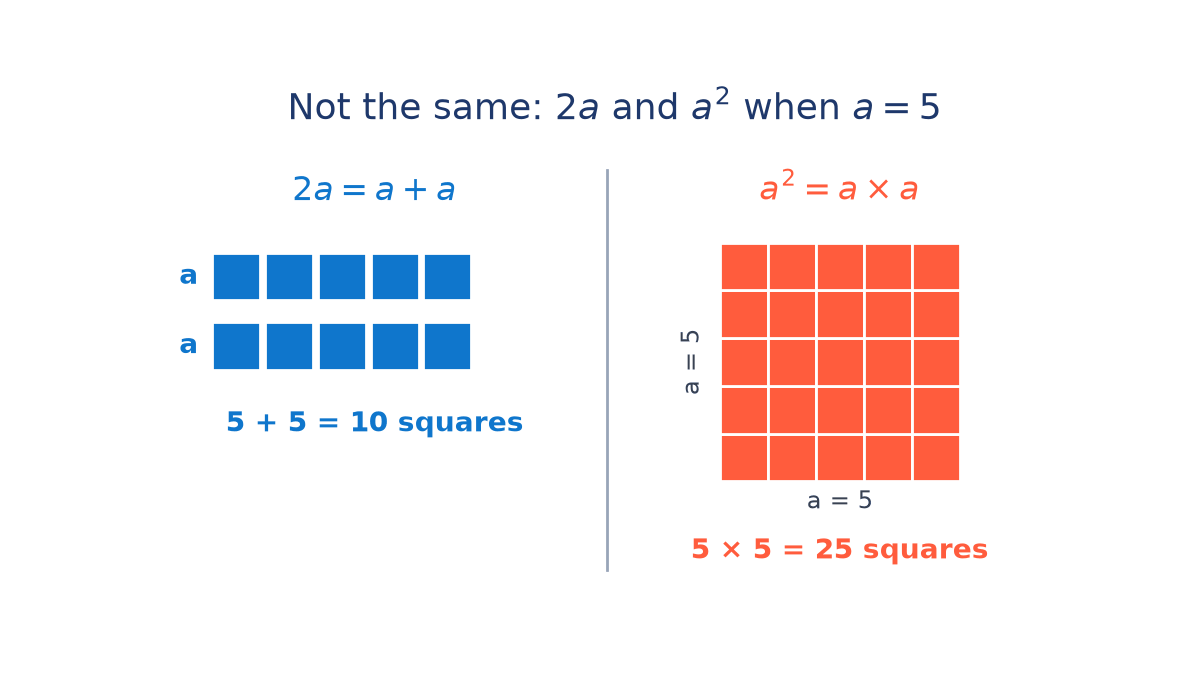
The picture below shows why and are so different. With , two rows of five make squares, but five rows of five make a whole square of . That is where the name "squared" comes from: is the area of a square whose side is .
The small raised number is a count, not an answer. It tells you how many 's are being multiplied together. It tells you nothing else. Written out in full, is . That is five of them, and slow to read. The small does the counting for you.
Take care not to read as . The two are not the same. Let be . Then but . Let be . Then but . They do agree when is . Both ways give . But among the counting numbers it is the only value they agree on. Try any other one. The two answers will not match.
| Written | What it means | Read aloud |
|---|---|---|
| two a | ||
| three a | ||
| added times | n a | |
| a squared, or a power 2 | ||
| a cubed, or a power 3 | ||
| 's multiplied together | a power n |
Remember. counts the 's that are added. counts the 's that are multiplied.
Exponential form
Three letters work together here. Each one has its own job. The letter is the number you multiply. The letter says how many of them to use. So multiply that many 's together. The answer you get is called . Then . You read that as a power n. And is called the exponential form of .
Take and . Then is . So the exponential form of is . The number is what you get. says what it is made of.
is the base. It is the number being multiplied. says how many times it appears. Give both of those. Then the number has been described in full.
Exponential is a long name for a short idea. The small raised number has a name of its own. It is called the exponent. The long name is built from that word. So the name is telling you where to look. Look at the small number.
This way of writing is worth having. It says what the number is made of. Ten 2s multiplied together is long to write. It is easy to miscount. And one look at it tells you nothing. is short. You cannot miscount it. And one look tells you the number is made of 2s and nothing else.
Express 1024 in exponential form, whose base is 2
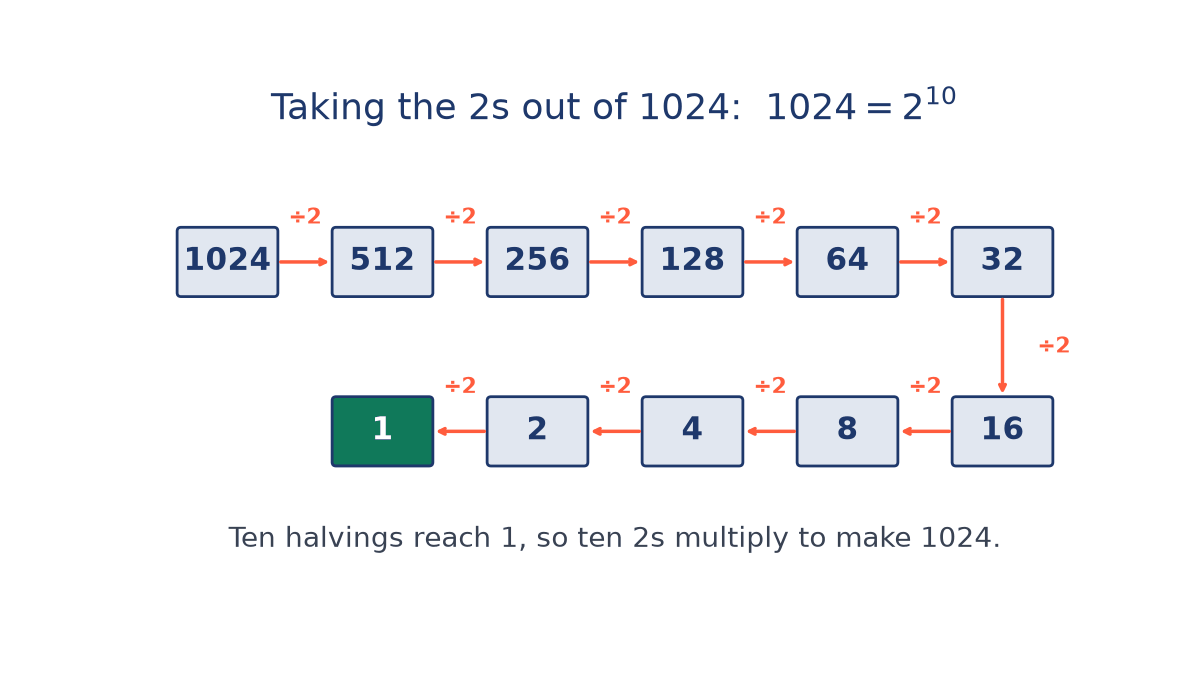
The base is given to you. So only one thing is left to find. How many times must be multiplied? Take the 2s out one at a time. You do that by halving.
can be halved exactly. You can share it into two equal parts with remainder . That is what divisible by means. You have met this idea before. The last lesson split the numbers into even ones and odd ones. The even ones are the ones you can halve exactly. So one 2 comes out of . That leaves . is divisible by as well. So another 2 comes out. Keep going until is all that is left.
Each division took one 2 out of the number. You reached with nothing left over. So put every one of those 2s back. They must give again.
as s multiplied together
Count the 2s on that line. There are ten. The base is and it appears ten times. So the exponential form of is . You read that as 2 power 10.
You can check it from the other end. This time you double. Start at . Double one row at a time until you reach .
| Exponential form | How many 2s | The number |
|---|---|---|
| one | ||
| two | ||
| three | ||
| four | ||
| five | ||
| six | ||
| seven | ||
| eight | ||
| nine | ||
| ten |
Each row after the first is the row above it doubled. The small number climbs by one as you go down. There is a reason for that. Doubling means multiplying by once more. So each row puts one more 2 into the multiplication. And the tenth row lands on .
Remember. In the base is what you multiply. is how many times you multiply it. The small number counts. It does not answer.
Another example: 243 with base 3
The same method works for any base. Take the 3s out one at a time by dividing by .
Five divisions reached . So . Check by multiplying up: .
Your turn
Variable or constant?
| 1) | 3) | 5) |
| 2) | 4) | 6) |
Count the letters
| 1) | 5) | 9) |
| 2) | 6) | 10) |
| 3) | 7) | 11) |
| 4) | 8) | 12) |
Write these with a power
| 1) | 3) | 5) |
| 2) | 4) | 6) |
Express in exponential form
- Express in exponential form, whose base is
- Express in exponential form, whose base is
- Express in exponential form, whose base is
- Express in exponential form, whose base is
- Express in exponential form, whose base is
- Express in exponential form, whose base is
- Express in exponential form, whose base is
- Express in exponential form, whose base is
Say these aloud
| 1) | 3) | 5) |
| 2) | 4) | 6) |
Common mistakes
- Reading as . The small means multiply two 's, not add them.
- Changing the letter when adding: is , not or .
- Joining different letters, as in writing .
- Thinking a letter always has the same value. A variable can take various values from question to question.
- Miscounting the base in exponential form. Count the divisions that reach , not the numbers in the chain.
- Writing as . The exponent is a count of 2s, not a number to multiply by.
Key terms
- Symbol
- A mark written on the page, such as or .
- Variable (literal)
- A symbol that can stand for various numbers.
- Constant
- A symbol whose value is fixed, such as .
- Base
- The number being multiplied in ; here it is .
- Exponent
- The small raised number that counts how many times the base is multiplied.
- Exponential form
- A number written as a base with an exponent, such as .
- Squared and cubed
- Names for a power 2 and a power 3.
Answers
Variable or constant?
1) : variable. 2) : constant. 3) : variable. 4) : constant. 5) : variable. 6) : constant.
Count the letters
1) 2) 3) 4) 5) 6) 7) 8) 9) 10) 11) 12)
Write these with a power
1) 2) 3) 4) 5) 6)
Express in exponential form
Say these aloud
Model answers: 1) "a squared", or "a power two". 2) "a cubed", or "a power three". 3) "two a". 4) "three a". 5) "a power n". 6) "n a".