H.C.F and L.C.M are usually taught one after the other, as if they had nothing to do with each other. In fact they are two halves of one picture. The H.C.F answers questions like "what is the largest equal share?" and the L.C.M answers questions like "when will these repeating events happen together again?". Bells, traffic lights, bus timetables and cutting cloth all lead to one or the other.
Two ideas, one picture
You know how to find the H.C.F of some numbers. You know how to find their L.C.M too. Now let us put the two side by side, because they are not strangers at all. For two numbers there is an exact link between them. Know one, and it tells you the other.
The same two ideas then stretch to fractions. The lesson ends with three problems. Each one tells you a story in words. You have to say which of the two it wants.
How the H.C.F and the L.C.M of two numbers are linked
Here is the rule, in the academy's own words. The product of two numbers is always equal to the product of their H.C.F and their L.C.M. A product is what you get when you multiply. So the rule says this. Multiply the two numbers together. You get the same answer as their H.C.F times their L.C.M. Now look at the word two. The rule is about a pair. A pair is where you use it.
The academy uses the pair and . Break each one into primes.
and broken into primes
They share only one prime, and that is . Each of them holds just one . So the H.C.F of and is .
Now for the L.C.M. Look at every prime that appears at all. From each one, take the larger count. That gives three s from , one , and one from .
The L.C.M of and
Now look at what those two answers took. The two numbers share one prime. The H.C.F took the smaller count of it: a single . The L.C.M took the larger count of every prime: three s, one and one .
Set the H.C.F and the L.C.M side by side. Every prime inside is there. Every prime inside is there too. Each one is counted once, and no more. The and the make . The three s and the make .
A Venn diagram of the prime factors makes this easy to see. The shared prime sits in the overlap. The H.C.F is just the overlap. The L.C.M is everything in both circles, each prime counted once.
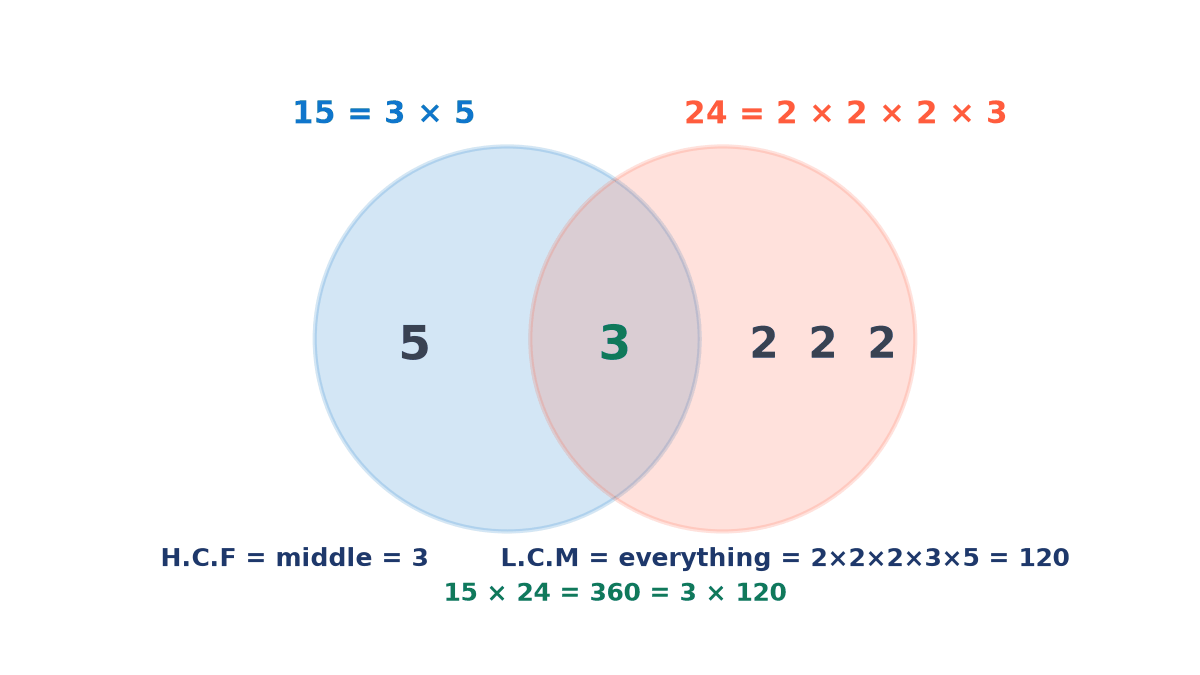
That is the reason, and it works for any pair. Think about one prime at a time. The H.C.F takes the smaller count of copies, because that is all both numbers can spare. The L.C.M takes the larger count of copies, because both numbers have to go into it a whole number of times.
Smaller and larger cover every copy in both numbers. No copy is counted twice. So multiply the H.C.F by the L.C.M. You put back just what the two numbers were made of.
Now test the rule on the numbers. The two numbers multiply to . The H.C.F and the L.C.M multiply to . The two agree. The rule says they must.
Remember. Multiply two numbers together. You get the same answer as their H.C.F times their L.C.M. On and , both come to .
What the rule is for
Four numbers sit in this rule. They are the two numbers, their H.C.F and their L.C.M. Know any three of them. Then you can work out the fourth. So once you have the H.C.F of a pair, one division gives you the L.C.M. You do not have to factorise a second time.
The L.C.M of and , once you know their H.C.F is
It works the other way round as well. Say two numbers multiply to . Say their L.C.M is . Then their H.C.F is .
A second worked example: 18 and 42
Here is the whole routine on a new pair.
Check the rule: and . They agree.
Now use the rule as a shortcut. If you had found only the H.C.F, one division would give the L.C.M: .
Two quick facts that follow
- The H.C.F always divides the L.C.M. In every example so far, divides and divides . This is a handy check on your working.
- For coprime numbers the H.C.F is , so the L.C.M is simply the product. The L.C.M of and is .
Remember. The product rule is for two numbers. For three numbers such as , and , the product is but the H.C.F times the L.C.M is .
H.C.F and L.C.M of fractions
Fractions have an H.C.F and an L.C.M too. The words still mean what they always meant. The H.C.F of some fractions is the largest fraction that goes into all of them a whole number of times. The L.C.M is the smallest fraction that all of them go into a whole number of times.
You do not need a new method for either of them. Both are built from the H.C.F and the L.C.M of whole numbers. Those you can find already. You work on the numerators, the top numbers, on one side. You work on the denominators, the bottom numbers, on the other.
First, write each fraction in its lowest terms. Lowest terms means the top and the bottom share no factor bigger than . Take . It is not in lowest terms, because the H.C.F of and is . Halve both and you have . That is the same fraction, written properly.
Do this first, because the two rules below read the top and the bottom just as they stand. Hand them when you meant . They will give you a different answer for the same fraction.
| What you want | How to find it |
|---|---|
| The H.C.F of some fractions | the H.C.F of the numerators, over the L.C.M of the denominators |
| The L.C.M of some fractions | the L.C.M of the numerators, over the H.C.F of the denominators |
The two rules are mirror images. There is a reason for that. A fraction gets smaller when its top number gets smaller. It also gets smaller when its bottom number gets bigger.
The H.C.F has to be the small one. So on top it takes the smaller choice, the H.C.F of the numerators. Underneath it takes the bigger choice, the L.C.M of the denominators. The L.C.M has to be the large one. So it takes them the other way round.
Finding the L.C.M of two fractions
Take and . The L.C.M of the numerators and is . The H.C.F of the denominators and is .
Find the L.C.M of and
Now check it from the other end. . And . Each fraction goes into a whole number of times. So is a common multiple of the two. The rule gives the least of them.
Finding the H.C.F of two fractions
Now take the same two fractions. Swap the two rules over. The numerators are and . Their H.C.F is . The denominators are and . Their L.C.M is .
Find the H.C.F of and
Check that it goes into both a whole number of times. . So it goes into five times. And . So it goes into six times. A whole number of times each way. That is what a common factor has to do.
On this pair the two products agree. . And as well. But take care here. The rule earlier in the lesson was about two whole numbers. So notice it on this pair. Do not use it as a rule for all fractions.
Remember. For fractions, the H.C.F is the H.C.F of the numerators over the L.C.M of the denominators. The L.C.M is the L.C.M of the numerators over the H.C.F of the denominators. Small over large gives you the small one. Large over small gives you the large one.
The academy's three problems
Here is a quick way to decide. Ask yourself whether the answer should be smaller than the given numbers or bigger. Words like "largest number that divides", "greatest length", or "maximum number of equal groups" point to an answer no bigger than the smallest given number: that is the H.C.F. Words like "smallest number divisible by", "next time together", or "least number of" point to an answer at least as big as the largest given number: that is the L.C.M.
The sheet ends with three problems. None of them says H.C.F. None of them says L.C.M. Each one tells you a story. You have to work out which of the two it is asking for. So go back to the two meanings every time. The H.C.F is the greatest number that goes into all the given numbers. The L.C.M is the least number that all the given numbers go into. Watch the direction. One number goes into them all. They all go into the other number.
1. The largest number which can exactly divide , and
A number that divides all three is a common factor of all three. The problem asks for the largest one. That is word for word what the H.C.F means. So the answer is the H.C.F of , and . The academy also calls it the G.C.D.
The 1st method (By writing all factors).
| Number | Every factor of it |
|---|---|
Four numbers appear in all three rows: and . The greatest of them is .
The 2nd method (Prime factorization method).
, and broken into primes
Every one of them holds one and one . Nothing else is in all three. So the H.C.F is .
The answer is . It goes into once. It goes into twice, and into three times. Nothing larger can work, because nothing larger than goes into at all.
2. Three planets
The time periods of three planets are days, days and days. A planet's time period is how long it takes to go round once. After how many days do the planets come back to where they stand now?
The first planet is back where it stands today after days. Then again after every further days. The second is back after days, and every days after that. The third is back after days, and every days after that.
So all three stand where they stand today on one kind of day. That day has to be a multiple of all three periods at once. The first such day is their least common multiple.
Prime factorise the three periods.
, and broken into primes
Take the largest count of each prime. There are two s, from and from . There is one , from . There are three s, from .
The L.C.M of , and
So the planets are back where they stand now after days. Count the journeys and you can see it is right. , and . In those days the first planet goes round fifteen times. The second goes round six times. The third goes round five times. All three arrive home together.
3. The largest five-digit number divisible by , , and
A number divisible by all four is a common multiple of all four. Look back at and in Least Common Multiple (L.C.M). Their common multiples were , , and on. Every one of them is a multiple of . And was their L.C.M. Common multiples always sit like that.
So every number that answers this problem is a multiple of one number. That number is the L.C.M of , , and . No other number can answer it.
, , and are four different primes. So they share nothing at all. None of them goes into any of the others. Their L.C.M is just all four of them multiplied together.
The L.C.M of , , and
Now find the largest multiple of that still has five digits. The largest five-digit number of all is . Divide that by . Then look at what is left over.
The remainder is . So sits above the last multiple of . Take that off.
The largest five-digit number divisible by , , and
Now test the answer against the divisibility rules. Take one rule at a time. The rules for , and are in Divisibility rules for 2, 3, 4 and 5. The rule for is in Divisibility rules for 6, 7, 8, 9, 10 and 11.
- Divisible by , because its unit digit is .
- Divisible by , for the same reason.
- Divisible by , because its digits add to , and is divisible by .
- Divisible by as well. Number the places from the right. The first place from the right is place one. The next is place two, and so on. Places one, three and five are the odd places. Places two and four are the even places. The digits in the odd places are , and . They add to . The digits in the even places are and . They add to . The difference between the two sums is .
And . So it is a multiple of the L.C.M, as it had to be.
It is the largest one, not just one that works, because is not divisible by . Nor is any of the eight numbers from to . Come down from . The first number you reach that is divisible by all four is .
Your turn
Check the rule
For each pair, find the H.C.F and find the L.C.M. Then multiply the two numbers together. Then multiply the H.C.F by the L.C.M. Check that the two answers agree.
| 1) | 3) | 5) |
| 2) | 4) | 6) |
Use the rule
- The H.C.F of two numbers is and their L.C.M is . One of the numbers is . What is the other?
- The H.C.F of two numbers is and their L.C.M is . One of the numbers is . What is the other?
- Two numbers multiply to and their H.C.F is . What is their L.C.M?
- Two numbers multiply to and their L.C.M is . What is their H.C.F?
H.C.F and L.C.M of fractions
Find both the H.C.F and the L.C.M of each set. Every fraction here is already in its lowest terms.
Before the word problems, one more example of the reasoning. Two ropes are m and m long. They must be cut into pieces all of the same length, as long as possible, with none left over. The length must divide both, and be as large as possible, so it is the H.C.F of and , which is m. There will be pieces.
Word problems
Before you work each one out, say what it asks for. Is it the H.C.F or the L.C.M? Say how you can tell. One question uses the word interval. An interval is the gap of time between one ring and the next.
- Find the largest number which can exactly divide , and .
- Find the smallest number which is exactly divisible by , and .
- Three bells ring at intervals of minutes, minutes and minutes. They have just rung together. After how many minutes will they next ring together?
- Find the largest four-digit number which is divisible by , , and .
- Find the largest five-digit number which is divisible by , , and .
Common mistakes
- Using the product rule on three or more numbers. It holds for a pair only.
- For fractions, putting the H.C.F on the bottom of the H.C.F. It is H.C.F of tops over L.C.M of bottoms.
- Forgetting to write fractions in lowest terms before using the fraction rules.
- Choosing H.C.F in a "next time together" problem. Events that repeat meet at a common multiple.
- In the largest-number problems, subtracting the quotient instead of the remainder.
- Giving an H.C.F that does not divide the L.C.M. If it does not, something went wrong.
Key terms
- Product
- The answer when numbers are multiplied.
- H.C.F (G.C.D)
- The greatest number that goes into all the given numbers.
- L.C.M
- The least number that all the given numbers go into.
- Prime factorisation
- Writing a number as a product of primes.
- Lowest terms
- A fraction whose top and bottom share no factor bigger than .
- Interval
- The gap of time between one event and the next.
- Remainder
- What is left over after dividing.
Answers
Check the rule
- : H.C.F , L.C.M ; .
- : H.C.F , L.C.M ; .
- : H.C.F , L.C.M ; .
- : H.C.F , L.C.M ; .
- : H.C.F , L.C.M ; .
- : H.C.F , L.C.M ; .
Use the rule
- .
- .
- .
- .
H.C.F and L.C.M of fractions
- H.C.F , L.C.M .
- H.C.F , L.C.M .
- H.C.F , L.C.M .
- H.C.F , L.C.M .
- H.C.F , L.C.M .
- H.C.F , L.C.M .
Word problems
- H.C.F, because one number must go into all three: .
- L.C.M, because all three must go into it: .
- L.C.M of the intervals, because the rings repeat: minutes.
- L.C.M first, . Then , so the answer is .
- L.C.M of is . Then , so the answer is .