What this lesson is about
Every counting number can be built by multiplying. Some numbers can be built in many ways; is and also . Others can only be built as one times themselves. Those are the prime numbers, and they are the building blocks of all the rest. You will use them when you find the H.C.F and L.C.M, when you cancel fractions, and in later classes when you factorise.
Counting the factors
You already know what a factor is. A factor of a number divides it exactly. Nothing is left over. The factors of are . The factors of are . Now we do just one new thing with that idea: we count them.
divides every number. And every number divides itself. Those two factors come free. So here is the question that matters. Does the number have any others?
That one question sorts the natural numbers into three piles. The natural numbers are the ones you count with. You start at one and keep going for ever. The three piles have names.
Prime numbers
The academy's definition. A natural number greater than is a prime number if it has only two divisors (factors): and itself.
Read it slowly. Every part of it does a job. Two divisors, not one and not three. and itself says which two they must be. And greater than keeps out. The part called Where belongs shows why.
Here are five prime numbers. Their factors are written out in full.
| Prime number | All its factors | How many |
|---|---|---|
| two | ||
| two | ||
| two | ||
| two | ||
| two |
Every row has exactly two. Look at . Nothing else will divide it: not , not , not , not , not . So keeps just the two factors that every number has. That is what makes a number prime. Not that it is special. Just that nothing else got in.
Seeing it with counters
Here is a way to see the difference. Take some counters and try to lay them out as a rectangle with at least one full row. Each rectangle you can make gives you a pair of factors.
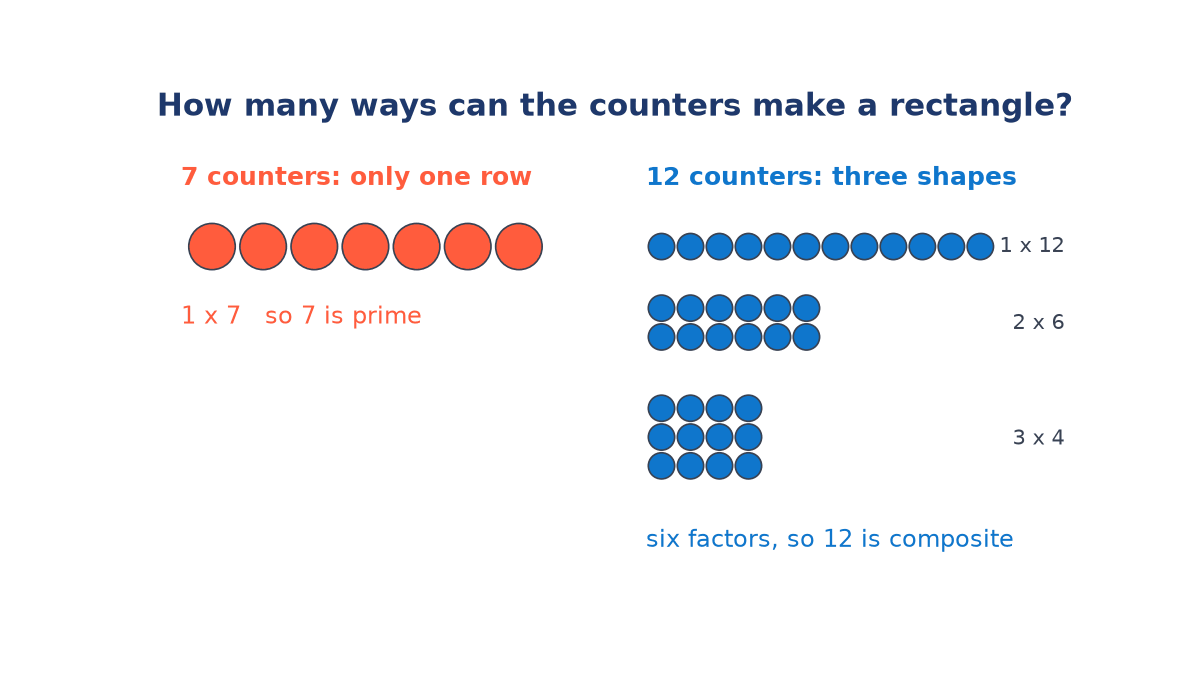
Seven counters will only lie in a single row of seven. Try two rows and one counter is left over. Try three rows and one is left over again. So the only factors are and . Twelve counters, though, make a row of twelve, two rows of six and three rows of four. Those three rectangles give the six factors .
Remember. A prime number has exactly two factors: and itself. Not one factor. Not three. Exactly two.
Composite numbers
Here is the definition, the plain way round. A natural number which has more than two divisors (factors) is a composite number. The academy writes it the other way round. A natural number which is neither nor prime is called a composite number. That says two things. The number is not . And it is not prime. Every other counting number is composite.
Here are eight composite numbers. Take first. The factors (divisors) of are . That is three factors. Three is more than two. So is composite.
The same counting for the rest of them.
| Composite number | All its factors | How many |
|---|---|---|
| three | ||
| four | ||
| four | ||
| three | ||
| four | ||
| six | ||
| four | ||
| four |
Notice how little it takes. To show that a number is composite, you do not need all of its factors. One extra factor is enough. Then you may stop. Take . It is not even, so will never divide it. But does. That third factor settles it. The factors of are . Three factors, and three is more than two.
Remember. A composite number has more than two factors. Find one more factor besides and the number itself. That is enough to prove it.
A worked example:
To list every factor without missing any, work in pairs. Start at and go up, writing each factor with its partner.
Five does not divide . The next number to try is , but is already in the list as the partner of . Once the pairs start to repeat, you have found them all. So the factors of are . That is eight factors, so is composite.
Now try . It is odd, so does not divide it. Nor do , , or . But . Here the pair is one number used twice, so it adds just one factor. The factors are : three of them, so is composite.
Where belongs
is neither prime nor composite. Here is why. The factors of are . That is one factor, and only one. Look at the two free factors of . The first one is . The second one is the number itself, which is also . They are the same number. So they fold into one.
So fails both tests at once. It does not have two factors. So it cannot be prime. It does not have more than two. So it cannot be composite. It sits on its own. That is the third pile.
Remember. is neither prime nor composite. It has one factor only. Prime asks for two. Composite asks for more than two.
is the only even prime number
The two definitions you have just read settle something about even numbers. divides every even number. So is a factor of every even number. Now take any even number bigger than . Its factor list holds . It holds . It holds the number itself. Those are three different numbers. Three is more than two. So the number cannot be prime.
The composite table above shows it happening. The factors of are . The factors of are . The factors of are . The same caught all three. That is why each one has more than two factors.
is the one even number this argument cannot touch. Look at what happens with . The free factor the number itself is . The factor is that same number. So nothing new is added. The list stays at . That is exactly two factors. So is prime. Every other even number is ruled out. So every prime after is odd.
Remember. is the only even prime number. Every even number bigger than has , and itself among its factors. That is more than two. So no other even number can be prime.
Four things to remember
- The smallest prime number is . is not prime. So is the first counting number with exactly two factors.
- The smallest composite number is . is neither. and are prime. So is the first number to pick up a third factor.
- is neither prime nor composite.
- There are prime numbers below .
Here is the list. Read it across each row.
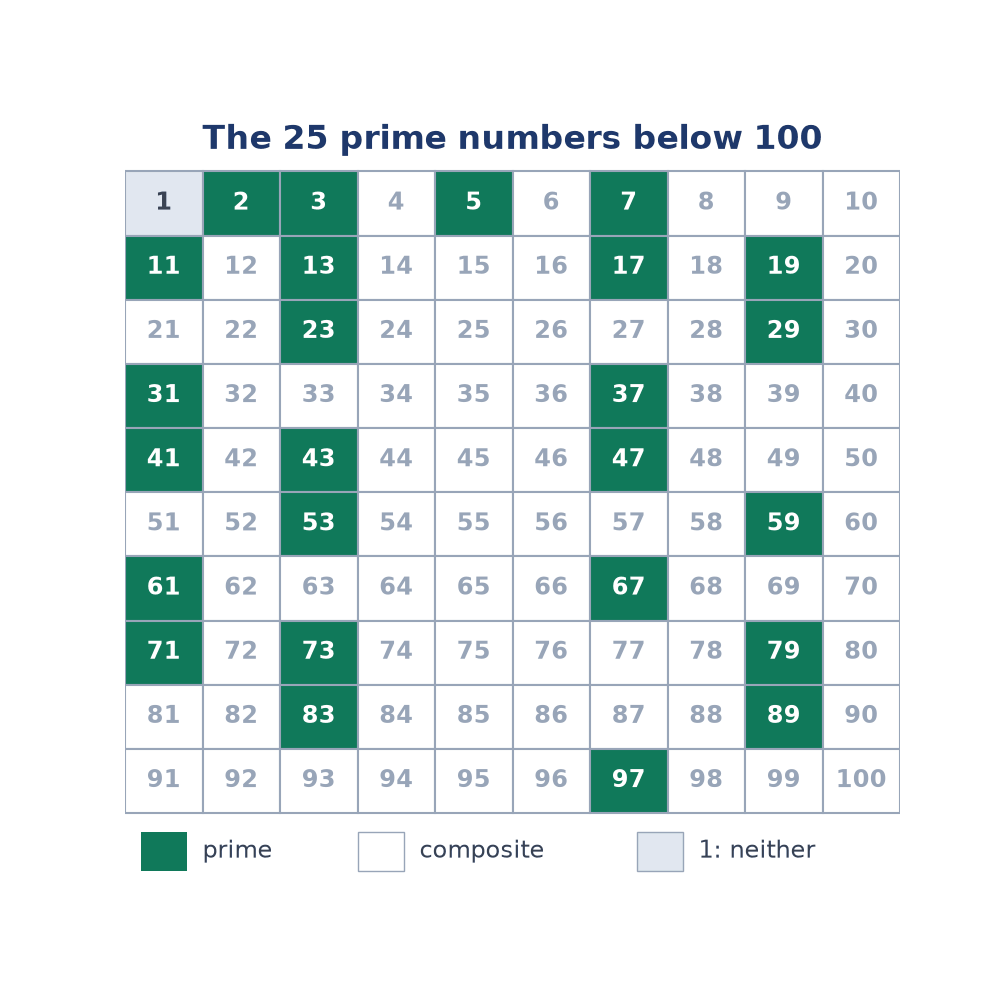
Twenty-five altogether. Count them ten at a time. That is a good way to check you have them all. It also shows how unevenly they fall.
| Ten numbers | The primes in it | How many |
|---|---|---|
| to | four | |
| to | four | |
| to | two | |
| to | two | |
| to | three | |
| to | two | |
| to | two | |
| to | three | |
| to | two | |
| to | one |
There are four in the first ten. There is only one in the last. But the count does not fall steadily on the way. The forties hold three. The seventies hold three too. Nothing you have learned so far tells you where the next prime will fall. You learn the list.
Proving that a number is composite
One extra factor is all it takes. You have just learned the divisibility rules. Each rule is a quick test. It tells you whether some small number divides your number. You do not have to do the dividing sum. Those tests are made for finding a factor. Try . It looks like a prime. It is not.
Start with the easy tests. ends in . The tests for , for and for all look at the last digit. A last digit of passes none of them. So does not divide . Nor does . Nor does .
Next add the digits: . The tests for and for use that total. But does not divide . So does not divide either. Nor does .
The test for asks for two things at once. Both and must divide the number. has just failed both. So does not divide it.
The test for looks at the last two digits. The test for looks at the last three. But has only two digits. So both tests look at the whole of . And does not divide . Nor does .
That leaves and to try.
Now try the rule for . You met it in Divisibility rules for 6, 7, 8, 9, 10 and 11. Here is what it says. Take the last digit and double it. Then take that away from the number the other digits make. Look at what you are left with. Is it ? Is it in the times table? Then divides the number.
Testing with the rule for
is in the times table. So divides . Divide it out. Now you can see what was hiding.
What really is
So the factors of are . That is four factors. So is composite. That is why it is missing from the list of twenty-five.
The other way round is harder. It is worth being honest about that. To show a number is composite, you find one factor. To show a number is prime, you need much more. You must know that no extra factor exists at all. Failing to find one is not the same as there being none. That is why the twenty-five primes below are worth learning by heart. Knowing them is quicker than working them out again every time.
Remember. One extra factor proves a number composite. Proving a number prime is a different kind of job. So learn the twenty-five.
A second worked example:
This number is above , so the list of twenty-five cannot help. Work through the tests. It ends in , so , and do not divide it. Its digits add to , which does not divide, so neither nor divides it.
Now the rule for . Double the last digit and take it from the rest.
The result is . The rule works with a negative answer too: is times . So divides , and . The factors are , so is composite.
The first twenty numbers, sorted
Here is everything gathered in one place. The table holds every number from to , with its factors, how many factors there are, and which pile that puts it in. Nothing here is new, but it is handy to see it all together.
| Number | All its factors | How many | Which pile |
|---|---|---|---|
| one | neither | ||
| two | prime | ||
| two | prime | ||
| three | composite | ||
| two | prime | ||
| four | composite | ||
| two | prime | ||
| four | composite | ||
| three | composite | ||
| four | composite | ||
| two | prime | ||
| six | composite | ||
| two | prime | ||
| four | composite | ||
| four | composite | ||
| five | composite | ||
| two | prime | ||
| six | composite | ||
| two | prime | ||
| six | composite |
Read the last column downwards. stands alone at the top. The primes are scattered through the rest. They follow no pattern you could predict. Everything else is composite. Now read the middle column. You can see just why each number landed where it did.
Your turn
Write out all the factors of each number, then say whether it is prime or composite
| 1) | 6) |
| 2) | 7) |
| 3) | 8) |
| 4) | 9) |
| 5) | 10) |
Which of these are prime?
| 1) | 6) |
| 2) | 7) |
| 3) | 8) |
| 4) | 9) |
| 5) | 10) |
And these, in words
- Why is neither prime nor composite?
- How many prime numbers are there below ? Write them all out from memory. Then check your list against the one above.
- is not a prime number. Find the factor that proves it. Which rule found it for you?
- Write down the smallest prime number. Say why no smaller number will do. Now write down the smallest composite number. Say why no smaller number will do there either.
- A number has exactly three factors. Is it prime or composite? How do you know?
- Between and there is only one prime number. Which one is it?
Common mistakes
- Calling a prime number. It has only one factor, and a prime needs exactly two.
- Thinking every odd number is prime. , , , and are all odd and all composite.
- Thinking cannot be prime because it is even. It has exactly two factors, and .
- Stopping too soon when testing. Not being divisible by , and does not make a number prime; and are caught by .
- Counting a repeated factor twice. The factors of are : three, not four.
Key terms
- Natural numbers
- The counting numbers and so on.
- Factor (divisor)
- A number that divides another number exactly, leaving nothing over.
- Prime number
- A natural number greater than with exactly two factors, and itself.
- Composite number
- A natural number with more than two factors.
- Divisibility rule
- A quick test that shows whether one number divides another without doing the division.
- Factor pair
- Two factors that multiply to give the number, such as and for .
Answers
Factors, then prime or composite
- : factors . Composite.
- : factors . Prime.
- : factors . Composite.
- : factors . Composite.
- : factors . Prime.
- : factors . Prime.
- : factors . Composite.
- : factors . Composite.
- : factors . Prime.
- : factors . Composite.
Which of these are prime?
- : prime.
- : not prime, since .
- : not prime, since .
- : not prime, since .
- : prime.
- : not prime, since .
- : prime.
- : not prime, since .
- : prime.
- : not prime, since .
So the primes are , , and .
In words (model answers)
- has only one factor, itself. A prime needs exactly two factors and a composite needs more than two, so is neither.
- There are : .
- The digits of add to , which divides. So the rule for finds the factor , and .
- The smallest prime is : the only smaller natural number is , which has one factor. The smallest composite is : is neither, and and are prime.
- Composite. It has more than two factors, and a prime has exactly two. (Such numbers are squares of primes, like , and .)
- .