A factor of a number divides it exactly. Nothing is left over. The factors of are and . Is a factor of ? That is the same as asking one thing. Can be divided by with nothing left over? You would rather not do that long division to find out.
A divisibility rule answers the question with a much smaller sum. You have met the rules for , , and . Now we take the next six, and each one comes with the reason it works. Why bother with the reason? Because a rule you understand is a rule you can trust, and you can build it again on the day you forget it.
Every rule below talks about a natural number. The natural numbers are the counting numbers and so on. Every number on this page is one of them.
You will use these rules long after this chapter is over: to cancel fractions quickly, to find factors and the HCF and LCM, to check a long multiplication, and to spot at once whether an answer in a test can be right.
The rule for 6
A natural number is divisible by if it is divisible by both and .
Six is . Take a number with a inside it and a inside it. That number has a inside it. Why? Because and are coprimes. They share no factor except . So the two tests do not overlap. Each test finds something the other one cannot.
| Number | Test for 2 | Test for 3 | Divisible by 6? |
|---|---|---|---|
| the unit digit is , so yes | , which is a multiple of , so yes | yes | |
| the unit digit is , so yes | , which is not a multiple of , so no | no |
Watch the two tests fit together in . It is even. So it is lots of . The digits of add to . So is lots of . The and the are both there. One sits inside the other.
7224
Now . It passes the first test. It fails the second one. A number only has to fail one test. There is a in . But there is no in it at all. So cannot divide it.
124
This only works because and are coprimes. A pair that is not coprime will not work. Look at . It is divisible by . It is also divisible by . But is not lots of anything: .
Why not? Because and share a factor. The inside gets counted twice. So the two tests together only ever show that is a factor. Nothing like that can happen with and .
Remember. A number is divisible by if it passes the test for and the test for . One test on its own is not enough.
The rule for 7
Take the unit digit of a natural number and double it. Take that away from the rest of the number. The number is divisible by if what is left is a multiple of , or is .
Cover the unit digit with a finger. Double it. Take that from the number still showing. Try . Cover the . That leaves . Twice is .
861
is a multiple of . So is a multiple of too.
Sometimes the doubled digit is the bigger of the two. Then take the smaller one from the bigger one. The test asks for the size of the gap. It does not care which way round you write it. Look at . Cover the . That leaves . Twice is . So the gap is . That is . And .
Why is covering a digit allowed to settle it? Doubling the unit digit and taking it away is a bigger move than it looks. It takes away lots of that digit. And is a multiple of .
Why the doubling works
Take a multiple of away from a number. That cannot change whether the number is divisible by . So and stand or fall together. And is ten lots of . Seven and ten are coprimes. So the ten cannot be the one giving the . If is a multiple of , the must be in the . That is why the small number decides the big one.
If the number left is still too big to judge, use the rule again on it. Try . Cover the : . Is a multiple of ? Use the rule once more: . So is, and so is . Indeed .
A second test
There is a second test for . You may use whichever one you like. Split the number into two blocks of three digits. Start from the right. Take one block from the other. The number is divisible by if the gap is or a multiple of .
splits into and .
342384
The reason is . Look at it closely: . So one is a multiple of . Two of them make a multiple of as well. Any whole number of s is a multiple of .
Why the split into threes works
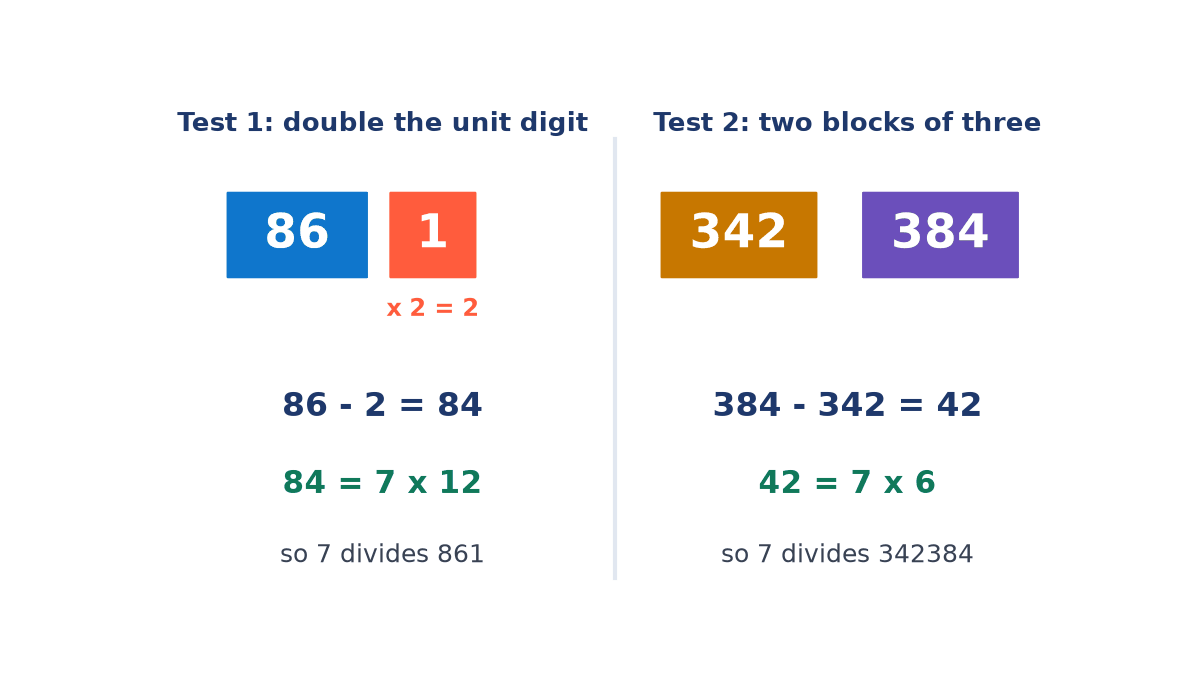
The first part is lots of . Every one of those is a multiple of . That stays true whatever the front block is. So the whole of that part can be dropped. Only the is left to test.
Remember. Double the unit digit and take it from the rest. Or split the number into two blocks of three. Then take one block from the other. Either way you are left with a small number to test.
The rule for 8
A natural number is divisible by if the last three digits are divisible by . Read those three digits as one number.
One thousand is . So every whole thousand is a multiple of . The thousands part of a number can never change the answer. Only what is left below the thousands can. That part is the last three digits.
93624
goes into exactly, seventy-eight times. So is divisible by as well. Now try . Its last three digits are .
9774
leaves over. The bit left over has a name. It is called the remainder. So leaves the same remainder of . It is not divisible by . The nine thousand added nothing to the remainder, just as promised.
One more: . The last three digits make , and . So is divisible by ; in fact . If the last three digits are still awkward, halve them three times. halves to , then , then . No remainder appeared, so divides it.
Remember. Every whole thousand is a multiple of . So cover everything except the last three digits.
The rule for 9
A natural number is divisible by if the sum of all its digits is divisible by .
Every digit in a number sits in a place. The place tells you what the digit is worth. A digit in the tens place is worth that many tens. A digit in the hundreds place is worth that many hundreds. Ten, a hundred and a thousand are the place values.
This rule looks like magic. Then you look at what the place values are doing. , and are all multiples of . Every place value is one more than one of them. Ten is . A hundred is . A thousand is .
So each digit hands over a pile of nines. It keeps only itself behind. What is left at the end is the sum of the digits.
6021
Everything before the bracket is a pile of nines. The bracket holds . That is a multiple of . So is divisible by .
9005
Here the leftover is . That is not a multiple of . So is not divisible by either.
The test for used this very same sum. Any total that is a multiple of is also a multiple of . So a number that is divisible by is always divisible by too. Look: . It does not work the other way round. The digits of add to . That is a multiple of , but not of . And is divisible by and not by .
Remember. Add the digits. Is that total divisible by ? Then so is the number. If the total is not, neither is the number.
The rule for 10
A natural number is divisible by if its unit digit is .
Ten lots of any number is that number with a written after it. That is what moving into the tens column means. So every multiple of ten ends in . Nothing else does. Any other digit in the units place is a leftover. It is what stayed behind after the tens were taken out.
902050
ends in . So it is exactly lots of ten, with nothing over. Now take a number that does not end in .
9005
has a in the units place. That is the remainder. Now notice one more thing. A number ending in ends in an even digit. So it passes the test for . It also ends in , so it passes the test for . Every multiple of ten is a multiple of both.
Remember. Only a in the units place makes a number divisible by . A there passes the test for . It does not pass this one.
The rule for 11
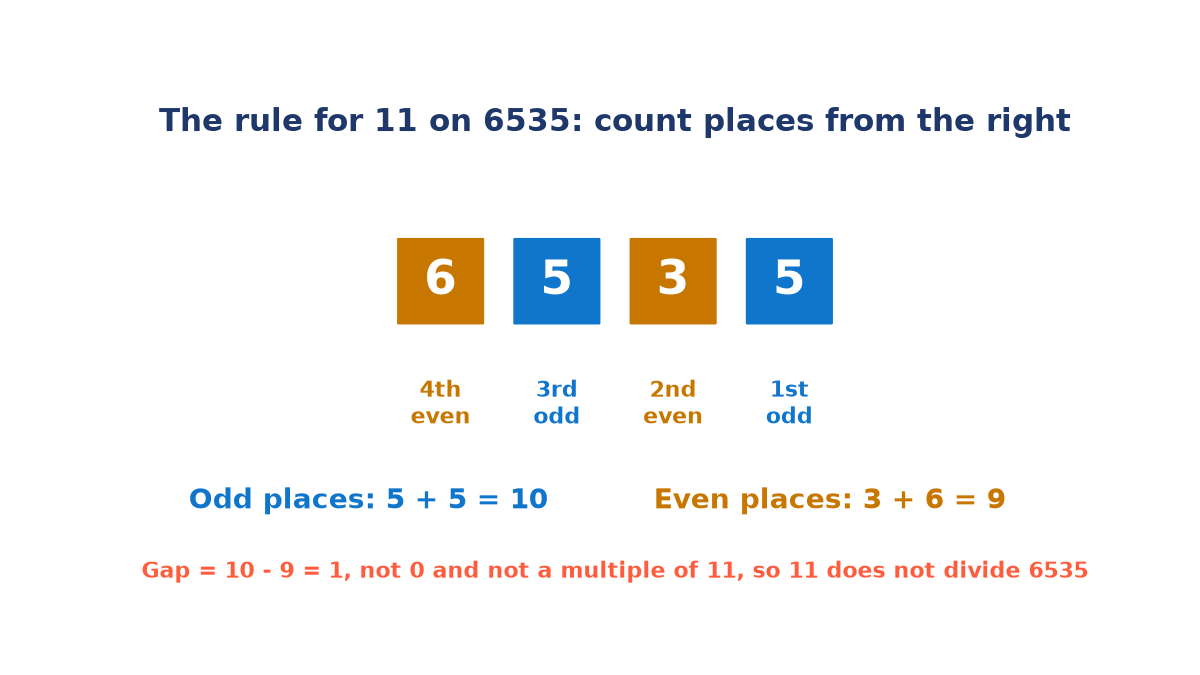
Count the places from the right. Add the digits at the odd places. Add the digits at the even places. Then find the gap between the two sums. A natural number is divisible by if that gap is or is divisible by .
Counting from the right is the part to watch. The units digit sits in the 1st place. That place is odd. The tens digit sits in the 2nd place. That place is even. The places then take turns all the way to the front.
| Place, counting from the right | Digit of | Odd or even place |
|---|---|---|
| 1st, the units | odd | |
| 2nd, the tens | even | |
| 3rd, the hundreds | odd | |
| 4th, the thousands | even |
1221
The two sums are equal. So the gap is , and counts. is divisible by . Now take . Its odd places hold and . Its even places hold and .
6535
The gap is . That is not , and it is not a multiple of . So is not divisible by . Now look at what that turned out to be. It is the remainder itself. This happens when the odd places make the bigger sum. The gap must also be smaller than . Then the gap is the remainder every time. That is not by chance.
Two more before the reason. For , the odd places hold and , which add to ; the even places hold and , which also add to . The gap is , so . For , the odd places give and the even places give . The gap is , a multiple of , so .
Here is the reason. , and are all multiples of . Every place value sits right beside one of them.
Take the in the tens place of . Ten is one less than . So those three tens are three elevens with taken off. Those three elevens are a multiple of , so they can be ignored. The cannot be ignored. It still has to be taken away. So a digit in the tens place is taken away, not added.
The in the hundreds place works the other way round. A hundred is one more than . So five hundreds are five lots of , with over. And is elevens. So five lots of is five lots of elevens. That comes to elevens, which can be ignored. The left over is added on.
A thousand is one less than . So a digit in the thousands place is taken away, just like a tens digit.
Why the two sums work
Add up everything left behind. The digits at the odd places are added on. The digits at the even places are taken away. So you are left with the odd-place total minus the even-place total. That is the very gap the rule asks for.
Sometimes the even places make the bigger sum. Then take the smaller sum from the bigger one. The test asks for the size of the gap. It does not care which way round you write it.
Remember. Start at the units and add every other digit. Add up the rest. Are the two totals equal? Or is the gap between them a multiple of ? If either one is true, the number is divisible by . If neither is true, it is not.
The six rules together
Here are the six rules on one page. Each one comes with the example it was worked on. Cover the middle column first. See if you can say the test yourself before you look.
| Divisible by | The test | An example |
|---|---|---|
| it passes the test for and the test for | is even, and | |
| double the unit digit, then take it from the rest. The answer is or a multiple of | : | |
| , second test | split it into two blocks of three. Take one block from the other. The answer is or a multiple of | : |
| the last three digits are divisible by | : | |
| the digits add to a multiple of | : | |
| the unit digit is | ||
| add the digits at the odd places, then the digits at the even places. Take one total from the other. The answer is or a multiple of | : |
Every one of these rules swaps a long division for a short sum. That is all they are for. Does a rule ever leave you unsure? Then do the division. The rule was only ever a short cut to the same answer.
Your turn
Which of these are divisible by 6? Give both tests for each.
| 1) | 3) | 5) |
| 2) | 4) | 6) |
Test these for 7 by doubling the unit digit
| 1) | 3) | 5) |
| 2) | 4) | 6) |
Test these for 7 by splitting them into two blocks of three
| 1) | 3) |
| 2) | 4) |
Which of these are divisible by 8?
| 1) | 3) | 5) |
| 2) | 4) | 6) |
Which of these are divisible by 9?
| 1) | 3) | 5) |
| 2) | 4) | 6) |
Which of these are divisible by 10?
| 1) | 2) | 3) | 4) |
Which of these are divisible by 11?
| 1) | 3) | 5) |
| 2) | 4) | 6) |
Every rule at once
- Test by all six rules in this lesson. Which one does it fail?
- Test by all six rules in this lesson. Which one does it fail?
Common mistakes
- Using only one test for . is even but its digits add to , so it is not divisible by .
- Combining tests that share a factor, such as and for . Only coprime pairs can be combined.
- Adding the doubled unit digit in the rule for instead of taking it away.
- Checking only the last two digits for . The rule needs the last three.
- Mixing up the rules for and . A digit sum of passes for but not for .
- Accepting a in the units place for . Only a passes.
- Counting places from the left in the rule for , or forgetting that a gap of counts as a pass.
Key terms
- Factor
- A number that divides another exactly, leaving nothing over.
- Divisible
- Able to be divided by a number with remainder .
- Divisibility rule
- A short test that decides divisibility without long division.
- Coprimes
- Two numbers whose only common factor is , such as and .
- Remainder
- What is left over after dividing.
- Place value
- What a digit is worth because of where it sits: ones, tens, hundreds and so on.
- Digit sum
- The total of all the digits of a number.
- Natural number
- A counting number
Answers
Divisible by 6?
- : even, and is a multiple of . Yes; .
- : even, and . Yes; .
- : odd, so it fails the test for (its digit sum fails for too). No.
- : even, and . Yes; .
- : its digit sum passes for , but it is odd. No.
- : even, and . Yes; .
Divisible by 7, doubling the unit digit
- : . Yes; .
- : . Yes; .
- : , not a multiple of . No.
- : . Yes; .
- : . Yes; .
- : , not a multiple of . No.
Divisible by 7, blocks of three
- : . Yes.
- : . Yes.
- : , and . No.
- : . Yes.
Divisible by 8?
- : . Yes.
- : . Yes.
- : . No.
- : . Yes.
- : . No.
- : the last three digits are , which is . Yes.
Divisible by 9?
- : digit sum . Yes.
- : digit sum . Yes.
- : digit sum . Yes.
- : digit sum . No.
- : digit sum . Yes.
- : digit sum . No.
Divisible by 10?
- : ends in . Yes.
- : ends in . No.
- : ends in . Yes.
- : ends in . No.
Divisible by 11?
- : odd places , even places , gap . Yes.
- : odd places , even places , gap . Yes.
- : odd places , even places , gap . Yes.
- : odd places , even places , gap . Yes.
- : odd places , even places , gap . No.
- : odd places , even places , gap . No.
Every rule at once
- passes for (even, digit sum ), (), (digit sum ), (ends in ) and (). It fails the rule for : .
- passes for (even, digit sum ), (), (), (digit sum ) and (). It fails the rule for , because it ends in .