Two school bells start ringing together at nine o'clock. One rings every minutes. The other rings every minutes. When will they next ring at the same moment? The answer is the least common multiple of and . The same idea tells you when two buses meet again at a stop, how many biscuits to buy so they pack evenly into two sizes of box, and, later on, how to add fractions such as .
Take a number and multiply it by , then by , then by , and keep going as long as you like. Each answer you get is a multiple of that number. So the multiples of are and on without end.
Every number has a list like that. You can carry the list on as far as you like.
The lesson before this one looked down from a number. It looked at the factors that divide into it. It asked for the biggest factor two numbers share.
Now we look the other way, up at the numbers a number divides into, and ask for the smallest one that two or more numbers share.
What a common multiple is
The academy's definition is short. It says this: the L.C.M of two (or) more natural numbers is the least common multiple of the given numbers. Take it one word at a time.
Natural numbers are the counting numbers, and on. A multiple of is a number that divides into exactly. A common multiple of and is a number both of them divide into. The least of those is the L.C.M.
Numbers like that are not rare. , and are all common multiples of and . The list goes on without end.
Each row of that grid says the same thing twice. The number is so many lots of . It is also so many lots of . That is what makes it common to them both.
The list of common multiples has no end. But it does have a start. That start is the L.C.M.
Remember. A common multiple of some numbers is a number they all divide into exactly. The L.C.M is the smallest common multiple there is.
1st method (By writing the multiples)
Give each number a line of its own. Write out its multiples along that line. Keep going until one number has turned up on every line. The first number that does is the L.C.M.
Find the L.C.M of
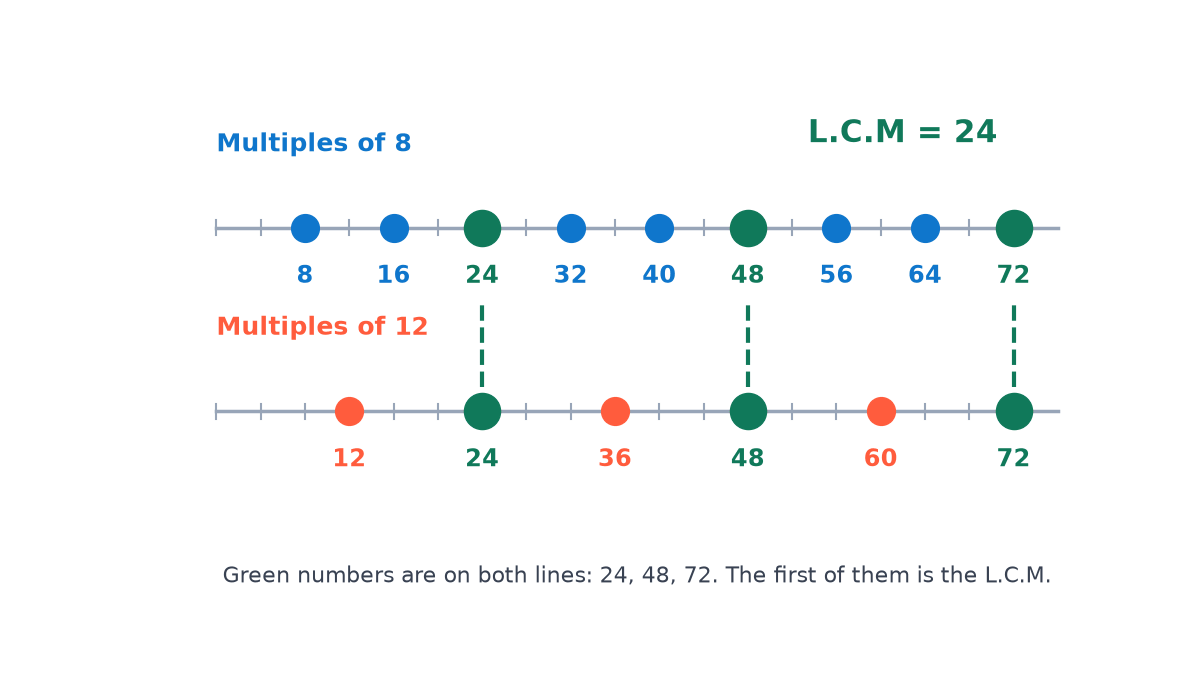
Only a number standing on both lines can be common to and . The smallest of those is . Look at the three the sheet lists: , then , then . Each one is more than the one before.
That is no accident. Add another and you add three more lots of . You add two more lots of as well. So you land on a number both of them still divide into. That is why , and .
Find the L.C.M of
This time only stands on all three lines. Take care here. Two lines out of three is not enough. Look at . It is on the first line and the third. But is not divisible by . Divisible means it divides in exactly. Nothing is left over. Now look at . It is on the second line and the third. But is not divisible by .
The method is slow and honest. It shows you just what an L.C.M is. That is why it comes first.
It also shows you its own limit. Try to reach the L.C.M of and this way. You would be writing lists for a very long time. That is what the next two methods are for.
Remember. The L.C.M is the first number that turns up in every one of the lists. Turning up in most of them counts for nothing.
The picture below shows the two lists for and as dots on number lines. The green dots are the numbers that stand on both lines.
A small one to try first
Find the L.C.M of
Notice that the L.C.M is not simply . That product is a common multiple, but it is not the least one. The two numbers share a factor of , and that is why a smaller common multiple exists.
2nd method (Prime factorization method)
The academy sets the method out like this: we prime factorize the given numbers. Then the product of the highest powers of all the factors that occur in any of the given numbers is the L.C.M. That is a lot of words at once. Take them a few at a time.
Start with product. A product is what you get when you multiply numbers together. So the L.C.M here is one long multiplication. Your job is to find out what goes into it.
Next comes occur in any of. A factor occurs in a number when it turns up inside it. So a factor that occurs in any of the given numbers turns up inside at least one of them. It does not have to be in all of them. One is enough.
Two more words come from earlier lessons. The first is prime factorisation. That means writing a number as a product of primes. So you write it as some primes multiplied together. Primes are the numbers picked out in Prime and composite numbers.
A composite number is one you can make by multiplying smaller numbers together. A composite number breaks into primes in one way only. Prime factorisation and the standard form of a number shows that. So the primes you find below are the number's own. They are not an accident of where you started.
The other word is power. A power is the short way of writing as . It is taught in Letters that stand for numbers. So the highest power of a prime means this. It is the most times that prime turns up inside any one of the given numbers.
Here is why the highest power is the right thing to take. Breaking a number into primes shows what it is built from. Take . So any number that divides into must carry three s inside it.
In the same way . So any number that divides into must carry two s. A number that both of them divide into needs three s and two s. Take fewer and one of them will not fit. Take more and the number is bigger than it had to be.
The L.C.M of
First break both numbers up: and .
| Number | Its prime factors | Written in powers |
|---|---|---|
| The highest power of each |
Only two primes turn up anywhere: and . The most s in any one of the numbers is three. Those three are inside . The most s is one, inside . Multiply those together and nothing else.
L.C.M of
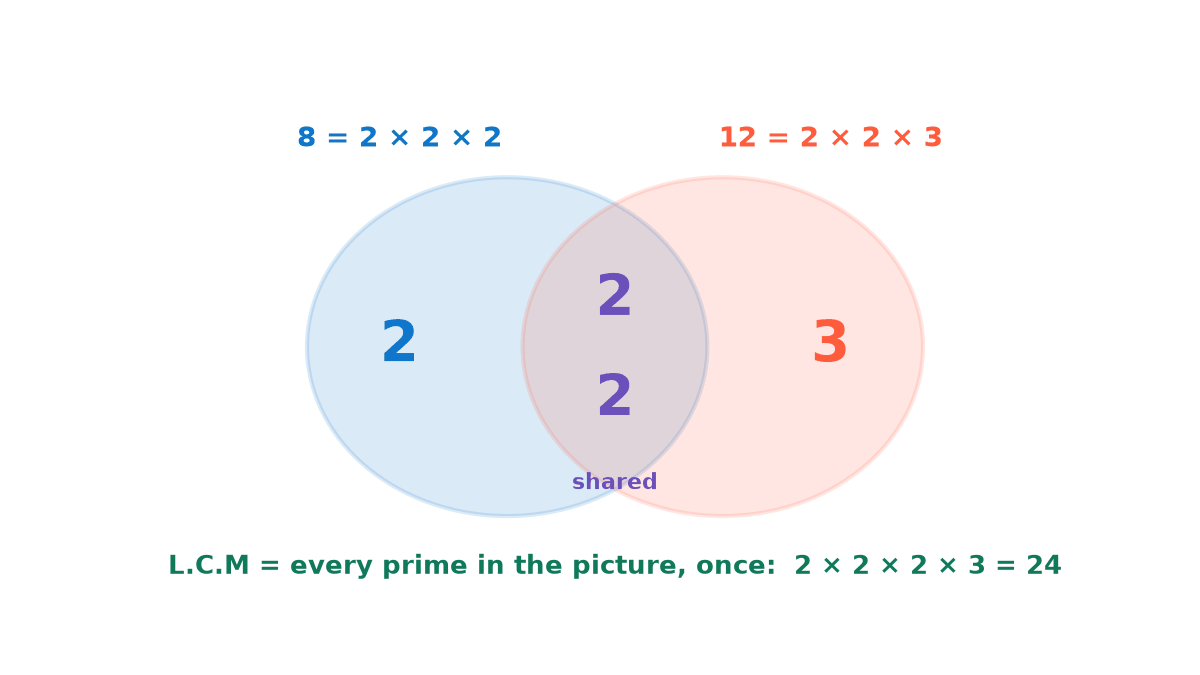
A Venn diagram shows the same working at a glance. The primes that and share sit in the middle. The ones that belong to only one number sit on its own side. The L.C.M takes every prime in the picture, each one once.
The L.C.M of
Break all three up first. . Then and .
| Number | Its prime factors | Written in powers |
|---|---|---|
| The highest power of each |
The most s in any one of them is three, in . The most s is two, in . Now look at . It is built from two s and a . Both of those are inside the counts already. So adds nothing new to the answer.
L.C.M of
It is worth testing an answer you have not seen listed. and . So all three numbers divide into it exactly. It is the same the first method reached by the longer road.
Remember. Every prime that turns up in any of the numbers must turn up in the L.C.M. Count how many times it appears in each number. Then take the biggest of those counts.
One more: the L.C.M of
Each of these numbers is a product of two different primes: , and . Only three primes turn up anywhere, and each turns up at most once in any one number.
Check it: . Multiplying the three numbers together gives , which is a common multiple too, but thirty times too big.
3rd method (Division method)
Write all the given numbers in a line, with commas between them. Find a number that divides at least two of them. Write that number out to the left. It is the divisor for the row.
Now go along the row. Under each number the divisor divides, write the answer to that division. divided by is , so goes under the . That answer is called the quotient. Any number the divisor does not divide comes straight down, unchanged.
Then start a new row and do the same again. Stop when no number bigger than divides two of the numbers left along the bottom. Numbers that share nothing but are called coprime.
The L.C.M is then the product of everything round the outside. So you multiply the divisors down the side by the coprimes along the bottom. Those rows of divisions make a shape like a ladder. In the ladders below, the upright line only splits the divisor from the row it divides. It is not a sum to work out.
Find the L.C.M of
Look at what happened. Both and can be halved. So went out to the side, and went underneath. Both of those halve again. That leaves and .
Nothing but divides both and . So they are coprime, and the ladder stops. Now multiply the side by the bottom: . That is the answer both of the other methods gave.
That down the side was a factor and were both carrying. Writing it once on the outside is how it gets counted once instead of twice. What is left along the bottom is the part of each number the other did not share.
The divisor need not be a prime. Look at . It divides both and . So you could have taken at the first step. You would end with , the same answer. But taking one small factor at a time keeps the rows easy to read.
Find the L.C.M of
The first halves and . It leaves where it is. That is because is not divisible by . Halving it would not come out exactly. So comes straight down. The second halves and .
Then divides and . This time it is the that comes down untouched. The bottom row is . No number bigger than divides any two of those. So they are coprime. The ladder is finished: .
Remember. The ladder is the rows of divisions you have built. It stops when the numbers along the bottom are coprime. Those numbers are the quotients. They are what is left of each number after the dividing. Coprime means nothing but divides any two of them. Then multiply everything down the side and along the bottom.
The three methods on one question
All three land on the same number. A set of numbers has only one least common multiple. What changes is how much writing each one costs. Each row below is only a short reminder. The full working for every method is further up the page.
| Method | What you do | L.C.M of |
|---|---|---|
| 1st method (By writing the multiples) | List the multiples of each number. Stop when one number stands on every line. | |
| 2nd method (Prime factorization method) | Break each number into primes. Take each prime the most times it turns up in any one number. Then multiply them all. | |
| 3rd method (Division method) | Divide the row by a number that goes into at least two of them. Keep going until the bottom row is coprime. Then multiply round the outside. |
Use the first when you want to see what is going on. Use the second when the numbers break into primes easily. Use the third when there are three or four numbers at once.
Using the L.C.M
Back to the bells
The bells ring together at nine o'clock. The first rings at minutes past. The second rings at minutes past. The first time on both lists is the L.C.M, . So the bells next ring together at minutes past nine, and after that every minutes.
A check for two numbers
For two numbers only, there is a neat link with the H.C.F from the lesson before. The H.C.F of and is . Multiply it by the L.C.M.
The H.C.F times the L.C.M of two numbers always equals the two numbers multiplied together. Use it as a check. Take care: it does not work for three or more numbers.
Your turn
Find the L.C.M of each set. Check each answer before you move on. Divide it by each of the given numbers in turn. Every one of those divisions should come out exactly. That much proves your number is a common multiple.
You still have to know it is the least one. So make sure no smaller common multiple passes the same test. With the division method, check one thing. Was the bottom row really coprime before you multiplied?
The twelve sets under the next two headings are not on the academy sheet. They are here to give you smaller numbers to work with. Walk the first two methods through them. The academy's own exercises come after.
Extra practice: by writing the multiples
| 1) | 3) | 5) |
| 2) | 4) | 6) |
Extra practice: by prime factorisation
| 1) | 4) |
| 2) | 5) |
| 3) | 6) |
The academy's own exercises
These three are the sheet's own. It asks for the first by the division method by name. Take the other two whichever way you like.
Take the last set slowly. The method does not mind large numbers. But the multiplication at the end needs care.
Common mistakes
- Multiplying the numbers together and calling that the L.C.M. , but the L.C.M of and is .
- Stopping at a number that is on most of the lists but not all. is a multiple of and but not of .
- Taking the lowest power of a prime instead of the highest. That gives the H.C.F, not the L.C.M.
- Leaving out a prime that turns up in only one of the numbers.
- Stopping the division ladder before the bottom row is coprime, or forgetting to multiply in the numbers along the bottom.
Key terms
- Multiple
- A number that a given number divides into exactly, such as for .
- Common multiple
- A number that every one of the given numbers divides into exactly.
- L.C.M
- The least common multiple: the smallest of the common multiples.
- Prime factorisation
- Writing a number as a product of primes, such as .
- Power
- A short way to write repeated multiplying, such as .
- Divisor
- The number written at the side of each row in the division method.
- Quotient
- The answer to a division, written under the number that was divided.
- Coprime
- Numbers that share no factor except .
Answers
Extra practice by writing the multiples
- : the multiples of are and of are . L.C.M .
- : and . L.C.M .
- : and . L.C.M .
- : and . L.C.M .
- : and . L.C.M .
- : and . L.C.M .
Extra practice by prime factorisation
- , . L.C.M .
- , . L.C.M .
- , . L.C.M .
- , . L.C.M .
- , , . L.C.M .
- , , . L.C.M .
The academy's own exercises
1. L.C.M of by the division method
The bottom row is coprime. L.C.M .
2. L.C.M of
L.C.M . By primes: .
3. L.C.M of
Here , and is prime, so no two of the bottom numbers share a factor. L.C.M . By primes: .