You learned to count before you learned any other maths. One, two, three, four. Now it is time to give those numbers their proper name. After that we add just one more number to make a second family, and then we sort every one of those numbers into two halves.
Natural numbers
Counting numbers are called natural numbers. The set of natural numbers has a short name. That name is . You write the set like this: .
They are called counting numbers because counting is what they do. Tip out a bag of marbles. You want to know how many there are. So you touch them one at a time. You say one, two, three. You never start at zero. Before you touch the first marble, you have not counted anything yet. So the natural numbers start at .
There is no last natural number. Pick any one you like. You can add to it. What you get is a counting number too. So the list is written with dots on the end. The dots are not laziness. They are the only honest way to write a list that never stops.
Read that line aloud like this. is the set whose members are , , , and so on. The three dots sit inside the brackets. They mean carry on the same way, for ever. You need them here. You could write all day and never reach the end of .
Remember. The natural numbers are the counting numbers. They start at . They never end.
Whole numbers
The natural numbers along with are called whole numbers. The set of whole numbers has the short name . You write it like this: .
Zero needed a home somewhere. Sometimes you ask how many and there is nothing there at all. Zero is the answer you give then. You cannot count up to zero. So it is not a counting number. But you still need to write it down. Maths keeps a second family with room for it.
Why zero is the only difference
| Family | Written as | Smallest member | Is in it? |
|---|---|---|---|
| Natural numbers, | no | ||
| Whole numbers, | yes |
Put the two rows side by side. The whole story is there. Every natural number is a whole number too. Here is why. After its , the set carries on with . That is just what does. But one whole number is not a natural number. That number is . It is the only difference between the two sets.
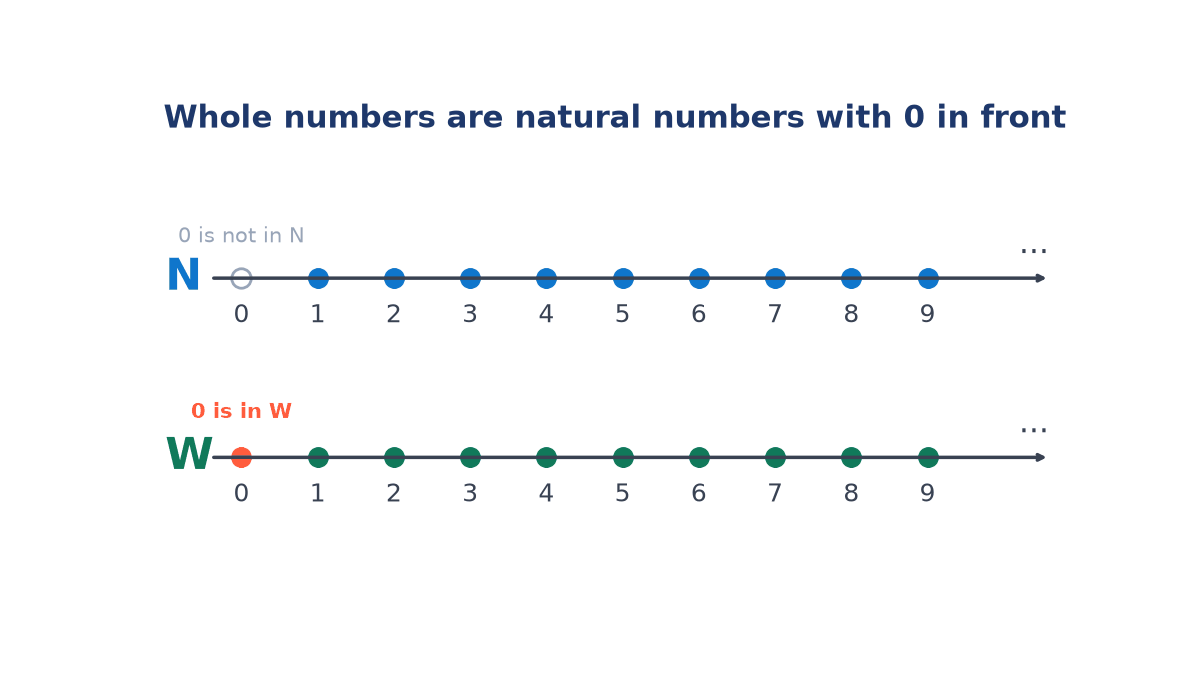
Think of where you meet each family. The number of pages in a book, the players in a team, the steps to your door: these are natural numbers. The goals scored in a match, the marks lost on a test, the sweets left in a tin: these can be , so they are whole numbers.
Remember. is with put in front. Nothing else is added. Nothing is taken away.
Even numbers
Share a number out into pairs. What is left at the end is called the remainder. Some numbers leave nothing at all. Numbers which give zero as remainder when divided by are called even numbers. For example are even numbers.
Dividing by asks how many pairs a number makes. Take counters. Pair them up. You get three pairs. Your hands are empty. Nothing is left over. The remainder is . So is even. An even number can be shared between two people. Nothing is left in the middle.
Every one of those divisions comes out exactly. Nothing is left after it. That is what makes each of those numbers even.
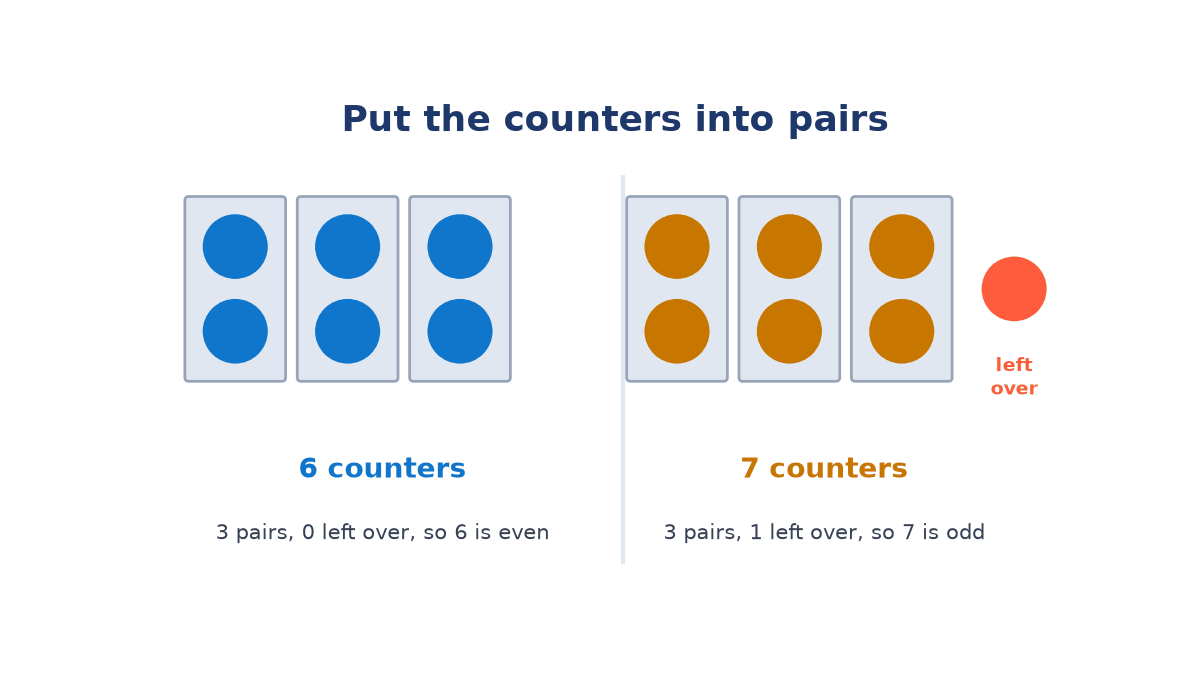
46
There are pairs. The remainder is . So is even. Nothing stands outside the pairs.
Odd numbers
Other numbers leave one over. Numbers which give as remainder when divided by are called odd numbers. For example are odd numbers.
Try to pair up an odd number of counters. One is always left standing on its own. It has nobody to go with. That lonely counter is the remainder .
| Odd number | Pairs it makes | Left over |
|---|---|---|
| no pairs at all | ||
| one pair | ||
| two pairs | ||
| three pairs | ||
| four pairs |
53
There are pairs. is left over. So is odd. Now look at how the working is written. You cannot put on one side of an equals sign and on the other. Why not? Because is not the whole answer. The that is left belongs to it as well. Writing keeps both parts together. It says just what happened.
Every whole number is one or the other
Divide by and take away all the pairs you can. What is left is the remainder. You could not take one more pair away. So what is left has to be smaller than . So it can only be or . A remainder of means the number is even. A remainder of means it is odd. There is no third answer. So no whole number can be both. And no whole number can be neither.
| Number | Pairs it makes | Left over | Even or odd |
|---|---|---|---|
| even | |||
| odd | |||
| even | |||
| odd | |||
| even | |||
| odd | |||
| even | |||
| odd | |||
| even | |||
| odd | |||
| even | |||
| odd |
Read the table two rows at a time. and both make a heap of pairs. makes of them. makes . The only difference is what is left over. leaves nothing. leaves one counter. Every row works the same way. So the left-over column is the one that decides.
Notice too that sits at the top of the even column. Zero counters make no pairs. They leave nothing over. So the remainder is . That makes zero even. It is why the list of even numbers starts with .
Remember. Divide by and look at what is left. Nothing left means even. One left means odd.
Telling even from odd at a glance
You do not have to divide every time. Just look at the last digit. It is the one at the unit place. A number is even if its unit digit is , , , or . Is the unit digit anything else? Then the number is not even. And you know from the section above what that means. A whole number that is not even is odd.
Look at the tens first. Every ten is . So one ten splits into two fives with nothing over. Any number of tens splits the same way. So the tens can never leave anything over. That leaves only the unit digit to leave anything over. That is why is even and is odd. You do not have to divide at all. This shortcut has a name. It is the Divisibility Rule for 2. The name means a rule for telling when one number divides by another with nothing left over. The lesson Divisibility rules for 2, 3, 4 and 5 states it and works it through. It gives the rules for , and as well.
Remember. Look only at the last digit. A number ending in or is even.
Worked examples with bigger numbers
Example 1. Is even or odd? Step 1: the unit digit is . Step 2: is in the list . So is even. Check by dividing:
Example 2. Is even or odd? Step 1: the unit digit is . Step 2: is not in the even list. So is odd. Check:
Example 3. A class has children. Can they all stand in pairs? The unit digit of is , so is odd. There will be pairs and one child left over, because .
Your turn
Say whether each number is even or odd
| 1) | 4) | 7) | 10) |
| 2) | 5) | 8) | 11) |
| 3) | 6) | 9) | 12) |
Answer these in words
Show answers
- Write down the first six natural numbers.
- Write down the set , showing its first five members and the dots.
- Which number is a whole number but is not a natural number?
- Is every natural number also a whole number? Say why.
- The dots in stand for something. What?
- A number leaves a remainder of when it is divided by . What is such a number called?
- A number leaves a remainder of when it is divided by . What is such a number called?
- Explain why no whole number can be even and odd at the same time.
Common mistakes
- Starting the natural numbers at . Counting starts at , so is not in .
- Thinking zero is neither even nor odd. Zero leaves remainder when divided by , so it is even.
- Leaving out the dots when writing or . Without them the list looks as if it stops.
- Looking at the first digit to decide even or odd. Only the unit digit matters: is odd, is even.
- Writing . The remainder must be kept: .
Key terms
- Natural numbers
- The counting numbers , written as the set .
- Whole numbers
- The natural numbers together with , written as the set .
- Set
- A collection of members, written inside curly brackets.
- Remainder
- What is left over after sharing out as many equal groups as you can.
- Even number
- A whole number that leaves remainder when divided by .
- Odd number
- A whole number that leaves remainder when divided by .
- Unit digit
- The last digit of a number, in the ones place.
Answers
Even or odd
- : odd
- : even
- : even
- : odd
- : even
- : odd
- : even
- : odd
- : even
- : odd
- : even
- : odd
Answers in words (model answers)
Show answers
- .
- .
- .
- Yes. contains and then , which is every natural number.
- They mean the list carries on the same way for ever; there is no last natural number.
- An even number.
- An odd number.
- When a whole number is divided by , the remainder is either or , never both. Remainder means even and remainder means odd, so a number cannot be both.