Purchase management is the planned and controlled buying of the materials, parts, equipment and services an organisation needs. The classic definition says its job is to obtain the right material, of the right quality, in the right quantity, at the right time, from the right source, at the right price. It is not simply "buying something"; it is a sequence of decisions and documents that starts with a need and ends only when the goods are received, checked, paid for and recorded.
The topic matters because no factory, hospital, college or shop can deliver anything until its inputs arrive. In most manufacturing firms bought-in materials are a large share of total cost, so a small saving in purchasing goes straight to profit, and a small mistake (late steel, poor flour, too few boxes) can stop production, damage quality and upset customers.
Why purchase management is important
Every organisation depends on purchasing in some way:
- A factory needs raw materials, components, spare parts, tools and packaging materials.
- A hospital needs medicines, surgical items, medical equipment and cleaning supplies.
- A college needs computers, furniture, stationery and maintenance materials.
If purchasing is poor, production may stop, quality may suffer, costs may rise, deliveries may be delayed and customers may become unhappy. Good purchasing, on the other hand, supports smooth operations, keeps money from being locked up in excess stock, and builds dependable supplier relationships.
A simple example
Suppose a bakery makes cakes and biscuits from flour, sugar, butter and eggs, and packs them in boxes. If it buys poor-quality flour, too much sugar, too few boxes, and receives some items late, then product quality falls, money is blocked in excess sugar, production is delayed, and some customer orders cannot be completed. Careful buying avoids all four problems; that careful buying is purchase management.
Objectives of purchase management
The central objective is to ensure the timely availability of materials of suitable quality at the lowest total cost. To achieve this, the purchase function balances quality, cost, time, quantity and supplier reliability. The cheapest purchase is therefore not always the best purchase. Supporting objectives include:
- maintaining continuity of supply so that production never stops for want of material;
- keeping investment in inventory as low as is safe;
- developing reliable suppliers and good long-term relationships;
- standardising items where possible to reduce variety;
- keeping honest, transparent records that can be audited;
- watching market trends so that price rises and shortages are anticipated.
The six "rights" of purchasing
The six rights are the easiest way to remember what purchasing tries to achieve.
| Right | Meaning | What goes wrong if it is missed |
|---|---|---|
| Right material | Exactly the item specified | A hospital that needs surgical gloves cannot use household gloves |
| Right quality | Quality suited to the use, not the highest possible | Too low: failures and complaints. Too high: money wasted |
| Right quantity | Quantity matched to actual need | Too much: excess stock and blocked cash. Too little: shortages |
| Right price | A fair price after comparing quotations, market rates, discounts and total cost | Overpaying, or choosing a cheap offer that costs more later |
| Right source | A supplier who is trustworthy, capable and punctual | Late deliveries, rejections, dependence on a weak supplier |
| Right time | Arriving before it is needed, but not so early that it clutters storage | A late purchase can stop production; an early one ties up space and money |
Some textbooks add a seventh right, the right place (delivery to the correct plant or store), and a few also mention the right mode of transport.
Scope and functions of purchase management
The scope of purchasing covers identifying the need, finding and selecting suppliers, obtaining and comparing quotations, negotiating price and terms, placing the order, following up delivery, checking quality, receiving goods, approving payment and maintaining records. The main functions are described below.
Identifying material requirements
The organisation must first know what is needed, how much and by when. This information comes from the production, stores, maintenance and project departments. If the requirement itself is wrong, the whole purchase goes wrong.
Searching for suppliers
Possible suppliers are found through existing supplier lists, market surveys, websites, catalogues, advertisements, references and tenders.
Selecting suppliers
Suppliers are compared on price, quality, delivery record, reputation, lead time and service support. Choosing the supplier is one of the most important purchasing decisions, and it is covered in depth under vendor selection and vendor rating.
Negotiating price and terms
The buyer may negotiate price, transport terms, payment terms, discounts, delivery dates and replacement terms. Good negotiation controls cost without harming quality.
Placing the purchase order
A purchase order is the formal document that tells the supplier what item is needed, how much, at what price, when it must be delivered and where it should be sent. Once accepted, it forms a legal contract.
Follow-up and expediting
Suppliers sometimes slip. The purchase department follows up open orders, and chases urgent ones (expediting), so that materials arrive on time.
Receiving and inspection
On arrival, goods are checked for quantity, quality, damage and conformity to specification, so that wrong or defective material does not enter stock.
Record keeping
Records of suppliers, orders, quotations, prices, delivery performance and payments support future decisions, vendor rating and audit.
The purchase procedure
The purchase procedure is the step-by-step routine followed for each purchase. A typical sequence is shown below.
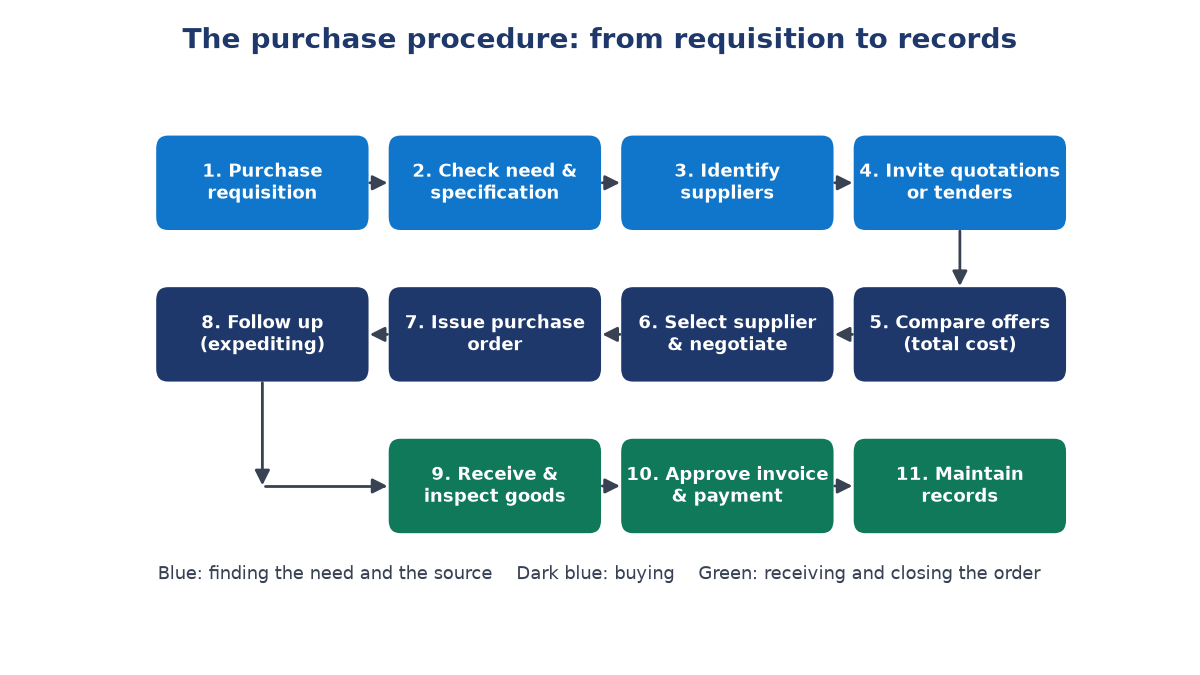
- Receive the purchase requisition.
- Check the need and the specification.
- Identify possible suppliers.
- Invite quotations or tenders.
- Compare the offers on total cost, not just price.
- Select the supplier and negotiate terms.
- Issue the purchase order.
- Follow up delivery.
- Receive and inspect the goods.
- Check the invoice against the order and the goods received note, then approve payment.
- Maintain purchase records.
Key documents
| Document | Prepared by | Purpose |
|---|---|---|
| Purchase requisition | User department or stores | Internal request to buy, for example "we need 500 kg of steel" |
| Request for quotation / tender | Purchase department | Invites suppliers to offer price and terms |
| Quotation | Supplier | Offer showing price, delivery time and payment terms |
| Comparative statement | Purchase department | Places competing quotations side by side |
| Purchase order | Purchase department | Official order to the chosen supplier |
| Goods received note | Stores | Confirms what actually arrived |
| Invoice | Supplier | Bill for payment, checked against order and receipt |
Matching the purchase order, the goods received note and the invoice before paying is called three-way matching; it prevents payment for goods that were never ordered or never received.
Worked example: comparing quotations on total cost
Suppose a bakery needs 1,000 kg of flour a month and receives three quotations. From past records it expects some flour to be rejected, and each rejected kilogram costs it ₹40 (the flour itself plus handling and lost baking time).
| Item | Supplier P | Supplier Q | Supplier R |
|---|---|---|---|
| Quoted price per kg | ₹30 | ₹31 | ₹32 |
| Freight per month | ₹2,000 | ₹1,000 | Free delivery |
| Expected rejection | 5% | 2% | 1% |
Step 1: purchase price. P: 1,000 × ₹30 = ₹30,000. Q: 1,000 × ₹31 = ₹31,000. R: 1,000 × ₹32 = ₹32,000.
Step 2: add freight. P: ₹30,000 + ₹2,000 = ₹32,000. Q: ₹31,000 + ₹1,000 = ₹32,000. R: ₹32,000 + ₹0 = ₹32,000.
Step 3: cost of rejections. P: 5% of 1,000 = 50 kg × ₹40 = ₹2,000. Q: 20 kg × ₹40 = ₹800. R: 10 kg × ₹40 = ₹400.
Step 4: total landed cost. P = ₹34,000; Q = ₹32,800; R = ₹32,400.
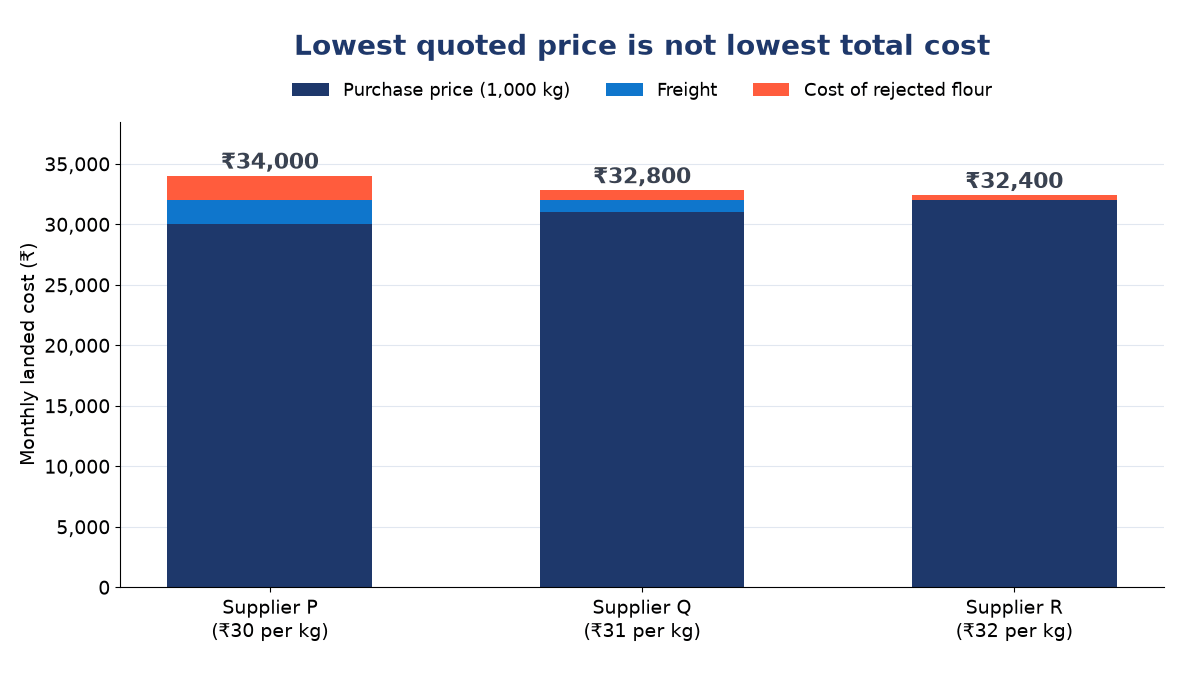
Decision: Supplier R, with the highest quoted price, is actually the cheapest by ₹1,600 a month compared with P. This is why purchasing looks at total cost of acquisition, not the price on the quotation.
How much to buy and when to reorder
Deciding the right quantity and the right time links purchasing with inventory control. Two standard tools are the economic order quantity (EOQ), first set out by Harris, and the reorder level.
Economic order quantity
EOQ is the order size that minimises the sum of annual ordering cost and annual holding cost:
where is annual demand, is the cost of placing one order and is the cost of holding one unit for a year.
Continuing the bakery example, suppose annual demand is kg, each order costs ₹500 to place and receive, and holding one kilogram for a year costs ₹3 (10% of the ₹30 price).
Number of orders a year = 12,000 ÷ 2,000 = 6. Annual ordering cost = 6 × ₹500 = ₹3,000. Average stock = 2,000 ÷ 2 = 1,000 kg, so annual holding cost = 1,000 × ₹3 = ₹3,000. Total = ₹6,000. At the EOQ the two costs are equal, which is a quick check that the answer is right.
Lead time and reorder level
Lead time is the gap between placing an order and receiving the material. If an order goes out on the 1st and arrives on the 6th, the lead time is 5 days. Long or uncertain lead times make purchasing harder because stock must last longer while the order is on its way.
The reorder level tells the buyer when to order:
If the bakery uses 40 kg a day, the lead time is 5 days and it keeps 100 kg as safety stock, the reorder level is kg. When stock falls to 300 kg, a new order for 2,000 kg is placed.
Methods of purchasing
Organisations choose a buying method to suit the item, the amount of money involved and the market.
| Method | How it works | Best for | Main risk |
|---|---|---|---|
| Open tender | Offers invited publicly | Government, public sector units, large formal purchases | Slow and paperwork-heavy |
| Limited tender | Only selected suppliers invited | Known suppliers, urgency, special quality | Less competition |
| Single-source buying | One supplier only | Sole supplier, patented product, brand standardisation | Heavy dependence on one firm |
| Multiple sourcing | Same item from two or more suppliers | Critical items needing security of supply | More coordination |
| Scheduled buying | One contract, deliveries in instalments | Steady usage, e.g. monthly deliveries of a year's need | Commitment if demand falls |
| Speculative buying | Buying beyond current need because prices are expected to rise | Commodities such as steel | Loss and blocked cash if prices fall |
| Just-in-time purchasing | Small, frequent deliveries timed to production | Stable demand, reliable nearby suppliers | Production stops if a supplier is late |
Other methods often listed are hand-to-mouth buying (only for immediate needs, useful when prices are falling or the item is rarely used), rate or running contracts (prices fixed for a period, orders placed as needed) and e-procurement through online portals and reverse auctions.
Supplier selection and vendor rating
A good supplier strengthens the whole operation; a poor one damages it. Selection should weigh quality consistency, cost competitiveness, delivery speed and reliability, location, service support, financial stability and communication. A supplier should never be chosen for low price alone, because poor quality or late delivery can create far bigger losses, as the worked example shows.
Vendor rating evaluates suppliers after business begins, usually on quality, price, delivery, service and lead time. It tells the buyer which suppliers deliver on time, which give good quality, and which should be continued or dropped.
Purchasing, production and cost control
Purchasing directly supports production. When materials are not bought properly, machines stop, workers wait, output falls and customer orders are delayed. Purchasing also affects many cost elements beyond price: freight, taxes, storage, handling, shortage cost and the cost of quality failures. The purchase department's aim is to lower total cost, not just the item price; cheap material that fails inspection usually ends up costing more.
Centralised and decentralised purchasing
| Basis | Centralised purchasing | Decentralised purchasing |
|---|---|---|
| Who buys | One central department for all units | Each branch or department buys for itself |
| Advantages | Better control, bulk discounts, uniform policy, specialist buyers, better supervision | Faster local response, flexibility, suits multi-location firms, uses local knowledge |
| Disadvantages | Slower for urgent local needs, less flexibility for branches | Less control, possible duplication, weaker bargaining power |
Many large firms use a mix: high-value, common items are bought centrally, while small or urgent local needs are bought by the branch.
Ethics in purchasing
Because purchasing spends the organisation's money, it is exposed to favouritism, bribes, buying without comparison, hiding supplier information and poor documentation. A sound system builds in transparency, proper documentation, fair treatment of suppliers, approval limits, separation of duties (the person who orders should not also approve payment) and clear accountability.
Problems in purchase management
- sudden price rises and market shortages;
- unreliable suppliers, delayed deliveries and transport problems;
- poor-quality materials and wrong quantities received;
- poor internal communication and weak demand estimates.
These call for continuous follow-up, backup suppliers and close links with production and stores planning.
Qualities of a good purchasing manager
Purchasing is both a technical and a commercial job, so a good purchase manager needs market knowledge, negotiation skill, cost awareness, honesty, communication skill, record-keeping ability, technical understanding of materials and sound judgement.
Purchasing and procurement
The two words are often used interchangeably, but purchasing usually means the buying transaction itself, while procurement is broader: need identification, supplier search, negotiation, purchasing, follow-up, receipt and payment coordination. Purchasing is one major part of procurement.
Exam-ready summary
Purchase management is the process of obtaining the right materials, of the right quality, in the right quantity, at the right time, from the right source and at the right price. It ensures smooth production, cost control, timely delivery and good supplier coordination. Its functions include identifying needs, selecting suppliers, obtaining quotations, negotiating, issuing purchase orders, following up, receiving and inspecting materials, and keeping records. Common methods are open tender, limited tender, single and multiple sourcing, scheduled buying, speculative buying and just-in-time purchasing. Decisions should be based on total cost of acquisition rather than quoted price.
Key terms
- Purchase requisition
- An internal request from a department asking the purchase department to buy a stated item and quantity.
- Purchase order
- The formal order sent to a supplier stating item, quantity, price, delivery date and place.
- Quotation
- A supplier's offer giving price, delivery time and payment terms.
- Lead time
- The time between placing an order and receiving the material.
- Landed cost
- The full cost of getting material into use: price plus freight, duties, handling and the cost of rejects.
- Economic order quantity
- The order size that minimises total annual ordering and holding cost.
- Reorder level
- The stock level at which a new order should be placed.
- Expediting
- Chasing a supplier to speed up an order that is late or urgent.
- Three-way matching
- Checking the purchase order, goods received note and invoice agree before payment.
Common questions
What are the objectives of purchase management?
To ensure uninterrupted supply of materials of suitable quality at the lowest total cost, keep inventory investment low, develop reliable suppliers, standardise items where possible and maintain transparent records.
Why is the lowest quotation not always accepted?
Because freight, rejections, delays and poor service add cost. In the worked example the ₹30 quotation led to a landed cost of ₹34,000, while the ₹32 quotation cost only ₹32,400.
What is the difference between centralised and decentralised purchasing?
In centralised purchasing one department buys for the whole organisation, gaining control and bulk discounts; in decentralised purchasing each unit buys for itself, gaining speed and flexibility at the cost of control and bargaining power.
What is the difference between scheduled buying and speculative buying?
Scheduled buying fixes one contract with deliveries spread over time to reduce storage. Speculative buying purchases more than current need because prices are expected to rise, which risks losses if prices fall.
What is the difference between a purchase requisition and a purchase order?
A requisition is an internal request to the purchase department; a purchase order is the external, legally binding document sent to the supplier after the source has been chosen.
How does lead time affect purchasing?
The longer the lead time, the more stock is needed to cover usage while an order is on its way, so the reorder level rises. Uncertain lead times also call for extra safety stock.
References
- Chary, S. N. Production and Operations Management. McGraw-Hill Education (India).
- Stevenson, W. J. Operations Management. McGraw-Hill Education.
- Heizer, J., Render, B. and Munson, C. Operations Management: Sustainability and Supply Chain Management. Pearson.
- Bedi, K. Production and Operations Management. Oxford University Press.
- Harris, F. W. (1913) "How Many Parts to Make at Once". Factory, The Magazine of Management, 10(2), 135–136.