Supply chain management (SCM) is the coordinated management of all the activities and organisations involved in getting a product from raw material to the final customer. It covers suppliers, manufacturers, warehouses, distributors, retailers and customers, and the flows of materials, information and money that connect them.
In simple terms, SCM makes sure the right product reaches the right customer, in the right quantity and condition, at the right time and at the lowest total cost. Customers rarely see the supply chain, but they feel it every time a product is in stock, arrives quickly and works as promised. Because firms increasingly compete as whole chains rather than as single companies, SCM has become one of the central topics of operations management.
Why supply chain management is important
Consider a packet of biscuits in a neighbourhood shop. Wheat, sugar and oil come from farmers and processors; packaging comes from a printing firm; the factory bakes and packs the biscuits; a warehouse stores them; distributors and retailers carry them to the shelf. If any link fails, the shelf is empty and the sale is lost. SCM coordinates all these links so that they act like one system.
Good SCM:
- reduces total cost across purchasing, production, storage and transport;
- improves product availability and delivery speed;
- cuts excess inventory while avoiding stock-outs;
- improves coordination between departments and partner firms;
- helps the business respond to changes in demand and to disruptions.
The main idea is that each firm should not optimise only its own part. Decisions are judged by their effect on the whole chain.
Stages of a supply chain
Supplier
Provides raw materials, components and services. Suppliers may themselves have suppliers, forming tiers.
Manufacturer
Converts inputs into finished products.
Warehouse
Stores raw materials and finished goods, and often sorts, packs and consolidates shipments.
Distributor
Buys in bulk from manufacturers and supplies smaller quantities to retailers over a wide area.
Retailer
Sells to final consumers through shops or online stores.
Customer
The final user, whose demand drives the whole chain.
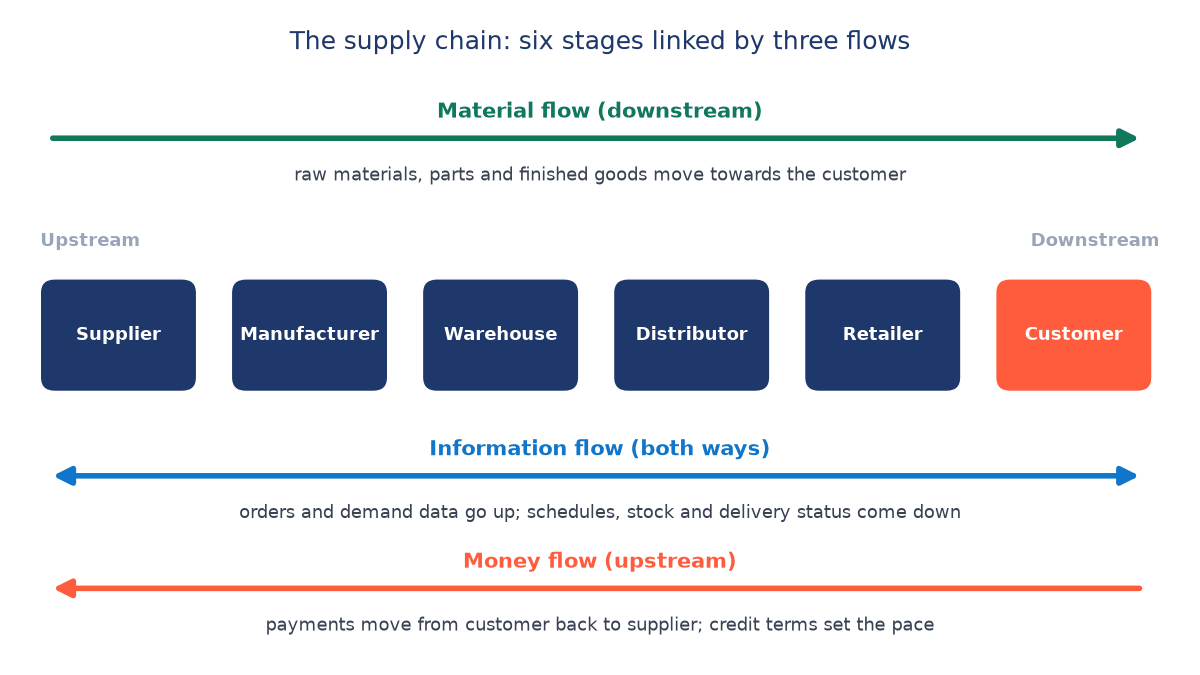
The side nearer to suppliers is called upstream; the side nearer to customers is downstream.
The three flows in a supply chain
- Material flow – raw materials, parts and finished goods move downstream towards the customer; returns, repairs and recycling move upstream (reverse logistics).
- Information flow – moves in both directions: orders, sales and forecasts go upstream; schedules, stock levels, shipping notices and delivery status come downstream.
- Money flow – payments move upstream from customer to supplier, shaped by prices, credit terms and invoicing.
Operations management versus supply chain management
| Basis | Operations management | Supply chain management |
|---|---|---|
| Scope | Activities inside one organisation | Activities across many organisations |
| Focus | Converting inputs into outputs efficiently | Moving materials, information and money from source to customer |
| Typical decisions | Capacity, layout, scheduling, quality, maintenance | Sourcing, supplier relations, distribution network, logistics, channel choice |
| Relationship | One part of the chain | Includes operations of every member |
Objectives of supply chain management
Ensure a smooth flow of materials
Inputs and products should move without interruption.
Reduce total cost
Cut the combined cost of buying, making, storing and moving, not just one of them.
Improve customer service
Raise availability, speed and reliability of delivery.
Reduce inventory problems
Avoid both overstocking and stock-outs.
Improve coordination
Share plans and data among partners so that decisions line up.
Increase speed and efficiency
Shorten lead times and the cash-to-cash cycle.
Components of supply chain management
- Purchasing (sourcing) – selecting suppliers, negotiating and buying inputs.
- Production – making the product to plan, on time and to quality.
- Inventory management – deciding how much stock to hold and where.
- Warehousing – storing, handling and consolidating goods.
- Transportation – choosing modes (road, rail, sea, air, pipeline) and carriers.
- Information management – ERP systems, barcodes, electronic data interchange and tracking.
- Distribution – designing the network that delivers products to customers.
Importance of information in SCM
Information is what allows partners to act together. When sales data, stock levels and forecasts are shared, each stage can plan production and orders more accurately. When information is missing or delayed, each stage guesses, adds its own safety margin and the chain holds more stock than it needs.
The bullwhip effect
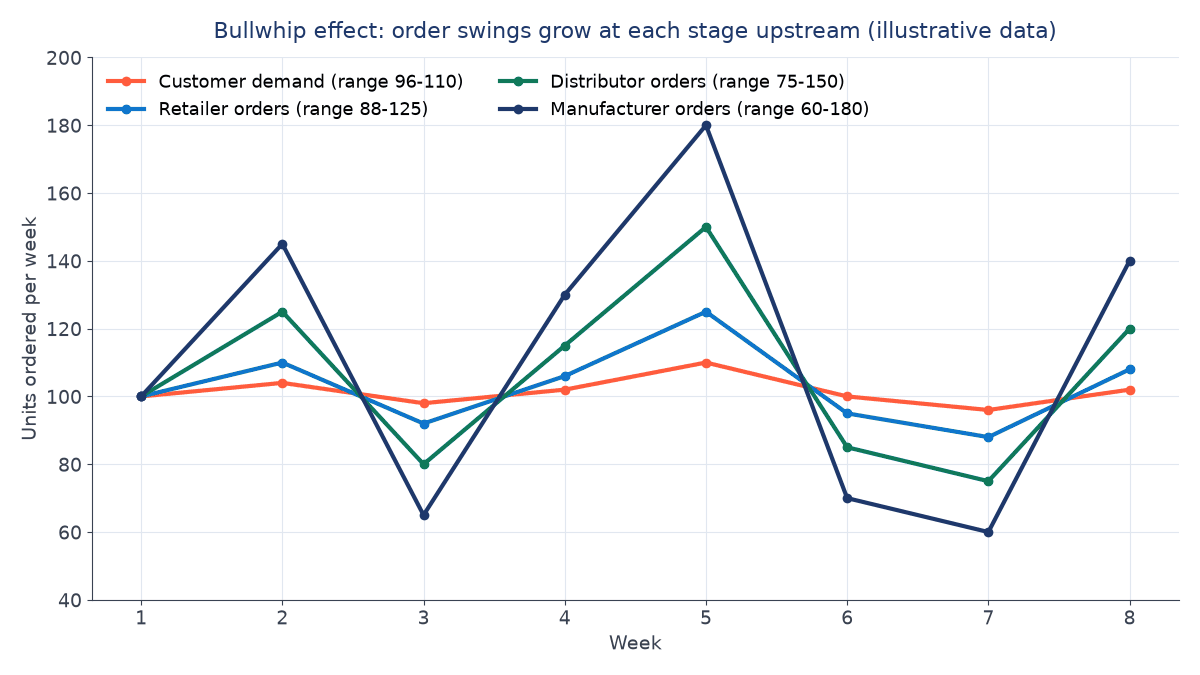
The bullwhip effect is the tendency for order quantities to swing more and more as one moves upstream, even when customer demand is fairly steady. Its causes include each stage forecasting from its own incoming orders, ordering in large batches, price promotions that encourage forward buying, and rationing during shortages. Sharing point-of-sale data, reducing lead times, ordering in smaller lots, stable pricing and vendor-managed inventory all reduce it.
Supply chains in manufacturing and services
Manufacturing example
A car maker buys steel, tyres, glass and electronics from many tiers of suppliers, assembles cars and sends them through dealers to buyers. Its supply chain is mostly about physical goods.
Service example
A hospital's supply chain brings medicines, equipment, food and linen, and depends on laboratories, ambulance services and insurers. Here the customer often takes part in the process, so capacity and information matter as much as goods.
Supply chain strategy and structure
Vertical integration
A company owns more than one stage of its own chain. Backward integration means owning suppliers, such as a steel maker buying iron ore mines; forward integration means owning distribution, such as a manufacturer opening its own showrooms. It reduces dependence on outsiders but needs large investment and reduces flexibility.
Horizontal integration
A firm joins with other firms at the same stage, for example one manufacturer merging with another. It increases scale and market share and may reduce competition.
Efficient and responsive supply chains
Functional products with stable demand, such as salt or soap, suit an efficient chain focused on low cost and high utilisation. Innovative products with uncertain demand, such as fashion garments or new phones, suit a responsive chain focused on speed and flexible capacity.
Channel strategy
Channel strategy decides how the product will reach the final buyer: through wholesalers, distributors, retailers, online stores or direct delivery. The choice affects cost, speed, market reach and customer experience.
Outsourcing
Outsourcing means giving activities such as transport, packaging, warehousing or component manufacturing to outside specialists, including third-party logistics (3PL) providers. It can reduce cost, bring expertise and let the firm focus on core activities, but heavy dependence on outsiders creates risk and must be managed through contracts and monitoring.
Role of suppliers and vendor rating
Suppliers provide the first inputs, so a weak supplier weakens the whole chain. Firms choose suppliers on quality, price, delivery reliability, lead time and service, and measure their performance with vendor rating systems that score suppliers on factors such as quality, cost and delivery. Price alone is a poor guide, as the example below shows.
Worked example: total landed cost of two suppliers
Suppose a manufacturer needs 10,000 units of a component a year, used evenly over 250 working days, that is 40 units a day. Two suppliers are available.
| Item | Supplier 1 | Supplier 2 |
|---|---|---|
| Price per unit | ₹48 | ₹45 |
| Transport per unit | ₹2 | ₹4 |
| Lead time | 4 days | 12 days |
| Defective rate | 0.5 per cent | 2 per cent |
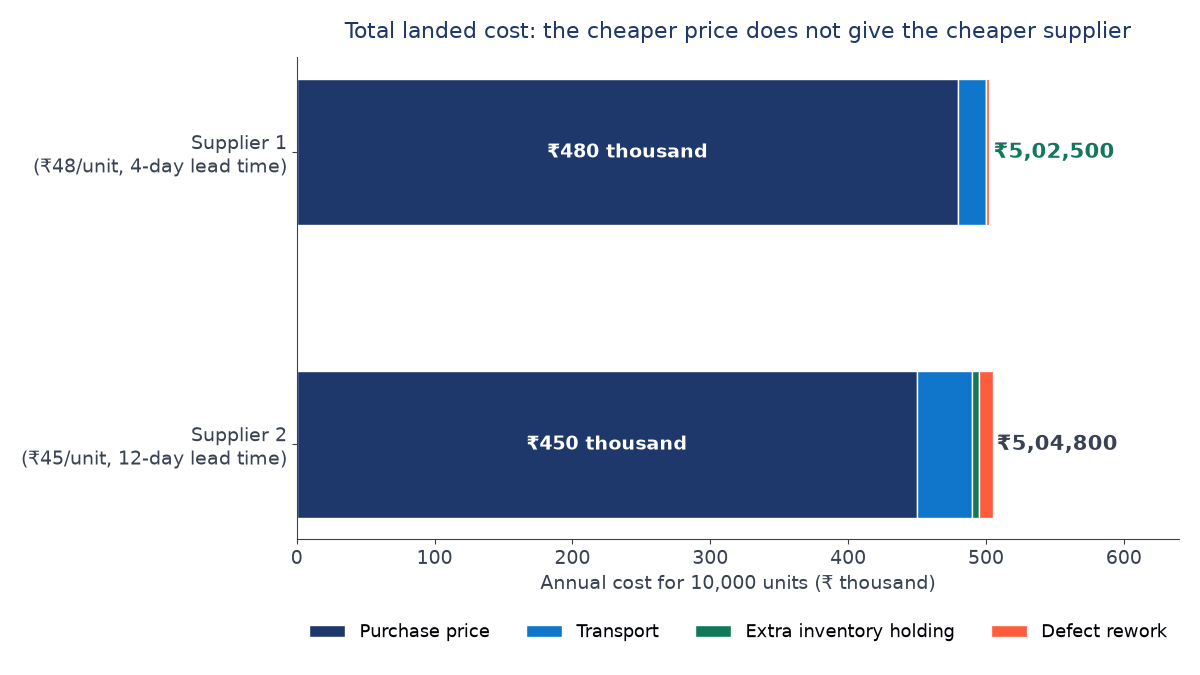
Assume each defective unit costs ₹50 to rework, and that the longer lead time of Supplier 2 forces the firm to keep 8 extra days of stock ( units) at a holding cost of ₹15 per unit per year.
Supplier 1:
- Purchase: = ₹4,80,000
- Transport: = ₹20,000
- Extra holding: ₹0
- Rework: defectives, and = ₹2,500
- Total landed cost = ₹5,02,500
Supplier 2:
- Purchase: = ₹4,50,000
- Transport: = ₹40,000
- Extra holding: = ₹4,800
- Rework: defectives, and = ₹10,000
- Total landed cost = ₹5,04,800
Although Supplier 2 is ₹3 cheaper per unit, Supplier 1 is cheaper overall by ₹2,300 a year. Once transport, inventory and quality are counted, the lower price does not give the lower cost.
Lead time in the supply chain
Lead time is the time between placing an order and receiving the material or product. If a company orders raw material on Monday and receives it on Friday of the same week, the lead time is 4 days. Shorter lead time improves response speed and reduces uncertainty and stock. It also sets the reorder point when demand is steady:
where is daily demand and is lead time in days. In the example above, Supplier 1 needs a reorder point of units, while Supplier 2 needs units, before any safety stock is added.
Measuring supply chain performance
Two common inventory measures are:
Worked example: inventory turnover
Suppose a distributor has an annual cost of goods sold of ₹60,00,000 and average inventory of ₹7,50,000.
- Inventory turnover times a year.
- Days of supply days.
The distributor holds about 46 days of stock. Raising turnover, for example to 10, would cut this to 36.5 days and free working capital. Other measures include order fill rate, on-time delivery percentage, perfect order rate and the cash-to-cash cycle.
Supply chain and customer value
A good supply chain increases customer value because products are available when needed, delivery is faster, stock-outs are fewer, goods arrive in good condition and service is more reliable.
SCM in e-commerce
When a customer orders a phone online, the order information reaches the seller's system, stock is checked at the nearest fulfilment centre, the item is picked, packed and handed to a courier, tracking updates flow back to the customer, and payment moves through the payment gateway to the seller. Speed depends on stock placement, warehouse processes and last-mile delivery working together.
Links with inventory and production
SCM decides where stock is held and how much, so inventory control is a core part of it: too much stock ties up money, too little causes lost sales. SCM also depends on production: the production plan sets what materials must be bought and when, and the delivery promise depends on the production schedule. This is why SCM is closely tied to production planning and control and to purchasing.
Problems in supply chain management
- Delayed supply – late inputs stop production.
- Transport issues – vehicle shortages, poor roads, port congestion and fuel price changes.
- Inventory imbalance – excess stock in one place and shortage in another.
- Poor coordination – partners working on different plans and data.
- Demand uncertainty – forecasts are wrong, feeding the bullwhip effect.
- Quality issues – defective inputs cause rework, returns and delays.
- Global disruptions – natural disasters, pandemics, conflicts and trade restrictions.
Benefits of good supply chain management
- Lower total cost and better profit margins.
- Higher product availability and customer satisfaction.
- Less working capital tied up in stock.
- Faster response to market changes.
- Stronger, longer-term relationships with suppliers and channel partners.
- Better resilience against disruptions.
Key terms
- Supply chain
- The network of organisations and activities that deliver a product from raw material to the final customer.
- Upstream and downstream
- Upstream is towards suppliers; downstream is towards customers.
- Bullwhip effect
- The growing variability of orders as they move upstream in a supply chain.
- Lead time
- The time between placing an order and receiving the goods.
- Vertical integration
- Ownership of more than one stage of the supply chain by one firm.
- Total landed cost
- Price plus transport, inventory, quality and other costs of getting an item to the point of use.
- Inventory turnover
- Cost of goods sold divided by average inventory; how many times stock is sold in a year.
- Third-party logistics (3PL)
- An outside firm that performs transport, warehousing or other logistics work for a company.
- Vendor rating
- A system that scores suppliers on factors such as quality, cost and delivery.
Common questions
What are the three flows in a supply chain?
Material flow, which moves mainly downstream; information flow, which moves both ways; and money flow, which moves mainly upstream.
How is supply chain management different from logistics?
Logistics deals with the movement and storage of goods. SCM is broader and also covers sourcing, supplier relations, production coordination, demand planning and information sharing across firms.
What causes the bullwhip effect and how can it be reduced?
It is caused by forecasting from orders rather than real demand, batch ordering, price promotions and shortage gaming. Sharing sales data, shorter lead times, smaller orders and stable pricing reduce it.
Why should a firm not choose the supplier with the lowest price?
Because transport, inventory, quality and delivery reliability add costs. In the example above, the cheaper supplier cost ₹2,300 more per year once these were counted.
What is the difference between vertical and horizontal integration?
Vertical integration joins different stages of the same chain, such as a manufacturer owning its suppliers. Horizontal integration joins firms at the same stage, such as two manufacturers merging.
References
- Chopra, S. and Meindl, P. Supply Chain Management: Strategy, Planning, and Operation. Pearson.
- Heizer, J., Render, B. and Munson, C. Operations Management: Sustainability and Supply Chain Management. Pearson.
- Chase, R. B. and Jacobs, F. R. Operations and Supply Chain Management. McGraw-Hill Education.
- Krajewski, L. J., Malhotra, M. K. and Ritzman, L. P. Operations Management: Processes and Supply Chains. Pearson.
- Dickson, G. W. (1966) "An analysis of vendor selection systems and decisions". Journal of Purchasing, 2(1), 5–17.