Production scheduling is the process of fixing the time and order in which production activities will be carried out. It decides when each job or operation should start and finish, which machine or worker will do it, and in what sequence jobs will be taken up, so that orders are completed on time with the least delay and waste.
In simple words, scheduling is the timetable of the shop floor. A plan may say that 5,000 units must be made this month; the schedule says which job runs on which machine on Monday at 10 AM. Without it, machines sit idle while others are overloaded, urgent orders are missed and costs rise. That is why scheduling is treated as a key part of production planning and control.
Why production scheduling is important
Take a printing press that has received three orders: wedding cards, school notebooks and business flyers. The manager must decide which order goes first, which machine prints what, when binding starts, when packing starts and which order must be delivered first. Getting this right means every order leaves on time using the same machines and staff. Getting it wrong means rush work, overtime and unhappy customers. The whole time-based arrangement is production scheduling.
Good scheduling:
- ensures timely delivery and better customer service;
- improves machine and labour utilisation;
- reduces idle time, waiting and congestion;
- lowers work-in-progress inventory and overtime cost;
- gives managers a clear standard to compare actual progress against.
Planning, routing, sequencing, scheduling and dispatching
These terms appear together in production planning and control, and students often confuse them.
| Term | Question it answers | Example |
|---|---|---|
| Planning | What and how much should be produced? | Make 5,000 notebooks this month |
| Routing | Through which operations and machines will the work pass? | Printing, then binding, then packing |
| Sequencing | In what order will waiting jobs be processed? | Flyers before notebooks on the press |
| Scheduling | When will each operation start and finish? | Flyers print from 9 AM to 11 AM on Monday |
| Dispatching | Who is authorised to start the work now? | A job order issued to the press operator at 9 AM |
Planning is broader and looks further ahead; scheduling converts the plan into a detailed time table. Scheduling prepares the timetable, and dispatching puts it into action by releasing orders, materials and instructions.
Objectives of production scheduling
Complete work on time
Meet promised delivery dates and reduce the number of late jobs.
Use machines efficiently
Keep costly equipment busy without overloading it.
Reduce waiting time
Shorten the time jobs spend queuing between operations.
Reduce production delays
Coordinate materials, tools and labour so that work is not held up.
Improve customer service
Give reliable delivery promises and respond to changes quickly.
Balance the workload
Spread work evenly across machines, departments and shifts.
Reduce production cost
Cut overtime, idle time, set-up changes and work-in-progress.
Features of a good schedule
- Realistic: based on actual capacity and standard times.
- Clear: easy for supervisors and workers to understand.
- Flexible: able to absorb rush orders and breakdowns.
- Coordinated: in step with purchasing, stores, maintenance and dispatch.
- Priority-based: urgent and important jobs are identified.
Types of production scheduling
Master scheduling
The master production schedule (MPS) states which end products will be made, in what quantity and in which week. It links the aggregate plan with detailed shop-floor schedules and material requirements planning.
Detailed scheduling
Detailed or operation scheduling fixes the start and finish time of each operation on each machine, usually for the next few days or shifts.
Forward scheduling
Work is scheduled from today onward, placing each operation as early as possible. It tells the manager the earliest possible completion date. It is common in job shops where orders must be done as soon as possible, but it can build up inventory if work finishes well before the due date.
Backward scheduling
Work is scheduled backwards from the due date, placing each operation as late as possible while still finishing on time. It keeps inventory low and is used in assembly and MRP systems, but it leaves little slack for disruptions.
Loading: finite and infinite
Before sequencing, jobs are assigned to work centres, which is called loading. Infinite loading assigns work without regard to capacity and then shows the overloads; finite loading never lets the load exceed capacity. Loading is often displayed on a load chart, a type of Gantt chart.
Scheduling in different production systems
| System | Nature of scheduling | Main difficulty |
|---|---|---|
| Job production | Each order is unique and scheduled separately, operation by operation | Many routes and competing priorities |
| Batch production | Batches are scheduled in turn on shared machines | Set-up changes between batches and batch sizes |
| Mass production | The line runs at a fixed rate; scheduling sets the output rate and shift plan | Keeping materials flowing and avoiding line stoppages |
Factors affecting production scheduling
- Nature of the product – simple or complex, standard or custom.
- Production volume – high volumes need rate-based schedules; low volumes need job-by-job schedules.
- Machine capacity – the available hours of each work centre.
- Labour availability – number, skills, shifts and absenteeism.
- Material availability – whether inputs will arrive in time.
- Delivery deadlines – promised dates and penalties for delay.
- Maintenance and breakdowns – planned downtime and breakdown risk.
- Set-up time – time needed to change a machine from one job to another.
Sequencing rules
When several jobs are waiting at one machine, a priority rule decides the order. The commonly used rules are:
- First Come, First Served (FCFS) – jobs are done in order of arrival. Simple and seen as fair, but urgent or short jobs may wait behind long ones.
- Shortest Processing Time (SPT) – the shortest job goes first. It minimises average flow time and average number of jobs in the system, but long jobs may keep waiting.
- Earliest Due Date (EDD) – the job due soonest goes first. It tends to reduce lateness, though short, easy jobs may be delayed.
- Longest Processing Time (LPT) – the longest job goes first; used occasionally when big jobs must be started early.
- Critical Ratio (CR) – compares time remaining with work remaining.
The measures used to compare rules are:
Worked example: comparing FCFS, SPT and EDD
Suppose a print shop has five jobs waiting at one machine at the start of day 0, listed in order of arrival.
| Job | Processing time (days) | Due date (day) |
|---|---|---|
| A | 6 | 8 |
| B | 2 | 6 |
| C | 8 | 18 |
| D | 3 | 15 |
| E | 9 | 23 |
Total processing time is days.
FCFS (A, B, C, D, E): completion times are 6, 8, 16, 19 and 28. Tardiness: A is 0, B is , C is 0, D is , E is .
- Average flow time days
- Average tardiness days; 3 jobs late
- Average jobs in system
SPT (B, D, A, C, E): completion times are 2, 5, 11, 19 and 28. Tardiness: B 0, D 0, A , C , E .
- Average flow time days
- Average tardiness days; 3 jobs late
- Average jobs in system
EDD (B, A, D, C, E): completion times are 2, 8, 11, 19 and 28. Tardiness: B 0, A 0, D 0, C 1, E 5.
- Average flow time days
- Average tardiness days; 2 jobs late
- Average jobs in system
| Rule | Sequence | Average flow time (days) | Average tardiness (days) | Late jobs |
|---|---|---|---|---|
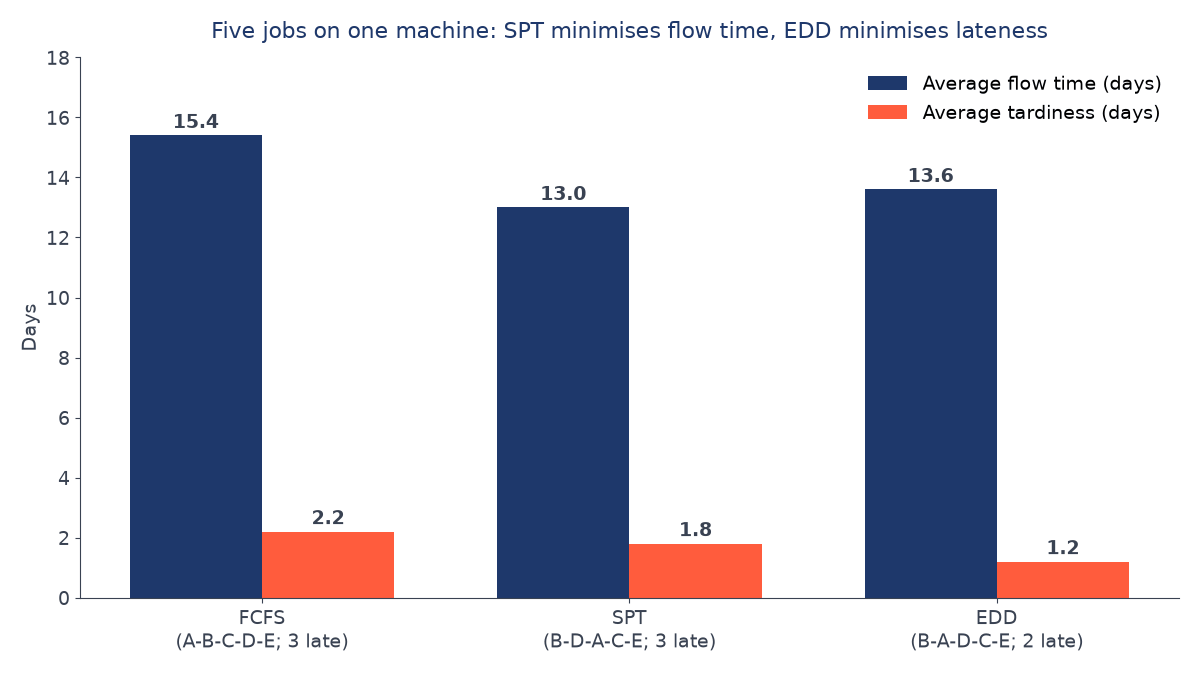
| FCFS | A-B-C-D-E | 15.4 | 2.2 | 3 |
| SPT | B-D-A-C-E | 13.0 | 1.8 | 3 |
| EDD | B-A-D-C-E | 13.6 | 1.2 | 2 |
SPT gives the lowest average flow time, while EDD gives the lowest tardiness and the fewest late jobs. FCFS is worst on both measures here. The choice of rule depends on what the shop values most.
Worked example: critical ratio
The critical ratio is:
A CR below 1 means the job is behind schedule, equal to 1 means on schedule and above 1 means ahead. Suppose today is day 12 and three jobs remain:
| Job | Due date | Work remaining (days) | Critical ratio | Priority |
|---|---|---|---|---|
| X | 20 | 4 | 3 | |
| Y | 16 | 5 | 1 | |
| Z | 15 | 3 | 2 |
Job Y is already behind schedule, so it is done first, then Z, then X.
Johnson's rule for two machines
When every job must pass through two machines in the same order, Johnson's rule gives the sequence that minimises makespan, the total time to finish all jobs. The steps are:
- List the time of each job on both machines.
- Find the shortest time remaining in the list.
- If it is on Machine 1, place that job as early as possible; if it is on Machine 2, place it as late as possible.
- Remove the job and repeat until all jobs are placed. Break ties arbitrarily.
Worked example: printing and binding
Suppose five print orders must be printed (Machine 1) and then bound (Machine 2). Times are in hours.
| Job | Printing (M1) | Binding (M2) |
|---|---|---|
| J1 | 5 | 2 |
| J2 | 1 | 6 |
| J3 | 9 | 7 |
| J4 | 3 | 8 |
| J5 | 10 | 4 |
- Shortest time is 1 (J2 on M1): J2 goes first. Sequence: J2, _, _, _, _.
- Next shortest is 2 (J1 on M2): J1 goes last. Sequence: J2, _, _, _, J1.
- Next is 3 (J4 on M1): J4 goes second. Sequence: J2, J4, _, _, J1.
- Next is 4 (J5 on M2): J5 goes in the last free slot from the end. Sequence: J2, J4, _, J5, J1.
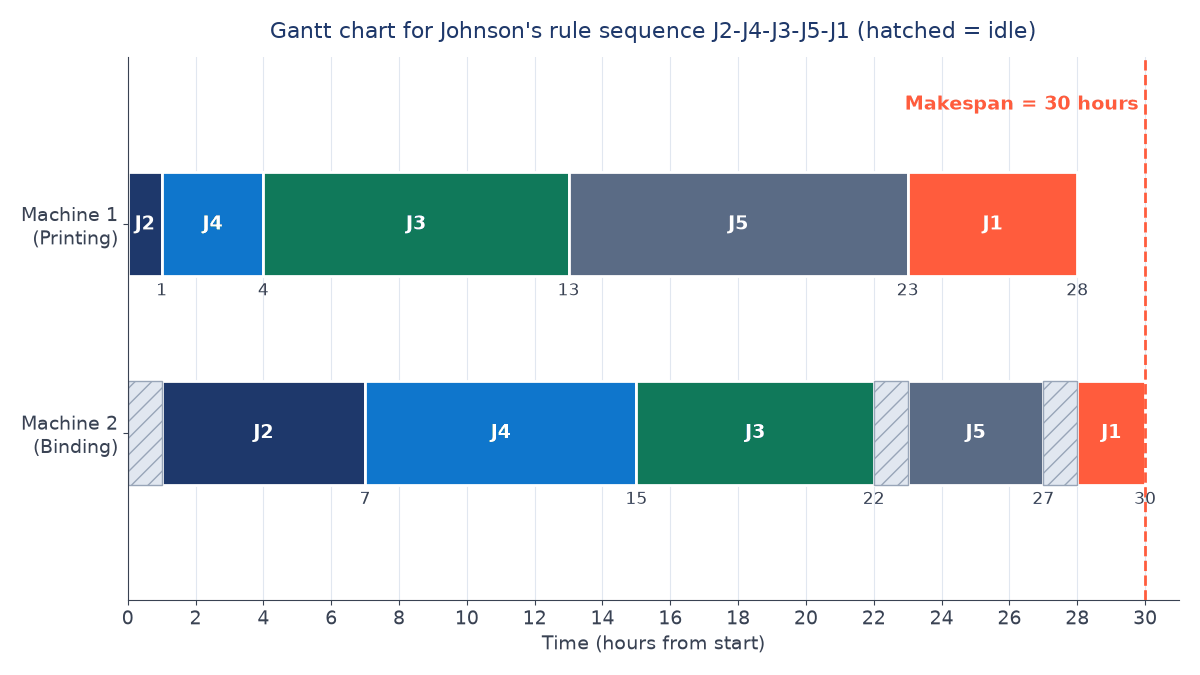
- J3 fills the remaining slot. Final sequence: J2, J4, J3, J5, J1.
Now compute start and finish times. A job starts on M2 only when it has left M1 and M2 is free.
| Job | M1 start | M1 finish | M2 start | M2 finish | M2 idle before job |
|---|---|---|---|---|---|
| J2 | 0 | 1 | 1 | 7 | 1 |
| J4 | 1 | 4 | 7 | 15 | 0 |
| J3 | 4 | 13 | 15 | 22 | 0 |
| J5 | 13 | 23 | 23 | 27 | 1 |
| J1 | 23 | 28 | 28 | 30 | 1 |
The makespan is 30 hours. Machine 2 works hours, so its idle time is hours.
Gantt charts in scheduling
A Gantt chart is a bar chart with time on the horizontal axis and machines, workers or jobs on the vertical axis. Each bar shows when an activity starts and finishes. It is easy to understand, shows progress clearly, helps compare planned with actual work and is widely used for machine and labour scheduling. Two common forms are the load chart, which shows how busy each work centre is, and the schedule chart, which tracks each job against time.
Scheduling in service organisations
Scheduling is not limited to factories:
- Hospital – doctor timings, operation theatre use and patient appointments.
- College – class timetable, faculty schedule and examination schedule.
- Bank – staff shifts and customer service counters.
- Restaurant – chef duty timings, table reservations and order flow.
Services cannot store their output, so they schedule staff to match demand and use appointments and reservations to shape the demand itself.
Scheduling and productivity
Scheduling raises productivity by reducing idle time, improving machine use, reducing waiting and avoiding congestion. When jobs start and finish at the right time, output rises without adding resources.
Problems in production scheduling
A poor schedule leads to missed deadlines, idle machines alongside overloaded ones, high work-in-progress, overtime and frustrated staff. Even a good schedule can be upset by rush orders, machine breakdowns, power failures, worker absence, material shortages, quality rejections and transport delays. Schedules must therefore be flexible and reviewed often; a rigid schedule fails when conditions change.
Qualities of a good scheduler
- Understands the production process and machine capacities.
- Knows job priorities and customer commitments.
- Communicates clearly and responds quickly to changes.
- Coordinates with production, stores, maintenance and dispatch.
Key terms
- Production scheduling
- Fixing the start and finish time and order of production activities.
- Sequencing
- Deciding the order in which waiting jobs are processed at a work centre.
- Dispatching
- Releasing orders and instructions so that scheduled work actually starts.
- Forward scheduling
- Scheduling from the present date onward to find the earliest completion.
- Backward scheduling
- Scheduling backwards from the due date so that work finishes just in time.
- Flow time
- The time a job spends in the shop, from its arrival until its completion.
- Critical ratio
- Time remaining until the due date divided by work time remaining.
- Makespan
- The total time needed to complete a group of jobs.
- Gantt chart
- A bar chart that shows activities against time, used for loading and scheduling.
Common questions
Which sequencing rule is best?
No single rule is best for every measure. SPT always minimises average flow time on a single machine, while EDD minimises the maximum lateness. Managers choose according to their main objective.
What does a critical ratio of 0.8 mean?
The job has less time left than the work it still needs, so it is behind schedule and should get priority.
When is Johnson's rule used?
When a set of jobs must pass through two machines or work centres in the same order and the aim is to minimise the total completion time.
How is forward scheduling different from backward scheduling?
Forward scheduling starts from today and finds the earliest finish; backward scheduling starts from the due date and finds the latest start. Backward scheduling keeps inventory lower but leaves less slack.
What is the difference between scheduling and dispatching?
Scheduling prepares the time plan, for example Job A starts at 10 AM. Dispatching tells the worker or department to begin Job A at 10 AM.
References
- Johnson, S. M. (1954) "Optimal two- and three-stage production schedules with setup times included". Naval Research Logistics Quarterly, 1(1), 61–68.
- Stevenson, W. J. Operations Management. McGraw-Hill Education.
- Heizer, J., Render, B. and Munson, C. Operations Management: Sustainability and Supply Chain Management. Pearson.
- Chary, S. N. Production and Operations Management. McGraw-Hill Education (India).
- Panneerselvam, R. Production and Operations Management. PHI Learning.