Production planning and control (PPC) is the function that decides in advance what, how much, how, when and where to produce, and then watches the work so that it actually happens as planned. In one line: PPC means planning production work before it starts and controlling it until it is finished, so that the required goods are made in the right quantity and quality, at the right time, at minimum cost.
PPC matters because a production system has many moving parts: materials, machines, workers, tools and deadlines. Without a plan, machines stand idle while other departments are overloaded, materials arrive late and delivery dates are missed. PPC is often called the "brain" or nerve centre of the factory because it coordinates all of these into a single, orderly flow.
Meaning of production planning and production control
PPC has two linked halves.
Production planning
Planning is done before production starts. It decides what to produce, how much, by which process, when and where, and it works out the machines, manpower, materials and time schedule needed. Planning is future-oriented.
Production control
Control is exercised during and after execution. It checks whether the plan is being followed, whether work is delayed, whether actual output matches the target, and whether correction is needed. Control is action-oriented.
| Basis | Production planning | Production control |
|---|---|---|
| Timing | Before production | During and after production |
| Nature | Deciding in advance | Checking and correcting |
| Main activities | Estimating, routing, loading, scheduling | Dispatching, follow-up (expediting), inspection, corrective action |
| Output | Route sheets, schedules, material and capacity plans | Work orders issued, progress reports, revised schedules |
| Question answered | "What should happen?" | "Is it happening, and if not, what do we do?" |
An everyday comparison is a school examination. Fixing the dates, the order of subjects, the rooms and the invigilators is planning. On the day, checking that papers start on time, rooms are ready and question papers have arrived is control.
Objectives of PPC
The main objective is to produce the required goods, of the required quality, in the required quantity, at the required time, at minimum cost. PPC therefore balances time, quantity, quality, resources and cost. More specific objectives are:
- Smooth flow of production without unnecessary stoppages.
- Better use of resources: machines, labour and materials.
- Timely completion of jobs on or before their due dates.
- Reduced wastage of materials, time and effort.
- Lower production cost through less idle time and fewer delays.
- Better coordination among purchasing, stores, production, inspection and dispatch.
- Improved customer service through reliable delivery.
- Lower work-in-progress, so less money is tied up on the shop floor.
Why PPC is needed
Without PPC, materials may not be available when needed, machines stay idle, workers wait for instructions, one department is overloaded while another has nothing to do, delivery dates are missed and costs rise. With PPC, work is organised, resources are balanced, delays shrink and management has a clear view of progress.
Functions of PPC
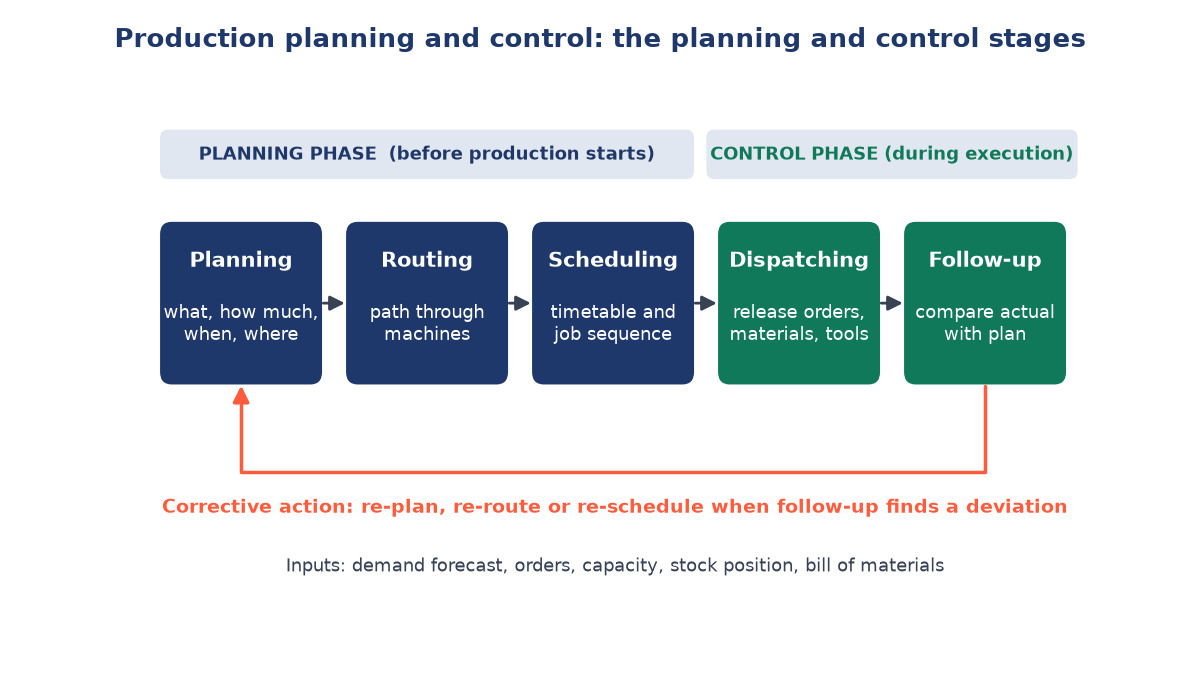
Textbooks list the functions slightly differently, but the core sequence is planning → routing → scheduling → dispatching → follow-up, with loading, sequencing and inspection fitted in along the way.
Planning and estimating
Using the sales forecast and customer orders, planners decide the quantity and timing of output and estimate the materials, machine hours and labour hours required. This is where the bill of materials and standard times are used.
Routing
Routing decides the path work will follow from raw material to finished product: which operations, in what order, on which machines or in which departments. For a metal chair the route might be cutting → bending → welding → painting → finishing → packing. The route is written on a route sheet (also called an operation sheet), which lists each operation, machine, tooling and standard time.
Good routing creates a smooth flow, avoids back-tracking, reduces handling and waiting, improves machine use and helps control cost.
Loading
Loading assigns work to machines or work centres according to their available capacity, so that no machine is overloaded while another is idle. It is often shown on a machine loading chart.
Scheduling
Scheduling fixes the time: when each job and operation should start and finish. It is the timetable of production. If routing is the path, scheduling is the clock. For example: cutting 9:00–10:00, welding 10:30–12:00, painting 1:00–2:00 and packing 3:00–4:00.
Two common approaches are forward scheduling, which starts from today and works forward to find the earliest finish date, and backward scheduling, which starts from the due date and works back to find the latest start date.
Sequencing
Sequencing decides the order in which waiting jobs are processed when several jobs compete for the same machine. It matters when jobs are many, machines are few and due dates differ. A worked example follows.
Dispatching
Dispatching is the action step that releases the work. It issues job cards and work orders, authorises the movement of materials, issues tools and drawings, and tells workers and machines to start. Dispatching puts the plan into operation.
Follow-up (expediting)
Follow-up monitors progress and compares actual with planned output. Production rarely goes exactly to plan: machines break down, workers are absent, materials arrive late, parts are rejected and rush orders arrive. Follow-up detects such problems early so that corrective action, such as re-routing, overtime or re-scheduling, can be taken.
Inspection and corrective action
Inspection confirms that output meets quality standards, and its results feed back into planning. When actual performance departs from the plan, control closes the loop by revising the plan.
A short memory aid: routing = path, sequencing = order, scheduling = time, dispatching = start, follow-up = check.
Worked example: sequencing four jobs on one machine
Suppose a workshop has four jobs waiting for a single machine. Processing times and due dates (in days from today) are:
| Job | Processing time (days) | Due date (day) |
|---|---|---|
| A | 6 | 8 |
| B | 2 | 6 |
| C | 8 | 18 |
| D | 3 | 15 |
Three common priority rules are compared: FCFS (first come, first served, in arrival order A, B, C, D), SPT (shortest processing time first) and EDD (earliest due date first). For each job, completion (flow) time is the cumulative processing time, and tardiness is completion time minus due date, or zero if the job is early.
Rule 1: FCFS (A–B–C–D)
| Job | Completion | Due | Tardiness |
|---|---|---|---|
| A | 0 + 6 = 6 | 8 | 0 |
| B | 6 + 2 = 8 | 6 | 2 |
| C | 8 + 8 = 16 | 18 | 0 |
| D | 16 + 3 = 19 | 15 | 4 |
| Total | 49 | 6 |
Rule 2: SPT (B–D–A–C)
| Job | Completion | Due | Tardiness |
|---|---|---|---|
| B | 2 | 6 | 0 |
| D | 2 + 3 = 5 | 15 | 0 |
| A | 5 + 6 = 11 | 8 | 3 |
| C | 11 + 8 = 19 | 18 | 1 |
| Total | 37 | 4 |
Rule 3: EDD (B–A–D–C)
| Job | Completion | Due | Tardiness |
|---|---|---|---|
| B | 2 | 6 | 0 |
| A | 2 + 6 = 8 | 8 | 0 |
| D | 8 + 3 = 11 | 15 | 0 |
| C | 11 + 8 = 19 | 18 | 1 |
| Total | 40 | 1 |
Comparing the rules
The measures are calculated as:
The makespan (time to finish all four jobs) is 19 days under every rule.
| Rule | Average completion time (days) | Average tardiness (days) | Late jobs | Average jobs in system |
|---|---|---|---|---|
| FCFS | 49 ÷ 4 = 12.25 | 6 ÷ 4 = 1.50 | 2 | 49 ÷ 19 = 2.58 |
| SPT | 37 ÷ 4 = 9.25 | 4 ÷ 4 = 1.00 | 2 | 37 ÷ 19 = 1.95 |
| EDD | 40 ÷ 4 = 10.00 | 1 ÷ 4 = 0.25 | 1 | 40 ÷ 19 = 2.11 |
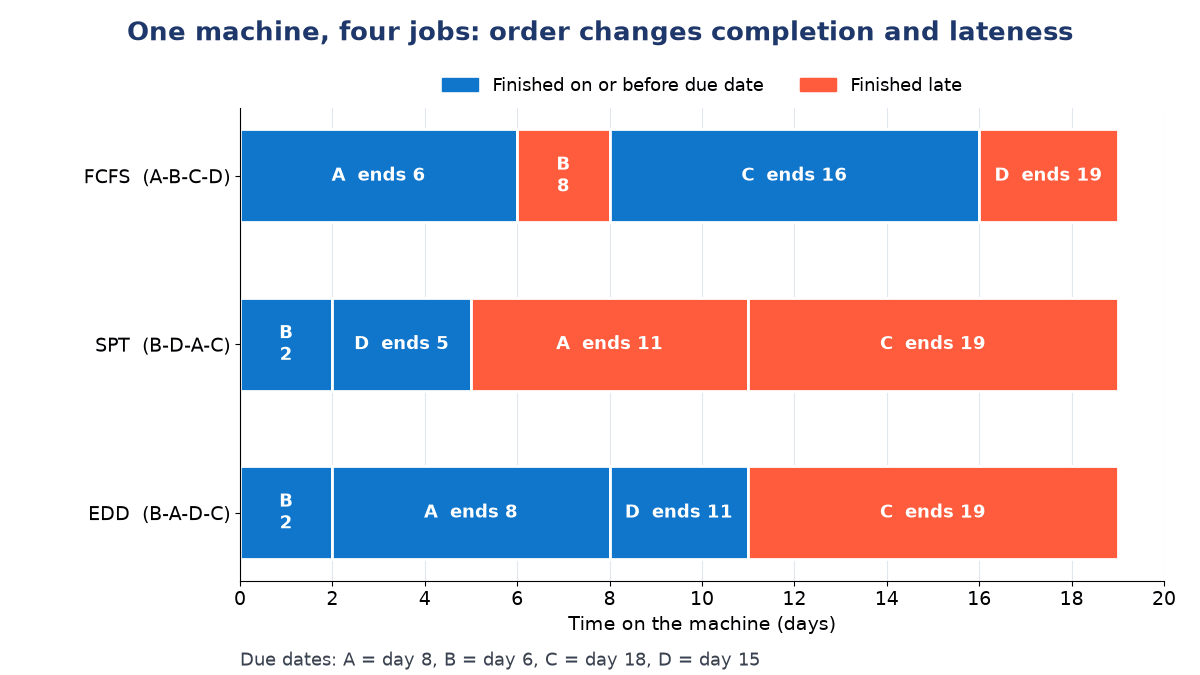
Conclusion: SPT minimises average completion time and work-in-progress; EDD minimises average tardiness and here leaves only one job late. FCFS is simple and seems fair but performs worst on both measures. The planner chooses the rule that matches the firm's priority: speed of flow, or meeting promised dates.
Worked example: checking capacity for an order
Suppose a furniture factory receives an order for 500 school desks. Each desk needs 1.2 standard labour hours. The assembly shop has 10 workers working 8 hours a day, 6 days a week.
Step 1: required hours. hours.
Step 2: available hours per week. hours.
Step 3: time needed. weeks, which is working days.
If the customer wants the desks within 6 working days, the shop is short by hours. PPC must then plan overtime, add workers, subcontract part of the work or negotiate a later date. Checking capacity like this before accepting an order is a basic planning step.
PPC in different production systems
| Production system | Nature of PPC | Main tools |
|---|---|---|
| Job production | Most difficult: every order differs in route and timing | Individual route sheets, job cards, Gantt charts, priority rules |
| Batch production | Moderately difficult: batch sizes, changeovers and schedules must be planned | Batch schedules, machine loading charts, EOQ-type batch sizing |
| Mass or continuous production | Routing is fixed, so planning is simpler, but control is critical because one stoppage halts the whole line | Line balancing, flow control, preventive maintenance plans |
PPC is universal, but how it is applied depends on the type of production.
Documents and tools used in PPC
- Route sheet: operations, machines and times for a product.
- Job card / work order: authorises a worker to perform an operation and records time taken.
- Machine loading chart: shows the work assigned to each machine.
- Schedules and Gantt charts: show planned versus actual progress against time.
- Production and dispatch orders: release work to the shop floor.
- Material requisitions and tool tickets: draw materials and tools from stores.
- Progress reports: tell management whether jobs are on time.
Today most of these are generated by MRP and ERP software, but the logic is the same.
Links with forecasting, purchasing and inventory
PPC does not work alone. Forecasting supplies expected demand, sales and future workload, from which PPC decides how much to produce, when, and what capacity and materials are needed. Purchasing, stores and inventory management make sure raw materials, components and tools are available and stock levels are known. Material requirements planning (MRP), developed by Orlicky, turns the production schedule into exact material needs and order dates, and is now a core part of PPC in manufacturing.
PPC and scheduling are not the same
Scheduling is one part of PPC. PPC is the wider system that includes planning, routing, loading, sequencing, scheduling, dispatching, follow-up and control.
Problems faced in PPC
- inaccurate demand forecasts;
- machine breakdowns and power failures;
- material shortages and poor supplier performance;
- labour absenteeism;
- urgent customer orders that disturb the schedule;
- design changes and quality defects.
For this reason PPC must be flexible and continuously monitored.
Benefits of good PPC
- smoother production flow and better machine use;
- less idle time and less work-in-progress;
- lower wastage and lower cost;
- more consistent quality;
- on-time completion and better customer service;
- better coordination and higher productivity.
A complete illustration
For the 500-desk order, PPC would decide how much wood and hardware are needed, which machines will be used, the order of cutting, drilling, assembly, polishing and packing, when each task starts, when workers begin, how progress will be checked, and what to do if delays occur. Planning prepares the job; control carries it through to completion. A bus trip is similar: the route, departure time and driver are fixed beforehand, and progress, delays and breakdowns are managed during the journey.
Exam-ready summary
Production planning and control is the process of planning production activities in advance and controlling them during execution to ensure smooth and efficient production. It aims to produce the right quantity, at the right time, of the right quality and at minimum cost. Its main functions are routing (path), loading, sequencing (order), scheduling (time), dispatching (release of work) and follow-up (checking progress and correcting deviations). PPC improves coordination, reduces wastage and idle time, ensures timely delivery and raises productivity.
Key terms
- Routing
- Fixing the sequence of operations and the machines or departments a job passes through.
- Route sheet
- A document listing each operation, machine, tooling and standard time for a product.
- Loading
- Assigning jobs to machines or work centres within their available capacity.
- Scheduling
- Fixing start and finish times for jobs and operations.
- Sequencing
- Deciding the order in which waiting jobs are processed at a work centre.
- Dispatching
- Releasing orders, materials and instructions so that work can begin.
- Follow-up (expediting)
- Monitoring progress against the plan and chasing delayed work.
- Flow time
- The time a job spends in the system from release to completion.
- Tardiness
- The amount by which a job finishes after its due date; zero if it is on time.
- Makespan
- The total time needed to complete a whole set of jobs.
Common questions
What are the main functions of PPC?
Planning and estimating, routing, loading, scheduling, sequencing, dispatching, follow-up and inspection, with corrective action closing the loop.
What is the difference between routing and scheduling?
Routing decides the path a job follows through operations and machines; scheduling decides when each operation will start and finish.
Which sequencing rule should be used?
SPT is best for minimising average completion time and work-in-progress; EDD is best for minimising lateness. In the worked example, SPT gave 9.25 days average completion and EDD left only one job late.
Why is PPC harder in job production than in mass production?
In job production every order has its own route, times and due date, so plans must be made afresh each time; in mass production the route is fixed and repeated.
What is dispatching in PPC?
It is the release of work to the shop floor by issuing job cards, material requisitions, tools and instructions, so that the scheduled operations actually start.
How is PPC related to forecasting?
Forecasts give expected demand; PPC turns that demand into decisions on output quantity, timing, capacity and materials.
References
- Chary, S. N. Production and Operations Management. McGraw-Hill Education (India).
- Panneerselvam, R. Production and Operations Management. PHI Learning.
- Stevenson, W. J. Operations Management. McGraw-Hill Education.
- Krajewski, L. J., Malhotra, M. K. and Ritzman, L. P. Operations Management: Processes and Supply Chains. Pearson.
- Orlicky, J. (1975) Material Requirements Planning. McGraw-Hill.