A vendor (or supplier) is any person or firm that provides materials, components, tools, equipment or services to a business: a steel supplier to a factory, a pharmaceutical distributor to a hospital, an electronics dealer to a college. Vendor selection is the process of choosing the most suitable supplier from those available. Vendor rating is the process of measuring how well a supplier actually performs once business has begun. Selection happens before or at the time of choice; rating happens during and after the relationship.
Both matter because an organisation's output can be no better, and no more punctual, than its inputs. A wrong supplier brings rejected material, late deliveries, shortages and customer complaints; a good one brings consistent quality, reliable delivery and lower total cost. Choosing a supplier is therefore not a small clerical decision; it affects the whole operation. Formal study of how buyers weigh these criteria goes back at least to Dickson's 1966 analysis of vendor selection systems.
Why vendor selection is important
A poor supplier can cause poor-quality materials, production delays, higher cost, sudden shortages, customer complaints, lower productivity and more wastage. A good supplier supports smooth production, quality consistency, timely delivery, cost control, lower risk and better coordination.
A simple example
Suppose a bakery needs flour every week and has three options. Supplier A is cheap but its quality is poor. Supplier B has good quality but often delivers late. Supplier C offers good quality, a fair price and timely delivery. The bakery should most likely choose C, because the decision should rest on overall performance, not price alone. That is the heart of vendor selection.
Objectives of vendor selection
- Right quality: materials that meet specifications every time.
- Timely delivery: materials arrive when required.
- Reasonable cost: competitive and fair total cost.
- Reliability: dependable suppliers who keep promises.
- Lower operational risk: fewer delays, rejections and stoppages.
- Long-term relationships: stable, efficient supply partnerships.
Factors considered in vendor selection
Quality
Does the supplier meet the required standard, keep defects low and stay consistent? For an automobile maker, poor brake parts threaten safety and reputation, so quality often matters more than a low price. Buyers look at rejection history, quality certification and the supplier's own inspection system.
Price and total cost
Price matters, but buyers examine the basic price together with transport cost, discounts, payment terms and hidden costs. The lowest quotation is not the cheapest if quality is poor, deliveries are late or extra inspection is needed. The comparison should be on total cost, not quoted cost.
Delivery performance
Does the supplier deliver on time, how often are there delays, and can it handle urgent demand? A late delivery can stop production even though the order was placed correctly.
Capacity and capability
Can the supplier handle large orders, increase supply when demand rises, and does it have the machines, staff and technical skill needed? A small supplier with good quality may still fail when volume grows.
Financial stability
A financially weak supplier may suddenly stop operating, fail to buy its own raw materials or delay orders. Buyers therefore check financial statements and credit standing.
Reputation and experience
How long has the supplier been in business, what is its market reputation, and do other customers trust it? Past performance is a strong guide to future performance.
Location
A nearby supplier usually offers faster delivery, lower transport cost and easier communication. A distant supplier may still be chosen for special quality or lower cost, but distance adds lead time and risk.
Service and support
Quick response to complaints, replacement of defective material, technical guidance and emergency help become very important in long-term relationships.
Lead time
Lead time is the time between placing an order and receiving the material, usually measured in days. Short and reliable lead times allow smoother planning and lower safety stocks.
Flexibility
A good supplier can respond to urgent demand, design changes, quantity changes and revised delivery dates. Flexibility is especially valuable when demand is uncertain.
Other factors
Many buyers also consider communication and information systems, compliance with laws and labour standards, environmental practices, and willingness to share improvements.
The vendor selection process
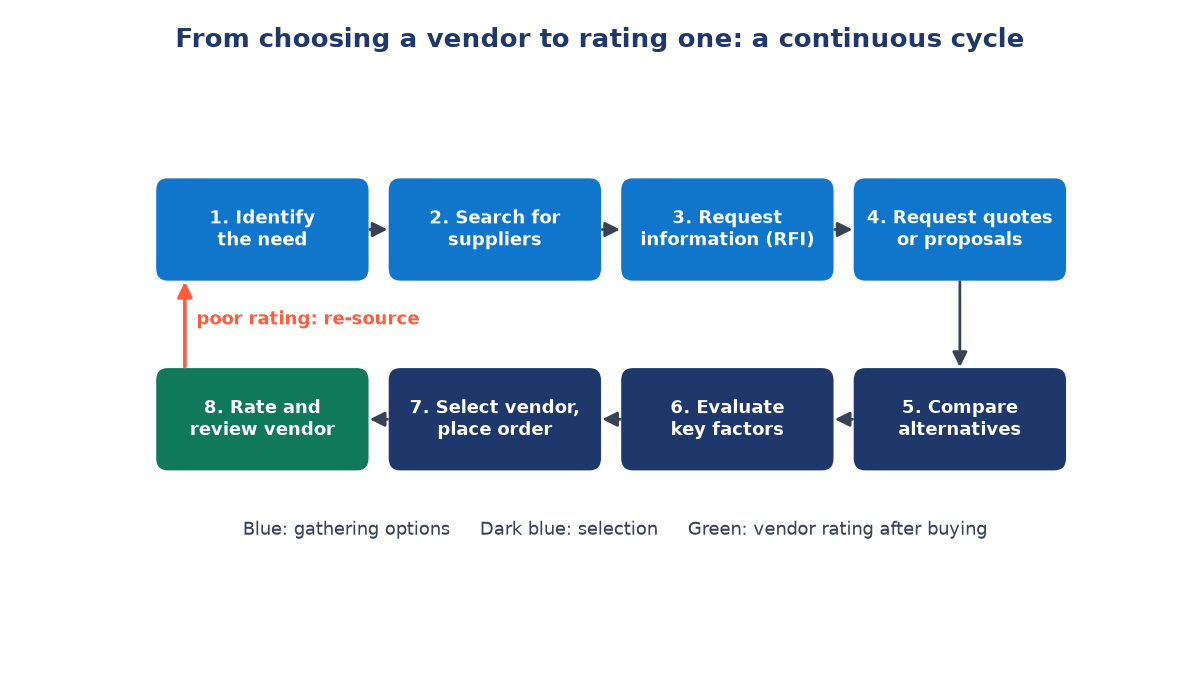
- Identify the need: what item, what specification, how much and by when. Without a clear requirement, good selection is impossible.
- Search for possible suppliers through existing vendor lists, market research, catalogues, websites, referrals, tenders and trade fairs.
- Request information (RFI): a request for information collects details of each supplier's capability before any formal offer.
- Request quotations or proposals (RFQ / RFP) covering price, delivery terms, quality details, payment conditions and service support.
- Compare alternatives on the chosen criteria.
- Evaluate performance factors such as quality history, delivery record, capacity, reputation and cost; this may include a visit to the supplier's plant.
- Select the supplier offering the best overall value and place the order.
- Review performance continuously, which leads into vendor rating.
Proposal evaluation
Proposal evaluation means examining each supplier's offer and assigning scores against every requirement. If three suppliers quote, the buyer should not choose at random or on price alone, but score each proposal systematically on the agreed factors.
Need for vendor rating
A supplier that was good at the start may later deliver late, slip on quality, raise prices unfairly or become inconsistent. Vendor rating helps the buyer to:
- identify the best suppliers and remove weak ones;
- give suppliers objective feedback and improve relationships;
- negotiate from facts;
- develop backup sources;
- allocate future business and support long-term planning.
Rating criteria commonly include quality, price, delivery, service, lead time, consistency, flexibility and response to complaints. The three emphasised most often are quality, cost and delivery.
Methods of vendor rating
| Method | How it works | Strengths | Weaknesses |
|---|---|---|---|
| Categorical (qualitative) method | Buyers rate each supplier on each factor as good, neutral or poor (or excellent to poor) and combine the opinions | Simple, cheap, needs little data | Subjective and imprecise |
| Weighted point method | Factors are given weights; each supplier is scored on each factor; weighted scores are added | Systematic, objective, combines several factors | Choice of weights is a judgement; needs data |
| Cost ratio method | Quality, delivery and service costs are expressed as a percentage of purchase value and added to the price | Converts everything into money | Needs detailed cost records |
| Scorecard system | Key indicators tracked on a regular scorecard, often monthly or quarterly | Shows trends: who is improving or declining | Takes effort to maintain |
The categorical method suits a small supplier base, limited data or general evaluations. The weighted point method is the one most often examined.
Worked example: weighted point method
Suppose a manufacturer buys a casting from three vendors and uses the following weights: quality 40, delivery 30, price 20, service 10 (total 100). Last half-year's records are:
| Data | Vendor X | Vendor Y | Vendor Z |
|---|---|---|---|
| Units received | 1,000 | 1,000 | 1,000 |
| Units accepted | 960 | 920 | 990 |
| Deliveries made | 20 | 20 | 20 |
| Deliveries on time | 18 | 20 | 15 |
| Price per unit | ₹50 | ₹48 | ₹52 |
| Service score (out of 10) | 8 | 6 | 9 |
Step 1: quality rating
X: . Y: . Z: .
Step 2: delivery rating
X: . Y: . Z: .
Step 3: price rating
The lowest price (₹48) earns full marks; others are scaled down.
X: . Y: . Z: .
Step 4: service rating
The service scores are already out of 10: X = 8, Y = 6, Z = 9.
Step 5: total
| Factor (weight) | Vendor X | Vendor Y | Vendor Z |
|---|---|---|---|
| Quality (40) | 38.40 | 36.80 | 39.60 |
| Delivery (30) | 27.00 | 30.00 | 22.50 |
| Price (20) | 19.20 | 20.00 | 18.46 |
| Service (10) | 8.00 | 6.00 | 9.00 |
| Total (100) | 92.60 | 92.80 | 89.56 |
| Rank | 2 | 1 | 3 |
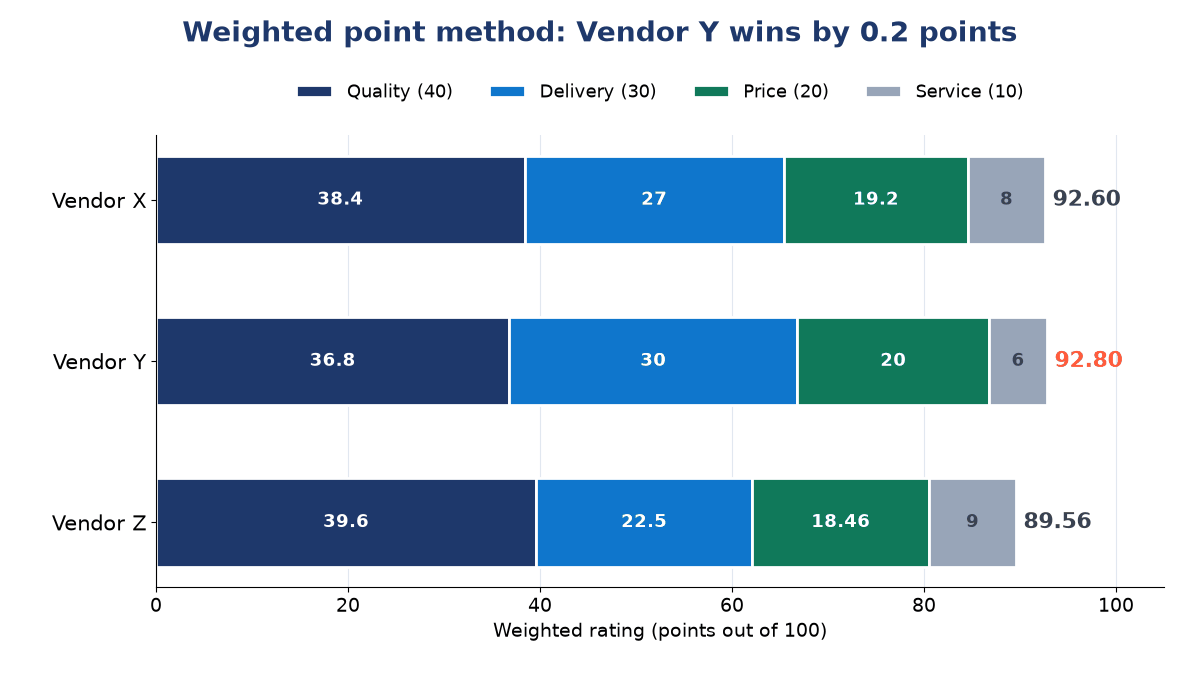
Interpretation: Vendor Y ranks first, although it has the weakest quality and service, because of its perfect delivery record and lowest price. The margin over X is only 0.2 points, so a small change in weights would reverse the result: if quality were weighted 45 and delivery 25, X would lead. When totals are this close, the buyer should look at the individual factors, perhaps split the business between X and Y, and ask Y to improve its quality.
A shorter version of the same idea: with weights quality 50, delivery 30 and price 20, a supplier scoring 45 + 20 + 18 = 83 loses to one scoring 40 + 28 + 17 = 85, even though the first has better quality. The full picture decides.
Worked example: cost ratio method
Suppose two vendors quote ₹50 and ₹48 for the same part. Records show the extra costs each vendor causes, expressed as a percentage of purchase value:
| Cost ratio | Vendor P (₹50) | Vendor Q (₹48) |
|---|---|---|
| Quality cost (inspection, rejection, rework) | 3% | 8% |
| Delivery cost (expediting, emergency freight) | 2% | 4% |
| Service cost (follow-up, complaints) | 1% | 2% |
| Total penalty | 6% | 14% |
P: , so ₹53.00. Q: , so ₹54.72. Vendor P is cheaper in reality by ₹1.72 a unit, despite the higher quotation.
Scorecards and approved vendor lists
A vendor scorecard tracks performance regularly, often monthly or quarterly, on measures such as percentage accepted, on-time delivery, price variance and complaint response. It lets management see quickly who is improving, who is declining and who is consistently strong, and it gives suppliers clear targets.
An approved vendor list contains suppliers who have already been evaluated and accepted. It saves time in future purchasing, improves consistency, reduces risk and protects quality standards. For important items, many organisations allow purchases only from approved vendors, and rating results decide who stays on the list.
Vendor rating and long-term relationships
Rating is not only for rejecting poor suppliers. It helps buyers discuss weaknesses with suppliers, encourage better service, reward strong performance and build dependable partnerships. Many firms run supplier development programmes for vendors who score well on some factors but poorly on others. A good rating system improves the performance of both buyer and supplier.
Single sourcing and multiple sourcing
| Basis | Single sourcing | Multiple sourcing |
|---|---|---|
| Meaning | Buying an item from one supplier only | Buying the same item from two or more suppliers |
| Advantages | Closer relationship, easier coordination, volume discounts, better standardisation | Lower dependence, backup available, better supply security, competition on price |
| Disadvantages | High dependence; risky if the supplier fails | More coordination and administration, smaller volumes per supplier |
Vendor strategy matters as much as vendor choice. Just-in-time systems tend to favour a few close, long-term suppliers, while critical items with uncertain supply often justify a second source.
Vendor rating in modern business
Global suppliers, fast-changing demand, lean inventories, just-in-time purchasing and strict quality requirements mean that even a small supplier failure can create major operational problems. Supplier evaluation is therefore a continuous activity, not a one-time formality.
Problems caused by poor vendor selection
- repeated rejection of material and poor-quality output;
- delivery delays and stock shortages;
- higher production cost and emergency purchasing;
- damaged customer service and an unstable supply chain.
Challenges in vendor rating
- lack of accurate performance data;
- too many suppliers to track;
- bias or subjectivity in scoring and in choosing weights;
- changing supplier conditions;
- different priorities for different materials.
Rating systems should therefore be simple, fair, based on records and updated regularly, and the weights should reflect what matters most for each category of item.
Qualities of a good vendor
A good vendor is reliable, quality-conscious, punctual, responsive, financially stable, cooperative, flexible and transparent. A strong supplier behaves like a long-term business partner.
Vendor selection, purchase orders and purchase management
Vendor selection decides who should supply; the purchase order is the formal order placed after that choice. Vendor rating supports purchase management by identifying preferred suppliers, strengthening negotiation, reducing risk, maintaining quality standards and preventing repeated poor performance.
Exam-ready summary
Vendor selection is the process of choosing the most suitable supplier for materials, components or services, considering quality, total cost, delivery, capacity, financial stability, reputation, location, service, lead time and flexibility. Vendor rating is the continuing evaluation of supplier performance, usually on quality, cost, delivery and service. Common rating methods are the categorical method, the weighted point method, the cost ratio method and the scorecard system. In the weighted point method each factor's score is multiplied by its weight and the totals are compared. Good vendor selection and rating ensure smooth production, consistent quality, cost control and reliable supply.
Key terms
- Vendor
- A person or firm that supplies materials, components, equipment or services to a business.
- Vendor selection
- Choosing the most suitable supplier from available alternatives.
- Vendor rating
- Measuring and scoring a supplier's actual performance over time.
- Request for information (RFI)
- A request to potential suppliers for details of their capabilities before formal offers.
- Weighted point method
- A rating method in which factor scores are multiplied by weights and added.
- Cost ratio method
- A rating method that adds quality, delivery and service costs, as a percentage, to the quoted price.
- Vendor scorecard
- A regular report of a supplier's performance on key indicators.
- Approved vendor list
- A list of evaluated suppliers from whom purchases are permitted.
- Multiple sourcing
- Buying the same item from more than one supplier to reduce risk.
Common questions
What is the difference between vendor selection and vendor rating?
Vendor selection chooses a supplier before buying; vendor rating evaluates how the chosen supplier performs during and after the purchase.
How is the weighted point method applied?
Choose factors, give each a weight, score every vendor on each factor (for example accepted ÷ received × weight for quality), add the weighted scores and rank the vendors. In the example the totals were 92.60, 92.80 and 89.56.
How is the price rating calculated in vendor rating?
Divide the lowest price quoted by the vendor's price and multiply by the price weight, so the cheapest vendor gets full marks: ₹48 ÷ ₹50 × 20 = 19.2.
Why should a vendor not be selected on price alone?
Because rejections, late deliveries and poor service add hidden costs. In the cost ratio example the ₹48 quotation became ₹54.72 after penalties, against ₹53.00 for the ₹50 quotation.
What are the advantages and disadvantages of single sourcing?
It gives closer relationships, easier coordination, volume discounts and standardisation, but creates heavy dependence and high risk if the supplier fails.
What is an approved vendor list?
A list of suppliers who have passed evaluation; it speeds up buying, keeps quality consistent and reduces risk.
References
- Dickson, G. W. (1966) "An analysis of vendor selection systems and decisions". Journal of Purchasing, 2(1), 5–17.
- Chary, S. N. Production and Operations Management. McGraw-Hill Education (India).
- Heizer, J., Render, B. and Munson, C. Operations Management: Sustainability and Supply Chain Management. Pearson.
- Chopra, S. and Meindl, P. Supply Chain Management: Strategy, Planning, and Operation. Pearson.
- Bedi, K. Production and Operations Management. Oxford University Press.