Stores management is the function of receiving, storing, protecting, recording and issuing materials in a systematic way, so that the organisation always has the items it needs, in usable condition, at the right place and time. A simple way to put it: purchase management brings materials into the organisation; stores management looks after them from the moment they arrive until they are used.
It matters because materials are money in physical form. A company may buy exactly the right item, yet if it is stored badly it can be damaged, stolen, misplaced or forgotten, and production may stop even though the item is somewhere in the building. Good stores management protects this investment, keeps production running and gives reliable stock figures for purchasing and accounting.
What is a store?
A store is a controlled area where materials are kept until they are required. It may hold raw materials, components, spare parts, tools, consumables, packing materials, maintenance items, office supplies, work-in-progress and, in some organisations, finished goods. A store is not just a room; it is a managed space with procedures, records and security.
A home kitchen is a useful comparison. If groceries are not arranged, sugar may be mistaken for salt, items expire, ingredients run out unnoticed and duplicates get bought. Arranged properly, everything is easy to find and waste is low. An organisation's store works the same way on a much larger scale.
Why stores management is important
Poor storage leads to damaged materials, misplaced items, production stoppages, theft and wastage, piles of excess stock and wrong items being issued. Good stores management helps in:
- smooth, uninterrupted production;
- proper material control and accurate stock records;
- reduced wastage, damage and pilferage;
- lower storage and handling cost;
- quick identification and issue of materials;
- timely information for purchase and inventory decisions.
Objectives of stores management
Safe custody
Materials must be protected from damage, theft, moisture, fire, rust and spoilage.
Continuous supply to users
Production and other departments should receive materials whenever they need them.
Proper classification and identification
Items should be grouped, coded and located so that they can be found quickly.
Avoiding overstocking and understocking
Too much stock increases cost and risk of obsolescence; too little causes shortages.
Accurate records
The organisation should always know what is available, how much, where it is kept and what it is worth.
Economy in storage
Space, labour and handling equipment should be used efficiently.
Functions of stores management
- Receiving materials from suppliers and checking quantity, condition, documents and delivery details.
- Coordinating inspection so that quality and specifications are checked before acceptance.
- Storing accepted material in the correct, labelled location.
- Preserving materials according to their nature.
- Issuing materials to departments only against proper authorisation.
- Maintaining records of receipts, issues, returns, damaged items and balances.
- Verifying stock by physical counting and comparison with records.
- Disposing of surplus, obsolete, scrap and damaged items properly.
- Reporting stock positions, slow-moving items and reorder needs to purchasing.
Principles of good stores management
- Proper location: the store should be close to the receiving area and the main users, so that receipt and issue are easy.
- Classification: items grouped by type, size, use or department.
- Codification: every item has a clear code.
- Systematic arrangement: frequently used items are the easiest to reach.
- Proper preservation suited to each material.
- Security against theft, misuse and unauthorised issue.
- Accurate documentation of every movement.
- Regular stock checking so that records match physical stock.
- First in, first out (FIFO) physical rotation, so that older stock is used before it deteriorates.
Types of stores
| Type | Description | Advantages | Limitations |
|---|---|---|---|
| Centralised store | One main store serves the whole plant | Better control, fewer staff, lower stock, easier stock-taking | Long distances to users, delays, higher handling |
| Decentralised (sub-) stores | Separate stores near each department | Quick issue, less handling, suits large or spread-out plants | Duplication of stock and staff, harder control |
| Central store with sub-stores | Main store feeds small sub-stores | Combines control with convenience | Needs good coordination and records |
Stores may also be classified by what they hold: raw material stores, general stores, tool rooms, finished goods stores, and special stores such as cold storage or bonded warehouses.
Store layout
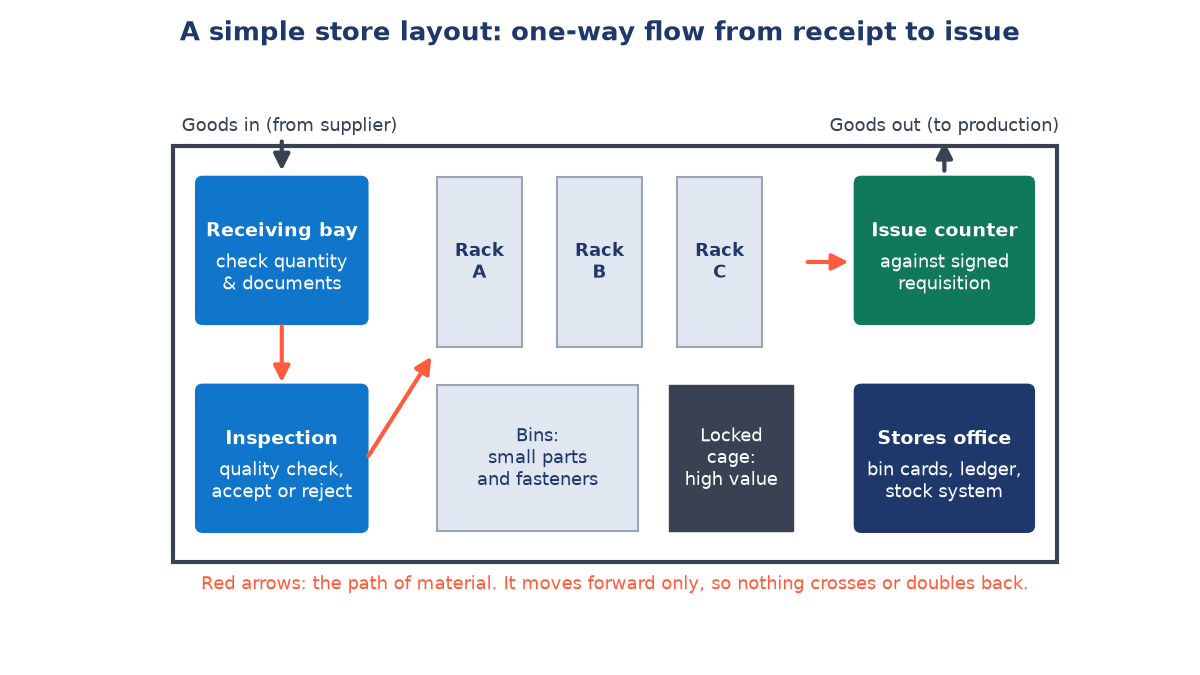
Store layout is the arrangement of racks, bins, shelves, aisles, the receiving bay, the inspection area and the issue counter. A good layout saves movement time, makes items easy to locate, allows safe handling, separates categories and supports quick receipt and issue. Store layout is to a store what plant layout is to a factory.
Storage equipment
- Racks for boxed items and bins for small components;
- open yards for bulky, weather-resistant materials such as steel sections;
- locked cupboards or cages for expensive or attractive items;
- cold storage for temperature-sensitive items;
- pallets, forklifts and trolleys for handling.
The choice depends on item size, value, frequency of use and required storage conditions.
Classification, codification and location
Classification
Items may be grouped by nature, department, usage, value, size or frequency of issue: for example, electrical items in one section, hardware in another, consumables in a third and fragile items separately. Classification makes identification, storage, issue, stock control and record keeping easier. Value-based classification using ABC analysis, first described by Dickie, lets the store give its tightest control to the few high-value items.
Codification
Codification gives each item a unique code, such as RM-101 for a raw material, SP-205 for a spare part or TL-310 for a tool. Codes avoid confusion between similar items, speed up record keeping, support computerisation and barcoding, help stock checking and prevent the same item being recorded under two names. Codes may be alphabetical, numerical or alphanumeric; many firms use a structured numeric code where each group of digits stands for class, sub-class and item.
Location system
Each item's address is recorded, for example "Rack A, Shelf 2, Bin 5". Without a location system, time is wasted searching, wrong items are issued and the store becomes disorganised.
Receiving and issue procedures
Receiving procedure
- Receive the consignment and check the delivery challan against the purchase order.
- Count or weigh the quantity and inspect the physical condition.
- Send the material for quality inspection where required.
- Accept, or reject and return, the material.
- Prepare the goods received note (GRN) and update records.
- Move the material to its storage location.
Issue procedure
- Receive an authorised material requisition.
- Identify the material and check availability.
- Issue the correct quantity, normally oldest stock first.
- Record the issue and update the balance.
Uncontrolled issue leads to excess use, theft and unreliable records. Unused material returned by a department is received back on a material return note.
Preservation of materials
Different items need different care: cement must be kept dry; chemicals may need sealed containers and ventilation; rubber items need cool, dark storage; metal items need anti-rust treatment; fragile items need careful handling; perishables need controlled temperature and strict FIFO. Good preservation reduces deterioration, spoilage, corrosion, breakage and financial loss.
Store records and documents
| Record | Kept by / where | Shows |
|---|---|---|
| Goods received note | Stores, on receipt | What was received, from whom, and whether accepted |
| Bin card | Storekeeper, at the storage location | Quantity received, issued and balance |
| Stores ledger | Cost or accounts office, or the stock system | Quantity and value of receipts, issues and balances |
| Material requisition / issue note | User department, then stores | What was issued, to whom and when |
| Material return note | Stores | Unused material returned by a department |
| Stock verification report | Verification team | Differences between physical and book stock |
Bin card and stores ledger compared
| Basis | Bin card | Stores ledger |
|---|---|---|
| Kept by | Storekeeper | Costing or accounts department |
| Location | Near the material | In the office or system |
| Content | Quantity only | Quantity and value |
| Timing of entry | At the moment of each movement | Often posted periodically from documents |
| Purpose | Physical control at the storage point | Stock accounting and costing |
Store accounting and pricing of issues
Store accounting records the movement and value of materials. It tells management about usage, stock levels, stock value, losses and reorder needs, and supports inventory control, cost control, audit, purchase planning and production continuity. When the same item has been bought at different prices, the store must decide which price to charge on issue. Two common methods are FIFO and weighted average.
Worked example: stores ledger for bolts
Suppose a factory's bolt account for June shows the following:
| Date | Transaction | Units | Rate |
|---|---|---|---|
| 1 June | Opening stock | 200 | ₹10 |
| 5 June | Received | 300 | ₹12 |
| 10 June | Issued | 250 | |
| 18 June | Received | 200 | ₹13 |
| 25 June | Issued | 300 |
FIFO (first in, first out) charges issues at the oldest prices first.
- 10 June issue of 250: 200 × ₹10 + 50 × ₹12 = ₹2,000 + ₹600 = ₹2,600. Balance: 250 × ₹12 = ₹3,000.
- 18 June receipt: balance becomes 250 × ₹12 + 200 × ₹13 = ₹3,000 + ₹2,600 = ₹5,600.
- 25 June issue of 300: 250 × ₹12 + 50 × ₹13 = ₹3,000 + ₹650 = ₹3,650. Closing balance: 150 × ₹13 = ₹1,950.
Weighted average recalculates an average rate after each receipt:
- After 5 June: , so the rate is ₹11.20.
- 10 June issue: 250 × ₹11.20 = ₹2,800. Balance: 250 × ₹11.20 = ₹2,800.
- After 18 June: , so the rate is ₹12.00.
- 25 June issue: 300 × ₹12 = ₹3,600. Closing balance: 150 × ₹12 = ₹1,800.
| Method | Cost of issues | Closing stock | Total |
|---|---|---|---|
| FIFO | ₹2,600 + ₹3,650 = ₹6,250 | ₹1,950 | ₹8,200 |
| Weighted average | ₹2,800 + ₹3,600 = ₹6,400 | ₹1,800 | ₹8,200 |
Check: total value available is ₹2,000 + ₹3,600 + ₹2,600 = ₹8,200 under both methods. With rising prices, FIFO charges lower costs to production and shows a higher closing stock; the weighted average smooths out price changes.
Stock levels maintained by the store
The store watches stock against set levels so that it neither runs out nor overstocks. The standard formulas are:
Worked example: stock levels for bolts
Suppose the same factory uses bolts at a minimum of 100, a normal rate of 150 and a maximum of 200 units a week. Lead time is 4 weeks at best, 5 weeks normally and 6 weeks at worst. The re-order quantity is 1,000 units, and an emergency purchase takes 2 weeks.
- Re-order level = 200 × 6 = 1,200 units.
- Minimum level = 1,200 − (150 × 5) = 1,200 − 750 = 450 units.
- Maximum level = 1,200 + 1,000 − (100 × 4) = 2,200 − 400 = 1,800 units.
- Danger level = 150 × 2 = 300 units.
- Average stock level = (minimum + maximum) ÷ 2 = (450 + 1,800) ÷ 2 = 1,125 units.
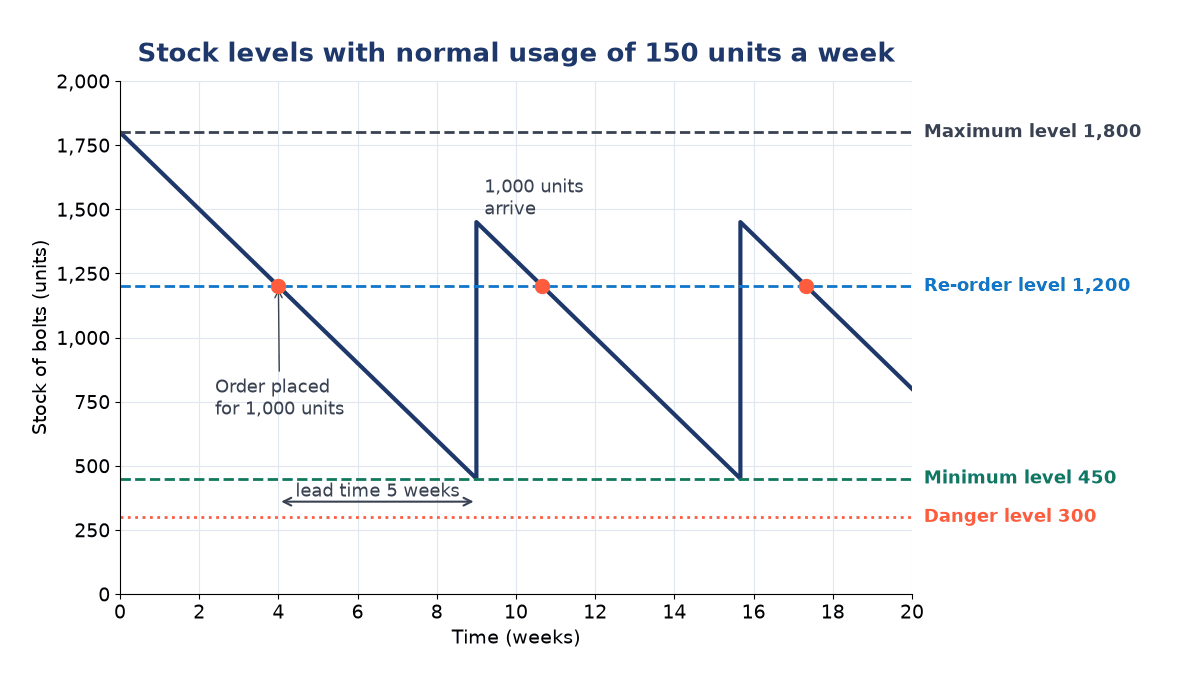
The chart confirms the logic: starting from 1,800, stock reaches 1,200 after 4 weeks, an order is placed, and during the normal 5-week lead time another 750 units are used, so stock touches 450 just as the delivery arrives. If stock ever falls to the danger level of 300, the store should arrange an emergency purchase.
Stock verification
Physical stock must be counted and compared with book stock. Periodic verification counts everything at set intervals, often at year end, usually with the store closed. Perpetual inventory with continuous stock-taking keeps records up to date after every movement and counts a few items every day, so that the whole store is covered during the year without stopping work. Differences may come from counting or posting errors, breakage, evaporation, theft or wrong issues; they must be investigated, approved and adjusted.
Storekeeping and the storekeeper
Storekeeping is the day-to-day running of the store by the storekeeper, who is both custodian and controller of materials. The storekeeper's duties include receiving and checking incoming material, arranging and labelling items, issuing only against authorisation, updating records, protecting material from damage, keeping the store clean and safe, reporting shortages, excess or damage, cooperating with purchase and production, and helping in stock verification. A careless storekeeper creates stock confusion, production delays, losses, wrong issues and record mismatches.
A good storekeeper needs honesty, care, record-keeping skill, knowledge of materials, discipline, alertness, communication skill and a sense of responsibility. A good store, in turn, is clean, well arranged, safe, secure, clearly labelled, easy to access, ventilated where needed and backed by good records.
Stores management, inventory control and purchasing
| Basis | Stores management | Inventory control | Purchase management |
|---|---|---|---|
| Focus | Physical handling and custody | How much stock to keep | Buying the material |
| Typical tasks | Receive, store, preserve, issue, record | Set reorder levels, order quantities, ABC classes | Find suppliers, negotiate, order, follow up |
| Key question | Is the material safe, findable and recorded? | Is the stock level right? | Is the right material coming from the right source? |
All three must coordinate. If purchasing buys well but stores manages badly, operations still suffer.
Stores management and cost control
A well-run store reduces cost by preventing damage and theft, avoiding duplicate purchases, reducing idle stock, ensuring timely issue so production does not stop, and identifying slow-moving and obsolete items early. It is a contributor to cost efficiency, not merely a support function.
Challenges in stores management
- very large numbers of items and shortage of space;
- record mismatches and system errors;
- obsolete and slow-moving materials;
- theft and pilferage;
- poor handling methods and congestion;
- slow issue processes and weak coordination with purchase and production.
Modern stores respond with barcodes, warehouse software, clear location systems and regular cycle counts.
Exam-ready summary
Stores management is the function of receiving, storing, preserving and issuing materials systematically so that they are available when needed. Its objectives are safe custody, uninterrupted supply, proper classification and codification, correct stock levels, accurate records and economy in storage. Its functions include receiving and inspecting materials, storing and preserving them, issuing against authorised requisitions, maintaining bin cards and the stores ledger, pricing issues, verifying stock and disposing of surplus. Good stores management reduces waste and cost, supports inventory control and keeps production running.
Key terms
- Goods received note
- A document prepared by stores recording material received and accepted.
- Bin card
- A quantity record kept at the storage location showing receipts, issues and balance.
- Stores ledger
- An office record of receipts, issues and balances in both quantity and value.
- Material requisition
- An authorised request from a department to draw material from the store.
- Codification
- Giving each item a unique code to avoid confusion and support records.
- Re-order level
- The stock level at which a fresh order is placed.
- Danger level
- A stock level below which emergency purchase action is needed.
- FIFO
- First in, first out: oldest stock is issued, or priced, first.
- Perpetual inventory
- A system that updates stock records after every receipt and issue, supported by continuous stock-taking.
Common questions
What is the difference between a bin card and a stores ledger?
A bin card is kept by the storekeeper near the material and records quantities only; the stores ledger is kept by the accounts or costing office and records both quantity and value.
How are the re-order, minimum and maximum levels calculated?
Re-order level = maximum usage × maximum lead time; minimum level = re-order level − normal usage × normal lead time; maximum level = re-order level + re-order quantity − minimum usage × minimum lead time. With the example data these give 1,200, 450 and 1,800 units.
What are the advantages of a centralised store?
Better control, lower total stock, fewer staff, easier stock-taking and better use of space; its drawback is distance from users and slower issue.
Why is codification of materials needed?
It gives every item one unambiguous identity, prevents duplicate names, speeds up records and makes computerised and barcoded stock control possible.
What is the difference between stores management and inventory control?
Stores management deals with physical receipt, custody and issue of materials; inventory control decides how much stock to hold and when to reorder.
Why does FIFO give a different closing stock value from weighted average?
FIFO leaves the latest prices in closing stock, while weighted average blends old and new prices. When prices rise, FIFO shows a higher closing stock, as in the example (₹1,950 against ₹1,800).
References
- Chary, S. N. Production and Operations Management. McGraw-Hill Education (India).
- Panneerselvam, R. Production and Operations Management. PHI Learning.
- Bedi, K. Production and Operations Management. Oxford University Press.
- Stevenson, W. J. Operations Management. McGraw-Hill Education.
- Dickie, H. F. (1951) "ABC inventory analysis shoots for dollars, not pennies". Factory Management and Maintenance, 109(7), 92–94.