Decimals are everywhere in daily life: on price tags, on the petrol pump, on a doctor's thermometer and on the weighing scale at the kirana shop. They let us write amounts that fall between whole numbers. So what exactly is a decimal? How do the places after the point work, how do you read one aloud, and which zeros can you safely leave out? Let's find out.
A rupee can be split into 100 paise, so a price tag may say Rs . That is more than 12 rupees but less than 13 rupees.
See the small dot in Rs ? That dot is called the point. The part before it is the whole rupees, and the part after it is the paise.
A ruler works the same way. One centimetre is marked off into 10 small parts, and a pencil line can easily stop between two whole marks. The way we write such an amount is called a decimal.
A decimal is a fraction
A decimal is simply another way to write a fraction. It uses base ten, which means the whole is cut into 10 parts, or 100, or 1000.
You can turn fractions into decimals and decimals back into fractions. It is the same number either way; only the writing changes.
Here we'll stick to tenths, hundredths and thousandths, so every fraction you see is cut into 10 parts, or 100, or 1000.
Take . As a decimal you write it .
From fraction to decimal
Remember. A decimal that stops is a fraction. It is written with a point instead of the line in a fraction.
Tenths, from base 10
Go back to the ruler. One centimetre holds 10 small parts, so one small part is one tenth of a centimetre.
As a fraction that is . As a decimal it is . You read it as zero point one.
A digit is one of the number symbols , , and so on up to . Where a digit sits tells you how big it is, and that spot is called its place.
The same digit means something different in each place, and only one digit fits in a place.
The first place after the point counts tenths. One centimetre holds exactly 10 small parts, and once you have 10 of them you have a whole centimetre again. That is why this place never needs to go past 9.
Now take one whole centimetre and 2 small parts more. As a decimal that is . You read it as one point two.
Hundredths, from base 100
Money cuts a rupee into 100 paise, so one paisa is one hundredth of a rupee.
As a fraction that is . As a decimal it is . You read it as zero point zero one.
Look at the zero just after the point. It is holding the tenths place, telling you there are no tenths. Leave it out and you would have , which is ten times bigger. Small zero, big job!
A longer one is . You read it as twelve point three five.
Say the digits one at a time
Don't read as twelve point thirty five. There's a good reason for this.
Each digit after the point sits in its own place: the means 3 tenths and the means 5 hundredths.
In Rs , the is three ten-paise coins and the is five single paise. Those are different coins.
Say thirty five and you have tipped the two piles together. So read the digits one by one, from left to right.
Remember. To read a decimal aloud, say the whole part as a number. Then say each digit after the point on its own.
You can also do a second job with a decimal: say what each digit is worth. is 12 wholes, 3 tenths and 5 hundredths. That is naming the parts, which is different from reading it aloud.
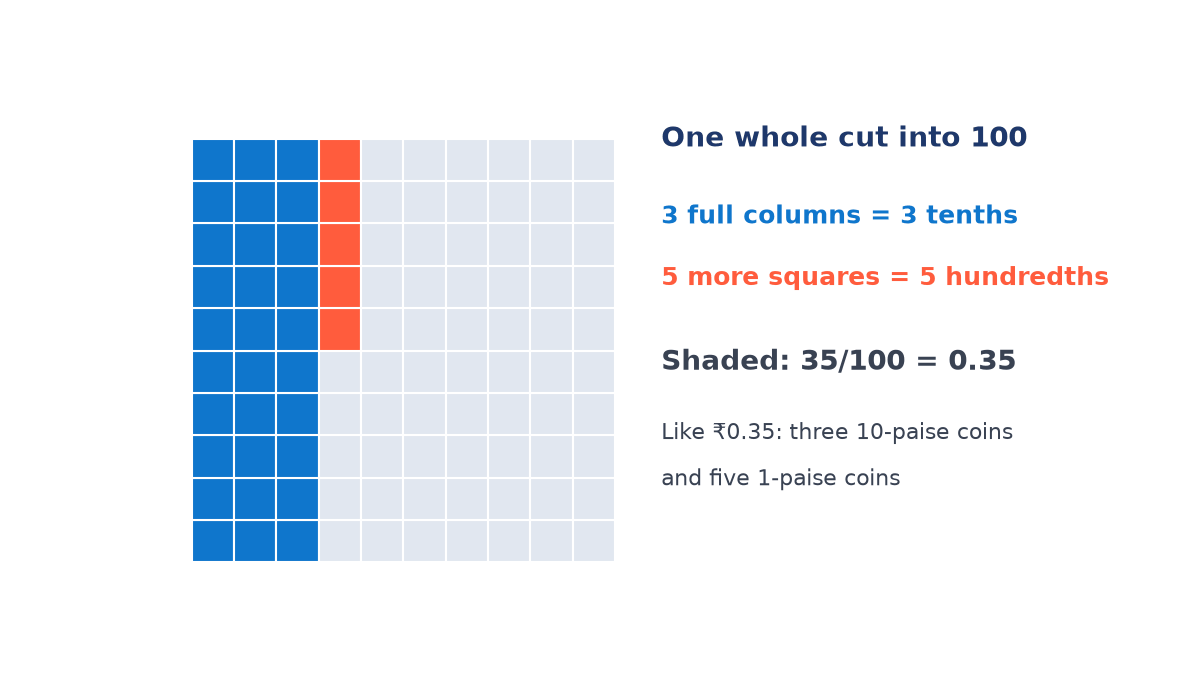
The grid shows why can be read two ways and still be the same amount. As one fraction it is . Split into places it is , because each column of ten squares is one tenth.
Thousandths, from base 1000
A litre jug of milk holds 1000 millilitres, so one millilitre is one thousandth of a litre.
As a fraction that is . As a decimal it is . You read it as zero point zero zero one.
The two zeros hold the tenths and hundredths places open, so the lands in the thousandths place.
Another one is . You read it as one point two three five. It is one whole, 2 tenths, 3 hundredths and 5 thousandths.
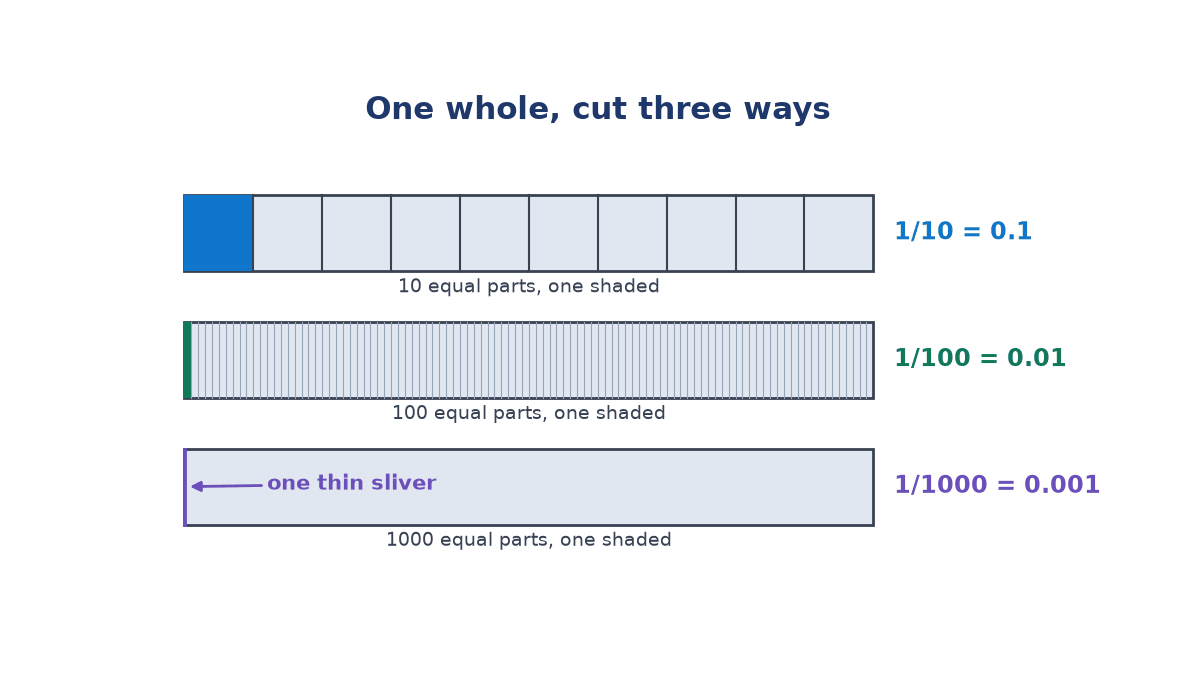
| Fraction | Decimal | Read it as |
|---|---|---|
| zero point one | ||
| zero point zero one | ||
| zero point zero zero one |
These three are read the same way, digit by digit.
| Decimal | Read it as |
|---|---|
| one point two | |
| twelve point three five | |
| one point two three five |
Zeros that do a job, and zeros that do not
Some zeros hold a place open. Others just sit there doing nothing, and those lazy ones can go.
The places in front of the point count ones, then tens, then hundreds. In there are no hundreds and no tens. So those two zeros count nothing at all. You can leave them out, and is just .
Extra zeros at the very end after the point do nothing either. and are the same amount. Fifty paise is half a rupee, written either way.
So a price can be tidied: Rs is just Rs . One zero went from the front and one from the tail.
Now try a long number. The rule is the same; there are just more zeros to count.
A bigger example
Three zeros went from the front and four from the tail, yet the number did not change one bit.
Two zeros to leave alone
The first kind sits between other digits. Rs and Rs are not the same money.
The zero in holds the tens place empty. Take it out and the slides down from hundreds to tens, so the number shrinks.
Zeros inside a number behave the same way after the point. In there are two zeros after the .
Drop one of them and every digit behind it slides one place to the left, becoming ten times bigger.
You would get , which is a different number altogether.
The second kind is the zero in . It doesn't change the amount at all; and are the same number.
We write it so the point can't be missed, and so the whole part isn't left blank. That is a rule of neat writing, not a rule of value.
Remember. A zero at the front can go only while another digit of the whole part is left standing. is , but keeps its zero. A zero at the tail can go only after the point. is , but is not . A zero doing a job stays.
More worked examples
Example 1: tenths
Write as a decimal.
Seven tenths means the digit goes in the first place after the point. There are no whole ones, so write before the point: . Read it as zero point seven.
Example 2: hundredths
Write as a decimal.
Forty-three hundredths is tenths and hundredths, because hundredths make tenths.
Example 3: a zero that holds a place
A parcel weighs kg and g. Write this in kilograms.
One gram is one thousandth of a kilogram, so g is kg. That is tenths, hundredths and thousandths.
The parcel weighs kg. The zero after the point must stay. Without it you would write kg, which is kg and g.
Practice
- Write as a decimal.
- Write as a decimal.
- Write as a decimal.
- Read aloud. Write down the words you said.
- Tidy .
- Why do you write the zero in ?
| Question | Answer | Question | Answer |
|---|---|---|---|
| Read | twelve point three five | ||
| Tidy | |||
| The zero in | It does not change the value. It keeps the point from being missed, and stops the whole part being left blank. |
Common mistakes
- Writing as . Hundredths need two places after the point: .
- Reading as "twelve point thirty five". Say the digits one at a time.
- Removing a zero from between digits, such as writing for .
- Removing a tail zero from a whole number. is , but is not .
- Putting a digit bigger than in one place. Ten tenths make a whole, so carry it to the units place.
Key terms
- Decimal
- A way of writing a fraction in base ten, using a point.
- Point
- The dot that separates the whole part from the parts of one.
- Base ten
- Counting in tens, so each place is worth ten times the place to its right.
- Tenth
- One of ten equal parts of a whole: .
- Hundredth
- One of a hundred equal parts: .
- Thousandth
- One of a thousand equal parts: .
- Place
- The position of a digit, which decides what it is worth.
Answers
Show answers
- Twelve point three five.
- . Three zeros go from the front and two from the tail.
- Model answer: the zero in does not change its value, since is the same number. It is written so that the point cannot be missed and the whole part is not left blank.