Decimals are not only a chapter in the textbook. You meet them every day at the kirana shop, on the weighing scale at the vegetable market, and on every bill. Here you'll see how one number with a decimal point can carry two units at once: kilograms with grams, and rupees with paise. Once you understand why the digits sit where they do, changing grams to kilograms or paise to rupees is just a matter of sliding digits.
Two units in one number
Look at a price label in a shop. It may say ₹. That one little number is holding two things at once: rupees and paise.
A decimal is a number with a dot in it, and the dot is called the decimal point. It separates the whole things on the left from the parts of a thing on the right.
Weights work the same way. A packet of atta can say kg, which is kilograms and grams packed into one number.
What the spots after the point mean
Picture a bag of sugar that weighs kilogram. Share it out into equal pinches, and one pinch is one gram.
This kind of sharing has names. Cut one whole thing into equal parts and one part is a tenth. Cut it into equal parts instead and one part is a hundredth. Cut it into parts and one part is a thousandth.
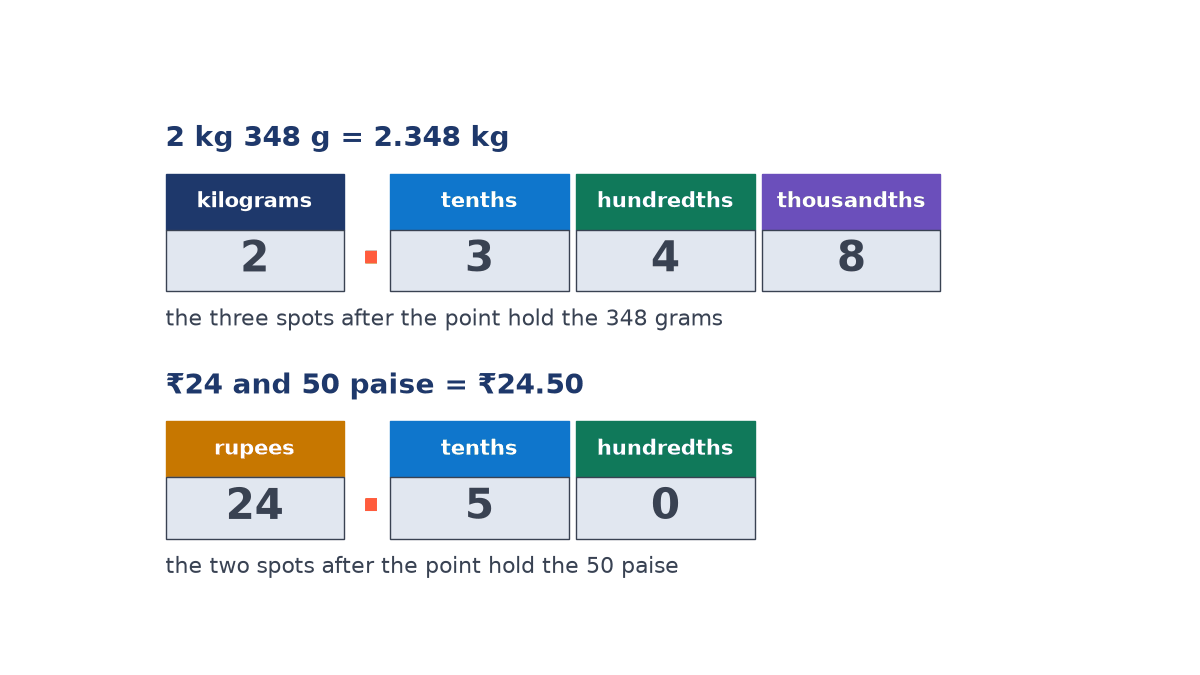
A decimal is simply how you write those parts down. The first spot after the point counts tenths, the next counts hundredths, and the next counts thousandths. Each spot is ten times smaller than the one before it.
Remember. grams kilogram. And paise ₹.
Both facts work in the same way: it always takes the same number of small ones to make one big one. It's grams every time, and paise every time.
So a gram is a thousandth of a kilogram, and a paisa is a hundredth of a rupee. Those are exactly the kind of parts you can write after a point.
Grams into kilograms
Go back to the sugar bag and its pinches. One pinch is one gram. So g is kg, which is kg.
| Weight in grams | Same weight in kilograms |
|---|---|
| g | kg |
| g | kg |
| g | kg |
| g | kg |
Notice the pattern in the table. Every spot to the right is ten times smaller, so one step makes a number ten times smaller, two steps make it a hundred times smaller, and three steps make it a thousand times smaller.
A gram is a thousand times smaller than a kilogram. That's three steps, so every digit slides three spots to the right. (A digit, remember, is one of the number symbols, like the and the in .)
So g becomes kg. That zero after the point is doing real work, keeping the tenths spot empty. Leave it out and you'd read kg, which is ten times too heavy. Imagine the shopkeeper's face!
g is more than a kilogram: it is whole kilograms and grams over, so it is kg. The part before the point counts whole kilograms, and the part after it counts the grams left over.
Paise into rupees
Put a ten rupee note on the table and imagine changing it for the smallest coins there are. You would need paise just to build back one rupee.
So one paisa is one of a rupee's hundred parts, which is ₹. A rupee is a hundred times bigger than a paisa, which is two steps. So to change paise into rupees, you divide by .
| Amount in paise | Same amount in rupees |
|---|---|
| paisa | ₹ |
| paise | ₹ |
| paise | ₹ |
| paise | ₹ |
A shop price label usually shows two spots after the point. A paisa is the smallest coin, so nothing smaller ever needs writing. The first spot counts ten paise coins and the second counts single paise. So ₹ means fifty paise, or half a rupee.
paise is more than a rupee. It is whole rupees and paise over. So it is ₹.
Writing kilograms and grams as one number
First turn the grams into kilograms, then add them to the whole kilograms. The point keeps the two parts neatly apart.
Write kg g in kilograms
Read the answer back to yourself. The counts kilograms and the after the point counts grams. Nothing was lost; the same weight is simply written a new way.
The chart below shows the same idea as a place-value chart. Each box holds one digit, and the point sits between the whole kilograms and the parts of a kilogram.
More kilograms and grams
Watch the empty spots. They must be filled with zeros so that every digit stays in its own column.
Write kg g in kilograms
Five grams is five thousandths, so the goes in the third spot. Two zeros hold the tenths and hundredths spots open.
Write kg g in kilograms
The zero at the end of can be dropped, but the zero straight after the point cannot.
Going the other way
To turn kilograms back into grams, multiply by : every digit slides three spots to the left. So kg is g.
Writing rupees and paise as one number
Money goes exactly the same way. Turn the paise into rupees, then add them to the whole rupees.
Write ₹ and paise in rupees
A price label would show ₹ instead, but it's the same money. Here's the difference to keep in mind: a zero between the point and a digit changes the number (that's why kg is not kg), while a zero at the very end changes nothing.
There's nothing after that last zero for it to push along. So ₹ and ₹ are the same amount.
Remember. Divide by however many small ones fit in one big one. grams fit in a kilogram, so divide grams by . paise fit in a rupee, so divide paise by .
Using decimals in real sums
Once weights and money are written as decimals, you can add and subtract them like ordinary numbers. Line up the points first.
Amma buys kg g of rice and kg g of wheat. What is the total weight?
So the bag holds kg, which is kg g.
A shirt costs ₹. You pay with ₹. How much change do you get?
You get ₹ back, which is rupees and paise.
Practice
Fill in each blank.
| 1) | 3) | 5) |
| 2) | 4) | 6) |
Check your answers
| Question | Answer | Question | Answer |
|---|---|---|---|
Common mistakes
- Writing g as kg. Grams need three spots, so it is kg.
- Using three spots for paise. A rupee has paise, so paise need only two spots: paise is ₹.
- Dropping a zero in the middle, such as writing kg g as kg.
- Adding decimals without lining up the points.
- Thinking ₹ and ₹ are different. A zero at the very end changes nothing.
Key terms
- Decimal point
- The dot that separates whole units on the left from parts of a unit on the right.
- Tenth, hundredth, thousandth
- One of , or equal parts of a whole.
- Kilogram and gram
- grams make kilogram.
- Rupee and paisa
- paise make ₹.
- Digit
- One of the number symbols to .
- Place value
- The worth of a digit because of the spot it sits in.