Every price tag, every ruler reading and every weight on a packet of dal is written with digits in places. Place value is the idea that where a digit sits decides what it is worth. Expanded form is a way of writing a number that shows those worths openly. Together they let you read any decimal with confidence and compare numbers like and without guessing.
Suppose a price tag says Rs . That means 24 whole rupees and 50 paise, and the point shows you exactly where the rupees stop.
Numbers like work the same way: the point splits the number into two parts. On its left are whole things; on its right are parts of one thing.
A number with a point in it is called a decimal, so Rs is a decimal, and so is .
The single signs , , , , and are called digits. A digit is just one number sign on its own.
How to say it
We read as four hundred fifty seven and three tenths six hundredths and eight thousandths.
When you say a decimal aloud, read the digits after the point one at a time. So is twelve point three five, not twelve point thirty five.
Why be so fussy? Because the means three tenths and the means five hundredths. They live in two different places.
Saying thirty five glues them into one number, and then nobody listening can hear where each digit belongs.
Expanded form
Expanded form breaks a number into the value of each digit and then adds those values back together.
It's a bit like opening up a toy to see how it works. Once you can see what each digit is really worth, you can tell from without guessing.
In fact, the way we read the number already hands you the answer. Three tenths is , six hundredths is , and eight thousandths is .
457.368 in expanded form
Each piece shows what one digit is worth. Add all six pieces together and you get back, safe and sound.
Place value
The place value of a digit is what that digit is worth where it stands.
The in stands in the hundreds place, so its place value is .
The same digit can be worth very different amounts. The in is worth , while the in is worth only four tenths. Same digit, different place, different worth.
The units place is the plain ones place, sitting just to the left of the point.
| Digit | Place | Place value | As a decimal |
|---|---|---|---|
| hundreds | |||
| tens | |||
| units | |||
| tenths | |||
| hundredths | |||
| thousandths |
Read any row across and you have that digit's place value.
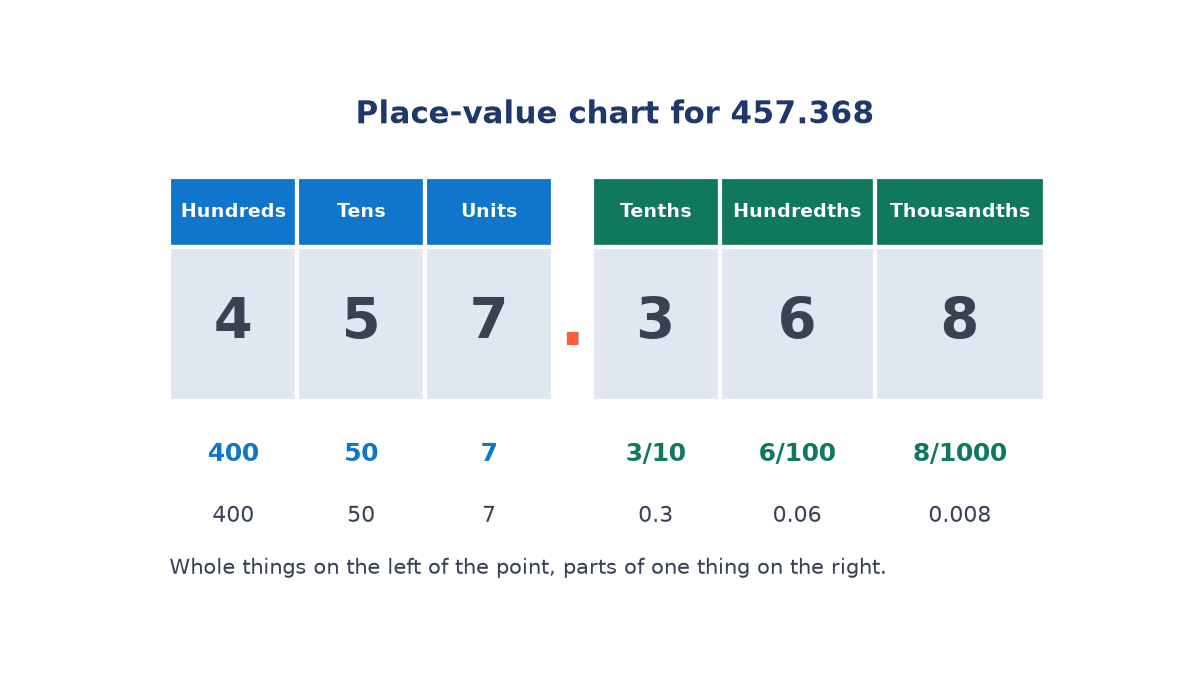
Now run your eye along the chart from right to left. Each place is worth ten times the place on its right: ten thousandths make one hundredth, ten hundredths make one tenth, and ten tenths make one unit. It is the same old pattern as ten units making one ten, simply carried on past the point.
Zeros at the two far ends
A zero before the first whole digit adds nothing, and neither does a zero after the last decimal digit.
So can be written as ; it is still the same number.
More worked examples
Example 1: a number with no zeros
Write in expanded form
The is in the tens place, the in the units, the in the tenths and the in the hundredths.
Example 2: zeros that hold places
Write in expanded form
Go place by place. Hundreds: , worth . Tens: , worth nothing. Units: . Tenths: , worth nothing. Hundredths: , worth .
The two zeros do not appear in the sum, but they still matter in the number. Without them the and the would slide into the wrong places.
Example 3: going backwards
Which number is ?
Put each worth in its place: tens , units , tenths (there are none), hundredths , thousandths . So the number is . Notice the zero you must write in the tenths place.
Where you have met the small places
The places after the point aren't really new to you. You meet all three almost every day.
- Look at a ruler. Between cm and cm there are ten small marks. One small mark is one tenth of a centimetre. In decimals that is cm.
- One paise is of a rupee. In decimals that is Rs .
- One gram is of a kilogram. In decimals that is kg.
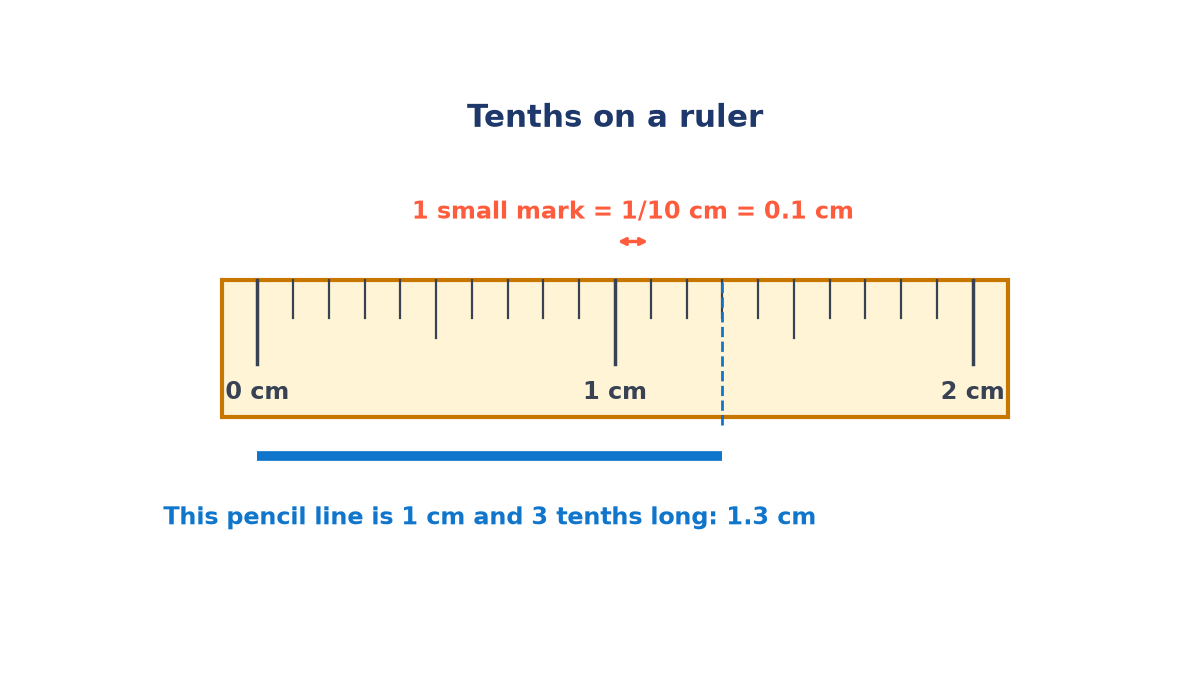
So tenths sit on your ruler, hundredths hide in the paise on a price tag, and thousandths are in the grams on a packet.
Remember. Every digit has a place. The place tells you what the digit is worth. Expanded form writes down all those worths and adds them up.
Try these
Write each of these numbers in expanded form.
A small tip before you start: if a place holds a zero, that piece is worth nothing, so just leave it out.
In the tenths place holds , so the answer starts at hundredths. In the units place holds , so that piece goes too.
| 1) | 2) | 3) | 4) |
| Question | Answer | Question | Answer |
|---|---|---|---|
Now answer these three about .
- What is the place value of ?
- What is the place value of ?
- Which digit is in the tenths place?
| Question | Answer |
|---|---|
| Place value of | , because it is in the units place |
| Place value of | , which is |
| Digit in the tenths place |
Common mistakes
- Reading as "twelve point thirty five". Say each digit after the point on its own.
- Thinking is bigger than because is bigger than . Compare tenths first: tenths is less than tenths.
- Leaving out a zero that holds a place, as in writing for .
- Giving a digit's face value instead of its place value. The in is worth , not .
- Writing for a digit in the hundredths place. Count the places after the point: second place, hundredths.
Key terms
- Decimal
- A number written with a point, such as .
- Digit
- One number sign on its own, from to .
- Decimal point
- The dot that separates whole things from parts of one thing.
- Place
- The position of a digit, such as hundreds, units or tenths.
- Place value
- What a digit is worth where it stands.
- Expanded form
- A number written as the sum of the values of its digits.
- Units place
- The ones place, just to the left of the point.
Answers
Expanded form
About 457.368
- , because it is in the units place.
- , which is , because it is in the hundredths place.
- is in the tenths place.