A rupee is worth 100 paise, so 50 paise is half a rupee. You can write that half as , or as Rs . Either way, it's the same money in your pocket.
A decimal is a number with a point in it, like or . The point splits the number in two: whole things sit on the left, and parts of a thing sit on the right.
Ten paise is of a rupee, which is the same as of a rupee. You write it as Rs .
So a fraction and a decimal can hold exactly the same value. is a fraction and its decimal is : two ways of writing one amount.
Here's the interesting part. Some fractions give a decimal that stops, and some give a decimal that never stops. By the end of this lesson you'll be able to tell which is which just by looking.
You meet decimals on price tags, weighing scales, thermometers and cricket run rates. Knowing how they connect to fractions lets you move between the two without a calculator. It also prepares you for the next big idea in this course: numbers whose decimals never stop and never repeat, called irrational numbers.
Tenths, hundredths and thousandths
Decimal places are built on ten. The first place after the point is tenths, the next is hundredths, and the next is thousandths. Each place is ten times smaller than the one before it.
So a decimal is really a fraction over ten, or a hundred, or a thousand. is . is . is .
Money works the same way: one paise is of a rupee, so one paise is Rs .
Try saying each number slowly. is read as zero point one. is read as one point two. is read as zero point zero one. is read as zero point zero zero one.
Remember. Read the digits after the point one at a time. is read as twelve point three five. It is not read as twelve point thirty five.
The same rule holds for longer numbers. is read as one point two three five.
Noughts at the very front do no work, and neither do noughts at the very end after the point. So can be written simply as .
Expanded form
Expanded form splits a number into the value of each digit.
Expand
You read it as four hundred fifty seven and three tenths six hundredths and eight thousandths.
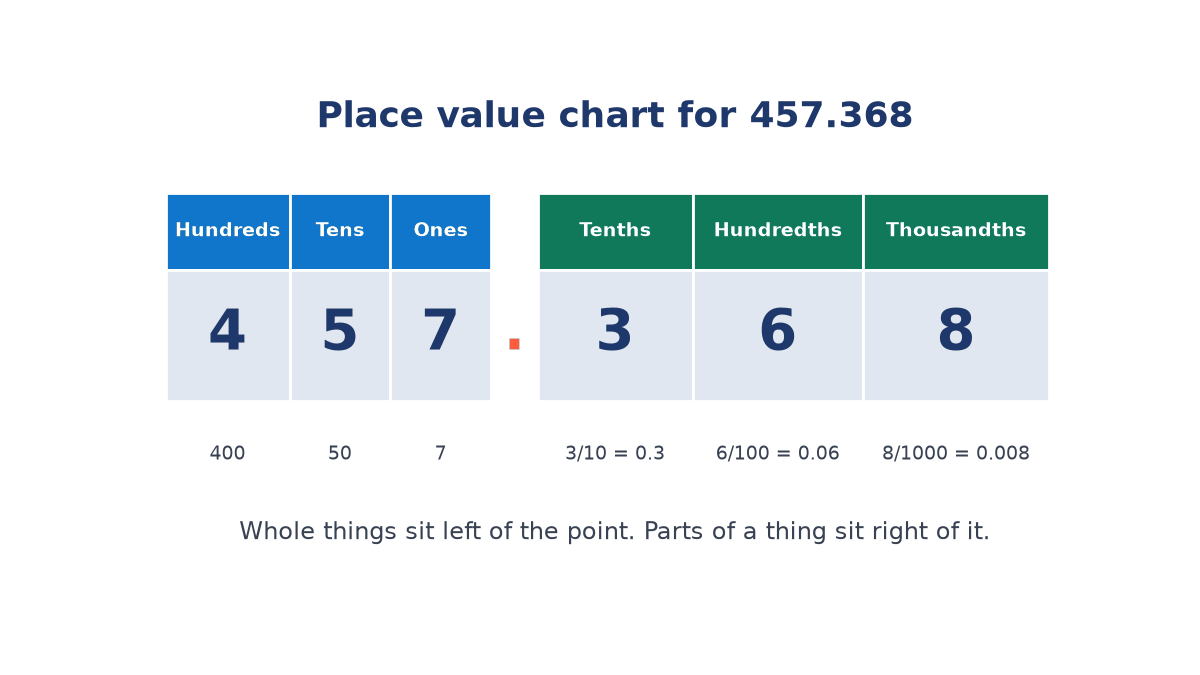
Place value
Place value tells you what a digit is worth where it sits. In the place value of 4 is . The place value of 3 is . The place value of 8 is .
Grams and rupees
The shopkeeper's weighing scale uses this idea every day. grams make 1 kilogram, so 1 gram is of a kilogram, or kg.
| Grams | Kilograms |
|---|---|
| 1 g | kg |
| 85 g | kg |
| 999 g | kg |
| 5678 g | kg |
Money follows the same pattern. paise make 1 rupee, so 1 paise is of a rupee.
| Paise | Rupees |
|---|---|
| 1 paise | Rs |
| 2 paise | Rs |
| 50 paise | Rs |
| 225 paise | Rs |
Write 2 kg 348 g in kilograms
Write Rs 24 and 50 paise in rupees
Why ten matters
Ten, a hundred, a thousand: each one is the one before with another nought on the end. We call these the powers of ten.
Now look at what they are made of. Ten is . A hundred is . A thousand is .
Only 2s and 5s, every single time, however far you go. Hold on to that one fact, because it drives the whole rule below.
Simplest form comes first
The bottom of a fraction is the number under the line. In the bottom is 8. It tells you how many equal pieces one whole was cut into.
A fraction is in its simplest form when no number divides into both the top and the bottom.
is not in simplest form yet. 3 goes into 6, and 3 goes into 15. Divide both by 3 and you get .
That is the same amount, just written as small as it will go. Shrinking a fraction like this is called cancelling.
The test
Remember. Put the fraction in its simplest form first. Then look at the bottom. If the bottom is made of 2s and 5s only, the decimal stops. If any other number is in there, the decimal repeats for ever.
Why does this work? In plain words: you want the bottom to become ten, or a hundred, or a thousand, and those can only be built out of 2s and 5s.
A bottom of 8 is ; feed it three 5s and it becomes . A bottom of 3, though, can never become a power of ten. No amount of multiplying will clear that 3 away.
A teacher's warning: always test the tidy fraction, never the untidy one. looks as if it fails, because its bottom holds a 3. But in simplest form the bottom is just 5.
Test
A fraction into a decimal, with no dividing
If you can turn the bottom into a power of ten, you can read the decimal straight off, with no long division at all.
The two fractions below are our own examples; your book uses its own numbers, but the method is exactly the same.
Take . The bottom is : three 2s and no 5s. Give it three 5s and it reaches , and three 5s multiply to .
Write as a decimal
Whatever you do to the bottom, you must do to the top. Multiplying both by 125 is really multiplying by , and is just 1.
And multiplying by 1 never changes an amount. So and are the same size; only the writing is different.
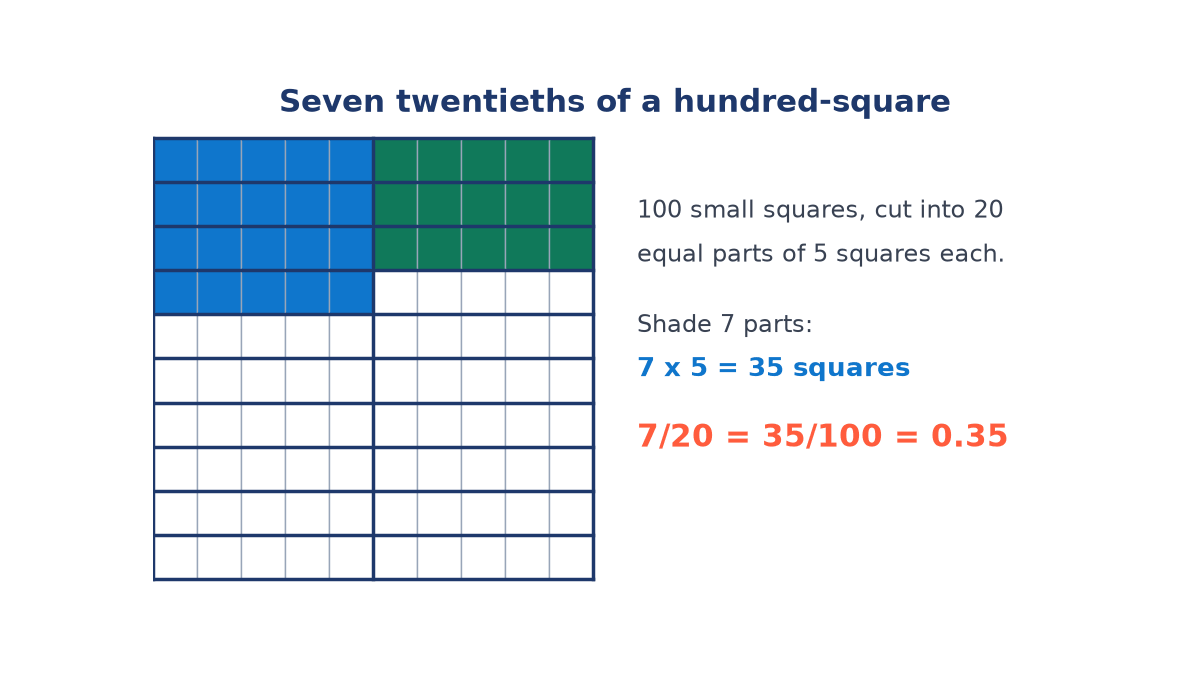
Now picture a measuring jug with a hundred small marks up the side, where full is one whole. Cut the jug into 20 equal parts and each part is 5 of those marks.
So of the jug is seven of those parts, which is marks. The working below simply writes down what you counted.
The bottom is : two 2s and one 5. One more 5 lifts it to .
Write as a decimal
35 marks out of a hundred is .
Ready for a harder one? Take . The bottom is , four 2s and no 5s. It needs four 5s, and four 5s multiply to .
Write as a decimal
Four 2s matched with four 5s make , so the decimal has four places.
When the decimal repeats
fails the test, because three is neither a 2 nor a 5. So its decimal cannot stop. Let's see what goes wrong.
Imagine sharing one rupee between three children. Each child gets 33 paise, and one paise is left over. Now break that paise into ten smaller bits.
Share those bits out. Each child gets 3 more, and once again one bit is left over. The leftover never goes away; it only gets smaller and smaller.
That bit left over is called the remainder, meaning what is still there after sharing. Now let's do the same thing as a division.
Divide 1 by 3
The remainder is 1 every time, so the same step comes round again and again, for ever. You get and the 3s just keep going.
To save yourself writing 3s all day, put a bar over the digits that repeat: .
fails too. Six is , and that 3 spoils it even though the 2 is perfectly fine. So .
| Fraction | Bottom in simplest form | Only 2s and 5s? | Decimal |
|---|---|---|---|
| Yes | |||
| Yes | |||
| Yes | |||
| No | |||
| No |
Remember. Your book uses longer words for these. A decimal that stops is called a terminating decimal. A decimal that repeats for ever is called a recurring decimal. The bottom of a fraction is called the denominator. Same things, longer names.
Going back: a decimal into a fraction
Now let's go the other way. has one digit after the point, so it is counted in tenths. Write it over ten, then cancel.
Write as a rational number
has two digits after the point, so it is counted in hundredths. Write it over a hundred.
Write as a rational number
So just count the digits after the point. One digit means tenths, two mean hundredths, and three mean thousandths.
It's the same ladder you saw at the start, with each place ten times smaller than the one before. The last digit tells you what to write the number over.
A repeating decimal into a fraction
A repeating decimal has no last digit, so you can't simply write it over a hundred. Luckily there's a neat trick for these.
The number below is our own example; your book works the same method on its own number.
Give the number a name, say , and multiply it by ten. That shifts every digit one place to the left.
Only one digit repeats here, just the 3, and ten moves the number along by exactly one digit. So the two endless tails line up neatly under each other.
From the point onwards, and now have the same endless run of digits, and taking one line from the other wipes that run out completely. (A block of two repeating digits would need a hundred instead.)
Write as a rational number
Now for a block of two repeating digits. This time you multiply by a hundred, because a hundred moves the number along by two digits.
Write as a rational number
Check it with the test: the bottom is , which is not made of 2s and 5s. So the decimal of must repeat, and it does.
And look: is , which matches the division you did earlier. The two ends of the lesson have met in the middle.
Rational numbers
A rational number is any number you can write as one whole number over another. and are both rational.
You have just seen both kinds of decimal turn back into fractions. became . And became .
Remember. A decimal that stops is a rational number. A decimal that repeats for ever is a rational number too. Both can be written as one whole number over another.
Practice
These six questions are ours, not your book's.
- Write as a decimal.
- Write as a decimal.
- Write as a decimal.
- Does stop or repeat?
- Write as a rational number.
- Write as a rational number.
| Question | Answer | Question | Answer |
|---|---|---|---|
| It repeats. Its decimal is . | |||
Common mistakes
- Reading as "twelve point thirty five". Read the digits after the point one at a time.
- Testing a fraction before cancelling it. looks as if it repeats, but it is .
- Multiplying only the bottom of a fraction. Whatever you do to the bottom, do to the top.
- Writing 85 g as kg. A gram is a thousandth of a kilogram, so 85 g is kg.
- Putting the bar over the wrong digits. In only the 6 repeats, so the bar sits over the 6 alone.
- Multiplying by ten for a two-digit repeating block. Use a hundred, so the endless tails line up.
Key terms
- Decimal
- A number written with a point, whole parts to the left and parts of a whole to the right.
- Place value
- What a digit is worth because of the place where it sits.
- Denominator
- The bottom of a fraction: how many equal pieces one whole is cut into.
- Simplest form
- A fraction whose top and bottom share no factor except 1.
- Terminating decimal
- A decimal that stops.
- Recurring decimal
- A decimal in which a digit or block of digits repeats for ever, shown with a bar.
- Rational number
- Any number that can be written as one whole number over another (the bottom not zero).
Answers
Show answers
- It repeats. is already in simplest form and has a 3, so .