Decimals are everywhere once you start looking. A shop bill says ₹. A cricket commentator says a bowler's economy is . Your height on the school card is metres. Sooner or later you'll need to add two of these, or take one away from another, and you'll want to do it without a single slip.
A decimal is a number with a dot in it, like a price of rupees. The dot, called the decimal point, splits the whole rupees on its left from the part of a rupee on its right.
Good news: you add decimals almost exactly the way you add whole numbers. There is just one extra thing to watch. The decimal points must sit in a straight line, one under the other.
First, the same form
The first rule is to change the decimals into the same form, which simply means giving them the same number of digits after the point.
A digit is a single number sign. In the 2, the 3, the 8 and the 0 are all digits.
Look at and . One has a single digit after the point and the other has two. Write as , and now both have two.
Is adding that zero safe? Yes. A zero added after the decimal point, at the right hand end, adds nothing to the value.
Think of rupees to convince yourself. There are 100 paise in a rupee, so one paisa is one hundredth of a rupee.
Now read rupees. It means 23 rupees and 8 tenths of a rupee, and eight tenths of a rupee is 80 paise. So names the very same money.
Remember. A zero written after the decimal point, at the right hand end, never changes the value. So and are the same number.
Line up the points, not the last digits
If decimal sums go wrong, this is almost always where. Don't line up the last digits; line up the decimal points.
Where a digit sits tells you how much it is worth, and that is its place value. In the 8 sits in the tenths place, so it is worth 8 tenths of a rupee, which is 80 paise.
So why do the points matter so much? Look at the table below. Each up-and-down column holds one place value: tenths go under tenths, and hundredths go under hundredths.
| Number | Hundreds | Tens | Ones | Point | Tenths | Hundredths |
|---|---|---|---|---|---|---|
| 2 | 1 | 2 | . | 6 | 2 | |
| 2 | 3 | . | 8 | 0 |
The two points stand in the same column, and that is exactly what you want on paper.
Suppose you lined up the last digits instead. The 8 tenths of would land under the 2 hundredths, and you'd be adding 80 paise to 2 paise as if they were the same kind of coin. The answer would come out wrong.
Adding decimals
Here are the three steps, every time.
- Change the given decimals into the same form.
- Write digits of the same place value under each other, in a column.
- Add as you add whole numbers. Then put the decimal point in the right place.
The point in the answer goes straight below the other points; it never wanders. Here is the first sum set out in columns.
| Sum | Hundreds | Tens | Ones | Point | Tenths | Hundredths |
|---|---|---|---|---|---|---|
| Take | 2 | 1 | 2 | . | 6 | 2 |
| add | 2 | 3 | . | 8 | 0 | |
| and you get | 2 | 3 | 6 | . | 4 | 2 |
The picture below shows the same sum as a place value chart. Look at the pink strip in the middle. Every decimal point sits in it, including the point in the answer.
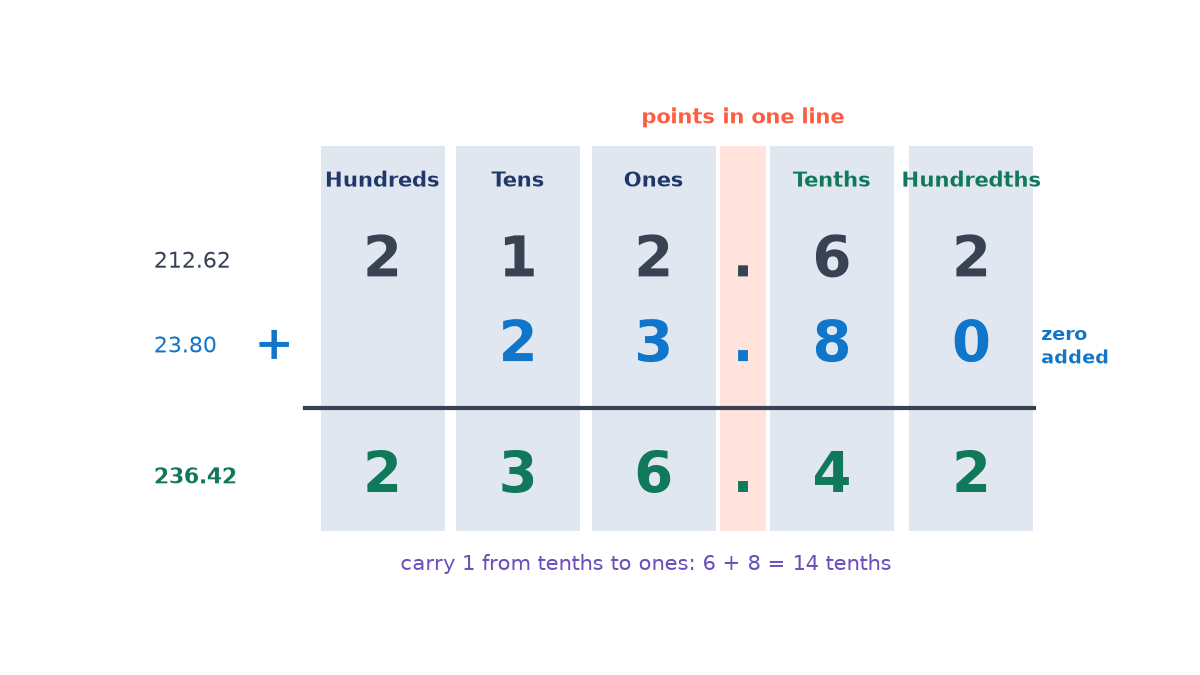
Start at the right, just as you do with whole numbers. Hundredths first: . Then tenths: tenths. Fourteen tenths is one whole and four tenths, so write and carry into the ones column. Ones: . Tens: . Hundreds: . Put the point under the other points and read the answer, .
Add 212.62 and 23.8
The next sum has three numbers, and the longest one has three digits after the point. So give all three numbers three digits after the point.
Add 3.625, 4.76 and 35.74
Two more sums to try with a pencil
Here are two more additions, a little gentler than the ones above. The first needs no carrying; the second needs a zero and a carry.
Add 4.5 and 2.3
Both numbers already have one digit after the point. Tenths: . Ones: . Nothing to carry, so you're done.
Add 7.25 and 0.8
Hundredths: . Tenths: tenths, which is one whole and no tenths. Write and carry . Ones: . The in the tenths place must stay. Without it, the answer would wrongly read .
Taking away decimals
Taking away is also called subtracting, and here there are four steps to follow every time.
- Change the given decimals into the same form.
- Write the smaller number below the bigger number.
- Write digits of the same place value under each other, in a column.
- Take away as you do with whole numbers.
Why does the bigger number go on top? Well, you can't take 8 rupees away from 3 rupees. Put the bigger number first and every column has enough to give. And yes, the decimal points still line up.
Subtract 42.32 from 83.95
Both numbers already have two digits after the point, so there's no zero to add this time.
When one number has no point
A whole number has no point written down, but you may always put one at its right hand end. So 40 is , and 100 is .
Think of money again: 40 rupees is 40 rupees and no paise. So is the same amount as 40.
Now the top number has the same form as the one below it, and you can take away column by column.
Take 13.6 away from 40
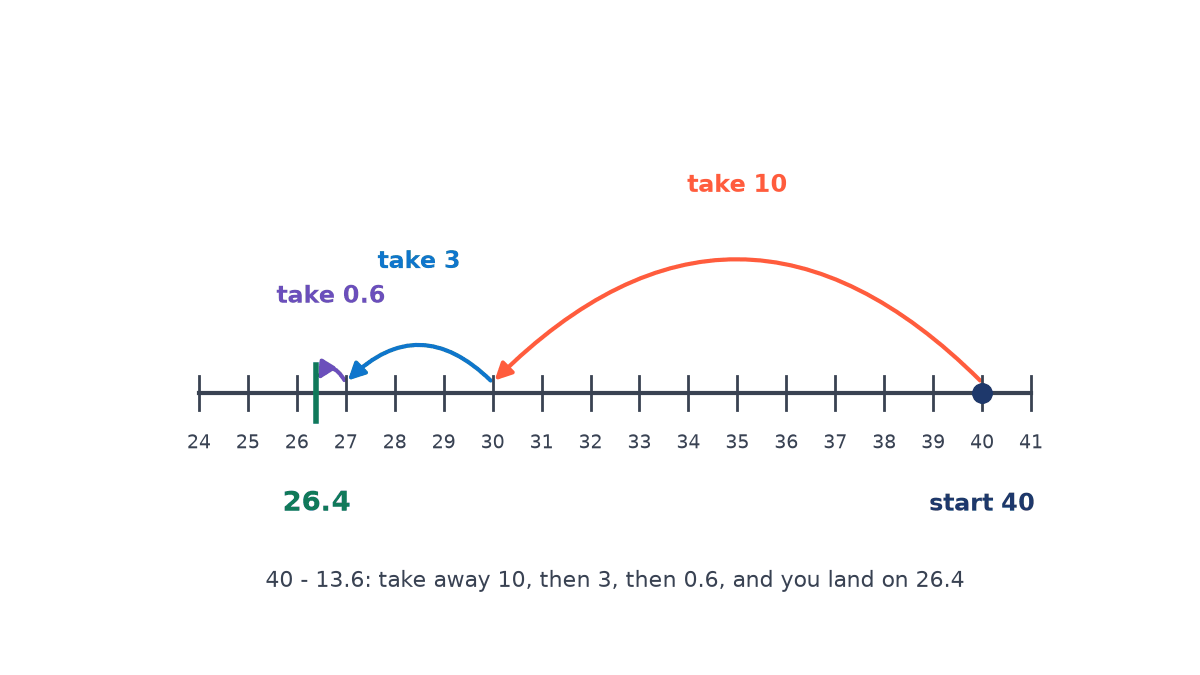
You can also see this sum on a number line. Start at and take away in three easy jumps: first , then , then .
Taking away with borrowing
Sometimes the top digit in a column is smaller than the one below it. Then you borrow from the column on the left, just as you would with whole numbers. The decimal point doesn't get in the way at all; you simply borrow straight across it.
Subtract 2.75 from 5.6
Hundredths: cannot be done, so borrow one tenth. Now it is . Tenths: the has become , and cannot be done, so borrow one whole from the ones. Now it is . Ones: the has become , and . The answer is .
Subtract 18.45 from 50
Here the top number is written with two zeros after the point, because has two digits after its point. Every column now has a digit to work with.
A sum with adding and taking away
Some sums mix the two. A handy approach: gather the numbers you are adding, gather the numbers you are taking away, and then do one single taking away at the end.
Why is that allowed? Think of money coming in and money going out of your piggy bank. Add up everything coming in, add up everything going out, then take the going-out total away from the coming-in total. The order you count them in doesn't change what is left.
In the sum below, . The numbers being taken away give .
The last step needs the same form, so is first written as .
Find the value of 123.52 - 27.53 + 2353.254 - 167.2345
Remember. Line up the decimal points. Fill any short number with zeros after its decimal point. Then work as you do with whole numbers.
A shopping sum
Meena buys a notebook for ₹ and a pen for ₹. She pays with a ₹ note. How much change does she get?
Meena gets ₹ back. Check it by adding: . Here's a teacher's tip worth keeping: adding back is the quickest way to check any taking away.
Practice
| 1) | 3) | 5) |
| 2) | 4) | 6) |
| Question | Answer | Question | Answer |
|---|---|---|---|
Common mistakes
- Lining up the last digits instead of the decimal points. In this puts tenths under hundredths.
- Dropping a zero that holds a place. and are different numbers.
- Forgetting that a whole number has a point at its right-hand end. is , not .
- Putting the smaller number on top when taking away, and then taking the top digit from the bottom one.
- Leaving the decimal point out of the answer, or moving it. It goes straight below the other points.
Key terms
- Decimal
- A number with a decimal point, such as , that shows parts of a whole.
- Decimal point
- The dot that separates the whole part on its left from the part less than one on its right.
- Digit
- A single number sign from to .
- Place value
- What a digit is worth because of where it sits: ones, tenths, hundredths and so on.
- Same form
- Decimals written with the same number of digits after the point, by adding zeros at the right-hand end.
- Carry
- Moving a ten from one column into the next column to the left when a column adds to ten or more.
- Borrow
- Taking one from the column to the left when a top digit is too small to take away from.