Decimals turn up whenever we measure or pay. Petrol costs so many rupees for each litre, cloth is sold by the metre, and a recipe may need of a kilogram of sugar. To find the cost of metres of cloth, or how many m pieces a ribbon makes, you must multiply or divide decimals. The good news is that you already know how: you multiply and divide as with whole numbers, and one short rule tells you where the point goes.
A decimal is a number with a point in it, like the Rs on a price label. The part after the point is less than one whole.
You have already added and subtracted decimals, so now it's time to multiply and divide them. Rather than just learn rules, we'll use a jug, a ruler and some money to see why the rules work.
Multiplying decimals
Say a jug holds glasses of water, and you fill it only half full. Half is , and you now have glasses. Of course half a jug is less than a full jug, so , and is smaller than .
A decimal below is only part of one whole, so multiplying by it gives you a smaller answer. A decimal above works the other way: , and is bigger than .
See it on a ruler first
Take a strip metre long and cut off of it. That piece is cm. Now take of that piece, and you get cm.
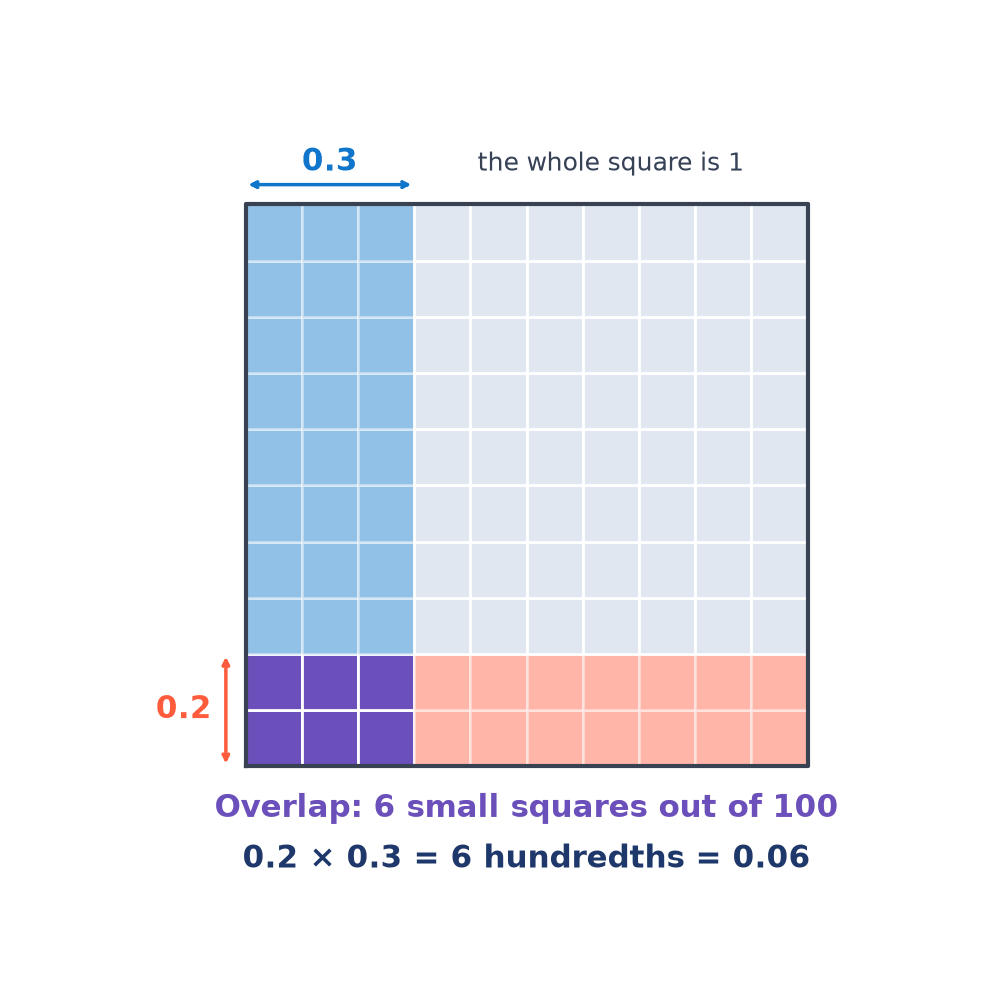
Six centimetres out of a whole metre is of the metre, so . The rule below is just the short way of reaching that same answer.
A hundred square shows the same thing. Let the whole square stand for , then shade of it one way and of it the other way. The part shaded both ways is of .
The method
The method has just two steps. First, multiply the numbers as if the points weren't there. Then count the digits after the point in both numbers.
A digit is one single number sign, like the or the , so has one digit after the point. Your answer needs as many digits after the point as the two numbers have between them.
The chapter's example
Work out . Cover the points with your finger and multiply to get . Now count: has digit after the point and has digit after the point, so you count digits.
The answer needs two digits after the point. Start at the right of and count two places; you'll need a zero to fill the gap. The answer is .
Multiplying
Why the rule works
Cut one rupee into equal parts. Each part is one tenth, and two of them make of the rupee.
Now cut each tenth into again. You get tiny parts of a rupee, each one a hundredth, and hundredths sit in the second place after the point.
A fraction is a way of writing part of something. means two parts out of ten. So is , and is .
Multiply the top numbers: . Multiply the bottom numbers: . So the answer is .
is six hundredths, and hundredths take two places after the point. That gives . So the counting rule is nothing magic; it is this fraction work made short.
Why gives
Remember. Multiply as if there were no points. Then count the digits after the point in both numbers. Your answer gets that many digits after the point.
One more of the same shape
The chapter gives only one example, so here is one of ours built to the same shape.
Work out . First multiply to get . Each number has one digit after the point, so the answer needs digits after the point. The answer is .
Multiplying
You can even check that in your head. is a half, and half of is . Spot on.
| Sum | Digits after the point | Answer | Where it comes from |
|---|---|---|---|
| The chapter | |||
| Ours | |||
| Ours |
Harder sums with the same rule
The rule works for any decimals, not just tenths. Here are three more, each a step harder than the last.
Multiplying
A whole number has no digits after the point, so it adds nothing to the count.
Multiplying
Check by estimating: is between and , and is a little more than . So the answer should be a little more than . fits.
Multiplying
Careful here. Count the three places first, and only then drop the zeros at the right-hand end. Drop them first and you'll put the point in the wrong place.
Dividing a decimal by a whole number
A whole number is a number with no point in it, like or .
The worked example and the rule in this section are our own, set out in the chapter's style.
Four children share Rs equally. How much does each child get? This time you are dividing a decimal by a whole number.
Rs is rupees and paise. Share the rupees first: each child gets rupees, and rupee is left over.
Change that leftover rupee into paise, and now you have paise to share. Each child gets paise, so each child gets Rs in all.
Sharing Rs between children (ours, not the chapter's)
Check by multiplying back: , which is exactly the money you started with.
Dividing by
Three goes into two times, with left over. Carry that across the point, so the tenths become tenths. Three goes into five times. Write the point in the answer straight above the point in , and you have . Check: .
Why the point does not move
Through the whole sharing, rupees stayed rupees and paise stayed paise. So each place in the answer means the same as the place above it.
That is why the point in the answer sits straight under the point in the number, and otherwise you divide just as you do with whole numbers.
Remember. When you divide by a whole number, the point does not move. Keep the point in the answer straight under the point in the number.
Dividing by another decimal
The worked example and the rule in this section are our own as well.
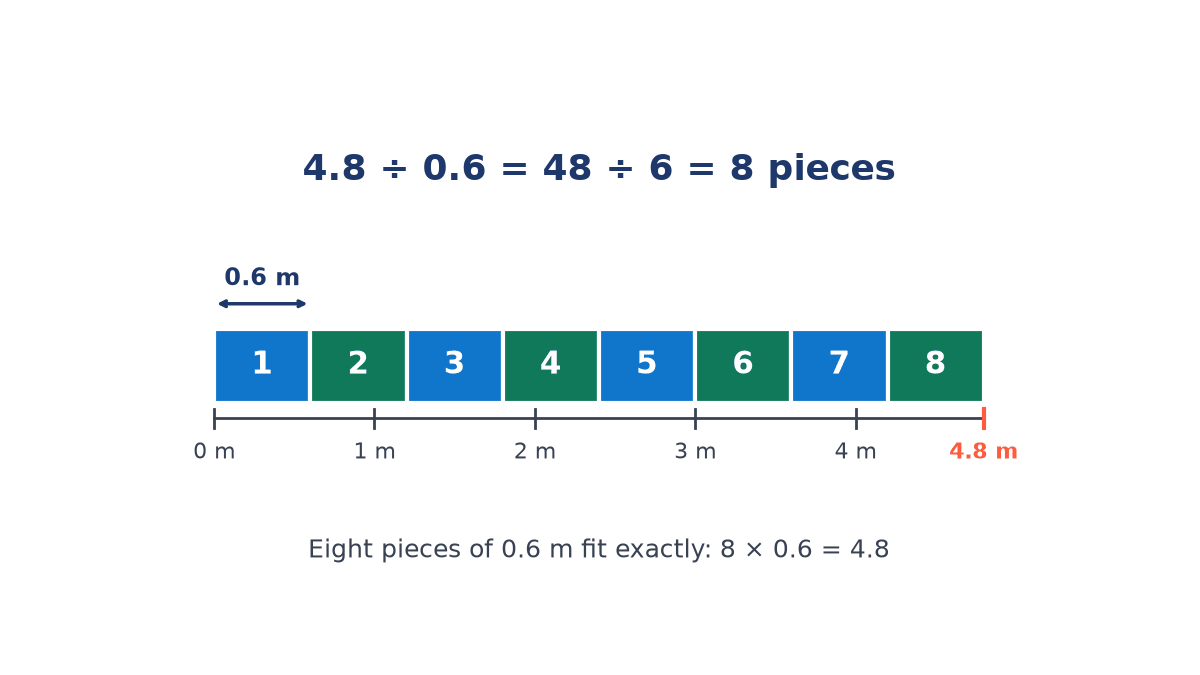
A ribbon is m long, and you cut it into pieces m long. How many pieces do you get? This time you are dividing by a decimal.
Sharing into pieces of feels awkward, while pieces of are much easier. So the trick is to change the into a whole number first.
Move the point in one place to the right and it becomes . Move the point in one place as well, and it becomes .
The key is to move the point the same number of places in both numbers. Then divide in the usual way.
Dividing by (ours, not the chapter's)
You get pieces. Check it on a ruler: eight pieces of m come to m.
Moving the point two places
Sometimes the number you divide by has two digits after the point. No problem: just move both points two places.
Dividing by
Check: . Moving both points two places multiplies both numbers by , so the answer stays the same.
Why you may move both points
Rs is paise. Move the point one place right and you get Rs , which is ten times as much.
In fact, moving the point one place right always makes a number ten times bigger, because every digit slides up one place.
Now remember that a division is also a fraction: means . You multiplied the top by ten, and you multiplied the bottom by ten as well.
Multiply the top and the bottom by the same number and the fraction is still the same amount, just as and are the same amount. So the answer doesn't change.
Why becomes
Remember. Move the point in both numbers by the same number of places. Move it until the number you divide by is whole. Then divide.
Practice
- Share Rs between children. How much does each child get?
- A ribbon is m long. You cut it into pieces m long. How many pieces do you get?
- A strip is m long. Take of the strip, then take of that piece. How much of the metre is that?
| 1) | 3) | 5) |
| 2) | 4) | 6) |
| Question | Answer | Question | Answer | Question | Answer |
|---|---|---|---|---|---|
Common mistakes
- Lining up the points when multiplying, as in addition. For multiplying you count digits instead.
- Counting digits in only one number. Count the digits after the point in both numbers and add the counts.
- Forgetting the filling zero. is , not .
- Moving the point in only one number when dividing by a decimal. Move it the same number of places in both.
- Expecting multiplying to always make a number bigger. Multiplying by a decimal below makes it smaller.
Key terms
- Decimal
- A number with a point in it, such as .
- Digit after the point
- A digit to the right of the decimal point; each one is a place of tenths, hundredths and so on.
- Tenth
- One of ten equal parts of a whole, written .
- Hundredth
- One of a hundred equal parts of a whole, written .
- Whole number
- A number with no point in it, such as .
- Estimate
- A rough answer worked out with easy numbers, used to check where the point goes.
Answers
Word problems
- , so each child gets Rs .
- pieces.
- of the metre, which is cm.