Splitting a restaurant bill, reading a cricket run rate, comparing your test score with a friend's: every one of these is a fraction in disguise, and the same fraction can wear many costumes. To compare two of them fairly, you first want each one in its neatest outfit. We call that outfit the simplest, or standard, form. Once you have it, deciding which of two rational numbers is bigger becomes almost easy.
Think of half a cake. You can call it of the cake. Cut the same cake into four equal pieces and it becomes ; cut it into six and it is . You still have exactly as much cake to eat. Only the slicing changed.
So one fraction can go by many names. Maths simply agrees to use the tidiest of them as its proper name.
Simplest form
You met rational numbers in Rational numbers. A rational number is any number you can write as . is one. So is . Here is the top number and is the bottom one.
Both and are integers, which just means whole numbers with no bits broken off. An integer can be a counting number, it can be zero, and it can carry a minus sign. The bottom number is never , though. After all, you cannot cut a cake into no pieces!
A rational number is in simplest form when two things are true.
- and have no common divisor except . That means no number except divides both of them.
- , the bottom number, is positive. Positive means above zero, with no minus sign on it.
Simplest form has a second name. It is also called standard form. The two names mean the same thing.
Why the two parts must share nothing
A common divisor is a number that divides both parts. Look at . Both and divide by . So this fraction can still be made smaller.
Picture a chocolate bar snapped into equal pieces, and you take of them. Now push the pieces together in groups of five. The whole bar makes groups, and you are holding of those groups. In other words, you hold of the bar.
Nothing was added and nothing was taken away. It is the same chocolate; we have only changed what we count as one piece.
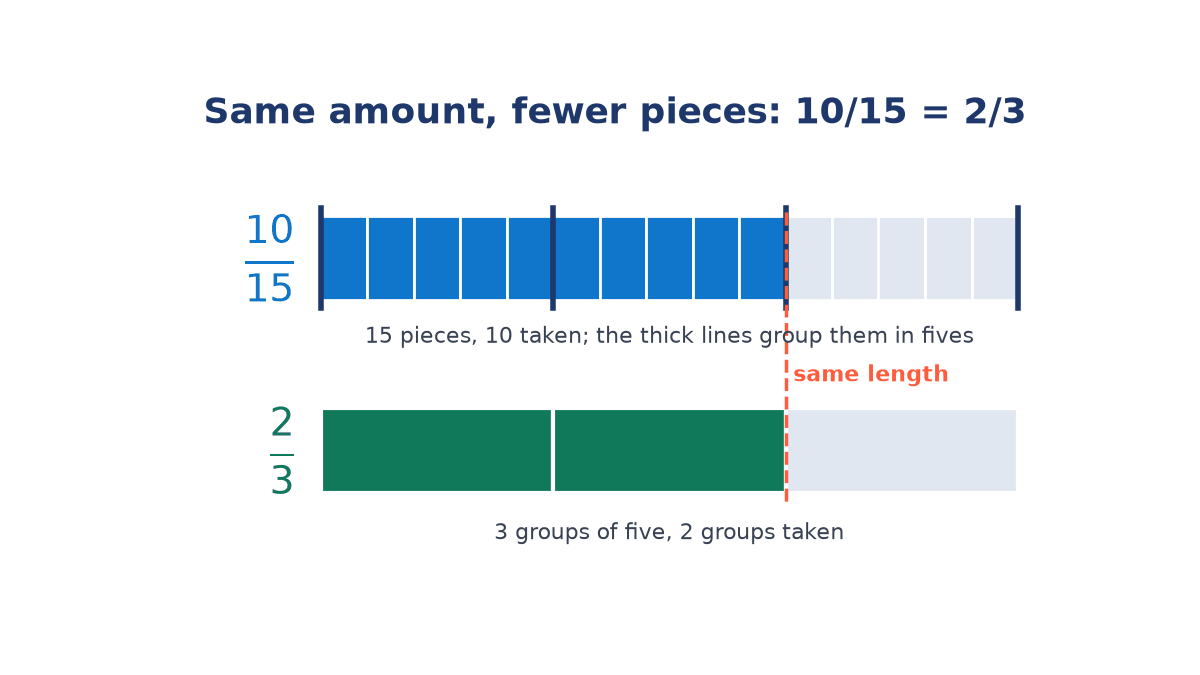
Now try to cut down again. You cannot. The only number that divides both and is . So is in simplest form.
Taking the same divisor out of the top and the bottom is called cancelling. In there is nothing left to cancel.
Here are three more numbers that are already in simplest form.
Check each pair. and share only . So do and . So do and . None of them can be cancelled any further.
Why the bottom must be positive
A minus sign can sit in three places. You can write , or , or . All three mean the same amount. Standard form keeps the sign off the bottom.
So and are both fine. The sign is off the bottom in each one. Only needs fixing.
Why fuss about where the sign sits? Very soon you will compare fractions by looking at their top numbers, and that trick only works when every bottom number is positive. Multiplying by a negative number turns the order round, and a positive bottom stops that from happening by accident. You will see exactly how a little later.
Now put into simplest form. First find the biggest number that divides both and . That number is . This biggest one has a short name. It is called the H.C.F.
Put into simplest form
So divide the top and the bottom by . On the top, . On the bottom, . That gives . Then lift the minus sign to the front. The answer is .
A number with two minus signs
Put into simplest form. The H.C.F of and is . Because both parts are negative, divide both by . That cancels the common divisor and makes the bottom positive in one step.
Check: and share only , and the bottom is positive. So is in simplest form. Two minus signs, one on top and one below, always make a positive number.
Don't worry if the H.C.F doesn't jump out at you. You can cancel in stages instead. For , divide by to get , by again to get , and then by to get . You land on the same answer; the H.C.F simply gets you there in one jump.
Remember. A number is in simplest form when two things are true. The top and bottom share no divisor but . And the bottom number is positive. Cancelling by the H.C.F does the first job. Moving the minus sign up to the front does the second.
Which fraction is bigger
Three symbols do a lot of work from here on. means 'is smaller than'. means 'is bigger than'. The mouth always opens towards the bigger number. And is short for 'so'.
Some fractions are easy to compare. Take and . Both are made of ninths, so the pieces are the same size, and five pieces obviously beat three. So .
Now try and . Thirds and ninths are different sizes, so it is like weighing big slice against small ones. Just counting slices won't settle it.
That gives us two jobs to do first: put every number into standard form, and then give them all the same bottom number.
For that you need one bottom number that every bottom fits into. Any such number will do, and multiplying the bottoms together always works. The smallest one, though, keeps the arithmetic light. That smallest one is called the L.C.M.
Where negative numbers sit
Zero is the middle of the number line. Numbers to the right of zero are above zero. Numbers to the left are below zero. We put a minus sign on those.
So means two thirds of a step to the left of zero. And is a whole step and one more third to the left. So it is further out still. Further left always means smaller.
Putting three numbers in order
Write , and in ascending order. Ascending means smallest first. Descending means biggest first.
All three are in standard form already. The bottom numbers are , and . The L.C.M of and is . So write every number in ninths.
| Number | Written in ninths | Top number |
|---|---|---|
The three top numbers are , and . Put them on a number line. sits far to the left. comes next. is over on the right.
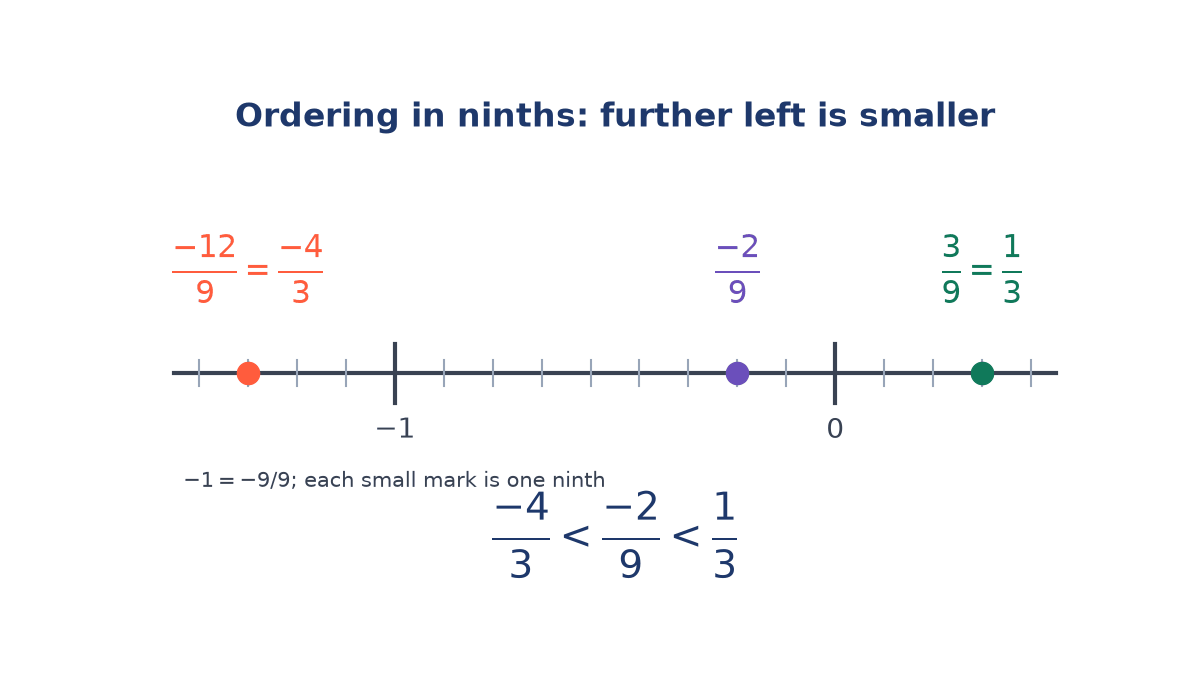
In order, smallest first
In the last line each number goes back to the name it started with. The order doesn't budge, because the numbers only changed clothes, not size.
Descending order is the same work read backwards. Read the top numbers the other way round. They go , then , then .
In order, biggest first
Finding the greatest of three
Which is greatest: , or ?
Put them in standard form first. The minus sign in is on the bottom. Move it up. That number is . The other two are already tidy.
The bottom numbers are now , and . The L.C.M of , and is . So write all three in sixths.
Change each one into sixths
Now read the top numbers: , and . Reading them from smallest to biggest gives , then , then .
The order
So is the greatest. A quick sense check agrees: it is the only one of the three that is bigger than .
A shorter way: cross products
When you only have two numbers to compare, there is a quicker path. We'll try it on and , doing it the long way first so you can see exactly what the shortcut is copying.
Both and fit into . So cut both cakes into pieces. One of those pieces is called a thirty-fifth.
Both in thirty-fifths
Look at the two top numbers you got. The came from . The came from . Each one is a fraction's top times the other fraction's bottom. Those two answers are called the cross products.
The two cross products
The bottom number was for both, and a bottom that both share can't decide anything. Only the two cross products matter, so the short way simply skips writing the bottoms down.
Now here is the rule, written once for every pair. The letters , , and stand for any numbers you like. Take and , both in standard form. Multiply by . Then multiply by .
- If then .
- If then .
- If then .
This is where the positive bottom earns its keep. Multiplying by a negative bottom would turn the answer round. Standard form stops that happening. The next section shows you why.
Cross products with two negative numbers
Which is greater, or ? Both are in standard form, with positive bottoms, so the rule can be used.
So is the greater. Check with a common bottom of : the numbers are and , and is further right on the number line.
Watch what goes wrong if a bottom is left negative. Compare with without tidying first. The cross products are and . Since the rule would say is the bigger, which is false, because a negative number is smaller than a positive one. Write it as first and the cross products become and , which give the right order.
Remember. First put every number into standard form. Then give them the same bottom number. Now every piece is the same size. So counting the pieces tells you the order, and the top numbers are that count.
Two facts about signs
A bigger bottom gives a smaller piece
Cut a cake into equal pieces, then cut an identical cake into . Which piece would you rather have? The half, of course. The more pieces you cut, the smaller each one gets.
So , but . The order turns round. Call the two numbers and . They stand for any two numbers you like.
Here is the first rule. If then . It holds when and have the same sign.
It works for two negatives as well. Take and . Both are below zero, so the signs match. Here gives .
You can read that line the other way round. , and . It says the same thing.
Here is the second rule. If and have opposite signs, then gives . This time the order does not turn round.
Try it with and . Here , and .
Here is the reason. is below zero, so is below zero too. And is above zero, so is above zero. One number is on the left of zero and one is on the right. The left one is still the smaller, whatever the pieces look like.
Multiplying by a negative turns the order round
Start with . Multiply both by the same number . What happens to the order?
If is positive, nothing surprising happens. Double both and you get and , and still . The pair moved further apart, but the order held.
If is negative, the order flips. Multiply both by . You get and . Now .
The number line shows why. Both and sit right of zero. And is further from zero than is.
Multiplying by sends each number to the other side of zero. Each one keeps its distance from zero. So lands further to the left than .
On a number line, further left means smaller. So , which is the same as . The order turned round.
Here is the rule in short. Take the numbers and again. If then gives . If then gives .
Remember. When you multiply both sides by a negative number, the order turns round. , but .
Practice
Write each one in simplest form
| 1) | 3) |
| 2) | 4) |
Compare these
Common mistakes
- Cancelling by a common divisor that is not the biggest, and then stopping. Always check that the new top and bottom share nothing but .
- Leaving the minus sign on the bottom, as in . Standard form needs a positive bottom.
- Dividing only the top, or only the bottom, by the H.C.F. Both must be divided by the same number.
- Comparing top numbers when the bottom numbers are different. Make the bottoms the same first.
- Using cross products before the bottoms are positive; the order can come out backwards.
- Thinking is bigger than because is bigger than . On the number line is further left, so it is smaller.
- Writing ascending order when the question asks for descending. Ascending is smallest first.
Key terms
- Rational number
- A number that can be written as with integers and , and .
- Simplest (standard) form
- A rational number whose top and bottom share no divisor but , and whose bottom is positive.
- Common divisor
- A number that divides both the top and the bottom.
- H.C.F
- The highest common factor: the biggest number that divides both.
- L.C.M
- The lowest common multiple: the smallest number that each bottom number divides into.
- Cross products
- For and , the two products and .
- Ascending and descending order
- Smallest first, and biggest first.
Answers
Write each one in simplest form
Compare these
- is greater, because .
- is greater, because in tenths.
The full working for each question:
Answers
| Question | Answer | Question | Answer |
|---|---|---|---|