You meet multiplying and dividing with fractions far more often than you might think. Half of three quarters of a litre of milk, two thirds of a class of 36 students, how many -metre pieces can be cut from a ribbon: each of these is a product or a quotient of fractions. The same rules work for rational numbers below zero, such as a fall in temperature or an amount owed, so we'll handle both together.
By the end you should be able to multiply any two fractions, cancel before you multiply, and divide by turning the second fraction over. Better still, you'll be able to explain why each rule works instead of just remembering it.
Here's some good news to start with: multiplying and dividing fractions is actually easier than adding them.
A quick reminder of the words first. The bottom number says how many pieces the cake was cut into, and the top number says how many of those pieces you have. In the cake was cut into 4 pieces and you have 3 of them.
When you add two fractions, you need the same bottom number in both. Multiplying doesn't care about that at all. Any two fractions will do.
Multiplying two fractions
Picture half a cake sitting on a plate, and suppose you want one third of that half. You cut the half into three equal pieces and take one.
Now think about the whole cake. It would give six pieces of that size, so your piece is of the cake. In other words, one third of is .
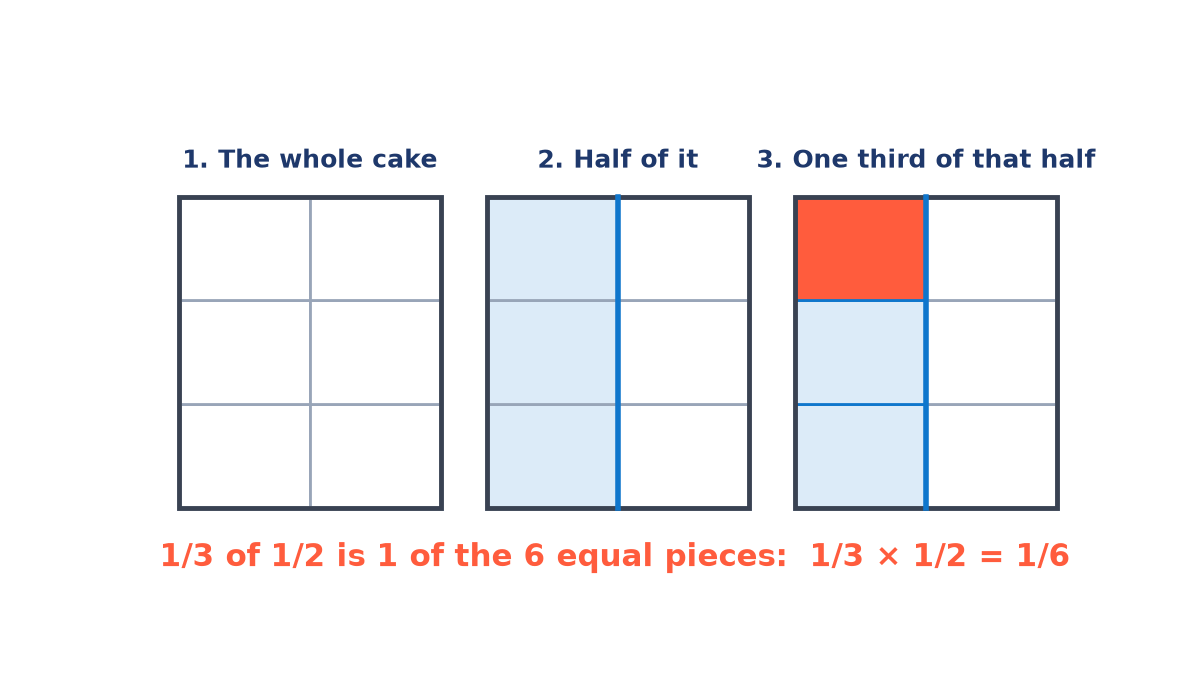
Now look closely at the numbers. The two tops are 1 and 1, and the two bottoms are 3 and 2.
One third of a half
The tops were multiplied and the bottoms were multiplied. That's all; nothing else happened.
Remember. To multiply two fractions, multiply the tops. Then multiply the bottoms. In symbols this is .
Notice that one third of a half means one third times a half. That little word "of" is quietly doing the multiplying.
Fractions below zero
A fraction can sit below zero as well. Draw a line with 0 in the middle: to the right of 0 is what you have, and to the left of 0 is what you owe.
So is five thirds on the left of 0. Think of it as owing five thirds of a cake. The minus sign only tells you which side of 0 you are on; the digits behave in exactly the same way on both sides.
A worked example
Let's try one from the chapter.
Multiply by
The tops give and the bottoms give . One minus sign went in, so one minus sign comes out.
Why? You started with something you owe, and taking of a debt still leaves you owing. So the answer stays on the left of 0.
Cancel before you multiply
Sometimes a top and a bottom can both be divided by the same number. When that happens, you can cut both of them down before you multiply. This is called cancelling, and it keeps the numbers small and the working short.
Multiply by
Here the 3 below goes into the 9 above. Since , the 9 becomes 3 and the 3 becomes 1.
You could also multiply first and cancel at the end. That gives . Both 45 and 12 can be cut into groups of 3, and 3 is the biggest number that goes into both (people call that biggest number the H.C.F for short). Cutting both by 3 leaves . Either road, you arrive at .
Three fractions at once
The chapter has one longer example, with three fractions and two minus signs. Don't panic at the big numbers. Just cancel as much as you can before you multiply.
Multiply by by
Each line cuts one pair down. 35 and 56 both go into groups of 7, so they become 5 and 8. 37 goes into 111 three times, so they become 1 and 3. 99 and 45 both go into groups of 9, so they become 11 and 5. Finally the last 5 above and the 5 below cancel too, leaving 11 on top and below.
And the signs? Two minus signs went in. A minus sign flips a number to the other side of 0, and two flips take you back where you started. So two minus signs give a plus.
A whole number times a fraction
A whole number is a fraction too, in disguise. Write 6 as . A bottom number of 1 means the cakes were never cut, so six whole cakes is simply six pieces of size one. Then multiply in the usual way.
Multiply by
goes on top and the bottom stays 25. One minus sign went in, so one comes out.
More worked examples
Cancelling across:
The 4 below goes into the 8 above twice. The 3 above goes into the 9 below three times.
Two negatives:
Two minus signs go in, so the answer is positive. Then 5 goes into 15 three times, and 2 goes into 8 four times.
A fraction of an amount
A class has 36 students and of them walk to school. How many walk?
Twenty-four students walk. Taking a third of 36 gives 12, and two thirds is twice that.
Zero
Zero times any fraction gives 0, so . If you take the half zero times, you end up with nothing on your plate.
Why the answer can get smaller
Many students find this part feels wrong at first. Multiplying always used to make numbers grow: is bigger than 3 and bigger than 4. But , which is smaller than both of them. What's going on?
means three lots of 4. You take the 4 three whole times, so the pile grows. , on the other hand, means one third of a half. You don't take the half even once; you take only a part of it, and a part of a cake is always smaller than the cake.
Let's leave debts aside for the rest of this part and only talk about amounts you have, above 0. Keep your eye on the second number.
| You multiply 6 by | You get | Bigger or smaller? |
|---|---|---|
| , more than 1 | bigger than 6 | |
| the same as 6 | ||
| , less than 1 | smaller than 6 |
is seven and a half, which is bigger than 6. But is a little less than 1, so should come out a little less than 6. Does it? Six lots of 25 make 150, and has only 144. So is indeed smaller than 6, just as we expected.
Remember. Start with a number above 0. Multiply it by more than 1 and the answer grows. Multiply by 1 and nothing changes. Multiply by a number between 0 and 1 and the answer shrinks.
Below 0 the words swap over, so take care there. For example, gives , which sits further left.
The reciprocal
Turn a fraction upside down, and the new fraction you get is called its reciprocal.
Remember. The reciprocal of is . The top and the bottom swap places.
| Number | Reciprocal |
|---|---|
A whole number has a reciprocal too. 7 is the same as , so turn it over to get .
Here's a lovely fact: a number times its reciprocal always gives 1. Look at . The top is and the bottom is . Whatever fraction you pick, the same two numbers get multiplied on top and below, so the answer is always a number over itself, and a number over itself is 1.
Zero, though, has no reciprocal. Turning over would give , and you cannot divide by 0. To see why, ask how many pieces of nothing fit into one cake. You could keep putting them in for ever and the cake would never fill up, so there is no answer.
Dividing fractions
Dividing always asks a question: how many of these fit into that? Take . How many quarters fit into one whole cake? Four of them. So .
Look at what just happened. You turned over and got 4.
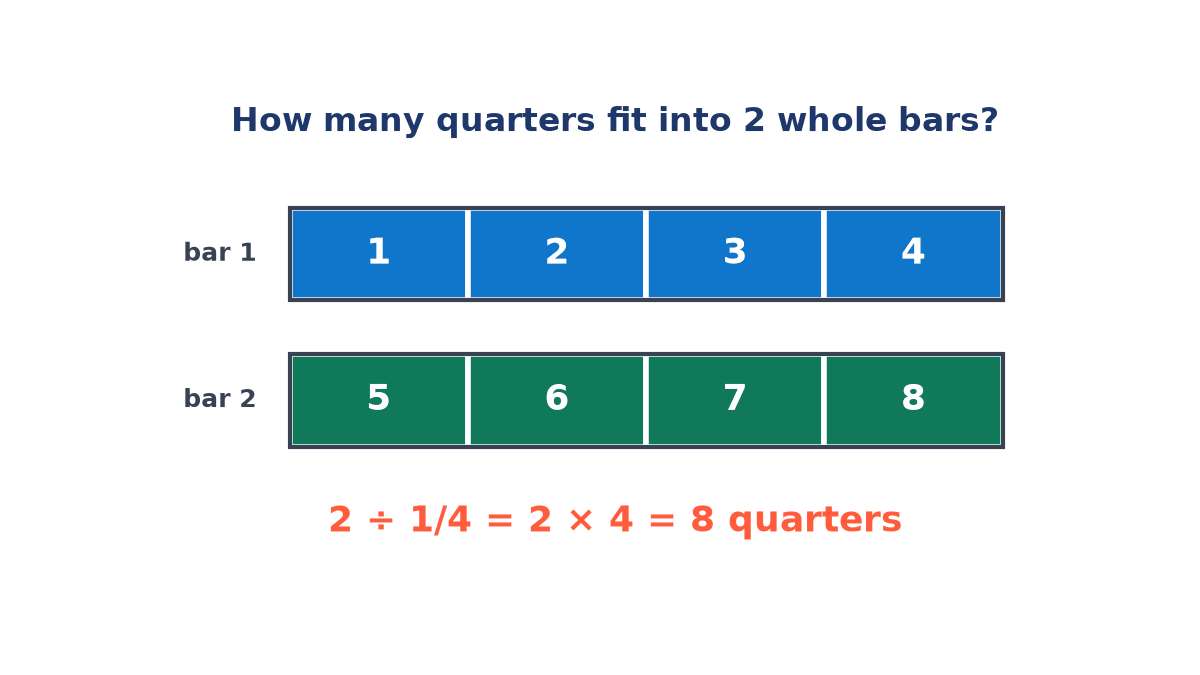
Now try two whole cakes. How many quarters fit into 2? Eight of them, and . So you turn the quarter over to get 4, then multiply by the 2 you started with. The flip and the multiply each do a job.
It makes sense, too. Small pieces fit in many times, so dividing by a small number gives a big answer, and turning a fraction over is exactly what makes a small number big.
Here is a second way to see it. Dividing by 2 is the same as taking half, and taking half means multiplying by . And is the reciprocal of 2. The two jobs are really one job.
Remember. To divide, turn the second fraction over. Then multiply. In symbols, , as long as is not 0.
Two ways to write it
The chapter often writes division without a sign, putting one fraction above the other instead.
The same job written two ways
The long line in the middle is the divide sign. Both ways mean exactly the same thing, so don't let the stacked version scare you.
The steps
- If a number has a whole part and a fraction part, change it into a single fraction first.
- Turn the second fraction over.
- Change the sign to a sign.
- Cancel where a top and a bottom can both be cut by the same number.
- Multiply the tops, then multiply the bottoms.
Divide by
can still be made simpler. Both 12 and 15 can be cut into groups of 3, so divide the top and the bottom by 3 and you are left with .
Cutting both by the same number doesn't change how much you have; it only counts the same cake in bigger pieces. So and are the same amount. Now no number goes into 4 and 5 any more, and a fraction like that is in its simplest form.
Divide by
Think of two thirds of a cake shared between two friends. Each one gets one third, so the answer feels right.
Notice that only the bottom changed. Dividing by 2 means multiplying by ; the top is multiplied by 1, so it stays as it was, while the bottom is multiplied by 2, so only the bottom grows.
Remember. Dividing by a whole number other than 0 changes only the bottom. In symbols, , as long as is not 0.
Mixed numbers
is a mixed number: it has a whole part and a fraction part. You can't turn it over as it stands, so change it into a single fraction first.
One whole cake cut into thirds gives three thirds, and you already have two thirds more. That makes five thirds in all, so is .
The working below is just the short way of counting those five thirds: multiply the whole part by the bottom, then add the top.
Change the mixed numbers
Now divide in the usual way.
Divide by
Both 45 and 213 can be cut into groups of 3: and .
A smarter move is to cancel earlier. The 3 below goes into the 9 above, leaving 3. Then the top is and the bottom is . That is again, reached with much friendlier numbers.
More division examples
A negative divisor:
Turn the second fraction over, keeping its minus sign, and multiply. One minus sign goes in, so one comes out.
Here 3 went into 9 three times, and 2 went into both 10 and 4.
A mixed number divided by a whole number:
A word problem
A ribbon is metres long. How many pieces of metre can be cut from it?
Six pieces. To check, multiply back: , which is the length of the ribbon. Multiplying the answer by the divisor should always give back the number you started with.
The rules together
The first three rules are printed in the chapter; the last one follows from what a reciprocal is.
Practice
Work these out on paper, and give each answer in its simplest form.
| 1) | 4) | 7) |
| 2) | 5) | 8) |
| 3) | 6) | 9) |
Answers
| Question | Answer | Question | Answer |
|---|---|---|---|
Three of them are worth a second look. In question 2 the 7 above and the 7 below cancel. In question 5 one minus sign goes in, so one comes out. In question 9, change into first, and into as well.
Did you notice? Two answers come out as whole numbers, not fractions.
Remember. Multiplying needs no common bottom number. Dividing needs one flip, then a multiply.
Common mistakes
- Looking for a common bottom number before multiplying. That step belongs to adding. For multiplying, just multiply tops and bottoms.
- Turning the wrong fraction over. In only the second fraction, , is turned over. The first stays as it is.
- Turning a mixed number over as it stands. must first become ; its reciprocal is .
- Cancelling two tops together. You may cancel a top against a bottom, never a top against another top.
- Losing a minus sign. Count the minus signs going in: one gives a negative answer, two give a positive answer.
- Writing the whole number on the bottom. In the 4 multiplies the top, because .
Key terms
- Numerator
- The top number of a fraction: how many pieces you have.
- Denominator
- The bottom number: how many equal pieces the whole was cut into. It is never 0.
- Rational number
- A number that can be written as with and integers and .
- Cancelling
- Dividing a top and a bottom by the same number to keep the working small.
- Simplest form
- A fraction whose top and bottom share no factor other than 1.
- Reciprocal
- The fraction turned upside down. A number times its reciprocal is 1.
- Mixed number
- A whole number and a proper fraction written together, such as .
- H.C.F.
- Highest common factor: the biggest number that divides two numbers exactly.