Fractions are everywhere at home. Amma cuts a roti in half. A pizza comes in eight slices. A bottle is three quarters full. Each time, something whole has been cut or shared into equal parts, and a fraction tells you how much of it you are talking about.
Here you will find out what the two numbers of a fraction mean, how to tell a proper fraction from an improper fraction, and why an improper fraction is nothing to be afraid of.
Think of a cake on a plate. You cut it so that everyone gets a piece. Fractions are how you name those pieces.
Every piece must be the same size
Cut a cake into two pieces. Make one piece huge and the other tiny. You cannot call the tiny piece a half.
A half means one of two equal pieces. Equal means the same size as the other. So cut with care, and check that the pieces match.
Remember. A fraction only works when the pieces are equal. Same size, every time.
One half
Take one whole cake. Whole means all of it, before you cut anything away. Cut it into two equal parts. Each part is of the cake. You say it as one half, or as one by two.
One third
Now cut a whole cake into three equal parts. Each part is . You say it as one third, or as one by three.
One quarter
Cut a whole cake into four equal parts. Each part is . You say it as a quarter, or as one by four.
| You write | You say | The whole was cut into |
|---|---|---|
| one half, or one by two | 2 equal parts | |
| one third, or one by three | 3 equal parts | |
| a quarter, or one by four | 4 equal parts |
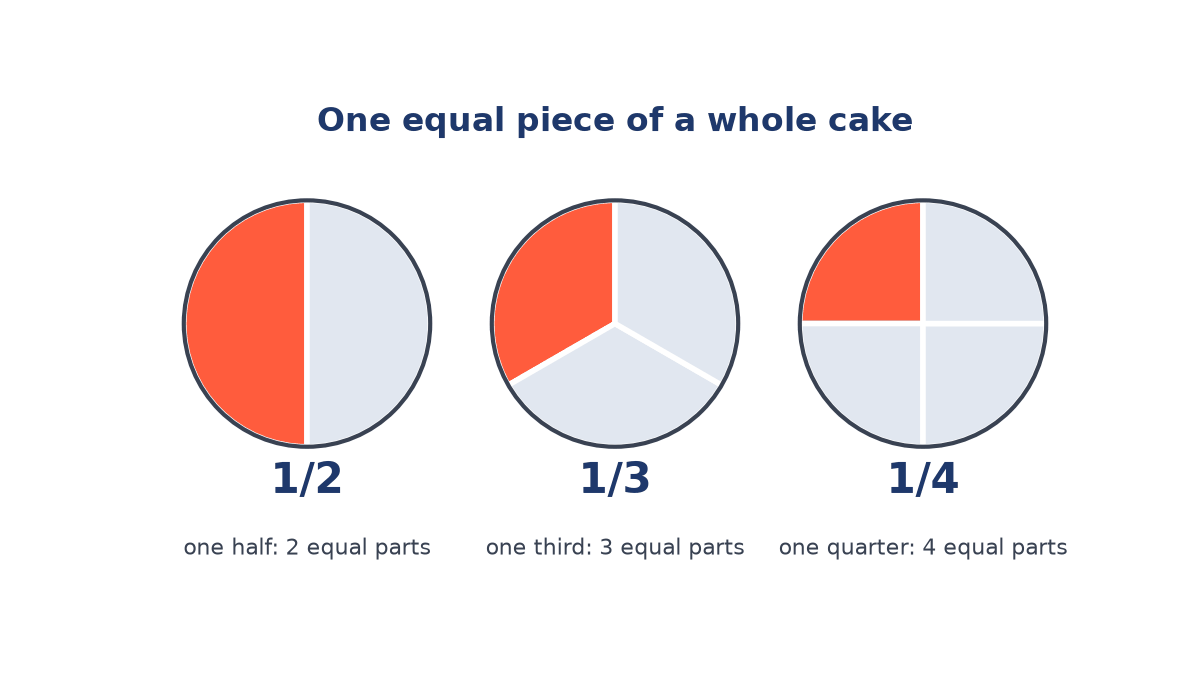
Look at the three cakes side by side. A half is bigger than a third, and a third is bigger than a quarter. When you cut the same cake into more pieces, each piece gets smaller. So of a cake is less than of the same cake, even though 4 is a bigger number than 2.
Taking more than one piece
Picture a bar of chocolate cut into three equal pieces. Two of them are coloured in. Each coloured piece is of the bar.
You have two of those pieces. So you add twice.
Two pieces out of three
Here is another bar. It is cut into four equal pieces and three are coloured in. The coloured part is of the bar.
Three pieces out of four
Example: a pizza in eight slices
A pizza is cut into 8 equal slices. Ravi eats 3 of them. Each slice is of the pizza, so Ravi ate
of the pizza. The 8 slices are still there in the count; only 3 of them are Ravi's.
All the pieces make the whole
Now colour the last quarter too. All four pieces are coloured in. You are back to the whole bar.
Four quarters
The same thing happens with thirds. Three thirds fill one whole cake.
Three thirds
It works whatever you cut. Cut a bar into five equal pieces. All five together are , which is one whole. Cut a bar into eight equal pieces. All eight together are , one whole again.
Remember. When the top number and the bottom number match, you have one whole. So and .
What the two numbers tell you
A fraction has a number on top and a number below. The bottom number counts the equal pieces in the whole. The top number counts the pieces you have.
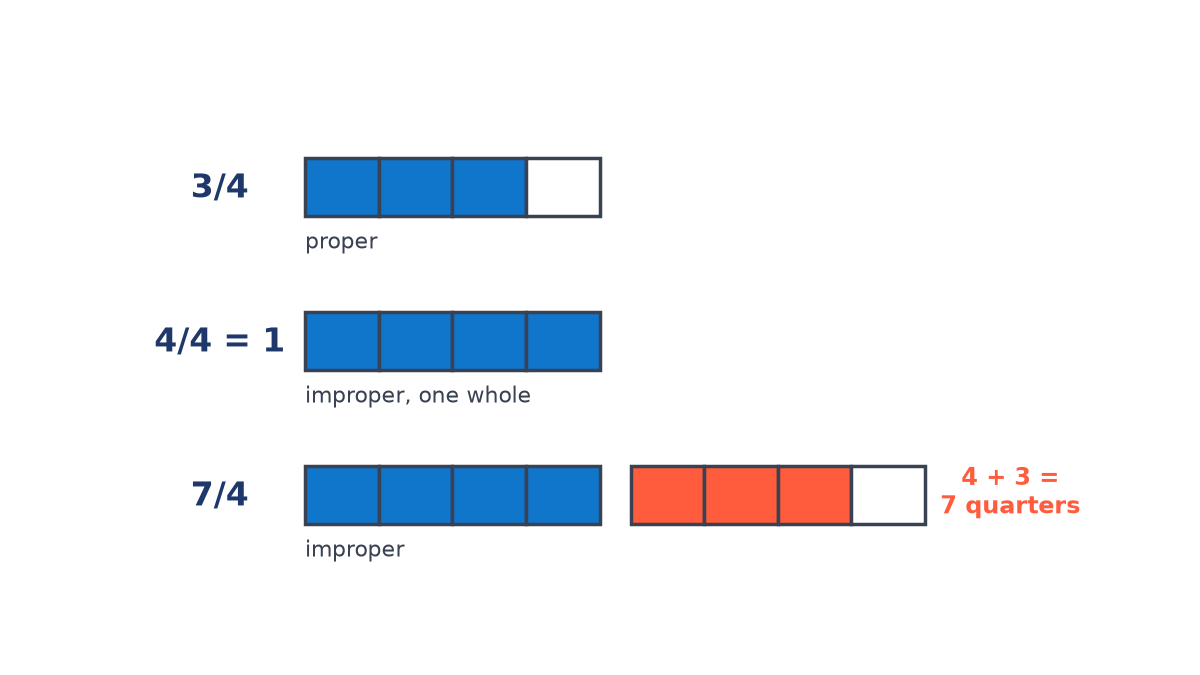
Look at . The bottom 4 says the whole was cut into four equal pieces. The top 3 says you have three of them.
Remember. Bottom number: how many equal pieces the whole was cut into. Top number: how many of those pieces you have.
Look back at , , , and . In each one the top number is smaller than the bottom one. That is what makes it a proper fraction. You have some of the pieces, but not all of them. So a proper fraction is less than one whole.
and are not proper fractions. Their top and bottom numbers match. So each one is a whole, not a part of a whole.
Example: which part is left?
Ravi ate of the pizza. The whole pizza is . Five slices are left, so of the pizza is left. Both and are proper fractions, and together they make the whole: .
These two numbers have names. You will meet the names in the next lesson.
Improper fractions
Improper does not mean wrong. It is just the name for a fraction that holds a whole, or a whole and a bit more.
Sometimes you have more than one whole. A proper fraction cannot say that. It is always less than one whole, because you never have all the pieces.
Picture one full bar of chocolate on the table. Beside it is a quarter of a second bar. You have a whole and a quarter.
The full bar is four quarters. Add the loose quarter to it. That gives five quarters in all.
A whole and a quarter
So is an improper fraction. It is a whole and a proper fraction joined together.
Now put three quarters beside the full bar. The full bar is still four quarters. Four quarters and three quarters give seven quarters.
A whole and three quarters
You can draw this. Draw one bar cut into four pieces, all coloured in. Beside it draw a second bar with three of its four pieces coloured in.
Example: a whole and four fifths
Meena has one full bar cut into 5 equal pieces, and 4 pieces of a second bar of the same size. The full bar is five fifths.
Example: going the other way
You can also start from an improper fraction and find the whole inside it. Take . Eight of the eleven eighths fill one whole bar. That leaves three eighths.
When nothing is left over
Sometimes you have every piece there is and nothing more. Four quarters fill one whole bar. You can write that as , or you can write it as 1.
Here the top number and the bottom number are the same. So is counted with the improper fractions, even though it is exactly one whole. It is not a part of a whole, so it cannot be a proper fraction.
Remember. An improper fraction has a top number bigger than its bottom number, or equal to it. When it is bigger, it is a whole and a proper fraction together, like . When the two numbers match, like , it is exactly one whole.
Remember. From here on, a fraction means either a proper fraction or an improper fraction.
| Fraction | Which kind | Why |
|---|---|---|
| proper | one piece out of two equal pieces | |
| proper | three pieces out of four, so less than a whole | |
| improper | all four quarters, so exactly one whole | |
| improper | a whole bar and one more quarter | |
| improper | a whole bar and three more quarters |
Practice
Add these equal pieces. Keep the bottom number the same, because the pieces are still the same size. Only the number of pieces you hold goes up. So only the top number changes.
| Question | Answer | Question | Answer |
|---|---|---|---|
Proper or improper
Say which kind each one is. Compare the top number with the bottom number.
| Question | Answer | Question | Answer |
|---|---|---|---|
Common mistakes
- Calling unequal pieces fractions. A cake cut into one big and one small piece is not cut into halves.
- Thinking a bigger bottom number means a bigger piece. is smaller than , because the whole was cut into more pieces.
- Adding the bottom numbers. is , not . The pieces stay the same size.
- Calling a proper fraction. When the top and bottom match you have the whole, so it is counted as improper.
- Thinking improper means wrong. is a perfectly good fraction; it just holds more than one whole.
Key terms
- Whole
- All of something, before any of it is cut away.
- Equal parts
- Pieces that are all exactly the same size.
- Fraction
- A number that names some of the equal parts of a whole, such as .
- Bottom number
- How many equal pieces the whole was cut into.
- Top number
- How many of those pieces you have.
- Proper fraction
- A fraction whose top number is smaller than its bottom number, so it is less than one whole.
- Improper fraction
- A fraction whose top number is equal to or bigger than its bottom number, so it is one whole or more.
Answers
Add these equal pieces
- Six sixths:
Proper or improper
- : proper, because 2 is smaller than 3.
- : improper, because 9 is bigger than 8. It is one whole and one eighth.
- : improper, because the numbers match. It is exactly one whole.
- : proper, because 1 is smaller than 10.