What this lesson is about
Fractions turn up the moment anything is shared. Half a litre of milk, and then a quarter litre more. Three quarters of an hour on homework and two thirds of an hour on cricket. A recipe that asks for one and a half cups of rice when you only want to cook for fewer people. Every time, you are quietly adding or taking away fractions.
So how is it done? We'll begin with the easy case, where the pieces are already the same size, and then see what to do when they aren't. By the end you'll be comfortable adding and taking away any two or three fractions, whole numbers included, and you'll even be able to write the rule in letters.
Picture a cake cut into three equal pieces. Each piece is of the cake. Two pieces are . Adding fractions is really just counting pieces.
You met rational numbers in Rational numbers. A rational number is any number you can write as , where and are integers and . So is one, and so is . Fraction is the everyday word for it, so that is the word we'll use here.
When the bottom numbers match
Every fraction has a top number and a bottom number. The bottom number tells you the size of each piece. The top number tells you how many pieces you have.
These two numbers have proper names: the top one is the numerator and the bottom one is the denominator. Mostly, though, we'll just say top and bottom.
You can have more pieces than one cake holds. Put a second cake beside the first. Cut it into three as well. Now there are six pieces to take from. Five of them is , which is one whole cake and two pieces over.
In and the bottom number is 3, so both are made of thirds. The pieces are the same size, and that is exactly why you can count them together.
Two thirds and five thirds make seven thirds. You add the top numbers and leave the bottom number as it is.
Two thirds plus five thirds
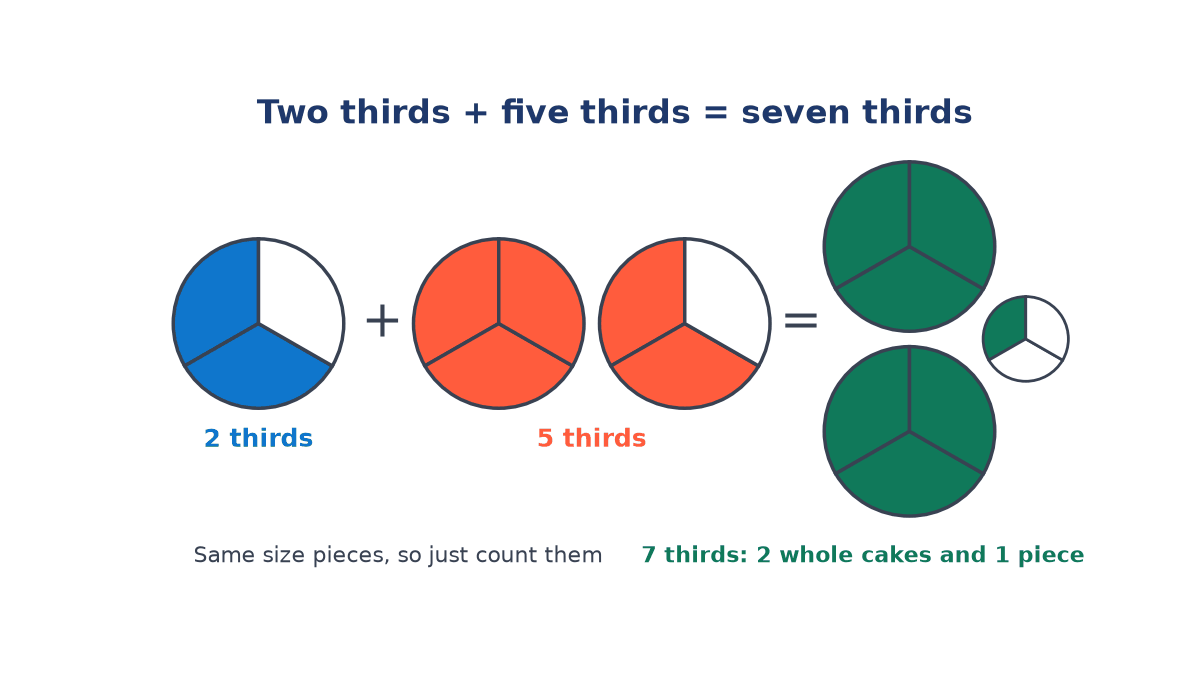
Seven thirds is more than one cake, and that is perfectly fine. It just means two whole cakes and one piece over.
Why didn't the bottom number change? Because you never cut the cake again. The pieces are still thirds; you simply have more of them.
Taking away works the same way. You take one top number from the other.
Sometimes you are asked to give away more than you have. You hand over everything, and you still owe the rest, a bit like borrowing from a friend. We write what you owe with a minus sign in front, so owing one whole cake is written .
Five thirds taken from two thirds
You had two thirds. You gave both away, and you still owe three more thirds. Three thirds make one whole cake. So you owe one whole cake, and we write that as .
The minus sign can sit on the top number, or in front of the whole fraction. and mean the same amount. Finished answers in this lesson put the minus in front. It tells you the whole amount is owed.
Remember. Same bottom number? Add or take away the top numbers. Leave the bottom number alone.
When the bottom numbers are different
Now picture two cakes of the same size, one cut into quarters and the other into sixths. The pieces are no longer the same size.
You can't count pieces of two different sizes together, so you cut both cakes again until every piece is the same size.
The new size has to fit both cakes exactly. The smallest number that both bottom numbers divide into is the one you want. Its short name is the L.C.M, or lowest common multiple.
Finding the L.C.M with a ladder
A ladder is a quick way to find it. You write the numbers in rows going down, like the steps of a ladder, and each row comes from the one above it.
A factor of a number is a number that goes into it exactly. The factors of 6 are 1, 2, 3 and 6.
Here is how you climb down. Divide by a number that goes into at least two of them, and copy down again any number it won't divide. Stop when no number goes into two or more of them.
Then multiply together the numbers you divided by, along with the numbers left at the bottom. You'll see this happen in the sums below.
Here is why it works. Each time you divide, you take out a part the numbers share. When nothing is shared any more, you have found every part just once. Multiply them all back together and you get the smallest number both bottom numbers fit into.
Adding five quarters and seven sixths
First build the ladder for 4 and 6.
| Divide by | 4 | 6 |
|---|---|---|
Nothing goes into both 2 and 3, so you stop. Multiply the 2 you used by the 2 and 3 left at the bottom. That gives .
So every piece will be a twelfth. Four goes into twelve three times. Six goes into twelve two times.
Multiply the top and bottom of by 3. Multiply the top and bottom of by 2.
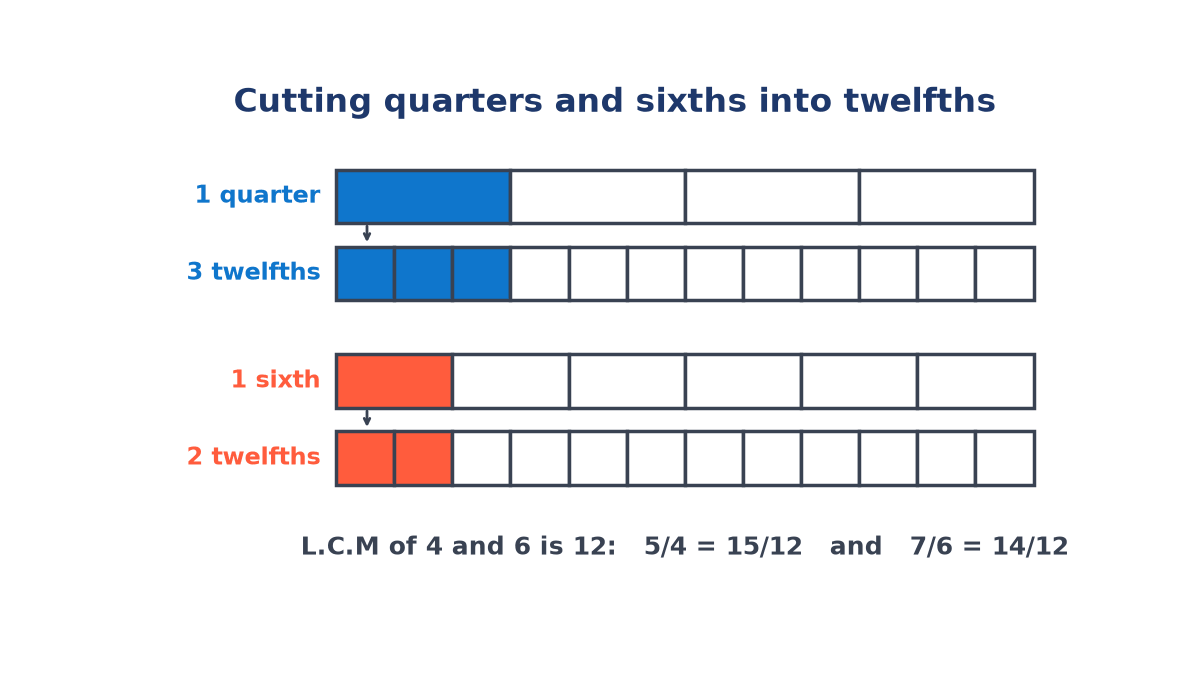
Is this allowed? Yes, completely. You have only cut each piece into smaller pieces. There are more of them now, but each one is smaller, so the amount of cake stays the same.
Five quarters plus seven sixths
Both are twelfths now, so you can count them. Fifteen pieces and fourteen pieces make twenty-nine pieces.
Taking seven twelfths from five eighths
Build the ladder for 8 and 12. This one takes two rows.
| Divide by | 8 | 12 |
|---|---|---|
You divided by 2 twice. The numbers 2 and 3 are left at the bottom. So the L.C.M is .
Eight goes into twenty-four three times. Twelve goes into twenty-four two times.
Five eighths minus seven twelfths
The two amounts turn out to be very close; the gap between them is just one twenty-fourth.
Adding five thirds and eight sevenths
Three and seven share no factor; only 1 goes into both. With nothing to take out, the ladder has no work to do.
The size that fits both is simply the two bottom numbers multiplied together, here . Twenty-one pieces split evenly into three parts, and just as evenly into seven.
Five thirds plus eight sevenths
Taking eight fifths from two sevenths
Seven and five share no factor either. So the L.C.M is .
Two sevenths minus eight fifths
is a small part of one whole, while is more than one whole. You can't give away that much, so you end up owing, and that is why the answer carries a minus sign.
One more worked example: tenths and fifteenths
Here is a pair whose L.C.M is not simply the two bottom numbers multiplied. Add and .
Both 10 and 15 divide by 5. Divide once by 5 and you are left with 2 and 3, which share nothing. So the L.C.M is . Ten goes into thirty three times. Fifteen goes into thirty two times.
Multiplying the bottom numbers would have given 150. That works too, but you would then have to cancel by 5 to reach the same answer. The ladder saves that step.
A whole number and a fraction
The numbers in this section, like , , and , have no pieces left over. Think of a whole cake, not a slice of one. Even so, any of them can be written as a fraction.
The trick is to put the whole number over 1. So and .
This works because of what the bottom number means: how many pieces one whole is cut into. Cut a cake into one piece and, well, it is still whole.
Once it looks like a fraction, you work exactly as before.
Five thirds plus one
Five thirds minus one
One whole is three thirds. That is why the 1 turned into .
Five plus seven sixths
Five minus seven sixths
Five wholes is thirty sixths. Each whole holds six sixths, and .
Three fractions at once
The same steps work just as well for three fractions, and you can do the whole line in one go.
Three like fractions in one line
Those bottom numbers already matched. When they do not, take the L.C.M of all three.
Here is the ladder for 6, 8 and 12. A number that will not divide just waits. Copy it down again and try the next row.
| Divide by | 6 | 8 | 12 |
|---|---|---|---|
Nothing now goes into two of them, so you stop. Multiply the numbers down the side, and the 2 left at the bottom. That gives .
Six goes into twenty-four four times. Eight goes into it three times. Twelve goes into it two times.
Three unlike fractions in one line
The next sum has owed amounts in it, so think about money for a moment. If someone cancels a debt you owe, you are better off, so taking away an owed amount turns into adding. Pile on another debt and you are worse off, so adding an owed amount turns into taking away.
First the ladder for 9, 12 and 18. This one starts by dividing by 3.
| Divide by | 9 | 12 | 18 |
|---|---|---|---|
Nothing goes into two of them now, so you stop. Multiply the numbers down the side, and the 2 left at the bottom. That gives .
Nine goes into thirty-six four times. Twelve goes into it three times. Eighteen goes into it two times.
Sixteen ninths, with two owed amounts
Notice that both signs were sorted out on the very first line. After that it is the same job as before.
Two more worked examples
A whole number minus a small fraction. Take away from 2. Two wholes are sixteen eighths, because .
Two owed amounts added. Add and . Both amounts are owed, so the total owed grows. The L.C.M of 5 and 10 is 10, since 5 already goes into 10.
You owed four tenths and then three tenths more, so you owe seven tenths altogether.
Three fractions with a mix of signs. Work out . The L.C.M of 4, 6 and 3 is 12.
This answer cancels, because 3 and 12 both divide by 3. Make it a habit: glance for a common factor before you write the final answer.
Practice
Try these on paper. The answers come after them.
| 1) | 6) |
| 2) | 7) |
| 3) | 8) |
| 4) | 9) |
| 5) | 10) |
| Question | Answer | Question | Answer |
|---|---|---|---|
The first answer can be written more simply. Both 12 and 9 divide by 3, so becomes . Making a fraction smaller like this is called cancelling. The amount does not change, only the way you write it.
The same rules in letters
Letters stand for any numbers you like. These eight rules say what you have just done.
Look at the third rule first. and shared no factor, so you multiplied 3 by 7. You multiplied the top of the first by the other bottom. Then you multiplied the top of the second by the first bottom. In letters that is and .
| Rule | What it says |
|---|---|
| Same bottom number. Add the top numbers. | |
| Same bottom number. Take away the top numbers. | |
| Different bottom numbers. The new bottom is . | |
| The same, but you take away. | |
| A whole number after a fraction. Multiply it by first. | |
| The same, but you take away. | |
| A whole number before a fraction. Multiply it by first. | |
| The same, but you take away. |
Rules 3 and 4 use as the new bottom number. That always works. Both bottom numbers divide into it.
But it is not always the smallest one. So the answer may still need cancelling. Watch what rule 3 does to a sum you have already met.
The same sum done by rule three
That matches the practice answer. Both 58 and 48 divide by 2. So cancels down to .
The L.C.M route gave 24 straight away, which is exactly why it is worth the effort of learning.
Remember. You can only add fractions when the pieces are the same size. Making the bottom numbers match is the whole job.
Common mistakes
- Adding the bottom numbers as well as the top ones. is , not . The size of the pieces does not change when you count them.
- Multiplying only the bottom number when changing a fraction. If the bottom is multiplied by 3, the top must be multiplied by 3 too, or the amount changes.
- Forgetting that a whole number has a bottom number of 1, and adding it straight to the top: is not .
- Losing a minus sign. Taking away an owed amount turns into adding. Adding an owed amount turns into taking away.
- Leaving an answer that can still be cancelled, such as instead of .
Key terms
- Rational number
- A number that can be written as , where and are integers and .
- Numerator
- The top number of a fraction. It tells you how many pieces you have.
- Denominator
- The bottom number of a fraction. It tells you how many equal pieces one whole is cut into.
- Like fractions
- Fractions with the same bottom number, so their pieces are the same size.
- L.C.M
- The lowest common multiple: the smallest number that each of the given numbers divides into exactly.
- Ladder
- A table of repeated division used to find the L.C.M of two or more numbers.
- Cancelling
- Dividing the top and bottom of a fraction by the same number, so it is written more simply without changing its value.
Answers
These answers match the practice table above, with the working shortened.