Fractions help you share a cake; negative numbers help you read a temperature below zero. Rational numbers bring the two together into one family. Every time you write a mark as , a loss as of a kilogram, or a whole number like , you are writing a rational number. Here you will find out exactly which numbers belong, why the bottom can never be zero, and how two fractions that look different can be the same number.
What a rational number is
You already know fractions like and . A rational number is that same idea, made wider.
We use letters when any number will do. Here is whatever number is on top. And is whatever number is on the bottom. So a rational number is any number you can write as .
Here and must both be integers. An integer is a whole number, with no bits of one. It can be a counting number like . It can be zero. It can be a number with a minus sign like .
One rule comes with this. The bottom number can never be zero. We write that as .
Remember. A rational number is any number you can write as . Here and are integers, and .
All these numbers together make a set. A set is just a collection. This one is called . Whenever you see , it means the whole collection of these numbers.
Here are some of the numbers in .
Each of these numbers has its own place on the number line. The fractions fall between the whole numbers, and the negative ones fall to the left of zero.
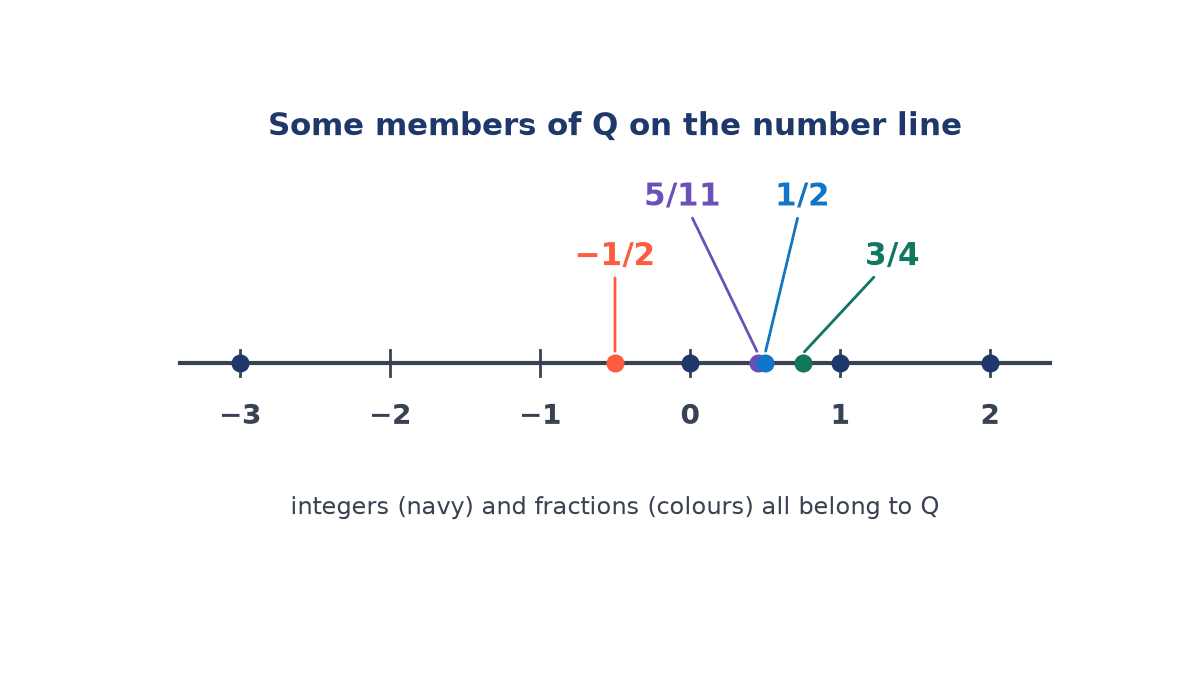
Whole numbers are rational numbers too
Look at that list again. It holds , , and . None of them looks like a fraction. They are rational numbers all the same.
Think about sharing cakes. means 6 cakes shared between 2 children. Each child gets 3.
Now share those 6 cakes between 1 child. That child gets all 6. So is just .
Every whole number works this way. Put it over and you have a fraction.
One number below has a minus sign. A minus can sit on the top, on the bottom, or out in front. All three mean the same number. We usually write it out in front, because that is easiest to read.
| Number | Written as |
|---|---|
Remember. Every whole number is a rational number. Write it over .
Zero is a rational number
Zero fits the rule as well. You can write .
Picture a cake cut into 2 equal pieces. Take none of them. Your plate is empty. So is .
Zero on top is fine. Zero on the bottom is the one thing we cannot have. The next part shows why.
Why the bottom cannot be zero
The bottom number tells you how many equal pieces the whole is cut into. Cut a cake into 4 pieces and the bottom is 4. Now try to cut a cake into 0 pieces. You cannot. There would be no pieces to hand out.
Division also asks a question. asks what number times 2 gives 6. The answer is 3.
Now look at . It asks what number times 0 gives 6. No number does. Anything times 0 gives 0. So there is no answer.
Remember. can never be . Nothing times gives , so has no answer at all.
Fractions that are worth the same
Two fractions can look different and still be worth the same. Here is a way to see that.
Take three chocolate bars. They are all the same length. Lay them one under the other.
- Cut the first bar into 2 equal parts. Shade 1 part. You have shaded .
- Cut the second bar into 4 equal parts. Shade 2 parts. You have shaded .
- Cut the third bar into 6 equal parts. Shade 3 parts. You have shaded .
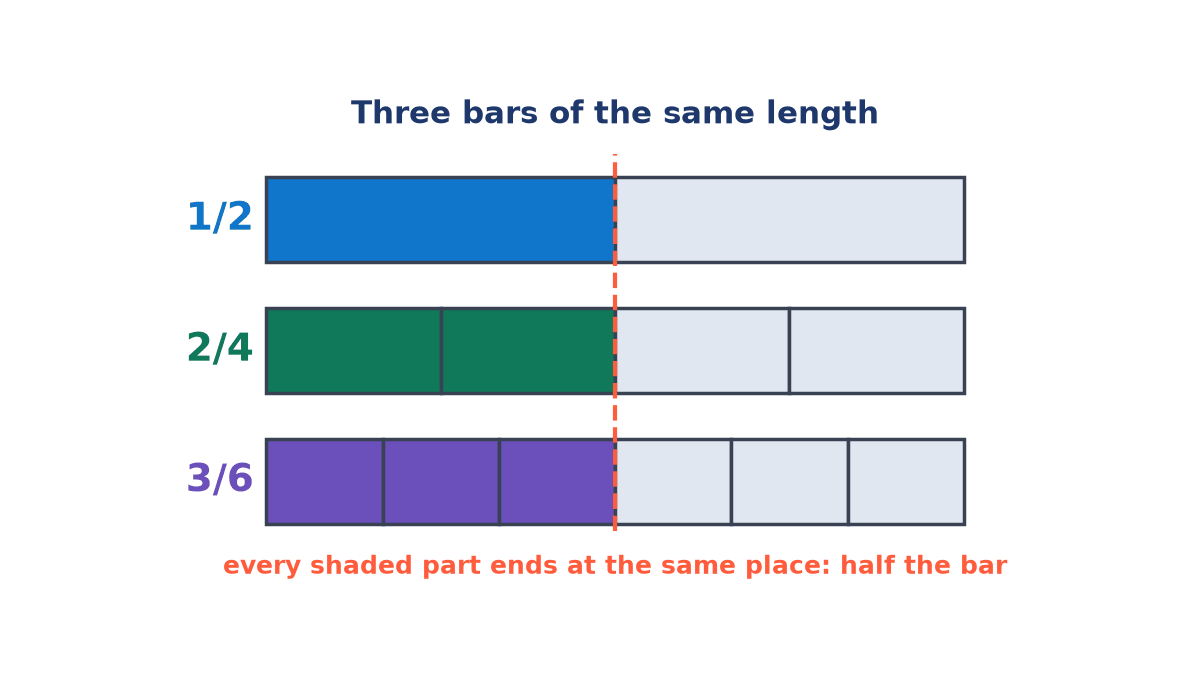
Now look down the three bars. The shaded parts all end at the same place. Each one covers half its bar. The pieces are different sizes, but the amount is the same.
Remember. . Numbers like these are called equivalent rational numbers.
The same thing happens with a full bar. Shade all 2 parts, or all 4 parts, or all 6 parts. Each time the whole bar is shaded. So .
The first rule: multiply the top and the bottom
How do you get from to ? You cut each piece in two. Now there are twice as many pieces. Each piece is half the size. The shaded amount has not moved.
So you multiply the top by 2 and the bottom by 2.
From a half to quarters
Sixths work the same way. This time you cut each half into 3 pieces.
From a half to sixths
One rule covers both of those. The letter just means the number you pick. In the first working, was 2. In the second, was 3.
Remember. , where .
Why must not be zero? Multiplying the bottom by 0 would make it 0. That is not allowed. The top would turn into 0 as well.
The rule holds with minus signs too. Take and double the top and the bottom.
Doubling the top and the bottom
So and are the same number. They are only cut into different pieces.
The second rule: divide the top and the bottom
You can travel the other way as well. Glue the small pieces back into bigger ones.
Look at the third bar again. It has 6 pieces, and 3 of them are shaded. Glue the pieces in threes. You now have 2 pieces, and 1 of them is shaded. The shaded amount stays where it was, so becomes .
The letter means the number you pick here too. Gluing in threes makes equal to 3.
Remember. , where .
Why must not be zero here? You cannot share the pieces into 0 groups. There would be nothing to count.
This time has to divide both numbers with nothing left over. Take . Both 10 and 15 split into 5s. Pick the biggest number that works, and you get the tidiest answer in one go.
Dividing the top and the bottom by 5
The last step only tidies the minus sign. A minus on the bottom means the same as a minus in front. Here the top is positive. So both forms say the number sits below zero.
You have not changed the number. You have written it with smaller numbers.
More worked examples
Write in its simplest form.
The biggest number that divides both and is .
Are and equivalent?
Simplify both. Dividing by gives . Dividing by gives . Both reach the same simplest form, so yes, they are equivalent.
What is ?
Divide the top and the bottom by . The rule allows any except zero, and a negative is fine.
A minus on the top and a minus on the bottom cancel, so the number is positive.
Fill the gap:
From to the top was multiplied by , so the bottom is . From to the bottom was multiplied by , so the top is . So .
Your turn
Now try these
Each one is missing a number. Work it out, then check below.
| 1) | 3) | 5) |
| 2) | 4) | 6) |
| Question | Answer | Question | Answer |
|---|---|---|---|
Common mistakes
- Thinking whole numbers and zero are not rational. Each can be written over .
- Allowing a zero on the bottom. has no answer at all.
- Changing only the top or only the bottom. Whatever you do to one, you must do to the other.
- Adding the same number to top and bottom. and are not equal; only multiplying or dividing keeps the value.
- Losing the minus sign when simplifying, or writing two minus signs where one positive number is meant.
Key terms
- Integer
- A counting number, zero, or a counting number with a minus sign.
- Rational number
- Any number that can be written as , where and are integers and .
- The set of all rational numbers.
- Numerator and denominator
- The top number and the bottom number of a fraction.
- Equivalent rational numbers
- Rational numbers that look different but have the same value, such as and .
- Simplest form
- The form in which the top and bottom share no factor other than .
Answers
Show answers
- , multiplying top and bottom by .
- , multiplying by .
- , multiplying by .
- , dividing by .
- , dividing by .
- , multiplying by .