You meet fractions all the time: half a roti, a quarter of an hour, three out of four slices of a pizza. Every one of these is a fraction, and every fraction is written with two numbers and a line. Once you know what each number does, fractions become much easier to read, compare and work with.
A fraction is made of two numbers. One sits above the line and one sits below it. Each number has its own job, so each deserves its own name. Let us meet them.
The two numbers in a fraction
Picture a cake cut into 7 equal slices. You take 4 of those slices. You now have of the cake.
The slices must all be the same size. Suppose one slice were much bigger. Then 4 slices out of 7 would not tell you how much cake you got. Equal slices are what make a fraction mean something.
The bottom number counts the equal parts in the whole cake. One complete cake is called one whole. This cake was cut into 7 parts. So the bottom number is 7.
The top number counts the parts you have. You took 4 slices. So the top number is 4.
These two numbers have proper names. The top number is the numerator. The bottom number is the denominator.
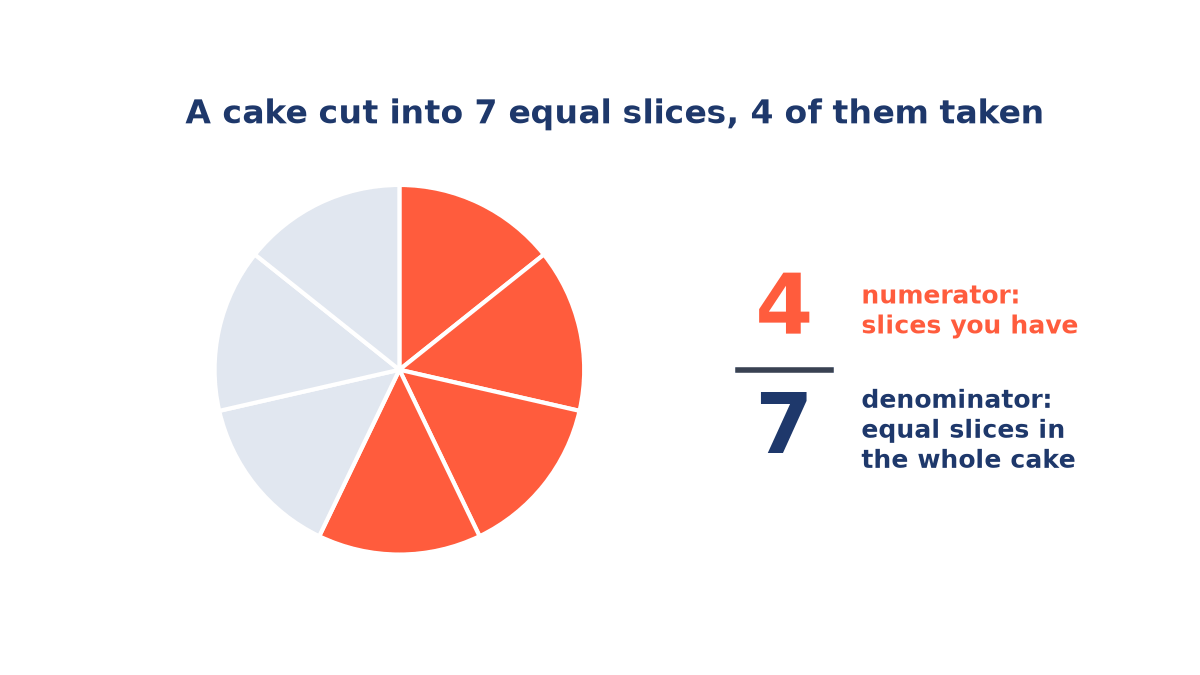
Remember. In the numerator is 4. The denominator is 7.
Which one is which
Those names are long, so here is a trick. The denominator is down. Both words start with the letter d. The other name, numerator, must be the one on top.
Remember. Denominator is down, below the line. The numerator sits on top.
The bottom number does one more thing. It tells you the size of each piece. Cut a cake into 4 parts and the pieces are big. Cut the same cake into 8 parts and they are small. A bigger bottom number means smaller pieces.
Proper fractions
In a proper fraction the top number is smaller. It is less than the bottom number. You hold some of the parts, but not all. So a proper fraction is less than one whole.
Take . The cake was cut into 4 parts. You hold 3 of them. One part is still on the plate.
When a cake is cut into 4 equal parts, each part is called a quarter. The bottom number gives the pieces their name. 5 parts are fifths. 6 parts are sixths. 8 parts are eighths.
Improper fractions
Sometimes the top number is bigger than the bottom. Sometimes the two numbers are the same. Both of these are improper fractions. Both mean you have a whole cake, or more than one.
Improper does not mean wrong. It is just the name for a fraction that has reached a whole cake or gone past it.
Look at first. It means 4 quarter pieces. Four quarters make the whole cake. So is 1.
Now look at . It means 5 quarter pieces. One cake gives you only 4 of them. The fifth piece must come from a second cake. So is more than one whole.
And means 7 quarter pieces. That is one whole cake and 3 quarters of the next one.
Remember. A proper fraction is less than one whole. An improper fraction is one whole or more.
| Fraction | Top | Bottom | Kind |
|---|---|---|---|
| 3 | 4 | proper | |
| 5 | 6 | proper | |
| 4 | 4 | improper | |
| 7 | 4 | improper |
Remember. From here on, the word fraction means one of these two. It is either a proper fraction or an improper fraction.
Mixed fractions
Go back to . You have one whole cake and one quarter. There is a short way to write that. You write . This is called a mixed fraction. It mixes a whole number with a fraction.
Writing as a mixed fraction
The 4 quarters became one whole cake. The quarter left over stays a quarter. Nothing was added and nothing was lost.
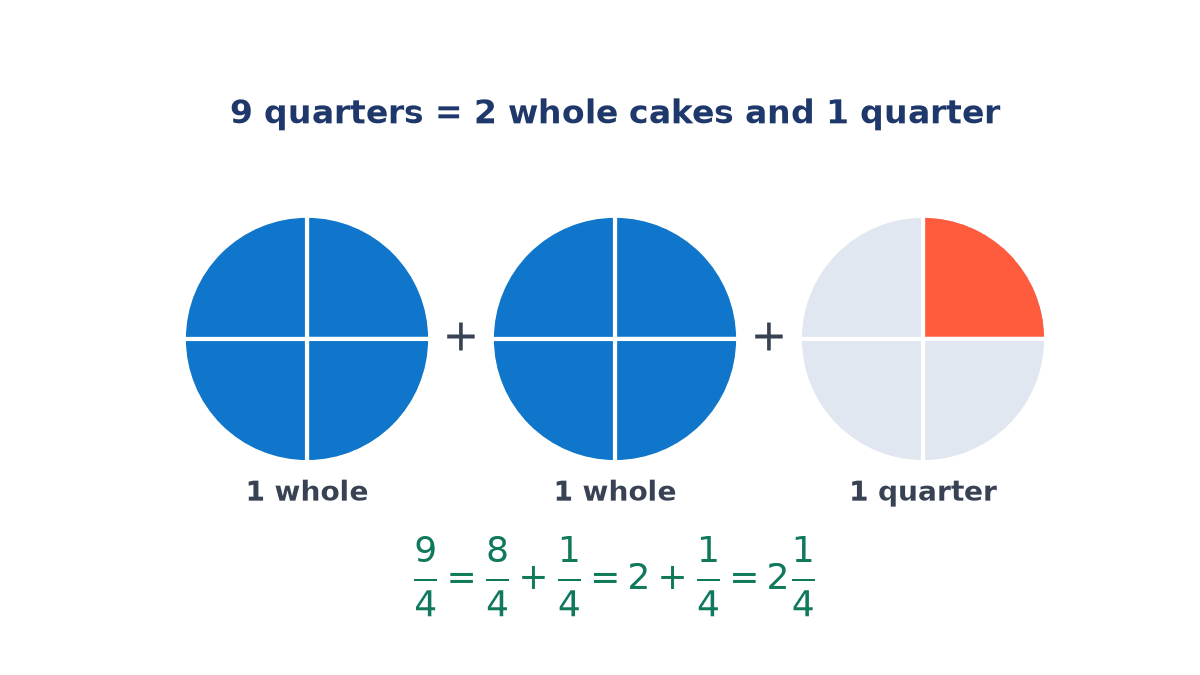
Changing into a mixed fraction
You have 9 quarter pieces. Each whole cake needs 4 of them. Two cakes use up 8 pieces. That leaves 1 piece over. So is .
Working out
Going back the other way
You can turn a mixed fraction back again. Start with . It means 2 whole cakes and 1 quarter.
Each cake holds 4 quarters. Two cakes hold 8 quarters. Add the 1 spare quarter. That gives 9 quarters in all. So is .
Changing into a fraction
The 2 is the number of cakes. The 4 is the quarters in each cake. So is the quarters in both cakes. The 1 is the spare quarter.
Remember. The same steps work every time. Multiply the whole number by the bottom number. Then add the top number. The bottom number does not change.
The bottom number stays at 4 for a reason. You are still counting quarters. Only the number of quarters changed.
Going back the other way
Now turn into a mixed fraction. You have 11 thirds. Each whole cake takes 3 of them. So ask how many times 3 goes into 11.
11 thirds
3 goes into 11 three times, with 2 left over. So you get 3 whole cakes and 2 thirds spare.
Remember. To go the other way, divide the top number by the bottom number. The answer is the whole part. What is left over is the new top number. The bottom number does not change.
Two more worked examples
Change into a mixed fraction
You have 17 fifths. Each whole needs 5 of them. Three wholes use 15 fifths, and 2 fifths are left.
Change into a fraction
Four wholes hold thirds. Add the 2 spare thirds.
Check by going back: gives quotient , remainder , which gives again.
Like and unlike fractions
Now look at a group of fractions together. Check the bottom numbers. If they all match, they are like fractions.
Every one of these is cut into fifths. Only the top number changes. The pieces are all the same size.
If the bottom numbers do not match, the fractions are unlike.
One is cut into quarters. One is cut into sixths. One is cut into eighths. The pieces are all different sizes.
Why this matters
Like fractions have pieces of the same size. That makes them easy to work with. Unlike fractions have pieces of different sizes. They need more care. The chapter comes back to this later.
Remember. Like fractions have matching bottom numbers. Unlike fractions do not.
Practice
Say whether each fraction below is proper or improper.
| 1) | 3) | 5) |
| 2) | 4) | 6) |
Write each of these as a mixed fraction.
| 1) | 2) | 3) |
Write each of these as one fraction.
| 1) | 2) | 3) |
Common mistakes
- Mixing up the two numbers. The denominator is down, and it counts the equal parts in one whole.
- Thinking a bigger denominator means a bigger piece. More parts means smaller pieces.
- Calling proper. When the top equals the bottom, the fraction is one whole, and it is improper.
- Changing the bottom number when you make a mixed fraction. The pieces are still the same size, so the bottom stays the same.
- For , adding instead of working out .
- Cutting a whole into parts that are not equal. A fraction only makes sense with equal parts.
Key terms
- Fraction
- A number that shows some equal parts of a whole.
- Numerator
- The top number: how many parts you have.
- Denominator
- The bottom number: how many equal parts make one whole.
- Proper fraction
- A fraction whose top number is smaller than its bottom number; it is less than one whole.
- Improper fraction
- A fraction whose top number is equal to or bigger than its bottom number.
- Mixed fraction
- A whole number and a proper fraction written together, such as .
- Like fractions
- Fractions with the same denominator.
- Unlike fractions
- Fractions with different denominators.
Answers
Proper or improper
1) proper 2) improper 3) improper, and equal to one whole 4) improper 5) proper 6) improper
Mixed fractions
1) 2) 3)
One fraction
1) 2) 3)
All the answers together, in a table:
Answers
| Question | Answer | Question | Answer |
|---|---|---|---|