You meet fractions on lines all the time: the markings on a measuring jug, the half-way line on a cricket pitch, the scale on a thermometer. Putting a fraction on a number line shows how big it is compared with the whole numbers around it. It also shows at a glance that is more than but less than . We'll start with halves and quarters, and then walk past and below .
A number line is simply a straight line with numbers marked along it, rather like a ruler. The whole numbers sit in order: 0, then 1, then 2.
Fractions live on the same line. They aren't strange new creatures at all; they just sit in the spaces between the whole numbers.
The bottom number cuts, the top number counts
Picture the space from 0 to 1 as one long bar of chocolate. The bottom number of a fraction tells you how many equal pieces to cut. The top number tells you how many pieces to count.
Take . The bottom number is 4, so you cut the bar into 4 equal pieces. The top number is 3, so you count 3 of those pieces from the start.
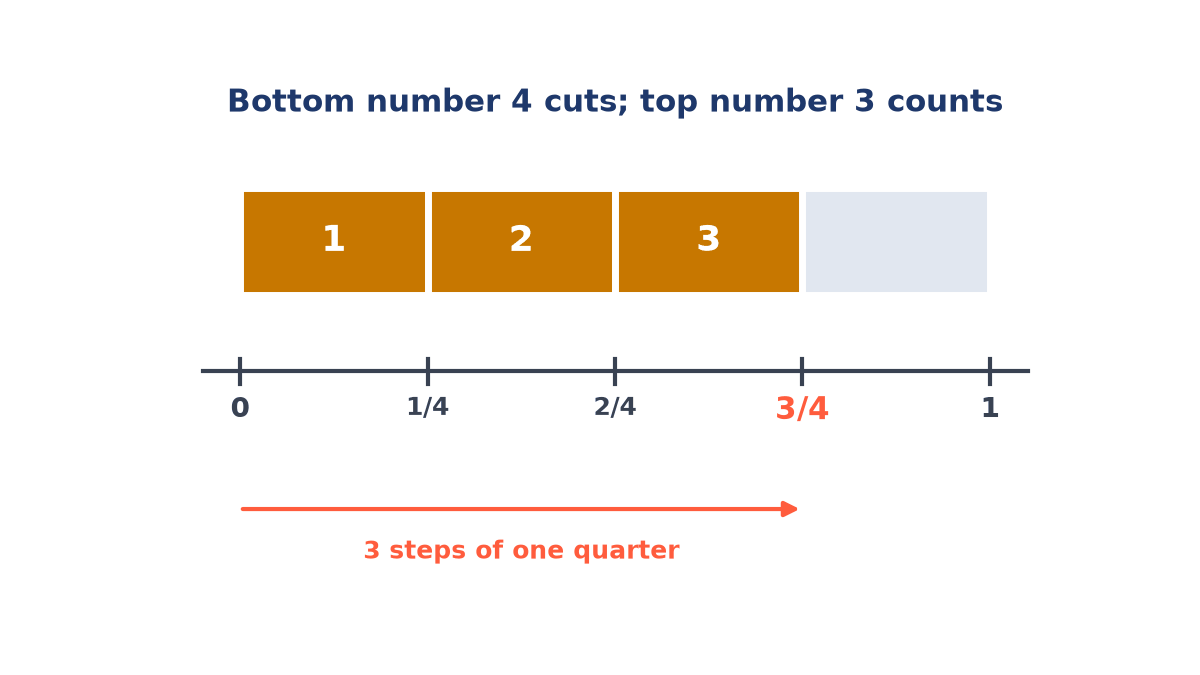
Remember. The bottom number cuts the whole up. The top number counts the parts you take.
One whole cut into 2 equal parts
Draw a line and put 0 near the left end. Put 1 further along to the right, leaving a nice wide gap between them.
Now cut that gap into 2 equal parts. You only need one mark for this, placed exactly in the middle.
That middle mark is , which we read as one half. Why the middle? Because both parts must be the same size, and only the middle gives you that.
Here are the marks in order, reading from left to right.
One whole in halves
Two halves fill the gap, so two halves make one whole. That is why the mark for is the very same spot as 1.
One whole cut into 4 equal parts
Use the same gap from 0 to 1. This time cut it into 4 equal parts. That takes 3 marks inside the gap.
Why 3 marks and not 4? Think of cutting a ribbon. One cut makes 2 parts, two cuts make 3 parts, and so three cuts make 4 parts.
When you cut a whole into 4 equal parts, we call one of those parts a quarter. So each part here is one quarter wide. Now count from 0. Each step to the right adds one more quarter.
| Where you are | Name of the point | Steps from 0 |
|---|---|---|
| The start | 0 | |
| First mark | 1 | |
| Second mark | 2 | |
| Third mark | 3 | |
| The end | 4 |
means you have cut the whole into 4 parts but taken none of them yet. You are still standing on 0.
Here is that same gap, mark by mark.
One whole in quarters
Remember. and 1 are the same point. Four quarters fill one whole, so they end in the same place.
Marking three quarters
Start at 0 and take 3 steps, each one quarter long. You land on the third mark.
That point is , sitting just before 1. You have walked 3 parts of the 4, so there is one part still to go.
Going past 1
Some fractions are bigger than one whole. is one of them. Seven quarters will not fit between 0 and 1.
So carry the line on past 1, towards 2. Cut that whole into 4 equal parts as well. Every whole on the line gets the same number of parts.
They really do have to match. A quarter is a quarter wherever you are on the line. If the second whole had a different number of parts, your steps would suddenly change size half way along, and your counting would go wrong.
Now the quarters carry on: , then , then . Then comes 2.
Here is the second whole, mark by mark.
Where seven quarters sits
So is one whole, then 3 more quarters. On the line it is the third mark after 1. It is near 2, but not at 2.
You can also just count the whole way. Take 7 quarter steps from 0. Step 4 lands you on 1, and three more steps bring you to .
Two wholes hold 8 quarters. So and 2 are the same point on the line.
Going left of 0
The line doesn't stop at 0, just as a thermometer doesn't stop at freezing. It carries on to the left, and numbers to the left of 0 are less than 0. We write them with a minus sign in front.
Cut the gap from to 0 into 4 equal parts too. Then count back from 0, one quarter at a time.
One step left is . Two steps left is . Three steps left is . Four steps left is .
Here is the gap to the left of 0, mark by mark.
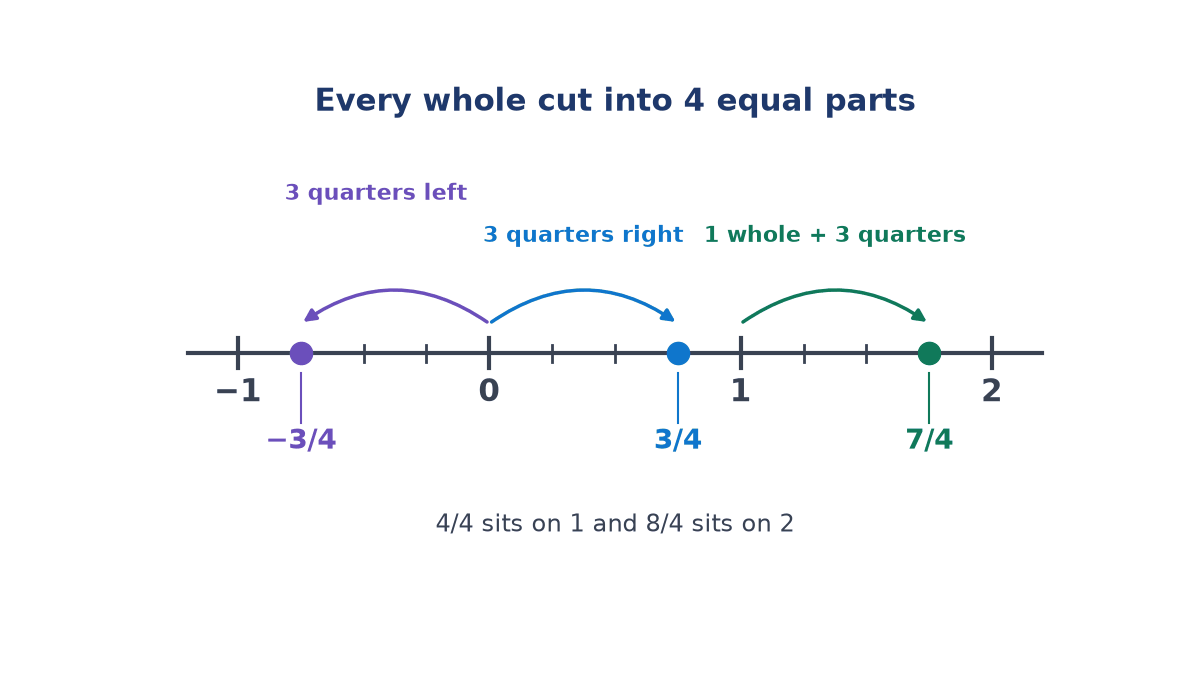
So is the mark just to the right of . You have gone 3 parts of the 4, with one part still to go.
Remember. The gap from to 0 is the same width as the gap from 0 to 1. You cut it into the same number of parts, so each step is the same size. Only the way you walk changes: right for plus, left for minus.
More worked examples
Example 1: halves past 2
Mark on a number line.
The bottom number is , so cut every whole into equal parts. Two halves make one whole, so four halves make .
So carry the line on to . The point is the middle mark between and .
Example 2: a longer walk
Mark on a number line.
Four quarters make one whole, so eight quarters make . That leaves quarters.
Go to , then take three more quarter steps. You land on the third mark after , just before .
Example 3: past minus one
Mark on a number line.
Walk left from . Four quarter steps take you to . One more quarter step takes you further left.
So is the first mark to the left of . You need to carry the line on past towards to show it.
How to draw one yourself
- Draw a straight line with a ruler. Leave spare room at both ends.
- Mark 0 somewhere near the middle.
- Mark 1 to the right of 0. Then mark 2 the same distance again.
- Mark to the left of 0, using that same distance.
- Look at the bottom number of your fraction. Cut every whole gap into that many equal parts.
- Check the parts by eye. They should all look the same width.
- Start at 0. Count the steps given by the top number. Go right for a plus, left for a minus.
A teacher's tip: the equal parts matter more than anything else. On a number line, distance is what tells you how big a number is, exactly as on a ruler. If one part is fatter than the rest, every mark after it tells you the wrong thing.
Practice
Draw a line from to 2. Cut every whole into 4 equal parts. Mark each of these numbers on it.
| 1) | 3) | 5) |
| 2) | 4) | 6) |
Extra practice with thirds
The line above uses quarters, just like your chapter. Thirds work in exactly the same way, so try this set once the quarters feel easy.
Draw a fresh line from to 2. Cut every whole into 3 equal parts this time. Mark each of these numbers on it.
| 1) | 3) | 5) |
| 2) | 4) | 6) |
Every number here sits on the line you drew. Check your marks below. Each answer names the whole number you reach first. It then gives the extra parts.
| Question | Answer | Question | Answer |
|---|---|---|---|
Remember. Cut each whole into as many equal parts as the bottom number. Then count along. That is all a fraction on a line means.
Common mistakes
- Cutting the whole into the top number of parts instead of the bottom number. For , cut into , then count .
- Drawing 4 marks inside the gap to make quarters. Three marks inside make four parts.
- Making the parts different sizes. Every part must be the same width, or the marks tell you the wrong size.
- Counting the mark as the first step. The first step ends at the first mark after .
- Walking right for a negative fraction. Minus means left of .
- Cutting the second whole into a different number of parts from the first.
Key terms
- Number line
- A straight line with numbers marked in order at equal distances.
- Fraction
- A number such as that names equal parts of a whole.
- Bottom number (denominator)
- How many equal parts each whole is cut into.
- Top number (numerator)
- How many of those parts you count.
- Half
- One of two equal parts of a whole.
- Quarter
- One of four equal parts of a whole.
- Negative fraction
- A fraction less than , marked to the left of .
Answers
Quarters, on a line from to
- : the first mark after .
- : the third mark after , just before .
- : the first mark after .
- : the third mark after , just before .
- : two marks left of , half-way between and .
- : three marks left of , the mark just to the right of .
Thirds, on a line from to
- : the second mark after , just before .
- : the first mark after .
- : the second mark after , just before .
- : the same point as .
- : the first mark left of .
- : the second mark left of , just to the right of .