A production system is the method an organisation uses to convert inputs into goods or services. It describes how work is done, how much is produced, whether the product is customised or standard, and whether production runs continuously or in small, separate quantities.
Choosing the right system is one of the most important decisions in operations management. It fixes the kind of machines to buy, the skills workers need, the layout of the facility, how inventory is held and, in the end, the cost per unit and the flexibility the business can offer its customers. A mismatch between the system and the market, such as making a standard product by hand or a highly customised product on a rigid assembly line, wastes money for years.
Meaning and features of a production system
Every production system has the same basic parts: inputs (materials, labour, machines, capital, information), a conversion process, outputs (products or services) and a feedback mechanism for control. What differs from one system to another is the pattern of the conversion process. A production system therefore explains:
- how work is done;
- how much is produced;
- whether the product is customised or standard;
- whether production is continuous or in small quantities.
Two factors decide which pattern fits best:
- Volume: how many units of each product are made.
- Variety: how many different products, or how much customisation, the operation must handle.
As volume rises, variety usually falls. This inverse relationship is the key to understanding every type described below.
Classification of production systems
Production systems are broadly divided into two groups:
- Intermittent systems, where the flow of work is stop-start because products differ and machines must be reset. Job and batch production fall here.
- Continuous (repetitive) systems, where items flow through a fixed sequence of operations with little or no interruption. Mass and continuous (process) production fall here.
Many textbooks also list project production separately, for very large one-off outputs such as a dam or a ship. It is best seen as an extreme form of job production. The four basic types, in order of increasing volume, are job, batch, mass and continuous production.
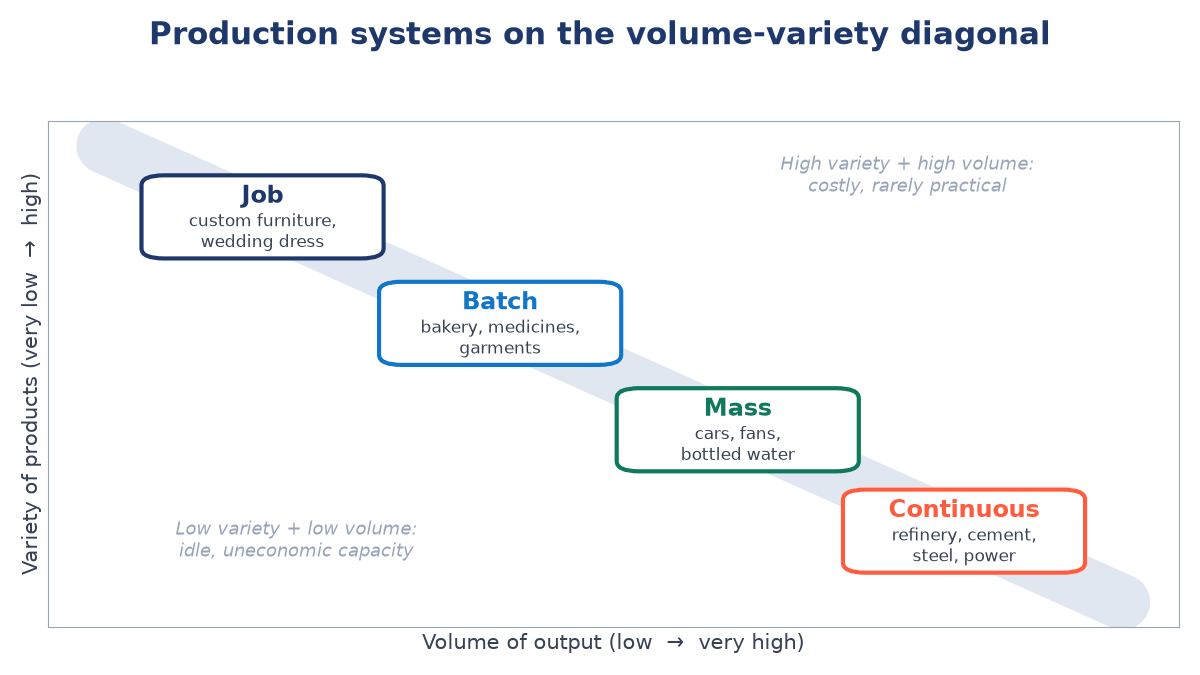
The main types of production systems
1. Job production
In job production, one product (or a very small number) is made at a time according to a customer's specific requirements. Each order is treated as a separate job and may never be repeated exactly.
Features
- high customisation and very high variety;
- small quantity, often a single unit;
- skilled, versatile labour required;
- general-purpose machines and tools;
- more time per unit and higher cost per unit;
- work usually starts only after an order is received.
Advantages: meets exact customer needs; high flexibility; low investment in specialised equipment; satisfying work for skilled staff.
Disadvantages: high cost per unit; slow output; scheduling and cost estimation are difficult; heavy dependence on skilled workers.
Examples: custom furniture, a wedding dress, house construction, tool rooms, printing of a special order.
Simple idea: each job is different.
2. Batch production
In batch production, products are made in groups or batches. The whole batch moves from one operation to the next, and after one batch is finished the machines are set up for a different product.
Features
- moderate quantity and moderate variety;
- the same product is made in lots, and the lot may be repeated later;
- a flexible system using general-purpose machines;
- machines are adjusted (set up) between batches;
- work-in-progress builds up between operations.
Advantages: better use of machines than job production; lower cost per unit than job production; can offer a range of products; spreads set-up cost over many units.
Disadvantages: set-up time and cost for each change; waiting and handling between stages; higher inventory; more complex production planning.
Examples: bakery items, medicines, garments, notebooks, paints.
Simple idea: make 100 units, stop, change over, then make another batch.
3. Mass production
In mass production, a large number of standardised products is made on a production or assembly line. Machines are arranged in the sequence of operations (a product layout) and the work moves steadily from one station to the next.
Features
- large volume and low variety;
- repetitive process with a fixed sequence;
- specialised, often dedicated machines;
- division of labour; workers may need less individual skill;
- low cost per unit because fixed costs are spread over many units;
- production is usually made to stock against a forecast.
Advantages: very low cost per unit; uniform quality; simple control once the line is balanced; less work-in-progress than batch production.
Disadvantages: high initial investment; little flexibility to change the product; a breakdown at one station can stop the whole line; repetitive work can be monotonous.
Examples: cars, bottled water, fans, mobile chargers, two-wheelers.
Simple idea: the same product is produced again and again.
4. Continuous production
In continuous (or process) production, production happens without interruption, often 24 hours a day, for long periods. The material flows through a series of highly automated stages, and the output is usually a homogeneous product measured in tonnes, litres or kilowatt-hours rather than in separate units.
Features
- very high volume and very low variety;
- highly standardised product;
- automated process with pipes, conveyors and control rooms;
- very high initial investment;
- runs continuously; shutting down and restarting is costly;
- little direct labour, but highly skilled maintenance staff.
Advantages: lowest cost per unit; consistent quality; minimal handling; very high output.
Disadvantages: almost no flexibility; huge capital requirement; a stoppage is very expensive; demand must stay high and stable.
Examples: oil refinery, cement, steel, chemicals, electricity generation.
Simple idea: production keeps flowing all the time.
Comparison of the four systems
| Basis | Job | Batch | Mass | Continuous |
|---|---|---|---|---|
| Quantity | Very low | Medium | High | Very high |
| Variety | Very high | Medium | Low | Very low |
| Customer requirement | Customised | Partly standard | Standardised | Fully standardised |
| Machines | General purpose | General purpose | Special purpose | Highly automated |
| Labour skill | High | Medium to high | Low to medium | Few, highly skilled operators |
| Layout | Process or fixed-position | Process | Product (line) | Product (flow) |
| Cost per unit | Highest | Medium | Low | Lowest |
| Flexibility | Highest | Medium | Low | Lowest |
| Example | Custom furniture | Bakery | Cars | Oil refinery |
A useful way to remember the order is Job, Batch, Mass, Continuous. As you move along this sequence:
- quantity increases;
- variety decreases;
- standardisation increases;
- automation and investment increase;
- flexibility decreases and cost per unit falls.
Job production versus mass production
This comparison is a common exam question.
| Job production | Mass production |
|---|---|
| Customised products | Standardised products |
| Small quantity | Large quantity |
| More flexibility | Less flexibility |
| High cost per unit | Low cost per unit |
| Made to order | Usually made to stock |
| Skilled, versatile workers | Specialised, repetitive tasks |
Worked example: choosing a system by volume
The link between volume and system can be shown with a simple break-even calculation. Suppose a furniture maker can produce a chair in two ways:
- Job-type workshop: annual fixed cost ₹50,000, variable cost ₹300 per chair.
- Mass-type line: annual fixed cost ₹4,00,000, variable cost ₹100 per chair.
Step 1: write total cost for each. If is the number of chairs per year:
Step 2: set them equal to find the break-even volume.
Step 3: check the total cost at that volume.
Both methods cost ₹5,75,000 at 1,750 chairs.
Step 4: compare cost per unit at other volumes.
| Annual volume | Job-type total cost | Job-type cost per chair | Mass-type total cost | Mass-type cost per chair |
|---|---|---|---|---|
| 1,000 | ₹3,50,000 | ₹350.00 | ₹5,00,000 | ₹500.00 |
| 1,750 | ₹5,75,000 | ₹328.57 | ₹5,75,000 | ₹328.57 |
| 3,000 | ₹9,50,000 | ₹316.67 | ₹7,00,000 | ₹233.33 |
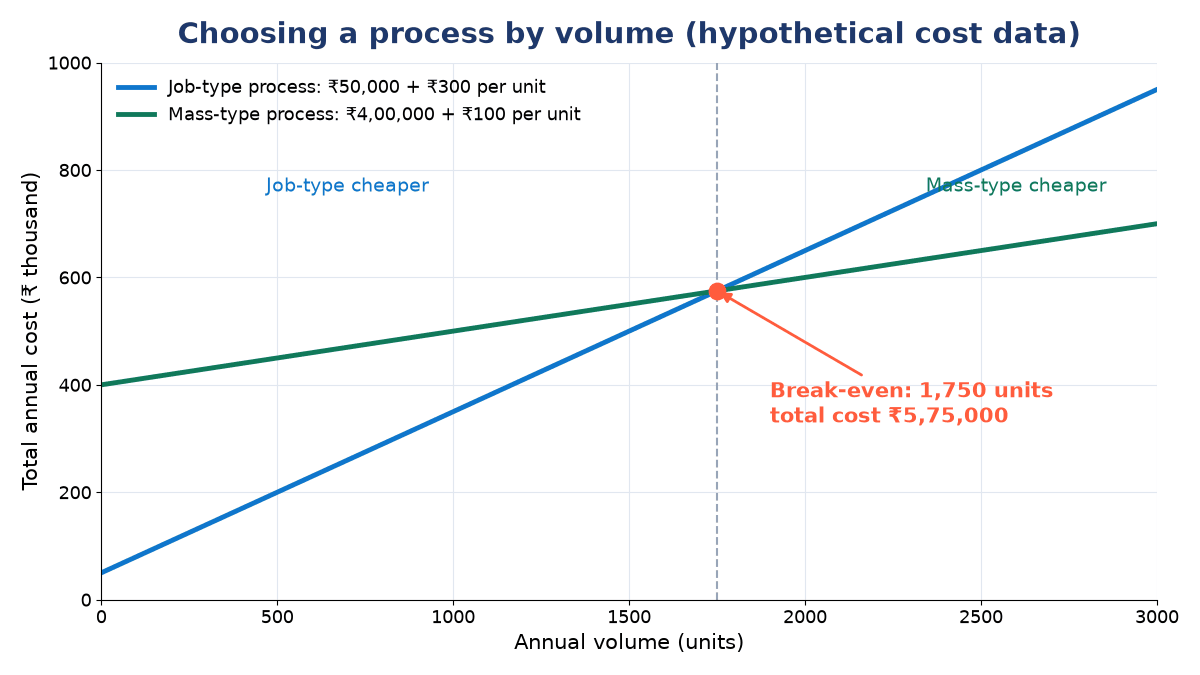
Conclusion: if expected demand is below 1,750 chairs a year, the flexible job-type workshop is cheaper. Above 1,750, the high fixed cost of the line is justified by its low variable cost. This is exactly why high-volume products move towards mass and continuous systems.
Factors that influence the choice of system
- Volume of demand and how stable it is.
- Variety and customisation customers expect.
- Nature of the product: discrete items or a flowing material.
- Capital available for machines and automation.
- Skills of the workforce.
- Technology available for the process.
- Competitive priority: low cost, or flexibility and speed of response.
Firms often use more than one system. A garment company may mass-produce school uniforms and run batches of fashion items in the same plant. Modern ideas such as mass customisation and flexible manufacturing try to combine high volume with some variety.
Production systems in services
The same ideas apply to services:
- Job-type service: personal legal advice, a custom software project.
- Batch-type service: training classes taught in groups, a tour bus.
- Mass service: a fast food chain, a railway reservation counter.
- Continuous service: electricity supply or internet service systems.
Exam answer formats
5-mark answer. Types of production systems are the different methods used by firms to produce goods and services. The main types are job, batch, mass and continuous production. Job production is used for customised products in small quantities. Batch production is used when goods are made in groups. Mass production is used for standardised products in large quantities. Continuous production is used when production runs without interruption. These systems differ in quantity, variety, cost and flexibility.
2-mark answer. A production system is the method used to convert inputs into outputs. Its main types are job, batch, mass and continuous production.
Memory line. Job = one by one; Batch = group by group; Mass = many identical products; Continuous = non-stop production.
Key terms
- Production system
- The method and arrangement used to convert inputs into goods or services.
- Intermittent system
- A system in which work flows stop-start because products vary; includes job and batch production.
- Job production
- Making one or a few customised units to a specific customer order.
- Batch production
- Making a set quantity of one product before changing over to another.
- Mass production
- Making large quantities of standardised products on a line.
- Continuous production
- Uninterrupted, highly automated flow production of a homogeneous product.
- Set-up time
- Time needed to prepare a machine to make a different product or batch.
- Break-even volume
- The output level at which two processes have equal total cost.
Common questions
What is the main difference between batch and mass production?
Batch production makes limited quantities of several products using general-purpose machines that are reset between batches. Mass production makes very large quantities of one standard product on dedicated machines arranged in a line, with little or no changeover.
Is continuous production the same as mass production?
Both are high volume, but continuous production usually handles a flowing, homogeneous material (oil, cement, electricity) and runs non-stop, whereas mass production assembles discrete units (cars, fans) and may stop at the end of a shift.
Why is cost per unit highest in job production?
Each job needs separate planning, skilled labour and set-up, and the cost cannot be spread over many identical units. There are no economies of scale.
Where does project production fit?
Project production is used for very large, one-off outputs such as bridges, ships or dams. It shares the features of job production (single unit, customised) but is managed with project planning techniques and often uses a fixed-position layout.
How does a firm decide which system to use?
It compares expected volume and required variety with the costs of each option, as in the break-even example above, and also considers capital, skills, technology and competitive priorities.
References
- Chary, S. N. Production and Operations Management. McGraw-Hill Education (India).
- Panneerselvam, R. Production and Operations Management. PHI Learning.
- Stevenson, W. J. Operations Management. McGraw-Hill Education.
- Krajewski, L. J., Malhotra, M. K. and Ritzman, L. P. Operations Management: Processes and Supply Chains. Pearson.
- Slack, N., Brandon-Jones, A. and Burgess, N. Operations Management. Pearson.