Two lines, three stories
Two linear equations in and are really two straight lines. Solving the pair means finding where the lines meet, and two lines can meet once, never, or everywhere. First we'll see all three cases on a graph, and then learn a quick coefficient test that tells you which case you're in without drawing anything at all.
A pair of linear equations
The general form is
A solution is a pair of values that satisfies both equations at the same time. On a graph, it's a point lying on both lines.
The three pictures
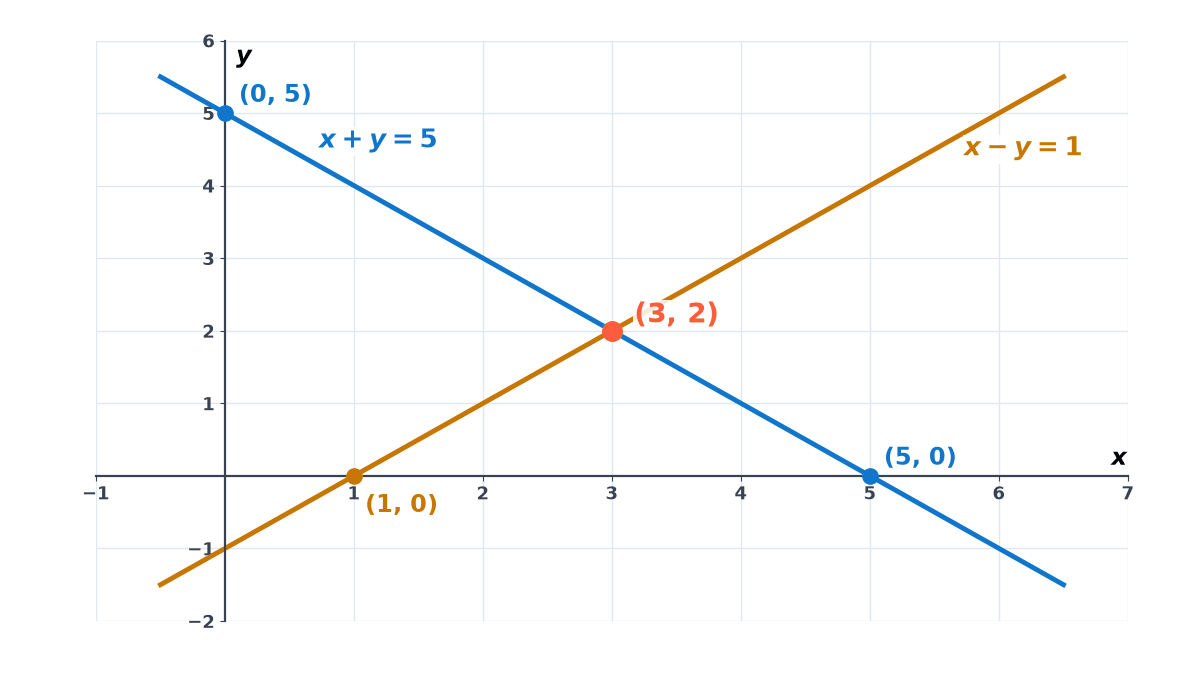
Intersecting lines, exactly one solution.
Take and . Two points are enough to draw each line: the first passes through and , the second through and . They cross at . Check: ✓ and ✓. The pair is consistent with a unique solution.
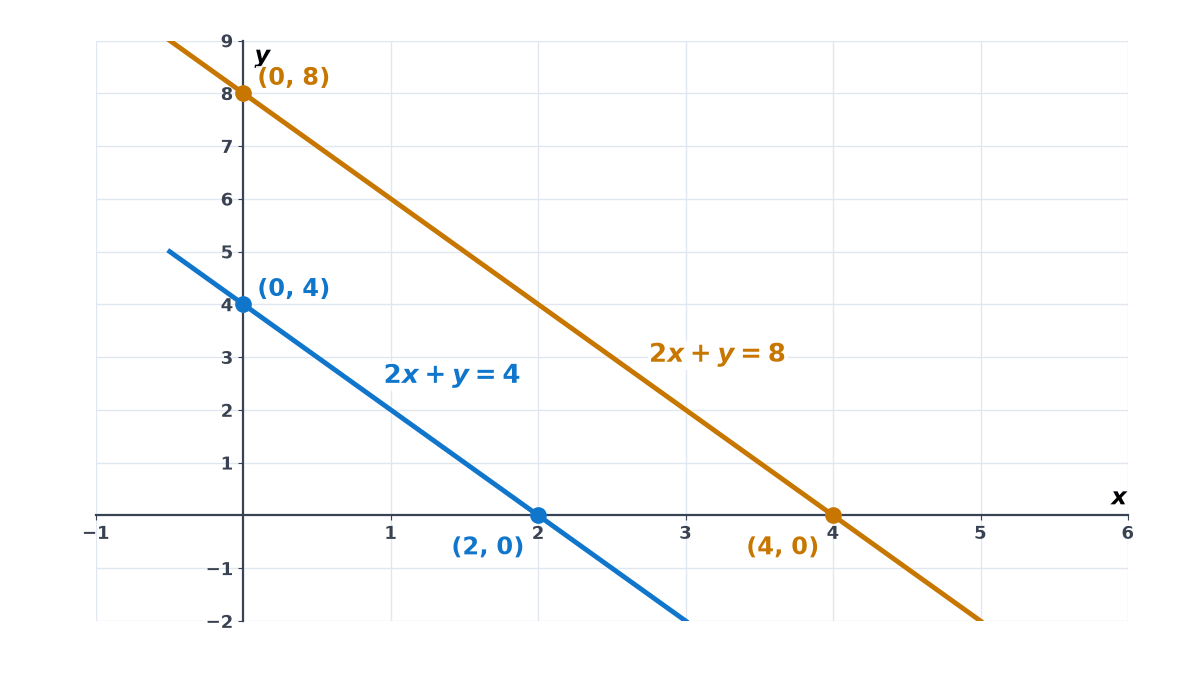
Parallel lines, no solution.
Now take and . They have the same slope but different intercepts: the first runs through and , the second through and . Like two railway tracks, they never meet. And that makes sense, since no pair can make equal to both and . The pair is inconsistent.
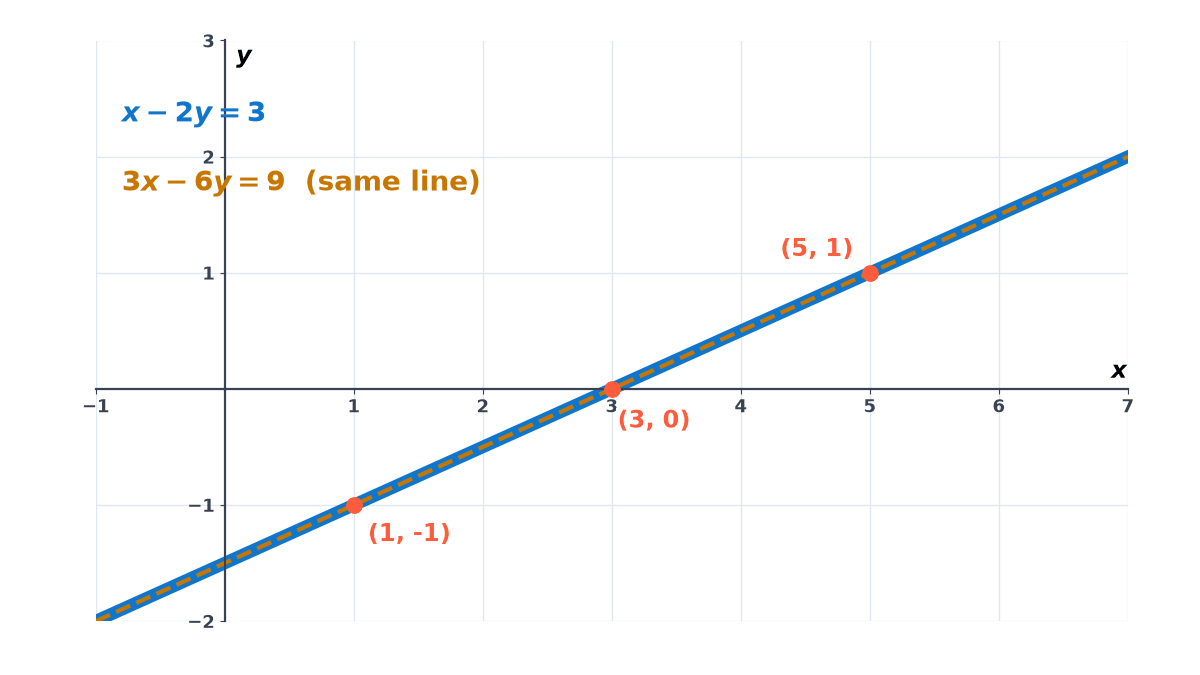
Coincident lines, infinitely many solutions.
Finally take and . Look closely: the second is just the first multiplied by , so they are the same line drawn twice. Every point on it, , , , and infinitely many more, is a solution. The pair is dependent (and therefore also consistent).
The coefficient test
Drawing takes time, and reading a crossing point off graph paper is unreliable when the coordinates are fractions. A faster way is to compare ratios of coefficients:
| Compare | Lines | Solutions | Name |
|---|---|---|---|
| intersect | exactly one | consistent | |
| parallel | none | inconsistent | |
| coincide | infinitely many | dependent |
One caution before you use it: put the equations in the form before you read off , , , and that includes the sign of . Reading from as instead of is the most common slip of all.
Example. Classify and .
, , . All equal: coincident, infinitely many solutions.
Example. Classify and .
, , . First two equal, third different: parallel, no solution.
Practice
- Solve graphically: and . Verify the solution algebraically.
- Classify without drawing: (a) and ; (b) and ; (c) and .
- For what value of does the pair and have infinitely many solutions?
- For what value of does the pair and have no solution?
- Two lines are parallel and both pass through . What can you conclude?
Answers
Show answers
- Lines through and cross at . Check: ✓, ✓.
- (a) All ratios : coincident, infinitely many. (b) Rewrite as and : , parallel, none. (c) : intersecting, one solution.
- Need . Both outer ratios are , so , giving .
- Need . So ; and confirms the lines are parallel, not coincident.
- They are the same line. Distinct parallel lines share no point; two lines sharing a point and having the same direction must coincide.