The idea in a nutshell
The elimination method gets rid of one variable by adding or subtracting the two equations, after first scaling them so that the variable has matching coefficients. When no variable has coefficient , it is usually quicker than substitution, and it keeps fractions away until the very last step.
The method
- Multiply one or both equations by constants so that one variable has the same coefficient in both (or the same size with opposite signs).
- Subtract (or add) the equations to eliminate that variable.
- Solve the resulting equation in one variable.
- Substitute back into either original equation to find the other variable.
As always, verify in both original equations.
Worked example 1, add
Solve and .
Eliminate . Multiply the second equation by so the -coefficients are and :
Add (1) and (2): , so .
Substitute into : , so .
Verify: ✓ and ✓.
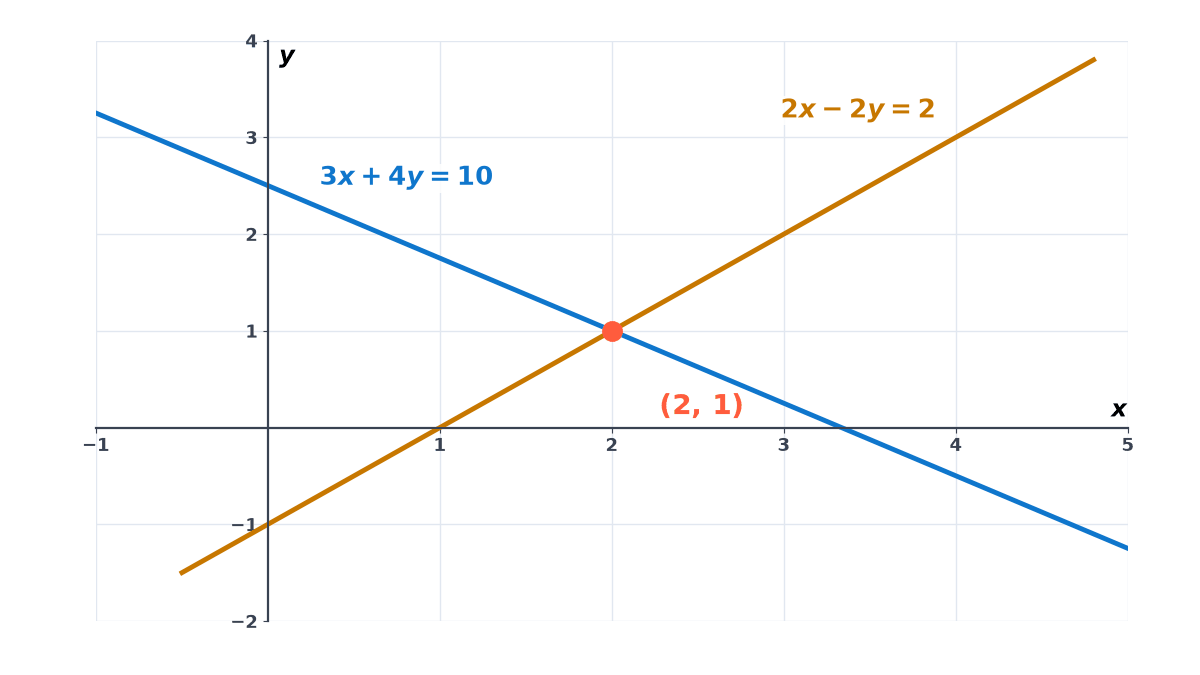
Worked example 2, scale both
Solve and .
This time neither variable lines up. To eliminate , make its coefficients and by multiplying the first equation by and the second by .
Add: , so . A fraction! That is a signal to re-check your arithmetic, not a reason to assume you went wrong. Here and are both right.
To be doubly sure, eliminate instead: multiply the first by and the second by .
Subtract: , so . Also a fraction. The solution genuinely is fractional: , . Verify: ✓.
The moral: an ugly answer is not proof of an error. Re-check the arithmetic, and then trust your work.
Worked example 3, signs
Solve and .
The -coefficients are already and . Add the equations: , . Then , .
Verify: ✓ and ✓.
Whether you add or subtract depends only on the signs: same sign, subtract; opposite signs, add. Get this backwards and you double the variable instead of removing it, but you'll soon notice, because nothing cancels.
When both variables vanish
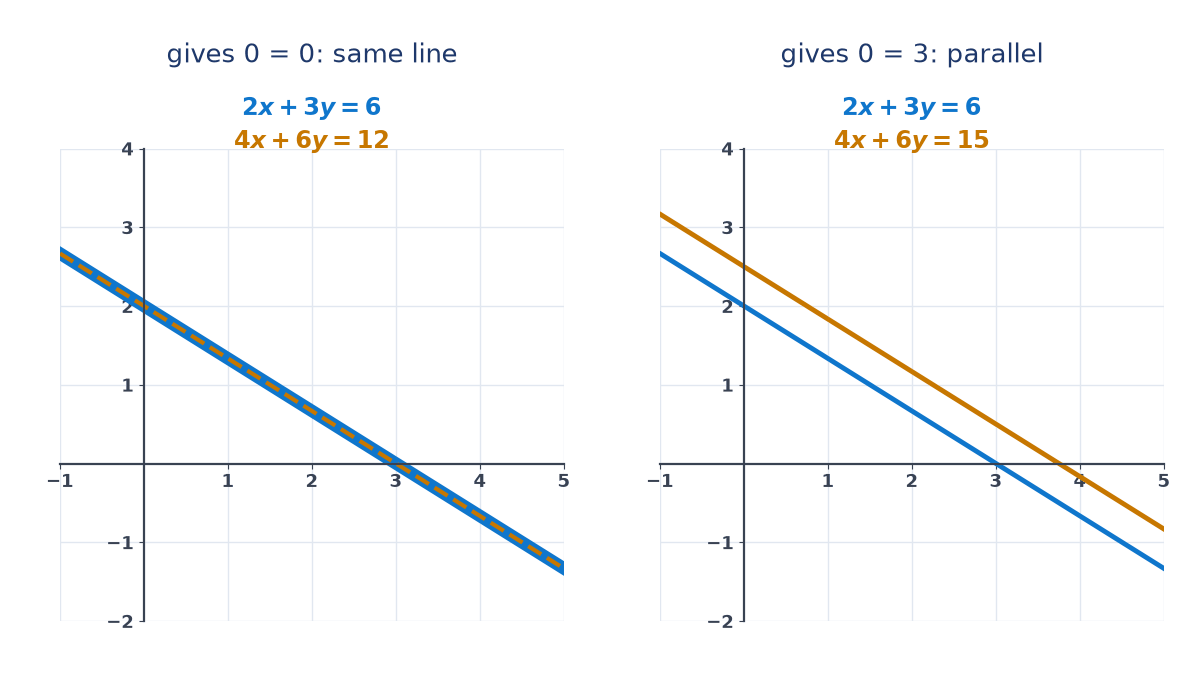
Just like substitution, elimination warns you about a non-unique case by wiping out both variables at once.
and : double the first and subtract from the second: . True, infinitely many solutions.
and : same step gives . False, no solution.
Practice
Solve by elimination and verify.
- , .
- , .
- , .
- , .
- , .
- , .
Answers
Show answers
- Add: , ; then . Check: ✓, ✓.
- Subtract: , ; then , . Check: ✓, ✓.
- Multiply first by , second by : , . Subtract: , ; then , . Check: ✓, ✓.
- Double the first: . Add to the second: , ; then , . Check: ✓, ✓.
- Double the first: . Add to the second: , ; then , . Check: ✓, ✓.
- Double the second: . Subtract from the first: . False: no solution. The lines are parallel.