Why we need it
Graphs are lovely for seeing what's going on, but they let you down when the answer is a fraction. The substitution method finds the exact solution by pure algebra: write one variable in terms of the other, substitute it in, and you're left with a single equation in one unknown, which you already know how to solve.
The method in three steps
- Take whichever equation is easier and write one variable in terms of the other.
- Substitute that expression into the other equation. You now have one equation in one variable, solve it.
- Put the value back into the expression from step 1 to get the second variable.
Then check your answer in both original equations. Checking in only one catches nothing, because the value came from that very equation.
Worked example 1
Solve and .
Step 1. The first equation gives cleanly: .
Step 2. Substitute into the second: , so , so , so .
Step 3. .
Verify. ✓ and ✓. Solution: , .
Worked example 2, a fractional answer
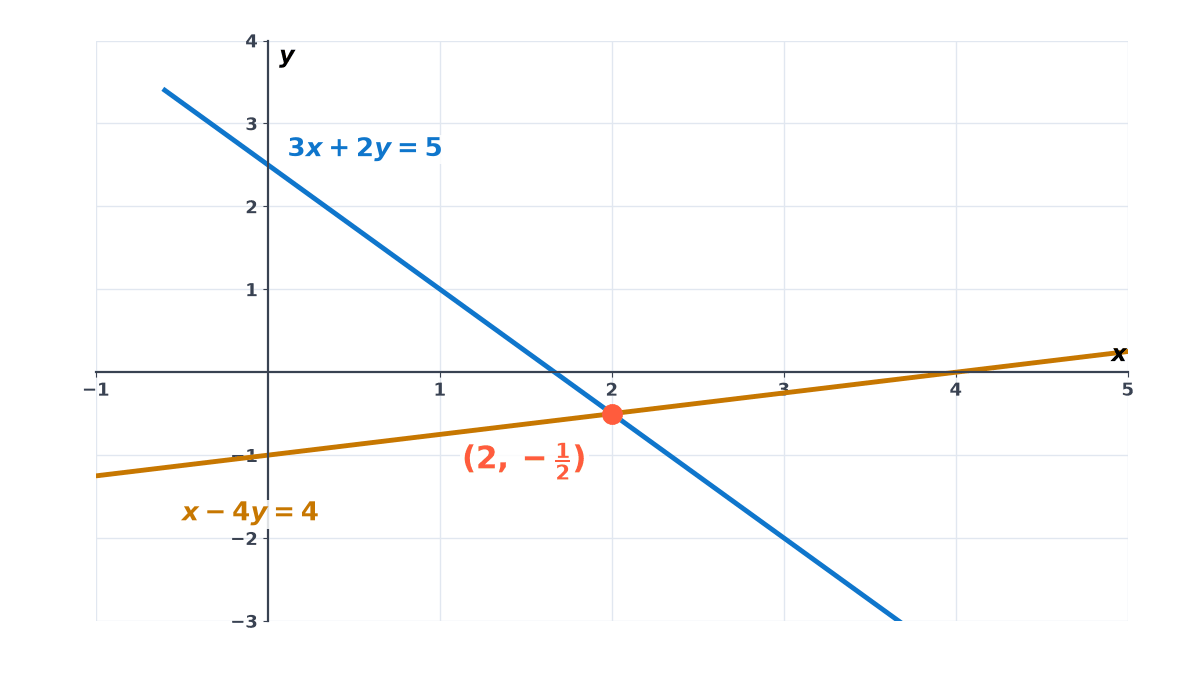
Solve and .
Step 1. From the second: .
Step 2. , so , so , so .
Step 3. .
Verify. ✓ and ✓.
A graph would have left you squinting and guessing at that value. Substitution hands it to you exactly.
What happens when there is no unique solution
Here's a nice thing about substitution: it never fails silently. When there isn't a single answer, it hands you a statement that is either always true or always false.
Parallel lines. Solve and . From the first, . Then gives , i.e. . That is false for every : no solution.
Coincident lines. Solve and . Same substitution: , i.e. . That is true for every : infinitely many solutions.
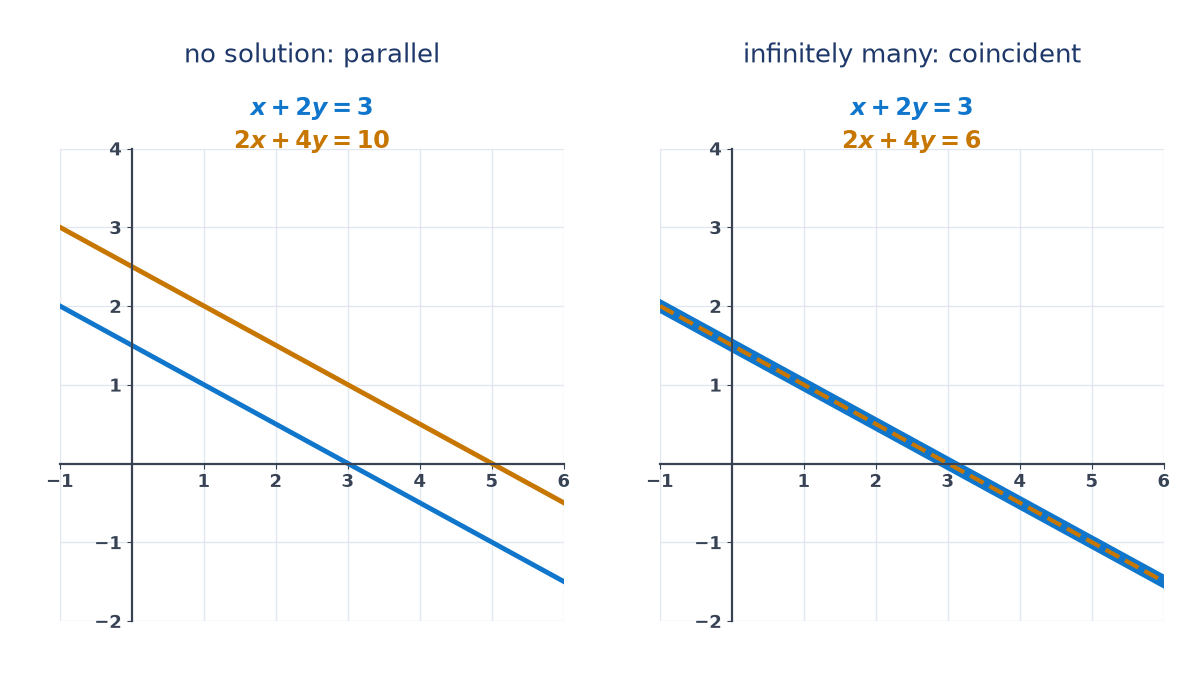
So if the variable suddenly vanishes, don't panic; just look at what is left. A false statement means the lines are parallel, and a true one means they coincide.
Choosing what to substitute
A practical tip: if some variable has coefficient or , pick that one. Solving for gives , which is correct but an open invitation to fraction errors. If the other equation has on its own, use that instead and save yourself the trouble.
Practice
Solve by substitution and verify.
- , .
- , .
- , .
- , .
- , .
- The sum of two numbers is and their difference is . Find them.
Answers
Show answers
- ; then , , . Check: ✓, ✓.
- ; then , , , . Check: ✓, ✓.
- ; then , , , . Check: ✓, ✓.
- ; then , i.e. . True for all : infinitely many solutions (coincident lines).
- ; then , i.e. . False: no solution (parallel lines).
- , . ; , , . The numbers are and .