Ten questions, five pairs to eliminate, including decimals and fractional answers, then word problems on prices, digits, boats and streams, incomes, and two cars, with every equation formed and every answer checked.
Ten questions in all. The first five are straightforward elimination; the rest are word problems where you have to form the equations first. For those, choose whichever method, substitution or elimination, suits the pair best, and say which one you used. In the exam either is accepted unless the question names one.
Three pencils and four pens cost ₹ 52. Four pencils and three pens cost ₹ 46. Find the cost of one pencil and one pen.
The sum of the digits of a two-digit number is 12. The number exceeds the number obtained by reversing its digits by 36. Find the number.
A boat goes 24 km upstream and 36 km downstream in 6 hours. It goes 36 km upstream and 24 km downstream in 621 hours. Find the speed of the boat in still water and the speed of the stream.
The ratio of incomes of two people is 8:5 and the ratio of their expenditures is 5:3. Each saves ₹ 3000 a month. Find their incomes.
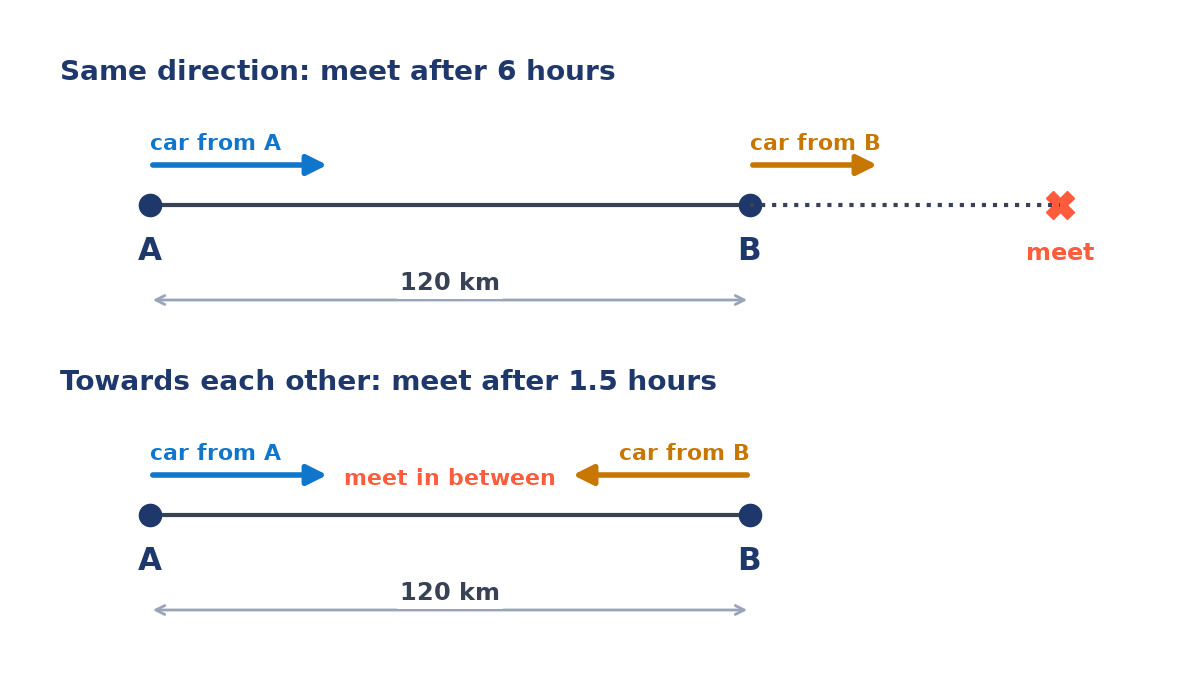
Places A and B are 120 km apart. Two cars start from A and B at the same time. Travelling in the same direction they meet in 6 hours; travelling towards each other they meet in 121 hours. Find their speeds.
Multiply first by 5, second by 2: 10x+35y=155, 10x−6y=2. Subtract: 41y=153 (check: 155−2=153 and 35+6=41), so y=41153, which does not simplify. Then from 5x−3y=1: 5x=1+41459=41500, x=41100. Verify in the first: 41200+411071=411271=31 ✓. The solution is fractional, and that's perfectly correct as it stands; don't go hunting for a mistake that isn't there.
Double the first: 8x−10y=−14. Add to the second: 14x=14, x=1; then 4−5y=−7, y=511. Check: 6+22=28 ✓.
Multiply both by 10: 3x+5y=19, 5x−2y=4. Multiply first by 2, second by 5: 6x+10y=38, 25x−10y=20. Add: 31x=58, x=3158. Then y=519−3x=15519⋅31−174=155415=3183. Verify: 0.5⋅3158−0.2⋅3183=3129−16.6=3112.4=0.4 ✓.
Pencil ₹ x, pen ₹ y: 3x+4y=52, 4x+3y=46. Add: 7x+7y=98, so x+y=14. Subtract the second from the first: −x+y=6, so y−x=6. Hence y=10, x=4. Pencil ₹ 4, pen ₹ 10. Check: 12+40=52 ✓, 16+30=46 ✓.
Digits x (tens), y (units): x+y=12 and (10x+y)−(10y+x)=36, i.e. 9x−9y=36, so x−y=4. Add: 2x=16, x=8, y=4. The number is 84. Check: 84−48=36 ✓.
Boat u km/h, stream v km/h. Upstream speed u−v, downstream u+v. Let p=u−v1, q=u+v1: 24p+36q=6 and 36p+24q=213. Multiply first by 3, second by 2: 72p+108q=18, 72p+48q=13. Subtract: 60q=5, q=121; then 24p+3=6, p=81. So u−v=8 and u+v=12: u=10, v=2. Boat 10 km/h, stream 2 km/h.
Incomes 8k and 5k; expenditures 5m and 3m. Savings: 8k−5m=3000 and 5k−3m=3000. Multiply first by 3, second by 5: 24k−15m=9000, 25k−15m=15000. Subtract: k=6000. Incomes ₹ 48000 and ₹ 30000. Check: m=9000, and 48000−45000=3000=30000−27000 ✓.
Speeds x and y km/h with x>y. Same direction: 6x−6y=120, so x−y=20. Towards each other: 23(x+y)=120, so x+y=80. Add: 2x=100, x=50, y=30. Speeds 50 km/h and 30 km/h.
Test yourself
Elimination and Word Problems: Practice, Quiz
Five questions on elimination and word problems. Pick one answer for each.