How to use this set
Here are ten questions on turning everyday situations into a pair of linear equations, on the three cases, and on the coefficient test. A few ask you to draw, but most ask you to classify a pair or find a missing constant. One habit to keep throughout: put each equation into the form before you read off its coefficients.
Section A, Forming the equations
- A pen and two notebooks cost ₹ 70. Three pens and one notebook cost ₹ 60. Write a pair of linear equations, taking a pen to cost ₹ and a notebook ₹ .
- Meera is years older than her brother. In years, the sum of their ages will be . Write the pair of equations for their present ages.
- The perimeter of a rectangle is cm and its length is cm more than its width. Form the equations.
Section B, Classifying
- Say whether each pair is consistent, inconsistent, or dependent: (a) and ; (b) and ; (c) and .
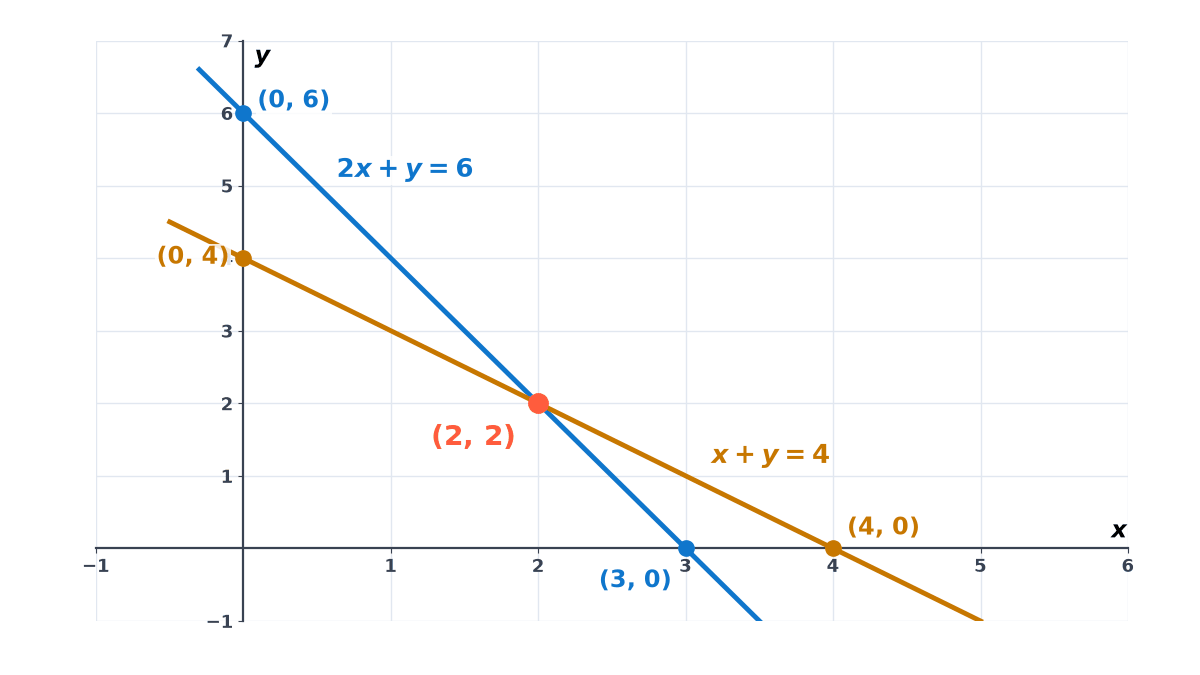
- Draw the lines and and read off their point of intersection. Then confirm it algebraically.
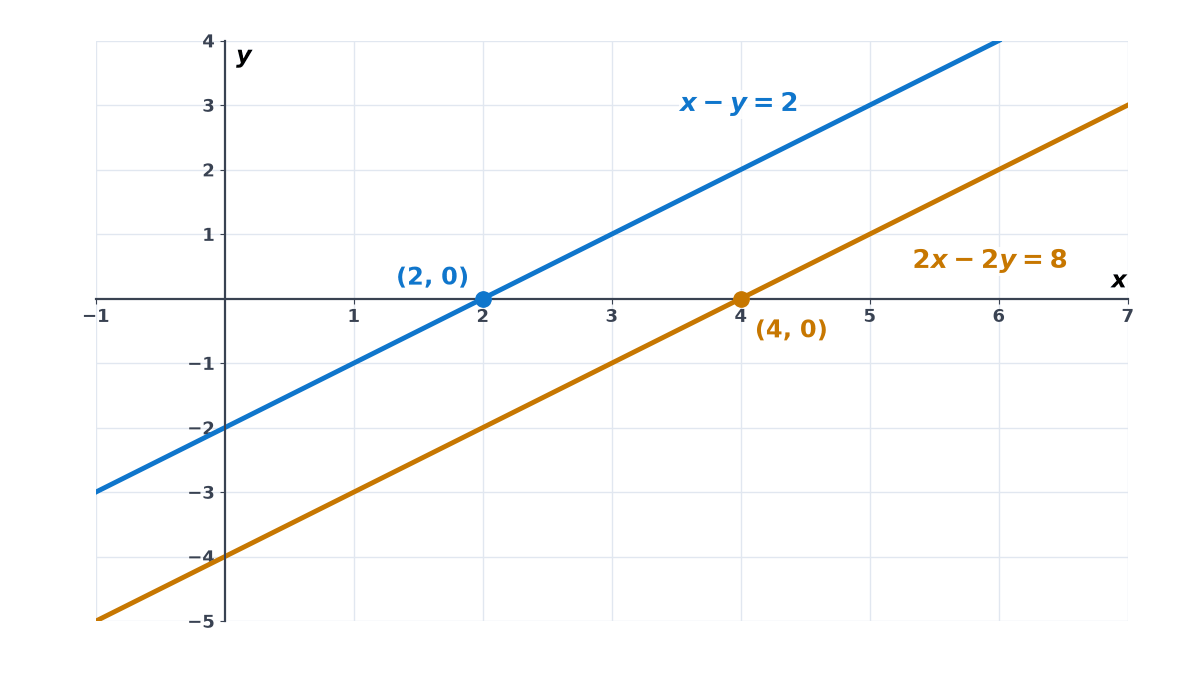
- Draw and . Describe what you see, and state the number of solutions.
Section C, Finding a constant
- Find so that and have infinitely many solutions.
- Find so that and have no solution.
- Find all values of for which and have a unique solution.
- A pair of equations is and with not both zero. Without any calculation, state how many solutions it has and why.
Answers
Show answers
- and .
- Let the brother be years and Meera years. Then , and , i.e. .
- Width , length : , i.e. , and .
- (a) , all : dependent. (b) Write as , : : inconsistent. (c) : consistent, unique.
- First line through and ; second through and . They meet at . Check: ✓, ✓.
- You see two parallel lines: . There is no solution, because the second equation is really , and cannot be both and .
- , so .
- Need . So ; and , so the lines are parallel.
- Unique solution needs , i.e. . Every real except .
- Infinitely many. The second equation is exactly twice the first, so they describe the same line and every point on it is a solution.