Work measurement is the application of techniques designed to establish the time for a qualified worker to carry out a specified job at a defined level of performance. Time study is its best-known technique: an analyst observes a job, breaks it into elements, times each element over several cycles, adjusts for the worker's pace and adds allowances to arrive at a standard time.
Without time standards, management works on guesswork. It cannot say how long a job should take, whether a slow result is due to the worker or the method, how many people a plan needs, or what a fair incentive target is. With a measured standard, a supervisor can say "this carton should take about 1.12 minutes" instead of "do it quickly", and planning, costing and wage decisions rest on evidence.
Objectives and uses of work measurement
The main objective is to determine the standard time for a job under normal conditions. That single figure answers several management questions: how long the job should take, how many workers are needed, how much output to expect and how to schedule the work.
Uses of standard time
- production planning, scheduling and delivery promises
- manpower planning and capacity planning
- line balancing on assembly lines
- labour costing, estimating and pricing
- wage incentive schemes and fair output targets
- comparing the productivity of workers, shifts and alternative methods
- revealing idle time, delays and underused equipment
What goes wrong without it
Schedules become unreliable, labour plans inaccurate, targets unrealistic, incentives unfair, machine loading difficult and cost estimates poor.
Work measurement and time study compared
Work measurement is the broad field; time study is one technique inside it. The objective of time study is to find the time an average (qualified) worker needs under normal conditions, neither an unusually slow nor an unusually fast one.
| Technique | Method | Best suited to |
|---|---|---|
| Stopwatch time study | Direct timing of elements over several cycles, with rating and allowances | Short, repetitive jobs |
| Work sampling | Random instantaneous observations give the proportion of time in each activity | Long, irregular or group work; utilisation studies |
| Standard data | Previously measured element times are combined for new jobs | Families of similar jobs |
| Predetermined motion time systems (PMTS), such as Methods-Time Measurement (MTM) | Published times for basic motions (reach, grasp, move) are added up | Jobs being designed; very short cycles |
| Analytical estimating | An experienced estimator builds times from past data and judgement | Non-repetitive maintenance or construction work |
Because a time standard is only as good as the method it measures, method study should come first; time study then sets the time for the improved method.
Equipment for time study
- Stopwatch: traditionally a decimal-minute watch reading to 0.01 minute; today often a digital timer or a tablet app.
- Time study board: a clipboard that holds the watch and the form so the analyst can read and write together.
- Time study (observation) sheet: a form listing the elements down the side and the cycles across the top.
- Calculator or computer for the analysis, and sometimes a video camera for detailed or micromotion study.
Instruments unrelated to timing, such as a thermometer, are not part of time study equipment.
Steps in a stopwatch time study
1. Select the job and the worker
Choose a job where a standard is needed: output is important, time is uncertain, delays are common or cost is high. Choose a qualified, experienced worker who works at a steady pace, and explain the purpose of the study to the worker and the supervisor.
2. Record and standardise the method
Write down the method, tools, materials, layout and working conditions. Timing should only begin once the method is proper and settled.
3. Break the job into elements
An element is a distinct part of the job with clear start and end points (break points). For carton packing the elements could be: fold carton, place items, seal, label. Elements make observation easier, separate machine-controlled from worker-controlled parts, show where the time goes and allow element times to be reused as standard data.
4. Time the elements over several cycles
With the continuous (cumulative) method the watch runs throughout and readings are subtracted afterwards; with the snap-back (flyback) method the watch is reset to zero after every element. Several cycles are timed, and abnormal readings caused by unusual events, such as a dropped tool, are excluded from the average.
5. Decide the number of cycles
More cycles give more confidence. A common formula for the number of observations, for 95 per cent confidence and an accuracy of plus or minus 5 per cent, is
where is the number of pilot readings and is each reading. Alternatively, with a pilot standard deviation and mean , , where is the confidence factor and the accuracy as a fraction.
6. Rate the worker's performance
The analyst compares the observed pace with a defined normal pace (100 per cent). A worker judged 10 per cent faster than normal is rated 110; one 10 per cent slower is rated 90. Rating turns the observed time into the time a normal worker would take. Common systems include pace (speed) rating and the Westinghouse levelling system, which considers skill, effort, conditions and consistency.
7. Add allowances and set the standard
No one can work continuously like a machine, so allowances are added to normal time.
- Personal allowance: for personal needs such as drinking water or using the washroom.
- Fatigue (relaxation) allowance: for recovery from physical and mental effort; it rises with heavy work, heat, noise or monotony.
- Process (unavoidable delay) allowance: compensates for machine waiting or process delays outside the worker's control.
- Contingency, policy or special allowances: for small, irregular extra work, or set by management policy.
Personal and fatigue allowances together are often called PF allowances, and a combined total of about 10 to 20 per cent is common in textbook problems.
The formulas
Here is the allowance expressed as a fraction of normal time. When allowances are instead given as a fraction of the total working day, the formula becomes . Read the question carefully to see which basis is intended.
| Term | Meaning |
|---|---|
| Observed (actual) time | What the analyst actually saw on the watch |
| Normal (basic) time | Observed time adjusted to a normal pace by rating |
| Standard (allowed) time | Normal time plus allowances; the figure used for planning and pay |
Worked example: standard time for carton packing
Suppose a packing unit (hypothetical figures) times a packer over five cycles. Readings are in minutes. Allowances are 15 per cent of normal time, and the wage is ₹180 per hour.
| Element | Cycle 1 | Cycle 2 | Cycle 3 | Cycle 4 | Cycle 5 | Total | Rating |
|---|---|---|---|---|---|---|---|
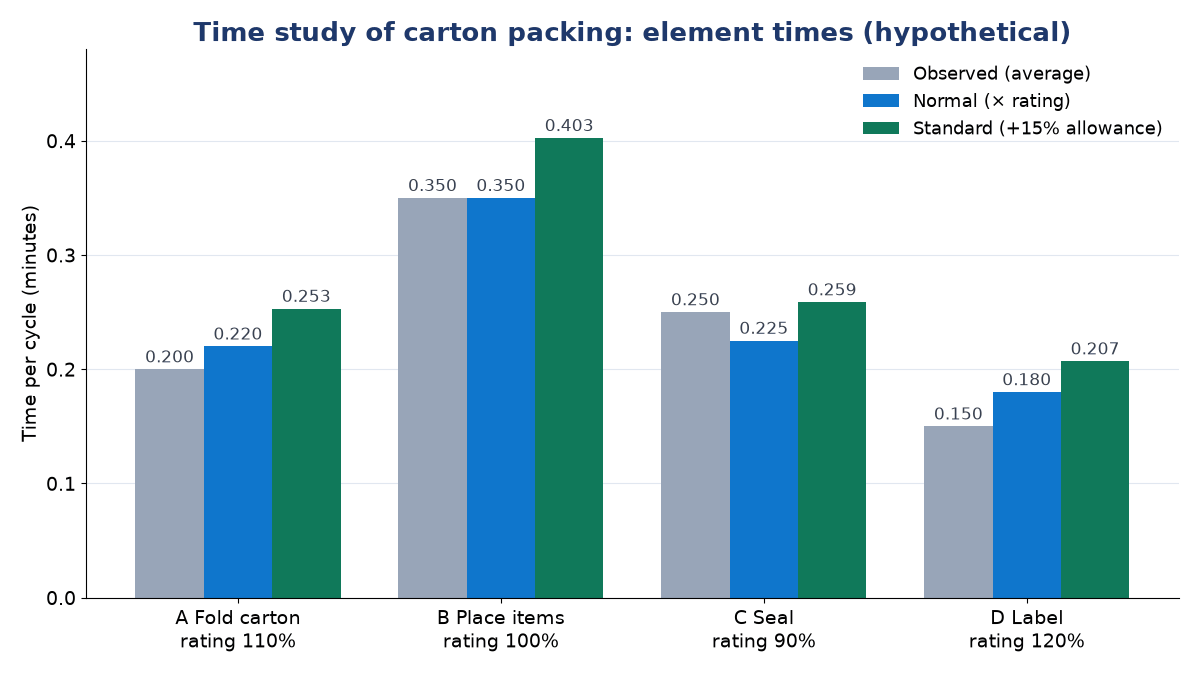
| A Fold carton | 0.20 | 0.22 | 0.19 | 0.21 | 0.18 | 1.00 | 110% |
| B Place items | 0.35 | 0.33 | 0.36 | 0.34 | 0.37 | 1.75 | 100% |
| C Seal | 0.25 | 0.27 | 0.24 | 0.26 | 0.23 | 1.25 | 90% |
| D Label | 0.15 | 0.16 | 0.14 | 0.15 | 0.15 | 0.75 | 120% |
Step 1: observed (average) time for each element.
Step 2: normal time for each element.
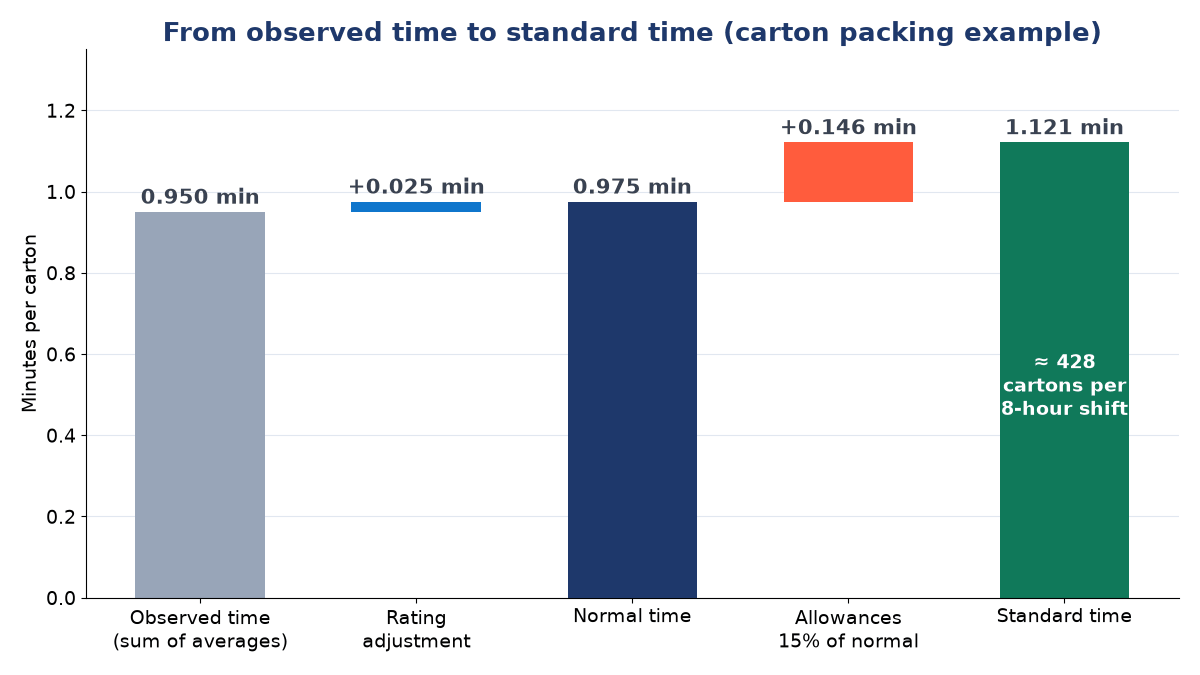
Step 3: total observed and normal time per carton.
Rating has added minute.
Step 4: standard time.
The allowances add minute.
Step 5: standard output per 8-hour shift.
Step 6: standard labour cost per carton. At ₹180 per hour, labour costs rupees per minute, so the standard labour cost is rupees, or about ₹3.36 per carton.
If the allowance had been stated as 15 per cent of the working day instead, the standard time would be minutes, which shows why the basis matters.
Work sampling
Work sampling (activity sampling), developed by L. H. C. Tippett in the British textile industry, estimates the proportion of time spent on different activities from a large number of random, instantaneous observations. At each random moment the observer simply notes whether the worker is working or waiting, or whether the machine is running or idle.
Worked example: machine utilisation
Suppose an observer makes 400 random observations of a packing machine over two weeks and finds it running in 340 of them.
The machine is estimated to be running 85 per cent of the time and idle 15 per cent. In a 480-minute shift that means about idle minutes. To be 95 per cent confident that the estimate is within plus or minus 3 percentage points (, ), the number of observations needed is
so at least 545 observations are required; the 400 already taken are not enough for that accuracy.
| Basis | Time study | Work sampling |
|---|---|---|
| Observation | Continuous timing of a job | Random, instantaneous snapshots |
| Result | Standard time per cycle | Share of time in each activity |
| Suited to | Short, repetitive cycles | Long, varied or group work |
| Effect on the worker | Worker knows they are being watched closely | Less intrusive |
| Cost | Needs a trained analyst for long periods | Cheaper; observers need less training |
Applications
Manufacturing
Packing, machining, assembly (for example, the time to assemble one switchboard unit), inspection, loading and unloading, and other repetitive operations.
Services
Patient registration in a hospital, processing a bank form, billing at a store counter, handling files in an office, order picking in a warehouse and admission work in a school.
Work measurement, incentives and productivity
Incentive schemes need a fair definition of expected output. If the standard for a carton is 1.121 minutes, a worker producing more than 428 cartons in a shift has beaten the standard and can be paid a bonus. Without measured standards, incentive schemes are arbitrary and often disputed. Measured time also improves productivity because it reveals delays, supports better scheduling, exposes underused capacity and helps balance work across stations and staff.
Benefits and problems
| Benefits | Problems |
|---|---|
| Better planning and scheduling | Workers may resist close observation |
| Control: actual performance compared with standard | If a poor method is timed, the standard is poor too |
| Shows where time is lost | Careless timing gives unreliable results |
| Better labour utilisation | Workers may change pace while being observed |
| Accurate labour cost estimates | Performance rating depends on the analyst's judgement |
| Fair incentive schemes | Standards date quickly when methods change |
Conditions for a successful study
- the method is improved and fixed before timing
- the worker understands the purpose
- the analyst is trained and impartial
- enough cycles are observed
- allowances are fair and clearly stated
- management uses the results for improvement, not harassment
Key terms
- Work measurement
- Techniques for establishing the time for a qualified worker to do a specified job at a defined level of performance.
- Time study
- Timing and rating the elements of a job to establish its standard time.
- Element
- A distinct part of a job with clear break points, timed separately.
- Observed time
- The average of the valid stopwatch readings for an element or job.
- Performance rating
- The analyst's assessment of the worker's pace against normal pace, as a percentage.
- Normal time
- Observed time multiplied by the rating factor.
- Allowances
- Extra time for personal needs, fatigue and unavoidable delays.
- Standard time
- Normal time plus allowances; the time allowed for the job.
- Work sampling
- Estimating the share of time in each activity from random instantaneous observations.
- PMTS
- Predetermined motion time systems, which build job times from published times for basic motions.
Common questions
What is the difference between normal time and standard time?
Normal time is the observed time adjusted to a normal pace by rating. Standard time is normal time plus allowances for personal needs, fatigue and delays. In the example, normal time is 0.975 minute and standard time is 1.121 minutes.
Why is performance rating necessary?
Observed workers do not all work at the normal pace. Without rating, timing a fast worker would give a standard that is too tight and timing a slow worker one that is too loose.
Are allowances added to observed time or normal time?
To normal time. Rating is applied first, then allowances. Check whether the allowance is a percentage of normal time, , or of the working day, .
What does the process allowance cover?
It compensates the worker for machine waiting or process delays that are outside the worker's control.
When is work sampling preferred to time study?
When jobs are long, irregular or spread across many people or machines, or when the question is how much time is idle or productive rather than how long one cycle takes.
Why should method study come before time study?
Timing a wasteful method builds the waste into the standard. The method is improved first, and then its time is measured.
References
- Kanawaty, G. (ed.) Introduction to Work Study. International Labour Office, Geneva.
- Taylor, F. W. (1911) The Principles of Scientific Management. Harper & Brothers.
- Stevenson, W. J. Operations Management. McGraw-Hill Education.
- Chase, R. B. and Jacobs, F. R. Operations and Supply Chain Management. McGraw-Hill Education.
- Panneerselvam, R. Production and Operations Management. PHI Learning.