Maintenance is the set of activities needed to keep plant, machinery, equipment, buildings and other facilities in good working condition. Maintenance management is the planning, organising, directing and controlling of those activities so that equipment is available, safe and reliable at the lowest total cost. In plain words, it means keeping machines fit, safe and ready for use, instead of waiting for them to fail.
The topic matters because production depends on machines. When a key machine stops, output is lost, workers sit idle, orders are delayed and customers complain. Good maintenance keeps production continuous, extends the life of costly equipment, protects workers and, over time, saves more money than it costs.
Why maintenance management is important
Every machine wears with use. Bearings wear, belts stretch, lubricants break down and electrical contacts loosen. Without a system, these small problems grow into sudden breakdowns. Maintenance management is needed because it:
- keeps production continuous and delivery promises reliable;
- reduces downtime, the time a machine is not available for productive use;
- protects the large investment in plant and machinery;
- improves product quality, since worn machines produce more defects;
- improves safety for workers and property;
- lowers total cost by replacing emergency repairs with planned work.
The basic idea is simple: it is usually cheaper to look after a machine than to rescue it. In a continuous or mass-production line, one stopped machine can halt the whole line, so maintenance is directly linked to production continuity.
Objectives of maintenance management
Reduce machine breakdowns
The first objective is to minimise unexpected failures of machinery.
Extend the useful life of plant and machinery
Correct operation, lubrication, cleaning, correct loading and timely replacement of parts help equipment last longer and give better value for the investment.
Reduce downtime
Less downtime means more output, better machine utilisation and fewer idle workers.
Improve reliability
Reliable machines allow accurate production schedules and on-time delivery.
Improve safety
Poorly maintained equipment can cause accidents, injury, fire, electrical hazards and damage to property.
Reduce maintenance cost in the long run
Planned care reduces emergency repair bills, overtime and production losses.
Types of maintenance
Organisations use a mix of the following approaches, chosen machine by machine.
Breakdown maintenance
Breakdown (reactive or run-to-failure) maintenance means repairing a machine only after it has failed. For example, a photocopier is used until it jams and stops, and only then is a technician called.
Advantages
- No planning or scheduled maintenance cost in advance.
- Few maintenance staff needed when failures are rare.
- Suitable for cheap, non-critical items with standby units.
Disadvantages
- Sudden stoppages and loss of production.
- Repairs are often more expensive and need overtime.
- Idle labour, delayed orders and unhappy customers.
- Higher safety risk, since failures can be violent.
- Large stocks of spare parts may be needed "just in case".
Preventive maintenance
Preventive (planned) maintenance means inspecting, servicing and replacing parts at fixed intervals, based on time or usage, before failure occurs. For example, a bus operator changes engine oil every 10,000 km and replaces brake pads on a schedule.
Advantages
- Fewer breakdowns and less unplanned downtime.
- Maintenance can be done at convenient times, such as weekends.
- Longer machine life and better product quality.
- Safer operation and better planning of spares and labour.
Disadvantages
- Regular cost even when the machine is running well.
- Parts may be replaced while they still have useful life.
- Needs records, schedules and trained staff.
- Poorly done servicing can itself introduce faults.
Preventive maintenance is especially important for costly equipment, critical machines, production lines and any machine whose breakdown causes heavy loss.
Corrective maintenance
Corrective maintenance goes beyond repairing a failure: it removes the root cause of repeated trouble, often by modifying or redesigning the equipment. If a conveyor belt keeps slipping, the firm may realign or redesign the drive instead of tightening the belt again and again.
Routine maintenance
Routine maintenance covers small regular tasks such as cleaning, lubrication, tightening, inspection and minor adjustments, done daily or at short intervals, often by operators themselves. Many major failures begin as small ignored issues, so routine care is very valuable.
Predictive (condition-based) maintenance
Predictive maintenance monitors the actual condition of equipment and acts when warning signs appear. Tools include vibration analysis, temperature (thermal imaging) checks, oil analysis, ultrasonic testing and sensor readings. The rule is: maintain when the condition says so, not merely by the calendar and not only after failure. It avoids both surprise failures and unnecessary part replacement, but it needs instruments and skilled analysts.
Total Productive Maintenance (TPM)
TPM, developed in Japan and described by Seiichi Nakajima, makes maintenance everyone's job. Operators perform basic care (autonomous maintenance), while specialists handle planned and improvement work. TPM aims for zero breakdowns, zero defects and zero accidents, and it measures performance with Overall Equipment Effectiveness (OEE).
| Type | When work is done | Best suited to | Main drawback |
|---|---|---|---|
| Breakdown | After failure | Cheap, non-critical items | Unplanned downtime |
| Preventive | At fixed time or usage intervals | Critical machines with known wear | May replace good parts |
| Corrective | After repeated faults, to fix the root cause | Chronic problem equipment | Needs analysis and investment |
| Routine | Daily or very frequently | All equipment | Easily neglected |
| Predictive | When monitoring shows deterioration | Expensive, high-risk equipment | Cost of instruments and skills |
Breakdown versus preventive maintenance
| Point | Breakdown maintenance | Preventive maintenance |
|---|---|---|
| Timing | After failure | Before failure, as planned |
| Nature | Reactive | Proactive |
| Downtime | Unplanned, often long | Planned, usually short |
| Cost pattern | Low routine cost, high failure cost | Regular cost, lower failure cost |
| Safety | Higher risk | Lower risk |
| Suitable for | Low-value, non-critical items | Costly and critical equipment |
Worked example: reliability, availability and choosing a policy
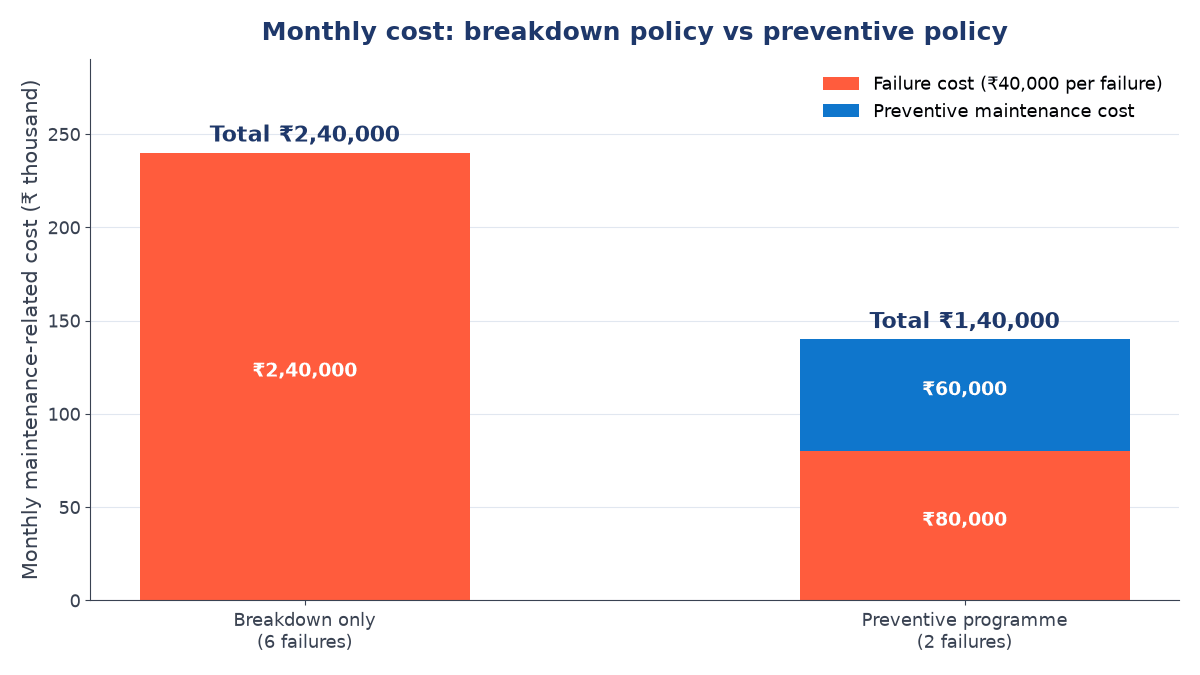
Suppose a packaging machine is scheduled to run 480 hours a month. Under a breakdown-only policy it fails 6 times a month, and the repairs take 24 hours in total. Each failure costs ₹40,000 in repair, scrap and lost output.
Step 1: Operating (up) time.
Step 2: Mean time between failures (MTBF).
Step 3: Mean time to repair (MTTR).
Step 4: Availability.
Step 5: Monthly cost of the breakdown policy.
Step 6: Monthly cost of a preventive policy. A preventive programme costing ₹60,000 a month (planned servicing, lubrication and part changes) is expected to cut failures to 2 a month.
Step 7: Decision. The preventive policy saves a month, so it should be adopted. The general rule is: choose preventive maintenance when the preventive cost is less than the failure cost it avoids. Here ₹60,000 is spent to avoid 4 failures worth ₹1,60,000.
Extension: OEE. If the machine's availability is 95 per cent, it runs at 90 per cent of its rated speed, and 98 per cent of its output is good, then
OEE shows that downtime is only one of three losses; speed losses and quality losses matter too.
Causes of machine failure
- Normal wear and tear, and old age
- Poor or missing lubrication
- Overloading or wrong operation
- Poor handling and lack of cleaning
- Loose parts and vibration
- Electrical faults
- Bad-quality spare parts
Maintenance management tries to prevent or reduce each of these causes through training, inspection and planned servicing.
Failure stages and the bathtub curve
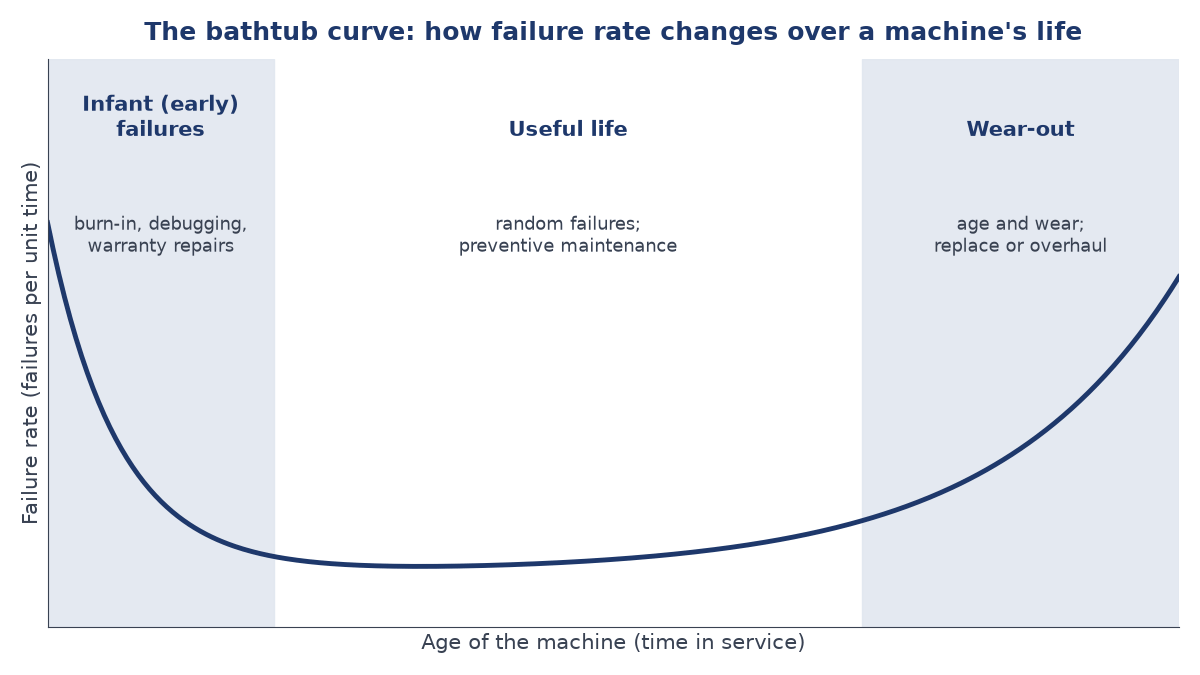
The failure rate of equipment changes over its life. Plotted against age, it forms the well-known bathtub curve.
Infant (early) failure stage
Failure rate is high at first because of manufacturing defects, poor installation or initial weakness. It falls quickly as these faults are found. Burn-in testing, careful commissioning and warranties deal with this stage.
Useful life stage
Failures are few and random. The machine works normally, and routine and preventive maintenance keep it that way.
Wear-out stage
As the machine ages, wear and tear raise the failure rate again. At this point major overhaul or replacement is considered, so maintenance and replacement decisions go together.
Replacement and group replacement
Some items do not deteriorate gradually but fail suddenly, such as bulbs, fuses and small electronic parts. For large numbers of identical, low-cost items, a firm may use group replacement: replace all of them together at fixed intervals, and replace individual failures in between. Replacing items in a group is cheaper per item, because labour and access costs are shared, than replacing each one when it fails. The best group-replacement interval is the one with the lowest average cost per period. Items that deteriorate gradually, such as vehicles, are replaced when their average annual cost, including rising running costs, is at its minimum.
Maintenance planning and control
Maintenance records
Good records include machine history cards, service dates, breakdown dates, repair costs, spare parts used, maintenance schedules and downtime data. They help managers identify problem machines, plan future work, control cost and make replacement decisions. Without records, maintenance becomes irregular and reactive.
Maintenance schedule
A maintenance schedule is a timetable showing which machine will be serviced, when, what work is needed and who will do it. It turns preventive maintenance from an intention into a routine and is coordinated with the production schedule so that servicing does not clash with urgent orders.
Spare parts management
If a machine fails and the spare is missing, downtime and production loss grow. Maintenance planning therefore identifies critical spares, keeps essential stock and coordinates with purchase and stores, linking maintenance with inventory management.
Role of the maintenance department
- Inspecting machines and carrying out repairs
- Planning and executing preventive maintenance
- Maintaining spare parts and tools
- Responding to emergency breakdowns
- Keeping records and analysing downtime
- Improving equipment reliability and safety
Benefits of good maintenance and problems of poor maintenance
| Good maintenance gives | Poor maintenance causes |
|---|---|
| Fewer machine failures | Frequent breakdowns |
| Continuous production and lower downtime | Interrupted production and delayed orders |
| Longer equipment life | Poor machine efficiency |
| Lower repair cost in the long run | High repair cost |
| Better safety | Safety risks |
| Improved product quality and less waste | Poor-quality output and increased wastage |
| Better machine utilisation and customer service | Low worker confidence |
Maintenance in manufacturing and services
Manufacturing: lathes, presses, boilers, conveyors, packaging lines, compressors and furnaces.
Services: aircraft in airlines, lifts and air-conditioning in hotels and malls, medical equipment in hospitals, ATMs in banks, servers in IT firms, and buses in transport undertakings. In services, a breakdown is often seen directly by the customer, which makes maintenance even more visible.
Conditions for effective maintenance management
- Support from top management and an adequate budget
- Clear maintenance policy for each class of equipment
- Trained and motivated maintenance staff and operators
- Accurate records and a working schedule
- Availability of tools and critical spare parts
- Coordination with production, stores and purchase
- Regular review of downtime, cost and failure data
Key terms
- Maintenance management
- Planning and controlling activities that keep facilities available, safe and reliable at the lowest total cost.
- Downtime
- The period during which a machine is not available for production.
- Breakdown maintenance
- Repair carried out only after equipment fails.
- Preventive maintenance
- Planned servicing at fixed intervals to prevent failure.
- Predictive maintenance
- Maintenance triggered by monitoring the actual condition of equipment.
- MTBF
- Mean time between failures: average operating time between two failures.
- MTTR
- Mean time to repair: average time taken to restore equipment after failure.
- Bathtub curve
- The pattern of failure rate over equipment life: infant, useful life and wear-out stages.
- Group replacement
- Replacing all identical low-cost items together at fixed intervals.
- TPM
- Total Productive Maintenance, which involves operators and aims at zero breakdowns.
Common questions
What is the difference between preventive and predictive maintenance?
Preventive maintenance is done at fixed time or usage intervals whatever the machine's condition. Predictive maintenance is done when monitoring, such as vibration or oil analysis, shows that the machine is actually deteriorating.
Is breakdown maintenance ever the right choice?
Yes. For cheap, non-critical items, or where a standby unit exists, the cost of planned servicing can exceed the cost of an occasional failure, so running to failure is sensible.
How is corrective maintenance different from breakdown maintenance?
Breakdown maintenance restores a failed machine. Corrective maintenance removes the root cause of repeated failures, often by modifying the equipment, so the fault does not return.
How do you calculate availability of a machine?
Availability equals MTBF divided by the sum of MTBF and MTTR. With an MTBF of 76 hours and an MTTR of 4 hours, availability is 76 out of 80, or 95 per cent.
What is group replacement and where is it used?
Group replacement means replacing all similar low-cost items, such as street lights or bulbs, at once at fixed intervals, while replacing individual failures in between. It saves labour and access cost per item.
Why is maintenance linked with safety?
Worn or faulty equipment can cause accidents, fires and electrical hazards. Regular checks and timely replacement of faulty parts correct unsafe conditions early.
References
- Nakajima, S. (1988) Introduction to TPM: Total Productive Maintenance. Productivity Press.
- Chary, S. N. Production and Operations Management. McGraw-Hill Education (India).
- Panneerselvam, R. Production and Operations Management. PHI Learning.
- Slack, N., Brandon-Jones, A. and Burgess, N. Operations Management. Pearson.
- Heizer, J., Render, B. and Munson, C. Operations Management: Sustainability and Supply Chain Management. Pearson.