Method study is the systematic recording and critical examination of the existing and proposed ways of doing work, carried out to develop and apply easier, more effective methods and to reduce costs. Put simply, it is the search for the best way to do a job.
Many jobs are done inefficiently without anyone noticing. A packer who walks far for material, bends repeatedly, hunts for tools and repeats needless steps loses time and energy on every cycle. Rearrange the workplace, keep material and tools within reach and simplify the sequence, and the same job becomes faster, easier, safer and cheaper. Method study is the disciplined way of finding and securing such improvements, and it is one of the two parts of work study.
Objectives and importance
The main objective of method study is to develop the simplest, safest, quickest and most economical way of doing a job. Speed alone is not the goal; the aim is better overall performance.
Specific objectives
- eliminate unnecessary work and movement
- improve processes, procedures and the flow of work
- improve the layout of the factory, shop or workplace
- improve the design of equipment and the use of materials, machines and labour
- reduce fatigue and improve working conditions and safety
- raise productivity, improve quality and lower cost
What a poor method costs
A poor method causes needless movement, extra time, fatigue, machines waiting for work, higher cost and low output. A good method reduces waste, smooths the flow of work, reduces effort, improves safety and raises output. Because the gains come from reorganising work rather than buying equipment, method study is often called work simplification.
Method study within work study
Work study has two parts: method study, which finds the best way, and work measurement, which finds the standard time for that way. Method study is normally done first, because timing a poor method only fixes its waste into the standard.
| Basis | Method study | Time study (work measurement) |
|---|---|---|
| Question | How should the job be done? | How long should it take? |
| Aim | Reduce work content through a better method | Set a standard time for the chosen method |
| Tools | Process charts, flow and string diagrams, motion study | Stopwatch, rating, allowances, work sampling |
| Order | First | After the method is fixed |
When method study is useful
Method study is useful both to improve old methods and to design new ones. Typical signals are:
- high production cost or low output
- excessive movement of workers or materials, or a poor layout
- frequent delays, bottlenecks or idle machines
- excessive handling of materials
- work that causes fatigue, complaints or accidents
- introduction of a new product or process
When choosing, the analyst weighs three sets of considerations: economic (is the saving worth the study?), technical (is expertise available to improve it?) and human (how will people react to the change?).
Steps in method study (SREDIM)
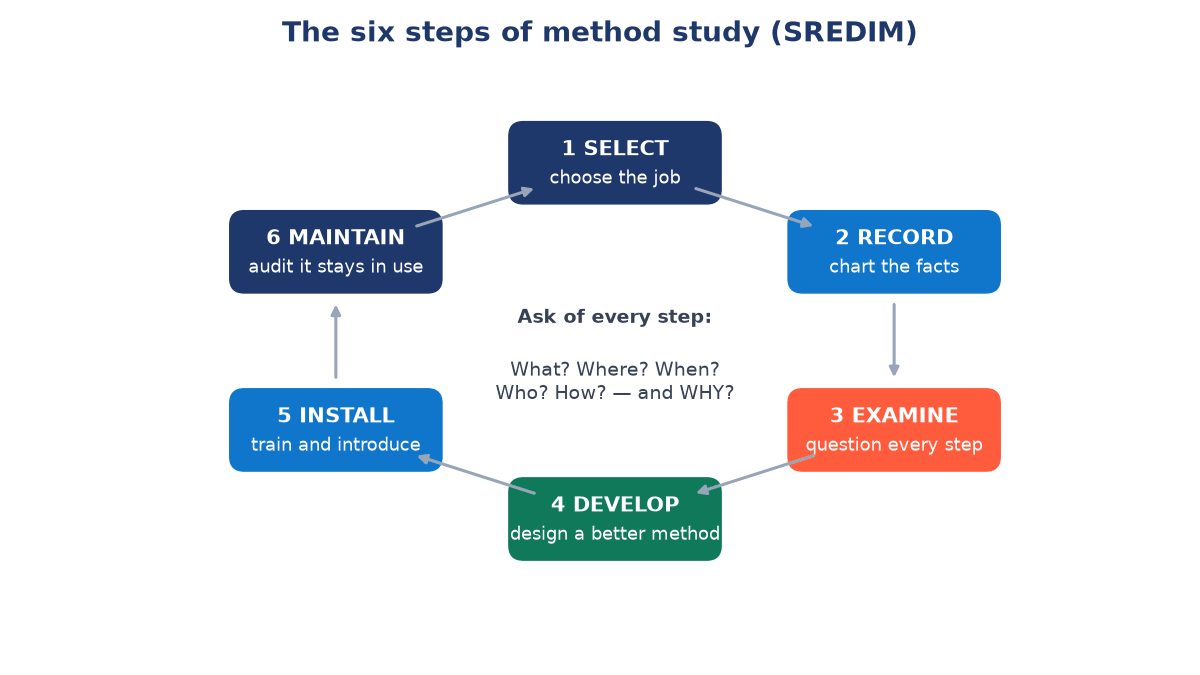
Method study follows a logical sequence, often remembered as SREDIM. The International Labour Office's classic treatment also lists Define (write down the new method as a standard practice) and Evaluate (compare results with the old method), which fit between Develop and Install.
1. Select
Choose the job or process to study. Priority goes to jobs where cost is high, delays are frequent, motion is excessive, complaints are common, output is low or safety is poor.
2. Record
Record all relevant facts about the present method, gathering enough data of good quality and quantity to act as the basis for examination: the sequence of steps, worker movements, machine use, distances travelled, material flow, times and workplace arrangement. No improvement is possible without clear facts, and recording tools are described below.
3. Examine
Examine every recorded step critically using the questioning technique. The primary questions challenge each activity:
| Primary question | Purpose | Secondary question (alternatives) |
|---|---|---|
| What is done? Why? | Purpose: can it be eliminated? | What else could be done? |
| Where is it done? Why there? | Place | Where else could it be done? |
| When is it done? Why then? | Sequence | When else could it be done? |
| Who does it? Why that person? | Person | Who else could do it? |
| How is it done? Why that way? | Means | How else could it be done? |
This is the most analytical step. It exposes unnecessary steps, duplicated work, bad layout, avoidable motion and poor sequence.
4. Develop
Develop the most practical, economical and safe method, taking all circumstances into account. The analyst applies four principles, in this order:
- Eliminate the step altogether if it adds no value.
- Combine steps where possible, for example inspecting while assembling.
- Rearrange the sequence for better flow and less backtracking.
- Simplify what remains with better tools, jigs, fixtures or layout.
5. Install
A good method has no value until it is used. Installation needs management approval, worker training, rearranging the workplace, new written instructions, supervisor support and often a trial run.
6. Maintain
Check regularly that the improved method is still followed, because people may drift back to old habits when supervision is weak. Maintenance means verifying compliance, monitoring results, making small corrections and keeping the new standard up to date.
Recording techniques
Method study relies on charts and diagrams that make the present method visible.
Process chart symbols
Process charts use five standard symbols, originally based on those of the American Society of Mechanical Engineers (ASME):
| Symbol | Activity | Meaning | Example |
|---|---|---|---|
| Circle | Operation | Something is changed, created or added | Drilling a hole, typing a letter |
| Arrow | Transport | Movement of a worker, material or equipment | Moving parts to the store |
| Square | Inspection | Checking quantity or quality | Measuring a diameter |
| Letter D | Delay | Temporary wait before the next step | Parts waiting for a crane |
| Triangle | Storage | Kept under control, released only by authorisation | Finished goods in the warehouse |
Charts
- Outline (operation) process chart: shows only the main operations and inspections, giving an overall picture of a process.
- Flow process chart: shows all five activities in sequence, with distances and times. It can be drawn from the point of view of the worker, the material or the equipment.
- Two-handed (left-hand, right-hand) process chart: records what each hand does at a workplace, useful for bench assembly.
- Multiple activity chart: shows the activities of several workers or machines on a common time scale, revealing idle time.
- SIMO chart: a simultaneous motion cycle chart that records therbligs of both hands from film or video, used in micromotion study.
Diagrams
- Flow diagram: a scale drawing of the workplace showing the path of movement; it reveals backtracking, crossing paths and long travel.
- String diagram: a scale plan on which a thread traces each movement, so the length of thread measures the total distance travelled. It suits irregular movements such as those of a storekeeper.
- Travel chart: a table of the number of moves between each pair of work centres, used for layout planning.
- Templates and models: two- or three-dimensional representations used to test layouts before moving equipment.
Worked example: present and proposed method
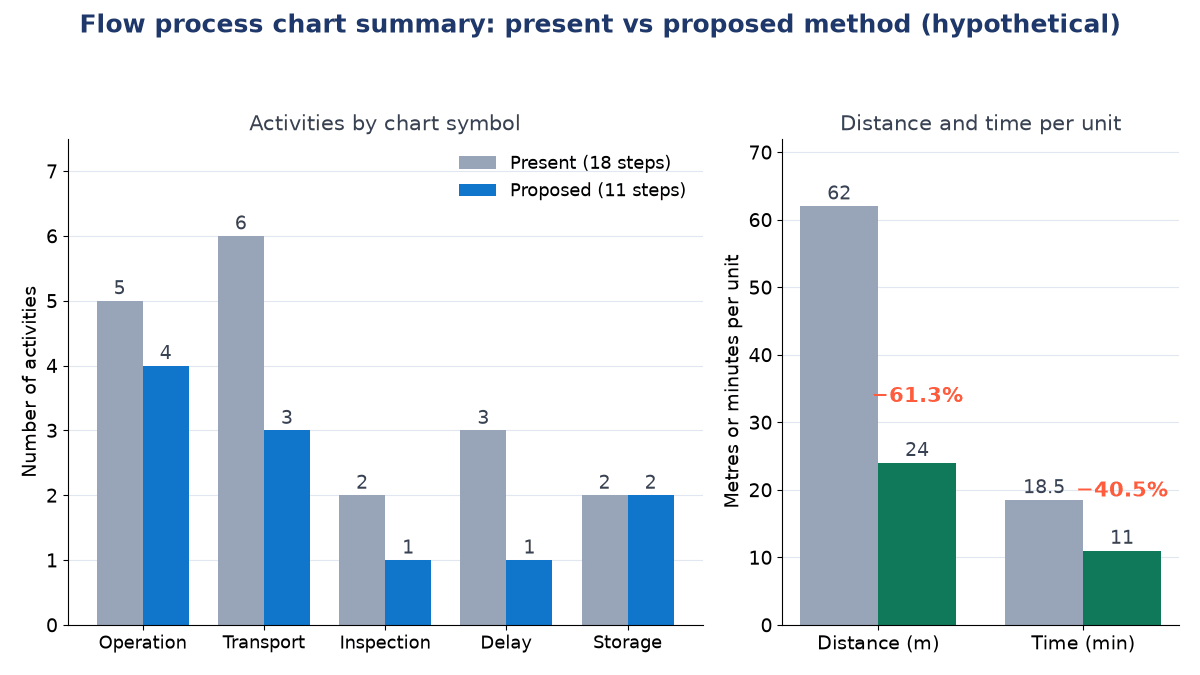
Suppose a small furniture unit (hypothetical figures) records the handling of a table top from cutting to despatch on a material-type flow process chart. The summary is:
| Activity | Present method | Proposed method | Saving |
|---|---|---|---|
| Operations | 5 | 4 | 1 |
| Transports | 6 | 3 | 3 |
| Inspections | 2 | 1 | 1 |
| Delays | 3 | 1 | 2 |
| Storages | 2 | 2 | 0 |
| Total activities | 18 | 11 | 7 |
| Distance (m) | 62 | 24 | 38 |
| Time (min per unit) | 18.5 | 11.0 | 7.5 |
The proposed method moves the drilling machine next to the saw (eliminating two transports), combines one inspection with sanding, and schedules the polish so the tops no longer wait.
Step 1: percentage saving in distance.
Step 2: percentage saving in time.
Step 3: output per 8-hour shift (480 minutes).
(Only complete units count, so the figures are rounded down.)
Step 4: labour cost per unit. If the labour cost of the crew is ₹4 per minute, the present method costs rupees per table top and the proposed method costs rupees, a saving of ₹30 per unit. At 43 units a shift, that is rupees saved per shift.
Principles of motion economy
Method study is closely linked with motion economy, which reduces unnecessary body movement and makes useful movement easier. The principles, developed from the Gilbreths' work, fall into three groups.
Use of the human body
- both hands should begin and end their motions together and should not be idle at the same time
- arm motions should be symmetrical and in opposite directions
- use the lowest body movement that will do the job (fingers before wrist, wrist before arm)
- use momentum and smooth, curved motions rather than sudden changes of direction
Arrangement of the workplace
- keep a definite, fixed place for every tool and material
- place tools and materials within the normal reach area and in the order of use
- use gravity-feed bins and drop deliveries
- provide good lighting and a chair and bench of the right height
Design of tools and equipment
- use jigs, fixtures or foot-operated devices to free the hands
- combine two or more tools where possible
- design handles and levers to suit the hand and give maximum advantage
Method study and layout
Many method problems are caused by layout: tools far away, materials moving backwards, badly arranged machines and crossing paths. Flow and string diagrams reveal these, and method study improves layout by shortening travel, improving the sequence, reducing congestion and smoothing flow. The table-top example shows how moving one machine removed two transports.
Applications
Manufacturing
Assembly work, material handling, machine loading, inspection flow, tool arrangement, workplace layout and packing. In a furniture factory, for instance, method study can cut the movement between cutting, drilling and assembly sections.
Services
Hospitals can reduce patient movement between departments, banks can cut the paperwork steps in loan processing, offices can simplify file flow, and retail stores can redesign billing counters.
Advantages and limitations
| Advantages | Limitations |
|---|---|
| Higher productivity from the same resources | Workers may see change as unnecessary or threatening |
| Lower cost as wasteful steps are removed | Needs cooperation from staff and supervisors |
| Less fatigue and better working conditions | Wrong or incomplete recording leads to a poor new method |
| Better use of machines, materials and space | Frequent changes in design, tools or volume force repeated revision |
| Smoother workflow and less handling | Takes the time of trained analysts |
| Better safety and quality through standard methods | Gains fade if the new method is not maintained |
Conditions for success
- management support and adequate resources
- worker cooperation and participation in suggesting improvements
- accurate observation and recording
- practical, affordable improvements
- training after the change and follow-up after installation
Method study should be introduced as a way of improving the work, not of criticising workers.
Key terms
- Method study
- Systematic recording and critical examination of existing and proposed ways of doing work to develop better methods.
- SREDIM
- Select, Record, Examine, Develop, Install, Maintain: the steps of method study.
- Questioning technique
- Asking what, where, when, who and how, and why each time, to challenge every activity.
- Flow process chart
- A chart showing the sequence of operations, transports, inspections, delays and storages, with distances and times.
- Flow diagram
- A scale drawing of the workplace showing the route followed by material or workers.
- String diagram
- A scale plan on which a thread traces movements so that total distance can be measured.
- Motion economy
- Principles for reducing unnecessary body movements and fatigue at the workplace.
- Therblig
- A basic element of manual motion, such as reach, grasp or release, used in micromotion study.
- Work simplification
- Another name for method study, stressing the removal of unnecessary work.
Common questions
What are the steps of method study?
Select, Record, Examine, Develop, Install and Maintain (SREDIM). Some texts add Define and Evaluate. Each step builds on the one before, and the questioning technique is applied during Examine.
What is the difference between a flow process chart and a flow diagram?
A flow process chart lists the activities in sequence using symbols, with distances and times. A flow diagram draws the same movement on a scale plan of the workplace, so the physical path, backtracking and crossing can be seen.
Why is "Why?" asked for every step in the Examine stage?
Because the purpose question decides whether a step is needed at all. If a step has no valid purpose it is eliminated, which is the biggest saving; only necessary steps are then combined, rearranged or simplified.
What are the five process chart symbols?
Operation (circle), transport (arrow), inspection (square), delay (letter D) and storage (triangle).
How is method study different from work study?
Work study is the broad field. Method study is one part of it, dealing with how the work is done; work measurement is the other part, dealing with how long it should take.
References
- Kanawaty, G. (ed.) Introduction to Work Study. International Labour Office, Geneva.
- Gilbreth, F. B. (1911) Motion Study. D. Van Nostrand Company.
- Chary, S. N. Production and Operations Management. McGraw-Hill Education (India).
- Panneerselvam, R. Production and Operations Management. PHI Learning.
- Muther, R. (1973) Systematic Layout Planning. Cahners Books.