Work study is the systematic examination of how a job is done, carried out to find a better method and to fix the right time that a qualified worker should take to do it. Its purpose is to raise productivity by making better use of people, machines, materials and space, usually without large new investment.
Think of a worker packing books into cartons. If the books are kept far away, the tape is often missing and the worker bends again and again, the job is slow and tiring. Place the books within reach, keep the tape in a fixed spot, set the table at the right height and arrange the steps in a sensible order, and the same job becomes faster and easier. Studying a job in this organised way, improving it and then setting a fair time for it is work study. The approach grew out of the scientific management movement of F. W. Taylor (time study) and Frank and Lillian Gilbreth (motion study) in the early twentieth century.
Objectives and importance of work study
The main objective of work study is to increase productivity by improving the method of work and by setting proper time standards. It therefore answers two questions: what is the best way to do this job, and how long should it normally take?
Why organisations use it
- more output from the same resources
- less waste of material, movement and machine time
- less worker fatigue and better safety
- lower cost per unit
- better use of time, and accurate data for planning
- standardised, better methods of working
What happens without it
When work is not studied, workers make unnecessary motions, jobs take longer than they need to, machines wait for material, production cost rises and productivity stays low. Management is left to plan by guesswork. Work study replaces that guesswork with observation, data and measurable standards.
The two parts of work study
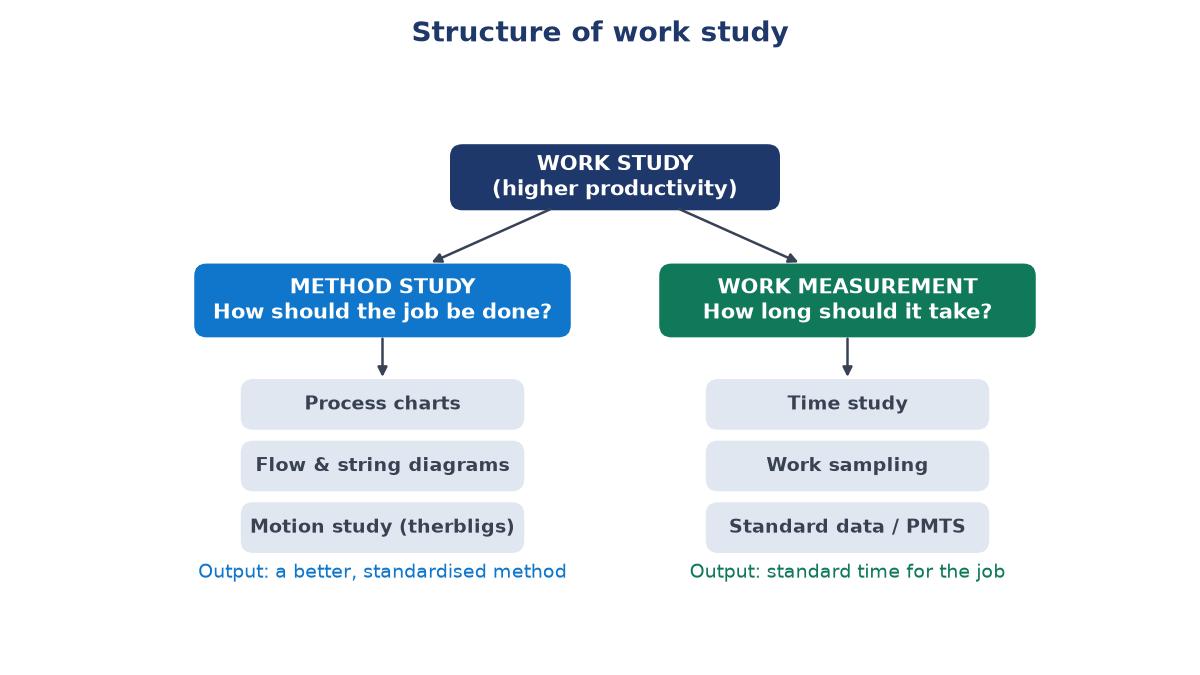
Work study has two complementary parts, and this is the most important point of the whole topic.
- Method study is the systematic recording and critical examination of the existing and proposed ways of doing work, in order to develop easier and more effective methods and reduce costs. In short, it finds the best way.
- Work measurement is the application of techniques to establish the time for a qualified worker to carry out a specified job at a defined level of performance. In short, it finds the right time.
The order matters. Method study normally comes first, because there is little value in measuring the time of a poor method with great accuracy. Once the method is improved and standardised, work measurement sets the time standard for it.
| Basis | Method study | Work measurement |
|---|---|---|
| Question answered | How should the job be done? | How long should the job take? |
| Focus | Procedure, layout, movement, sequence | Time taken by a qualified worker |
| Main output | An improved, standardised method | Standard time |
| Typical tools | Process charts, flow and string diagrams, motion study | Time study, work sampling, standard data, PMTS |
| Sequence | Done first | Done after the method is fixed |
Method study in brief
Method study is the careful analysis of the present method so that a better one can be developed. It asks whether the work can be done more simply, whether steps can be removed, whether movement can be reduced, whether tools can be rearranged and whether fatigue can be cut. It is used to eliminate unnecessary operations, improve the flow of work, simplify the job, lower cost and improve quality and safety.
For example, if a worker has to walk to fetch material, bring it back, search for a tool and then return for another item, method study may suggest keeping material near the worker, keeping tools in fixed positions, changing the sequence of steps and improving the table arrangement.
Steps in method study
- Select the job that most needs improvement (high cost, frequent delay, excessive movement, safety problems).
- Record all relevant facts about the present method, gathering enough data of good quality to serve as the basis for examination. Process charts and diagrams are used here.
- Examine each step critically by asking what is done, why, where, when, who does it and how.
- Develop the most practical, economical and safe method.
- Install the new method: train workers, rearrange the workplace and issue instructions.
- Maintain the method by checking regularly that it continues to be followed.
Some textbooks add a Define step (write down the new method as a standard practice) and an Evaluate step (compare results with the old method). The detailed treatment is in the separate article on method study.
Motion study and therbligs
Motion study examines the body movements used in a task in order to remove useless motions, reduce fatigue and improve the arrangement of the workplace. Frank Gilbreth broke manual work into basic motion elements called therbligs (roughly "Gilbreth" spelt backwards). Examples are search, select, grasp, reach (transport empty), move (transport loaded), hold, release load, position, inspect, and delays such as unavoidable delay and rest. When therbligs are studied frame by frame from film or video, the technique is called micromotion study. Motion study is narrower than work study: it deals with the movements inside a method, not with the time standard.
Work measurement in brief
Work measurement tells management the standard time for a job: the time allowed for a qualified worker, working at a normal pace under stated conditions, including allowances for rest and personal needs. Without it, management does not know how long a job should take, whether a worker is slow or the method is poor, or how to plan wages, schedules and capacity.
Uses of work measurement
- fixing standard time and output targets
- manpower planning and capacity planning
- production scheduling and delivery promises
- labour cost estimation and pricing
- comparing productivity across workers, shifts or plants
- designing fair wage incentive schemes
Techniques of work measurement
| Technique | How it works | Best suited to |
|---|---|---|
| Stopwatch time study | An analyst times each element over several cycles, rates the worker's pace and adds allowances | Short, repetitive jobs |
| Work sampling (activity sampling) | Many random, instantaneous observations show what share of time is spent working, waiting or idle | Long, varied or group work; machine utilisation |
| Standard data | Element times already measured in the plant are reused to build times for new jobs | Families of similar jobs |
| Predetermined motion time systems (PMTS), such as MTM | Published times for basic motions are added up without timing the worker | Jobs not yet in operation; very short cycles |
| Analytical estimating | An experienced estimator judges times using past data | Non-repetitive maintenance or project work |
Time study
Time study is the technique of recording the times and rates of working for the elements of a specified job, and analysing the data to obtain the time needed to do the job at a defined level of performance. The job is broken into elements (for packing: pick the product, place it in the box, seal, label), each element is timed over several cycles, the average is adjusted by a performance rating, and allowances are added. The core formulas are:
Work sampling
Instead of timing a job continuously, the observer checks at random moments: is the worker working, is the worker waiting, is the machine idle, is a set-up under way? If 340 of 400 random observations find a machine running, the machine is estimated to be busy , or 85 per cent, of the time. Work sampling suits long jobs, many workers or machines, and situations where continuous timing is impractical.
Worked example: measuring the gain from work study
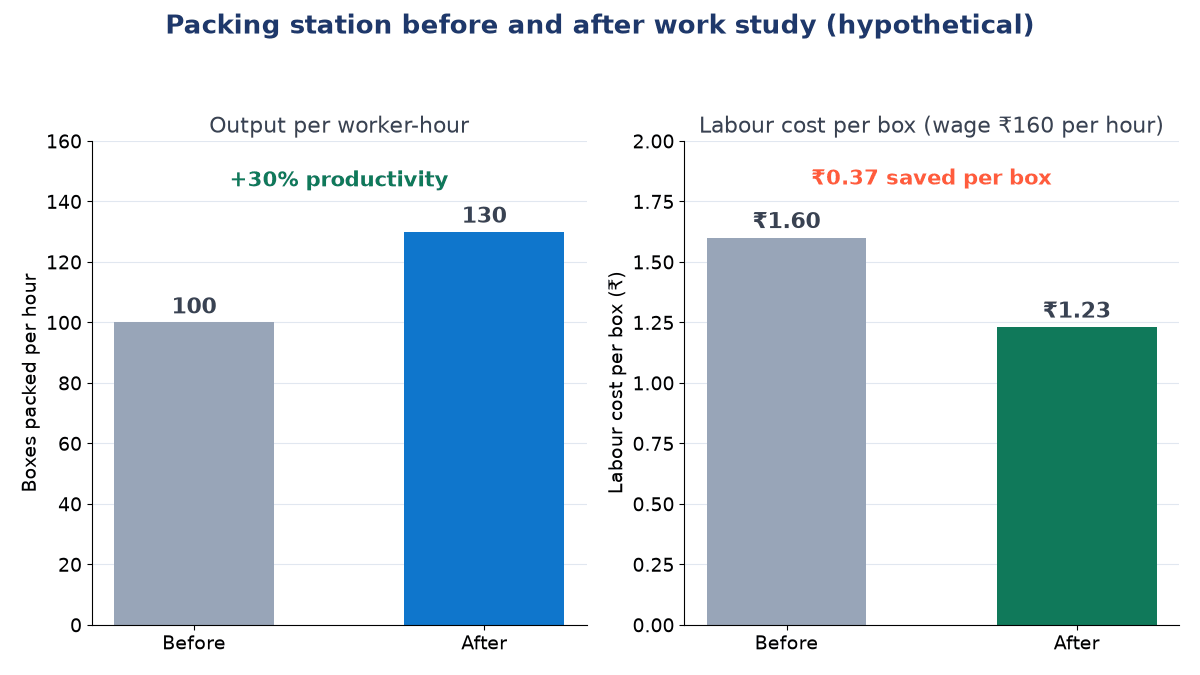
Suppose a warehouse packing station (hypothetical figures) packs 100 boxes per hour. The analyst finds that the packer walks to a far rack for cartons, the tape dispenser is on another table and both hands are rarely used together. After method study the cartons are placed within reach, the tape is fixed to the bench and the sequence is changed. Output rises to 130 boxes per hour. The packer is paid ₹160 per hour.
Step 1: labour productivity. Before: 100 boxes per labour-hour. After: 130 boxes per labour-hour.
Step 2: percentage improvement.
Step 3: labour cost per box.
So labour cost falls from ₹1.60 to about ₹1.23 per box, a saving of about ₹0.37 per box.
Step 4: saving per shift. In an 8-hour shift the station now packs boxes. Packed the old way, those boxes would have cost rupees in labour; they now cost rupees. The saving is ₹384 per shift.
Step 5: a new standard time. A time study of the improved method gives an observed time of 0.42 minute per box for a worker rated at 105 per cent, with allowances of 10 per cent:
The standard output is therefore , or about 123 boxes per hour. The measured 130 boxes per hour is a good worker's pace; the standard of about 123 is what planners should assume for a normal worker once rest is included.
Benefits of work study
Better use of resources and higher productivity
People, machines and materials are used more effectively, and output can rise without adding resources.
Lower cost
Better methods and proper time standards remove waste and inefficiency.
Better planning and control
Management gets reliable time data for scheduling, costing, pricing and delivery promises.
Less fatigue and better safety
Improved motions and layouts remove awkward reaches, bending and needless walking, which also reduces accident risk.
Fair wages and incentives
Measured standards give an objective basis for incentive schemes, so extra pay is linked to genuine extra output.
Work study in services
Work study is not confined to factories. Hospitals use it to speed up the movement of patient files and reduce waiting; banks use it to cut the steps in account opening and reduce customer queues; offices use it to simplify form processing; retail stores use it to design billing counters; warehouses use it to improve picking and packing; schools and colleges use it to streamline admissions. Wherever a task is repeated, it can be studied and improved.
Problems and conditions for success
Common problems
- Worker resistance: workers may feel watched and fear higher targets or job losses.
- Inaccurate observation: careless recording or too few cycles gives weak results.
- Unnatural behaviour: people may speed up or slow down while being observed.
- Poor cooperation: without support from supervisors and unions, changes are not adopted.
- Changing conditions: when tools, layout or product design change, standards become out of date.
Conditions for success
- visible support from top management
- open communication and worker participation, with an assurance that gains will be shared
- trained, impartial analysts
- a clear definition of the job and method before timing
- practical improvements rather than theoretical ones
- regular review of methods and standards
Work study should be presented as a tool for improving the work, not for criticising the worker.
Distinguishing related terms
| Term | Scope | Relation to work study |
|---|---|---|
| Work study | Broadest: method study plus work measurement | The whole |
| Method study | How the job is done | One of the two parts |
| Work measurement | How long the job should take | The other part |
| Time study | Stopwatch timing of a specific job | One technique within work measurement |
| Motion study | Body movements within a task | A technique within method study |
Work study is one of the core tools of industrial engineering and operations management because it improves systems through observation, data, analysis and standardisation.
Key terms
- Work study
- The systematic examination of methods of doing work, and the measurement of the time needed, to improve productivity.
- Method study
- Recording and critically examining existing and proposed ways of doing work to develop easier, more effective methods.
- Work measurement
- Techniques for establishing the time a qualified worker needs for a specified job at a defined level of performance.
- Standard time
- Normal time plus allowances; the time allowed for a job for planning, costing and incentives.
- Performance rating
- The analyst's judgement of a worker's pace compared with a defined normal pace, expressed as a percentage.
- Allowances
- Extra time added to normal time for personal needs, fatigue and unavoidable delays.
- Therblig
- One of the basic motion elements, such as grasp, reach or release, identified by Gilbreth.
- Work sampling
- Estimating the share of time spent on different activities from many random observations.
- Qualified worker
- A worker with the physical attributes, skill and knowledge to do the job to the required standard.
Common questions
Why is method study done before work measurement?
Because a time standard is only as good as the method it measures. If a wasteful method is timed, the waste is built into the standard. The method is improved and fixed first, and then its time is measured.
Is time study the same as work study?
No. Work study is the broad field that includes method study and work measurement. Time study is one technique of work measurement.
How does work study increase productivity without new machines?
It removes unnecessary steps, movement and waiting, so the same worker and equipment produce more output in the same time. In the example above, output rose from 100 to 130 boxes per hour with the same packer and bench.
When should work sampling be used instead of time study?
When work is long, irregular or spread across many people or machines, or when the aim is to find the share of idle time or machine utilisation rather than the time for one repetitive cycle.
Why do workers sometimes resist work study?
They may fear tighter targets, reduced earnings or job losses, and dislike being watched. Explaining the purpose, involving workers in finding improvements and sharing the gains reduces resistance.
References
- Kanawaty, G. (ed.) Introduction to Work Study. International Labour Office, Geneva.
- Taylor, F. W. (1911) The Principles of Scientific Management. Harper & Brothers.
- Gilbreth, F. B. (1911) Motion Study. D. Van Nostrand Company.
- Stevenson, W. J. Operations Management. McGraw-Hill Education.
- Panneerselvam, R. Production and Operations Management. PHI Learning.